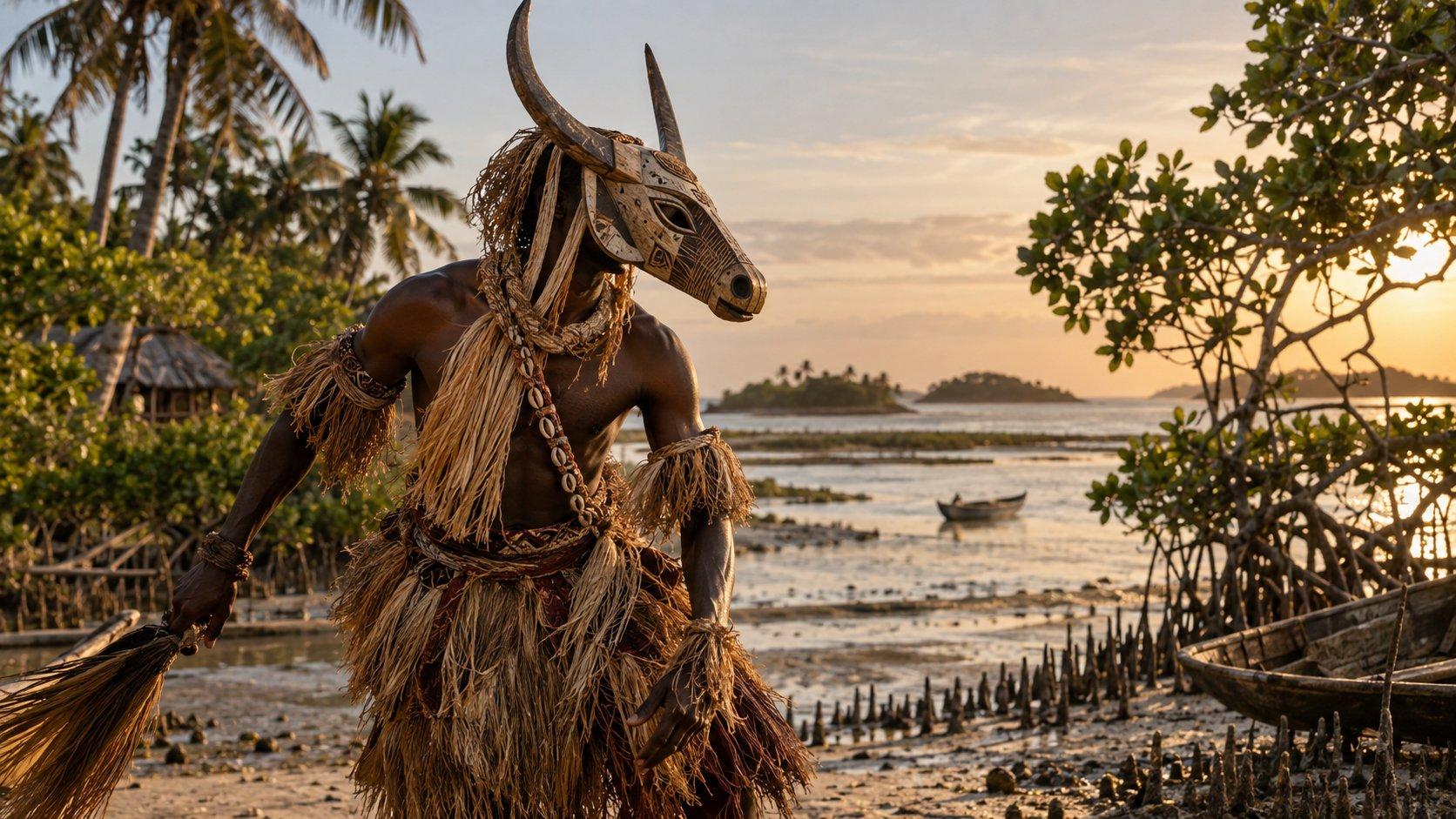
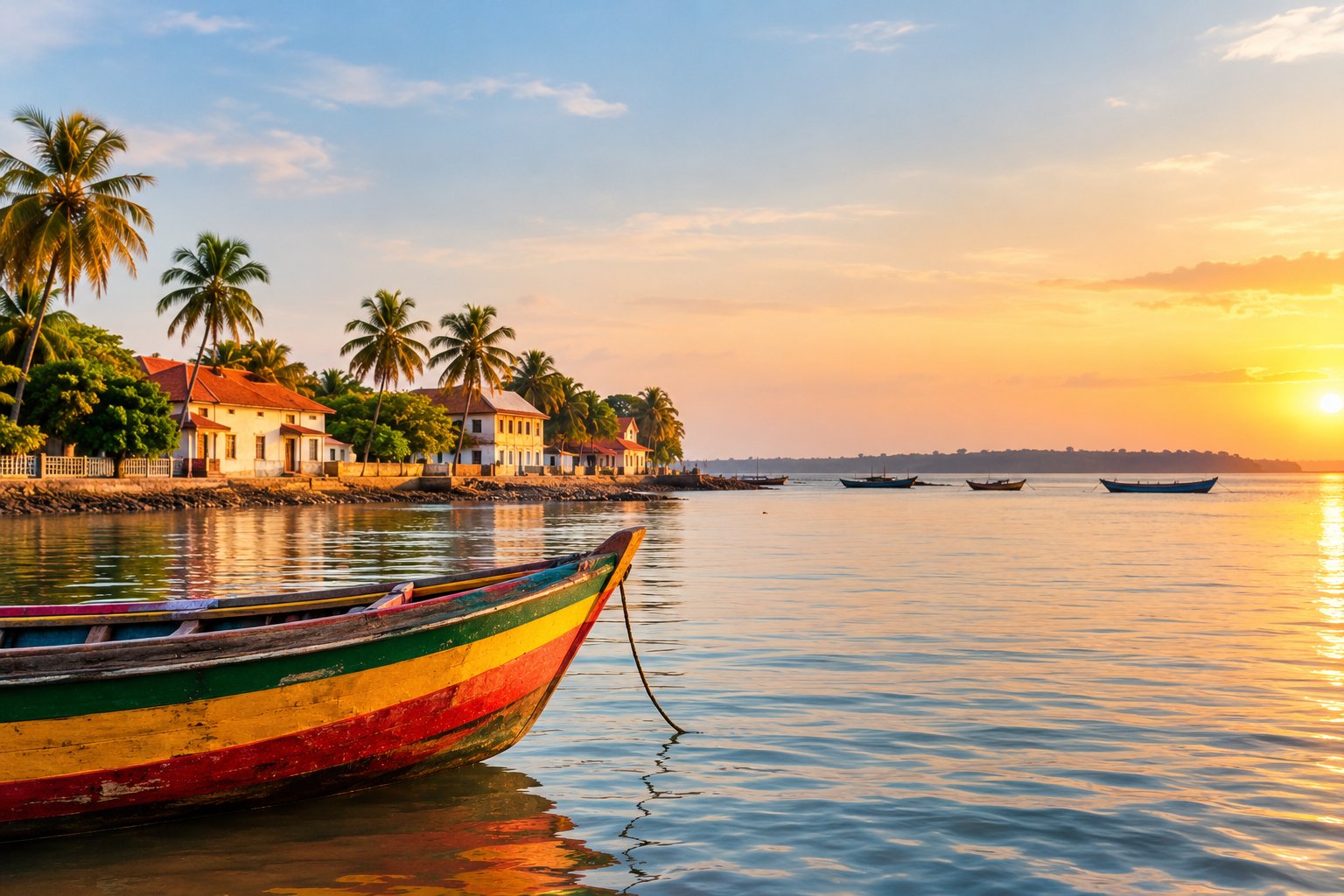
On the Bijagós Archipelago, a group of 88 islands off the coast of Guinea-Bissau, masks are not simply objects made to be displayed. In some Bijagó communities, they are part of ceremonies that mark a person's movement through different stages of life. Young men taking part in initiation may wear carved wooden masks shaped like oxen, sharks, swordfish and other animals, with each form connected to ideas about strength, behaviour, responsibility and adulthood.
One of the best documented examples is the dugn'be, an ox mask used during male initiation. The Smithsonian's National Museum of African Art explains that the mask represents a young man who has developed physical strength but has not yet gained all the discipline expected of an adult. Some versions even include a cord passing through the ox's nose, showing an animal whose power still has to be controlled. During performances, the person wearing the mask moves in ways associated with the animal, so the meaning comes from the mask, the dance and the stage of initiation taking place around it.
The ceremonies are part of a much longer process. In communities studied by anthropologists, male initiation can unfold through several age groups over many years. A person does not simply attend one ceremony as a teenager and immediately become a fully initiated adult. Different stages bring different responsibilities, knowledge and social positions, and some parts of the process continue well into adulthood.
The islands themselves are only one part of Guinea-Bissau, but they offer an early glimpse of how diverse the country is. Guinea-Bissau has a population of around two million people, more than 20 indigenous languages and several ethnic and religious communities with their own histories. It is also one of the poorer countries in the world by conventional economic measures and has experienced repeated political crises since independence. World Bank records count four successful coups as well as 17 attempted, plotted or alleged coups since the country became independent.
Those political problems are real, but they are not the entire story of Guinea-Bissau. The country also has a history connected to one of West Africa's important precolonial states, a liberation struggle that became one of the strongest military challenges to Portuguese colonial rule in Africa, agricultural systems built around mangrove rice farming, a Creole language that allows people from different ethnic groups to speak to one another, and cultural traditions that continue to change while remaining recognisable to the communities that practise them.
Where the culture came from
Before there was a country called Guinea-Bissau, much of the territory belonged to a wider political and trading world that stretched across what is now Senegal, The Gambia, Guinea and Guinea-Bissau.
One of the most important powers in the region was Kaabu, sometimes written as Gabú. Kaabu was a Mandinka state with roots in the Mali Empire, which had become one of West Africa's major powers by the 13th century. Mandinka expansion into the area that later became Kaabu took place during that period, and over time the region developed from an area connected to Mali into a powerful state in its own right.
By around the 16th century, Kaabu was operating as an independent Mandinka kingdom. It controlled important trade routes and exercised political influence over a large part of the Upper Guinea region. Its power lasted for centuries before coming to an end in 1867, when forces connected to the Islamic state of Futa Jallon defeated Kaabu at the Battle of Kansala.
Portuguese sailors had already begun travelling along the Upper Guinea coast in the 15th century. The exact details of their earliest arrival in the territory of modern Guinea-Bissau are still debated by historians, so it is safer to speak about Portuguese exploration of the wider coast rather than claim that the territory became Portuguese Guinea in one particular year.
Portuguese traders gradually established themselves in coastal areas and settlements such as Cacheu, which became an important centre of trade. Their presence on the coast did not mean they controlled the entire interior. For centuries, many African communities continued to govern themselves, trade on their own terms and resist attempts by Portugal to expand its authority inland.
Portugal only began establishing firmer control over much of the interior much later, particularly during the 19th and early 20th centuries. Even then, military campaigns continued for years. The Bijagós Islands were among the areas that resisted Portuguese control for the longest, and the final military subjugation of the archipelago was not completed until 1936.
Colonial rule also brought very limited investment in education. Formal secondary education developed late, and access remained restricted. Bissau's first public secondary institution grew out of the Colégio-Liceu de Bissau, founded in 1950, while the Liceu Honório Barreto became the territory's official secondary school in 1958. A technical school followed around the end of the decade.
For much of the African population, particularly people living outside the small urban centres, opportunities for formal education remained narrow. That became one of the problems the independence movement later tried to address in areas under its control.
The person most closely associated with that struggle was Amílcar Cabral.
Cabral was born in Bafatá, in present-day Guinea-Bissau, on 12 September 1924, into a family with strong Cape Verdean roots. He spent part of his childhood and education in Cape Verde before travelling to Lisbon to study agronomy. An agronomist is someone who studies agriculture, soil, crops and the conditions needed to improve farming. Cabral's training later gave him an unusual way of understanding the country he wanted to liberate.
After returning to Portuguese Guinea, he worked in agricultural services and travelled widely through rural areas while carrying out research, including a major agricultural survey. He was not studying the countryside from a distance. His work took him into farming communities and gave him detailed knowledge of how people lived, how land was used and how different ethnic groups were distributed across the territory.
In September 1956, Cabral and several others, including Aristides Pereira, Luís Cabral, Júlio de Almeida, Fernando Fortes and Elisée Turpin, helped create the organisation that became the African Party for the Independence of Guinea and Cape Verde, better known as the PAIGC.
The name tells you something about the original plan. The movement was not created only to free Portuguese Guinea. It wanted independence for both Guinea and Cape Verde, two Portuguese colonies separated by the Atlantic but linked by colonial rule and by people like Cabral whose families had connections to both places.
The struggle did not immediately become a full guerrilla war. An important change came on 3 August 1959 at the Pidjiguiti docks in Bissau. Dockworkers had gone on strike over pay and working conditions when Portuguese forces opened fire. The exact number of people killed varies between historical accounts, but the dead numbered in the dozens.
After the massacre, the PAIGC moved further away from trying to win change through peaceful political action in the city. Sustained armed struggle began in January 1963 with an attack on the Portuguese military post at Tite in southern Guinea.
The war developed quickly. PAIGC fighters operated mainly in rural areas, where the landscape of forests, rivers and difficult terrain made Portuguese military operations harder. The movement also received foreign assistance, including weapons, training and other support from countries such as the Soviet Union, Cuba and China.
By the late 1960s, the PAIGC had established control or strong influence across large parts of the territory. A United States State Department account later stated that by 1968 the movement controlled most of the country. Portuguese authorities disputed some of those territorial claims at the time, but there was little doubt that the PAIGC had become a serious military force and had created administrative structures in areas where it operated.
It did more than fight. In territory under its influence, the movement organised schools, health services and local administration. Education became part of the independence project because colonial schooling had reached such a small share of the population.
Cabral never saw the country become independent. He was assassinated in Conakry, Guinea, on 20 January 1973. Eight months later, on 24 September 1973, PAIGC representatives meeting at Boé declared the independence of Guinea-Bissau.
Portugal did not recognise the declaration immediately. The political situation changed after Portugal's Carnation Revolution in April 1974 removed the authoritarian government in Lisbon. The new Portuguese authorities began withdrawing from the country's African colonies, and Portugal formally recognised Guinea-Bissau's independence on 10 September 1974.
Luís Cabral, Amílcar Cabral's half-brother, became the country's first president. Independence, however, did not bring lasting political stability. João Bernardo Vieira overthrew Luís Cabral in a coup in 1980. Guinea-Bissau later went through a civil war from 1998 to 1999, followed by further coups, attempted coups and political crises.
National politics have changed repeatedly, but life at community level has continued through family networks, religious institutions, village systems and local customs that existed before independence and, in some cases, long before colonial rule.
Ethnic groups and languages
Guinea-Bissau has several large ethnic communities rather than one group that represents the entire country.
The Fula and Balanta are among Guinea-Bissau's largest ethnic communities. In the World Bank's 2021 to 2022 household survey data, they were the two most numerous ethnic categories recorded, with 27.3 percent of raw cases identified as Fula and 25.2 percent as Balanta. The dataset cautions that these raw case percentages should not be treated as exact national population shares.
Other groups include the Mandinka, Papel, Manjaco, Beafada, Mancanha, Bijagó and Felupe, among others.
Many Balanta communities have historically been organised without the kind of central king or ruler found in some other West African societies. Authority was spread across families, elders, age groups and village institutions rather than concentrated under one large political hierarchy.
Cabral described Balanta society as relatively horizontal and believed that this helped the PAIGC organise in Balanta areas during the independence struggle. Balanta participation in the liberation movement was substantial, although people did not make political choices simply because they belonged to one ethnic group.
The Mandinka have a different political history, closely connected to Kaabu and the wider Mande world. Fula communities were also deeply involved in the history of the region, but from another direction. Fula-led forces connected to Futa Jallon played a central part in the defeat of Kaabu in the 19th century, so it would be misleading to describe Fula political history as simply an extension of Kaabu.
Off the mainland, Bijagó society developed its own forms of kinship, religion and social organisation.
Bijagó kinship has traditionally been described as matrilineal. This means family descent is traced through the mother's line. It does not mean women automatically control every aspect of political authority, property or family life. Anthropological studies show a more complicated system in which women may hold important ritual and social roles while men also hold significant economic, political and household authority. Customs also differ between islands, so one community cannot stand for the entire archipelago.
Language is just as varied.
Portuguese is Guinea-Bissau's official language and is used in government, formal administration and much of the education system. It is not the first language of most people.
Kriol, or Guinea-Bissau Creole, is much more common in everyday communication between people from different ethnic groups. It developed through centuries of contact between Portuguese and African languages. A recent World Bank education report estimates that around 15 percent of the population speaks Kriol as a mother tongue and another 30 to 40 percent uses it as a second language.
The same report records more than 20 indigenous languages in the country.
Someone may therefore speak Balanta, Fula, Mandinka or another language at home, use Kriol with people from other communities and encounter Portuguese at school or in government offices. A country with no single indigenous language spoken by a majority needs a shared language for everyday communication, and Kriol has taken on much of that role.
Religion and belief
Religion in Guinea-Bissau does not fall neatly into one national pattern.
Estimates used by the United States State Department place Muslims at about 46 percent of the population, followers of Indigenous religious traditions at around 31 percent and Christians at roughly 19 percent.
Even those categories do not always describe how religion works in everyday life. Some people who identify as Muslim or Christian also take part in ceremonies or maintain beliefs connected to older Indigenous religious traditions.
Islam is especially common among Fula and Mandinka communities and is strongest in the north and northeast of the country. Christianity includes both Catholic and Protestant communities and is more common in some coastal and urban populations. Indigenous religious systems remain important among several groups.
In the Bijagós, religious life has traditionally included ancestors, sacred places, ritual specialists and ceremonies connected to age and social responsibility.
Male initiation is one of the best documented parts of this system. Anthropological research among Añaki communities describes several age categories through which males move during their lives. A person gains new responsibilities and access to particular knowledge as he moves through them, and the process can take years.
Women also have their own parts in the religious and social system. Research has documented female ritual responsibilities, including ceremonies connected to young males who die before completing certain stages of initiation.
The ceremonies therefore involve more than putting on a mask or marking a boy's birthday. They are part of a longer system for organising age, responsibility, ancestry, death and membership in the community.
Food
Rice is at the centre of food in Guinea-Bissau.
The International Fund for Agricultural Development estimates that rice accounts for about 75 percent of the grain consumed in the country. Guinea-Bissau does not grow enough to meet national demand, and around half of the rice consumed is imported.
That creates an interesting situation because rice farming itself has a long history in the country.
Balanta farmers in particular are known for mangrove rice cultivation. Farming rice in mangrove areas requires more than planting seeds in wet soil. Farmers build and maintain dikes, control how saltwater enters the fields and use rainfall and freshwater to reduce the amount of salt in the soil before planting.
The system takes knowledge and labour. If too much salt remains in the soil, rice will not grow properly. If rainfall is poor, farmers may not have enough freshwater to flush the fields. Researchers continue to study these farming methods because they remain important to food production, especially in southern Guinea-Bissau.
Rice is commonly eaten with fish, meat, vegetables or sauces. Stews and sauces often described with the Portuguese and Kriol word caldo are usually served over rice and can be prepared with fish, meat, palm oil and local vegetables.
Fish and shellfish are especially important in coastal communities and across the Bijagós, where fishing, oyster collection and other marine activities provide both food and income.
Palm wine also appears in social and economic life. The drink is made by collecting sap from palm trees and allowing it to ferment naturally. It is consumed socially and during some ceremonies, although its importance varies between communities.
Cashew plays a very different role from rice.
Rice is mainly a food crop and Guinea-Bissau imports a large amount of it. Cashew is the country's dominant export crop. The International Fund for Agricultural Development estimates that raw cashew nuts account for around 80 percent of national exports.
Cashew trees are not native to West Africa. The plant originally came from Brazil and was introduced into different parts of the Portuguese colonial world. Commercial production expanded sharply in Guinea-Bissau during the late 20th century.
Today, many rural families depend on the cashew season for cash income. The money can be used to buy rice and other food, pay school costs, travel or meet household expenses. Heavy dependence on one crop also creates risk. When international cashew prices fall or harvests are poor, the effects can move quickly through rural communities.
Music, dance, and art
The animal masks of the Bijagós are some of the country's most recognisable ceremonial objects, but they make more sense when seen as part of a performance.
Museum collections contain ox, shark, swordfish and other animal masks from the islands. Materials can include carved wood, animal horn, fibre, cloth, pigments and glass.
The person wearing the mask does not simply walk around with it. Movement is part of the performance. A dancer wearing an ox mask may imitate the force and behaviour associated with the animal. In initiation, that strength can represent a young man who has physical power but is still learning the discipline and responsibilities expected of an adult.
Music in Guinea-Bissau has its own long history of movement between places.
Gumbe, also written as gumbé, is closely associated with Guinea-Bissau today, but the wider history of gumbe music reaches across the Atlantic and the West African coast. Researchers have traced an important part of that history to Jamaican Maroons who were transported to Sierra Leone around 1800, bringing musical traditions and the gumbe drum with them.
Different forms later developed across West Africa. In Guinea-Bissau, musicians combined gumbe with local rhythms, Kriol lyrics and modern instruments until it became part of the country's own popular music.
Music became closely connected to politics during the independence period. Groups including Cobiana Djazz and Super Mama Djombo became important voices in Guinea-Bissau's cultural life. Their songs used Kriol, drew from local musical traditions and spoke to a population living through liberation and the creation of a new state.
Super Mama Djombo became particularly associated with the first years after independence, when music was one of the ways artists explored what a new national identity might sound like in a country with many ethnic groups and languages.
Clothing, textiles, and craft
There is no single form of traditional dress that represents every community in Guinea-Bissau. Clothing and ornament differ according to ethnic background, religion, region, generation and occasion.
In the Bijagós, some of the objects outsiders are most likely to recognise as traditional dress are actually ceremonial pieces rather than everyday clothing.
Masks may be combined with fibres, cloth, horns and body ornament during performances. They belong to particular ceremonies and stages of social life, so seeing one hanging in a museum is different from seeing how it functions when worn.
Guinea-Bissau has also tried to preserve examples of its material culture through the National Ethnographic Museum in Bissau.
The museum was established in 1988, but the civil war of 1998 and 1999 disrupted its work and damaged the country's cultural institutions. Surviving collections, photographs and research later helped support efforts to revive the museum, including work connected to its reopening and exhibitions in 2017.
The museum holds objects from different communities, giving researchers and visitors a record of material traditions that otherwise depend heavily on families, craftspeople and communities passing knowledge from one generation to another.
Festivals, ceremonies, and rites of passage
Initiation in the Bijagós can last much longer than the word “ceremony” suggests.
Different islands follow different practices, but anthropologists have documented systems in which males move through a series of age grades. Each stage can come with its own responsibilities, ceremonies and knowledge, and a person may spend years before moving to the next one.
Full social adulthood is therefore something that develops over time. Younger members learn from older ones, while people who have completed particular stages gain responsibilities that were not available to them before.
Bissau's Carnival developed in a very different setting.
During the colonial period, carnival in the main urban centres was associated heavily with Creole communities. After independence, the government reorganised it into a national celebration and competition, and participation expanded to include performances and cultural references from different parts of the country.
Today's carnival brings together costumes, masks, music and dance associated with several communities. That does not mean the country's cultures have become one tradition. They remain distinct, but carnival gives people a public space where several of them can appear during the same celebration.
Guinea-Bissau's main civic holiday is Independence Day on 24 September, marking the declaration of independence made at Boé on 24 September 1973.
Muslim communities also celebrate Eid al-Fitr and Eid al-Adha, while local agricultural, religious and initiation ceremonies continue according to the calendars of particular communities.
The two-country independence project
Amílcar Cabral's connection to Cape Verde is sometimes described so loosely that he is incorrectly said to have been born there.
He was actually born in Bafatá, in present-day Guinea-Bissau.
The more interesting part of his story is what he tried to build between the two places.
The PAIGC was created to fight for the independence of both Portuguese Guinea and Cape Verde. The territories were separated by hundreds of kilometres of Atlantic Ocean and had different populations and histories, but Cabral and his colleagues believed they could form part of the same political liberation project.
The idea survived his death.
After Guinea-Bissau declared independence in 1973 and Cape Verde became independent in 1975, both countries were governed by closely connected movements that came out of the PAIGC. Political union remained an ambition.
That changed after the 1980 coup in Guinea-Bissau removed Luís Cabral from power. The political relationship between the two countries broke down, and Cape Verde's branch of the movement separated from the PAIGC. The plan for political union effectively ended.
Cabral still occupies an important place in the history of both countries because his life and political work connected them. He grew up partly in Cape Verde, worked in Guinea, studied in Portugal and built a movement that tried to free two colonies at once.
What it looks like today
The Bijagós Archipelago now has international recognition for something closely connected to the way island communities have lived with their environment.
UNESCO designated the archipelago a Biosphere Reserve in 1996. A biosphere reserve is an area recognised for important ecosystems where conservation is meant to exist alongside human communities and sustainable economic activity.
In July 2025, the Coastal and Marine Ecosystems of the Bijagós Archipelago, known as Omatí Minhô, were also added to UNESCO's World Heritage List.
The World Heritage listing is for the islands' natural environment rather than their masks or initiation traditions. UNESCO highlighted the archipelago's mangroves, mudflats, sandbanks and marine habitats, as well as its importance for sea turtles, migratory birds, sharks, rays, dolphins and West African manatees.
Local knowledge is part of the way those ecosystems have been managed. Communities in the archipelago have long had their own rules around fishing, sacred areas and the use of natural resources, while government agencies and conservation organisations now work alongside those systems.
Tourism remains limited compared with many better-known island destinations. Fishing pressure, development, pollution and climate change are among the environmental challenges the archipelago faces.
Life on the islands has also changed.
People use mobile phones, attend schools, travel to Bissau, work in markets and interact with state institutions, tourists and conservation organisations. Young people may leave the islands for education or work and later return. Traditional ceremonies continue inside communities that are also part of a modern economy and state.
That is true across Guinea-Bissau.
A farmer cultivating rice in mangrove soil is using knowledge developed over generations while also dealing with rainfall patterns, imported food and changing market prices. A family selling cashew is connected to buyers and commodity prices far beyond the country. Someone who speaks an indigenous language at home may switch to Kriol in the market and Portuguese in a government office.
Carnival has moved from its earlier urban Creole setting into a national celebration. Gumbe has travelled through different generations of musicians. The National Ethnographic Museum has had to recover from war. Bijagó initiation continues, but the people taking part are not living outside the modern world.
Guinea-Bissau is often described internationally through poverty, coups and political instability because those are some of the easiest things to measure and report. They are part of the country's story, but they do not tell you how people organise family life, how a farmer turns salty mangrove land into a rice field, why Kriol became useful in a country with more than 20 indigenous languages, or why a young man might spend years moving through different stages before his community considers his initiation complete.
Those parts of the country are easier to see once you look beyond the statistics.
On the Bijagós Islands, one place to begin is still the mask. An ox carved from wood can represent strength, but the person wearing it is being taught that strength on its own is not enough. Growing older means learning what to do with it.
The mask may be the first thing that catches your attention. The society around it is the larger story.