Explore Mali culture through its history, jeli traditions, music, food, religion, textiles, festivals, and the living traditions that connect the country to its past.
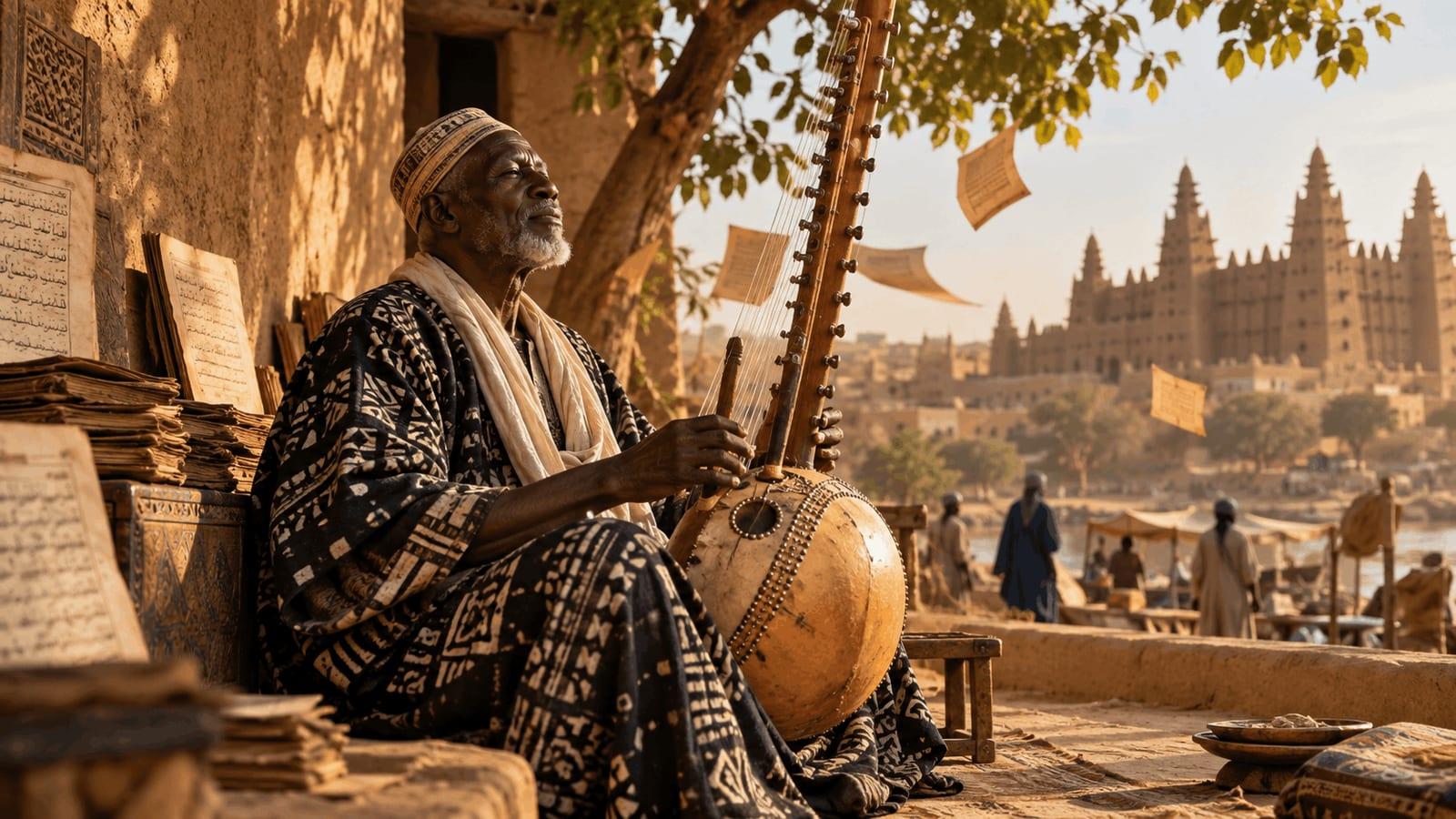
In a small courtyard in Bamako, an old man sits with a kora resting against his knee. Twenty-one strings stretch across its long neck and over a resonating body made from a large calabash. Then he begins to play. He is not just performing a song.
He is a jeli.
The word jeli refers to a role traditionally passed down through certain families: musicians, storytellers, praise singers, and keepers of family histories, sometimes called griots in English and French. But “griot” does not capture fully what a jeli traditionally does. A jeli can be a musician, storyteller, praise singer, genealogist, mediator, adviser, and keeper of family and political histories.
For centuries, certain jeli families have inherited this role. Traditionally, you did not simply apply to become one or decide one morning that storytelling was your profession. You were born into a jeli lineage and learned from the people around you. As a child, you might grow up hearing the names of ancestors repeated in songs, listening to family histories performed at ceremonies, and learning which stories belonged to which families and communities. Knowledge was passed from person to person through years of listening, repetition, correction, and performance.
This is part of what is known as oral tradition: the preservation and transmission of knowledge through speech and performance. A genealogy could be memorised. A historical event could be turned into a story and passed down from one generation to another. The names of rulers could be connected to the events of their reigns. Families could commission praise songs that preserved their ancestry and achievements. Important stories are repeated so often, across generations, that they become part of a shared cultural archive.
A jeli telling the story of a 13th-century king today is not necessarily repeating every sentence exactly as it was told 700 years ago. Oral traditions naturally change over time. Different performers may emphasise different details, add local perspectives, or interpret parts of the story in new ways. The story may sound slightly different from one generation to the next, while still carrying the history and knowledge that people wanted to preserve. That flexibility helped keep the tradition alive. The stories survived because people kept telling them, performing them, and passing them on.
The most famous example is the story of Sundiata Keita, the 13th-century founder traditionally associated with the Mali Empire. His life survives most famously through the Sunjata Epic, performed and transmitted by jeliw for generations. There are different versions of the story, and historians cannot treat every detail as literal fact. But the existence of variations does not make the tradition meaningless. It shows something important about how history was preserved: it did not always have to exist in one fixed document to be remembered and passed on. People could carry knowledge through stories, songs, genealogies, and performance.
And the history of Mali was anything but small.
The Mali Empire, which emerged in the 13th century and became one of the dominant powers of West Africa, controlled territories connected to some of the world's most valuable commodities at the time: particularly gold and salt. This was the medieval period, the broad historical era between the ancient world and the modern age, roughly spanning the 5th to the late 15th century in European historical terminology, though African societies followed their own political and cultural timelines.
When historians describe Mali as one of the wealthiest empires of that era, they are not suggesting that someone calculated Mansa Musa's net worth and placed him on a modern billionaire ranking. There is no verified Forbes-style list of medieval rulers.
Mali's wealth comes from contemporary and near-contemporary historical accounts, the scale of its trans-Saharan trade, its control over important gold-producing regions, and the extraordinary descriptions left by travellers and scholars who encountered its rulers and cities.
Its most famous ruler, Mansa Musa, made this wealth impossible for the wider world to ignore.
In 1324, he travelled from Mali to Mecca on pilgrimage with an enormous caravan. Medieval Arabic accounts describe hundreds of attendants, camels carrying gold, and such extensive spending and gift-giving in Cairo that the sudden increase in gold reportedly affected its value for years. Historians debate the exact size of his caravan and the precise economic consequences, because medieval accounts often exaggerated numbers, but there is broad agreement on the fact that: Mansa Musa possessed and controlled access to extraordinary wealth by the standards of his time.
His fame travelled far beyond West Africa. On the Catalan Atlas of 1375, one of the most important surviving medieval maps of the world, Mansa Musa appears holding a golden orb and wearing a crown, visually representing how closely Mali had become associated with gold in the imagination of people far beyond its borders.
Yet wealth alone is not what makes Mali's history remarkable. What is particularly striking is the number of ways knowledge was preserved.
Some knowledge was written down. Some was passed from one generation to the next through stories, songs, and performance. Some was preserved through ceremonies, crafts, and other traditions that people continued to practise.
During the periods when the Mali and later Songhai empires were at their most powerful, cities such as Timbuktu had become major centres of Islamic scholarship. Scholars wrote and copied manuscripts on subjects including law, theology, medicine, astronomy, mathematics, poetry, and history. Many of these manuscripts were kept by individual families and passed down from parents to children, sometimes for generations.
Other knowledge lived in people.
A jeli could carry a family's genealogy. A praise song could preserve the name and reputation of an ancestor. A long historical story could connect a living community to the founding of an empire centuries earlier. A ceremony could teach history without looking anything like a history lesson.
Knowledge in Mali was preserved in many forms. Some of it was written down in manuscripts. Some lived in stories, songs, and performances passed from one generation to the next. Other knowledge was carried through ceremonies, crafts, and traditions practised by families and communities.
Paper could burn. Libraries could be destroyed. But a story known by a hundred people could survive.
And memory stored only in people had its own vulnerabilities too. A story could change. A performer could die without passing on everything they knew. That is why repetition, apprenticeship, family lineages, ceremonies, and performance mattered. They were not simply entertainment. They were part of the infrastructure through which knowledge moved from one generation to another.
That is one of the most useful ways to understand Mali today.
Its music is not only music. Its ceremonies are not only ceremonies. Its textiles carry symbols and histories. Its manuscripts preserve centuries of intellectual life. And its jeliw still perform a tradition in which remembering can itself be a profession.
In Mali, history has often lived in libraries.
But it has also lived in voices.
Where the culture came from
In this section
The scale of his wealth came largely from Mali’s control of territory, gold production, and major trade routes.
Mali’s geography helped shape its history. The Niger River runs through the country before turning north toward the Sahara, placing the region along important trade routes that connected West Africa to North Africa. Gold travelled north from regions further south, while salt came south from the Sahara. Cities along these routes grew wealthy by trading these goods and collecting taxes from the merchants who passed through them.
Long before the Mali Empire rose, the Ghana Empire had become a major power in this wider trading world. Despite the name, the ancient Ghana Empire was not located in the modern country of Ghana. Its core territory lay largely in what is now southeastern Mauritania and western Mali. By the first millennium CE, it had become known across North Africa and the Middle East for the wealth generated by its control of trade.
The Mali Empire eventually became the dominant power in the western Sahel, rising in the 13th century under Sundiata Keita. His story was passed down through generations of jeli, who preserved the history of the Mandé world through storytelling, music, and performance. It was also recorded by Arabic-speaking historians. That means the story of Sundiata exists in more than one form: in oral traditions that have evolved over generations and in written historical accounts.
Mali’s most famous ruler came a century later. Mansa Musa became ruler in the early 14th century and is often described as one of the wealthiest rulers in recorded history. The scale of his wealth came largely from Mali’s control of territory, gold production, and major trade routes. But it was his pilgrimage to Mecca in 1324 that made him famous far beyond West Africa.
Musa travelled with a huge caravan and carried enormous quantities of gold. Accounts of his journey describe him giving away so much gold in Cairo that its value fell significantly there, with the effects reportedly lasting for years. His pilgrimage introduced many people in the wider Muslim world to the extraordinary wealth and power of the Mali Empire. More than 50 years later, he appeared in the famous 1375 Catalan Atlas, shown seated on a throne and holding gold.
Under Musa and the rulers who followed him, Timbuktu grew into one of the most important centres of Islamic learning in West Africa. Its mosques, Quranic schools, madrasas, scholars, and libraries supported the study of subjects including law, theology, astronomy, medicine, mathematics, and poetry.
Knowledge was preserved not only through teaching but also through writing. Scholars copied and collected manuscripts, many of which were kept by families and passed down through generations. Hundreds of thousands of manuscripts are believed to have existed across Timbuktu and the surrounding region. Many survived in private family libraries, while others were moved out of the city when armed groups took control of Timbuktu in 2012 and threatened its cultural heritage.
By the late 15th century, the Songhai Empire had displaced Mali as the dominant power in the region. Based in Gao, Songhai continued to expand Timbuktu’s importance as a centre of learning. During the reign of Askia Muhammad, beginning in 1493, the city’s scholarly institutions became part of an even wider network of Islamic learning. Sankoré Mosque was among these institutions, but it was not a university in the modern sense. Learning was organised around individual scholars, mosques, madrasas, and groups of students who studied with particular teachers.
Songhai's power eventually came to an end after a Moroccan army crossed the Sahara and defeated its forces at the Battle of Tondibi in 1591. The empire fragmented afterwards and never recovered its former political power.
French colonial rule arrived in the late 19th century, and the region became part of French Sudan within France’s wider West African empire. Independence came in 1960. Colonial rule brought major changes to the region’s economy and agriculture, including forced labour and policies designed to increase the production of cash crops such as cotton. Large projects such as the Office du Niger also transformed land use and agricultural production, often through coercive labour practices.
After independence, Mali went through different forms of government, including one-party rule and later a period of multiparty democracy. But political stability was badly disrupted from 2012 onward by a Tuareg-led uprising in the north, the seizure of northern cities by jihadist groups, international military intervention, and eventually military coups in 2020 and 2021.
Mali remains under military rule. In 2025, the military authorities formally dissolved political parties and extended the political mandate of the military leadership. The country's instability has disrupted daily life and damaged cultural institutions in many areas. Yet many traditions have continued: jeli still tell stories, musicians continue to perform, craftspeople continue to work, and communities continue to practise ceremonies and traditions that connect the present to generations that came before.
Ethnic groups and languages
In this section
The river has supported different communities through fishing, farming, trade, and transport for centuries.
Mali is home to many different peoples, languages, and cultural traditions. The Bambara, also called Bamanan, are the country's largest ethnic group and belong to the wider Mande-speaking world. Bambara is also widely spoken and understood across Mali, including by people who do not identify as Bambara themselves. It often serves as a common language between people from different ethnic and linguistic backgrounds.
Mali's language landscape also reflects its history. Under the country's 2023 constitutional framework, its national languages have official status, while French is a working language rather than the country's official language.
Beyond the Bambara are the Fulani, also known as Peul or Fula. Fulani communities have long been associated with cattle herding, but their history is much broader than pastoralism. Fulani people have also been farmers, traders, scholars, and members of settled communities. They have a particularly long history in the Inner Niger Delta around Mopti and other parts of central Mali. In the 19th century, Fulani Muslim reformers established the Massina, or Macina, state in this region.
Further along the Niger River are communities including the Songhai and Bozo. The Bozo are particularly known for their long tradition of fishing, although fishing has never belonged to one ethnic group alone. The river has supported different communities through fishing, farming, trade, and transport for centuries.
In the hills around the Bandiagara Escarpment, the Dogon developed distinctive languages, traditions, architecture, and religious practices. Their history includes oral accounts of how and why communities settled in the cliffs, while researchers have offered different interpretations of those movements, including the possibility that people sought refuge from conflict or political pressure. Today, Dogon cultural traditions remain some of the most distinctive in Mali.
Farther north, the landscape changes again. Tuareg and Moor communities have traditions shaped by centuries of movement across the Sahara, pastoralism, trade, and connections between North and West Africa. The Tuareg speak Tamasheq and other related Berber languages, linking them linguistically to the wider Amazigh peoples of North Africa. Their history and identity are distinct from those of the Mande-speaking communities farther south, and those differences have also intersected with the political tensions and uprisings that have shaped northern Mali since independence.
Together, these communities make Mali a country of many different cultural traditions. Its identity has been shaped by people who speak different languages, live in very different landscapes, follow different livelihoods, and have preserved their histories in different ways.
Religion and belief
In this section
Objects such as masks, doors, and granaries can carry meanings connected to religious and ancestral traditions.
Islam is the majority religion in Mali, with most Muslims belonging to the Sunni tradition and historically following the Maliki school of Islamic law. Islam spread through the region over many centuries, carried by merchants, scholars, rulers, and religious communities along the trade routes connecting West Africa with North Africa. It became deeply rooted in major trading cities and royal courts, including those of the Mali Empire. Under Mansa Musa and the rulers who followed him, Mali became closely connected to the wider Muslim world through trade, scholarship, and pilgrimage.
For many Muslims in Mali, religious life is also shaped by Sufi traditions. The Tijaniyya and Qadiriyya are two important Sufi brotherhoods in the country. They are networks of Muslim communities centred around religious teachers and spiritual leaders, and they have played an important role in religious education, prayer, and devotional life.
In some communities, older religious practices continued alongside Islam, sometimes influencing local customs and rituals.
The Dogon are one example, although their religious traditions are diverse and have been interpreted differently by researchers. Anthropological accounts describe a creator figure called Amma and beings known as the Nommo, as well as beliefs involving ancestors and the spiritual significance of the natural and built environment. Religion is closely connected to Dogon art, architecture, ceremonies, and social life. Objects such as masks, doors, and granaries can carry meanings connected to religious and ancestral traditions.
Among the Bambara, traditional practices involving ancestors, spirits, protective objects, and ritual specialists have also continued in some communities alongside Islamic belief and practice. This does not mean that every Muslim combines Islam with traditional beliefs in the same way. Rather, Mali's religious life reflects centuries of interaction between Islam and older local traditions.
Food
In this section
In Mali's drier regions, where millet and sorghum grow more reliably than rice, tô remains an everyday staple.
What people eat in Mali depends partly on where they live and what can be grown or found there. In central Mali, the Niger River spreads out into a vast network of wetlands known as the Inner Niger Delta. When the river floods, it creates fertile fields where rice can be grown, while the surrounding waters support fishing. Rice is therefore an important staple in this part of the country, often served with sauces made from peanuts, okra, baobab leaves, or other ingredients, alongside meat or fish depending on the region and household.
Away from these wetter river areas, millet and sorghum become more important. These grains are used to make tô, a thick porridge eaten with a richly seasoned sauce. In Mali's drier regions, where millet and sorghum grow more reliably than rice, tô remains an everyday staple.
Fish is particularly important for communities living along the Niger River and around the Inner Niger Delta. It may be dried, smoked, grilled, or cooked into sauces. The Bozo are traditionally known for fishing, and their communities have played an important role in the fishing and trade of the region, although they are not the only people who fish.
Meat also has an important place in Malian food and celebrations. Grilled mutton and beef may be served in larger quantities at weddings, naming ceremonies, and other important occasions. During Tabaski, the West African name commonly used for Eid al-Adha, families who take part in the sacrifice share the meat with relatives, neighbours, and others in their community.
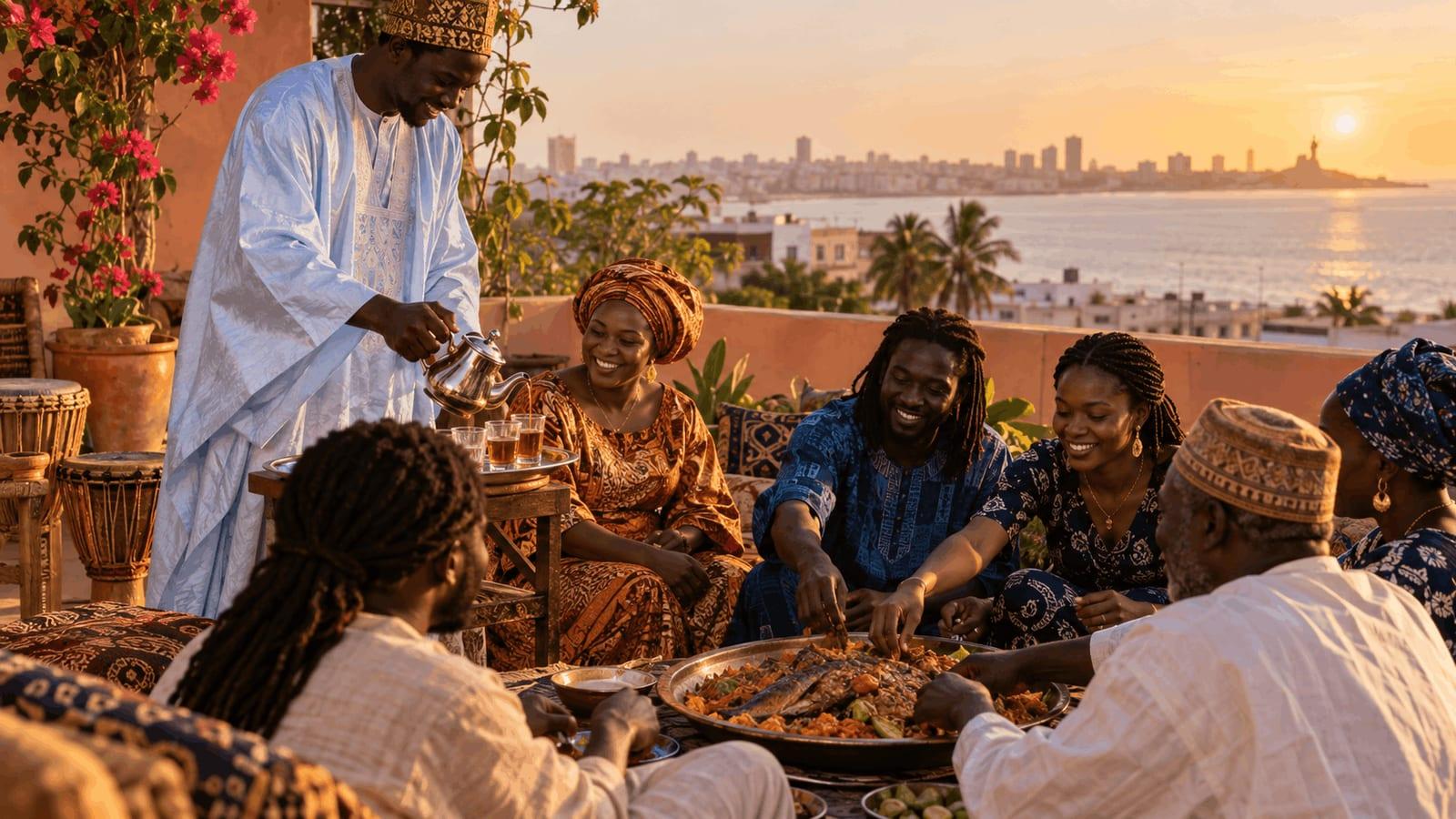
Then there is tea. In many parts of Mali, particularly among Tuareg and Moor communities in the north, making and sharing tea is an important social ritual. The tea is traditionally prepared and served in three rounds, with each round becoming sweeter. A widely repeated Saharan saying describes the three rounds as bitter like life, sweet like love, and gentle like death. It is a small piece of folk poetry, but it captures the social purpose of the ritual: tea gives people a reason to sit, talk, and spend time together.
And then there are the everyday foods that barely feel like culture until you stop to notice them. Peanuts are widely used in the south, appearing in snacks as well as sauces. When mangoes come into season, they fill markets and roadside stalls in Bamako and other cities. It is not a grand ceremony or an ancient ritual. It is simply the familiar pleasure of seeing mangoes everywhere and knowing that, for a while, it is mango season again.
Music, dance, and art
Malian music carries a global reputation disproportionate to the country's size, and much of its traditional Mande music is connected to the jeli tradition described at the start of this piece. The kora, a twenty-one-string bridge harp built around a large calabash resonator, is the instrument most associated with Mande jeli performance, traditionally played by members of hereditary jeli families who inherit both musical knowledge and traditions of historical and praise performance. The ngoni, a smaller plucked lute belonging to a family of West African instruments that contributed to the musical traditions from which the American banjo eventually developed, and the balafon, a wooden xylophone with calabash resonators, round out the core instrumentation of traditional Mande music.
Ali Farka Touré, born in Niafunké in the Timbuktu Region, built an international career in the late 20th century by playing electric guitar in a style that audiences around the world heard as closely connected to American Delta blues. Touré rejected the idea that his music was simply derived from American blues, and the similarities between Malian musical traditions and African American blues have long been the subject of discussion among musicians and scholars, particularly because both traditions have deep connections to West African musical practices carried across the Atlantic through the history of the slave trade. His son, Vieux Farka Touré, and the kora virtuoso Toumani Diabaté, who came from a renowned hereditary kora-playing jeli family, carried that international profile forward, along with Wassoulou singer Oumou Sangaré, whose music draws strongly on the traditions of the Wassoulou region rather than depending on hereditary jeli lineage.
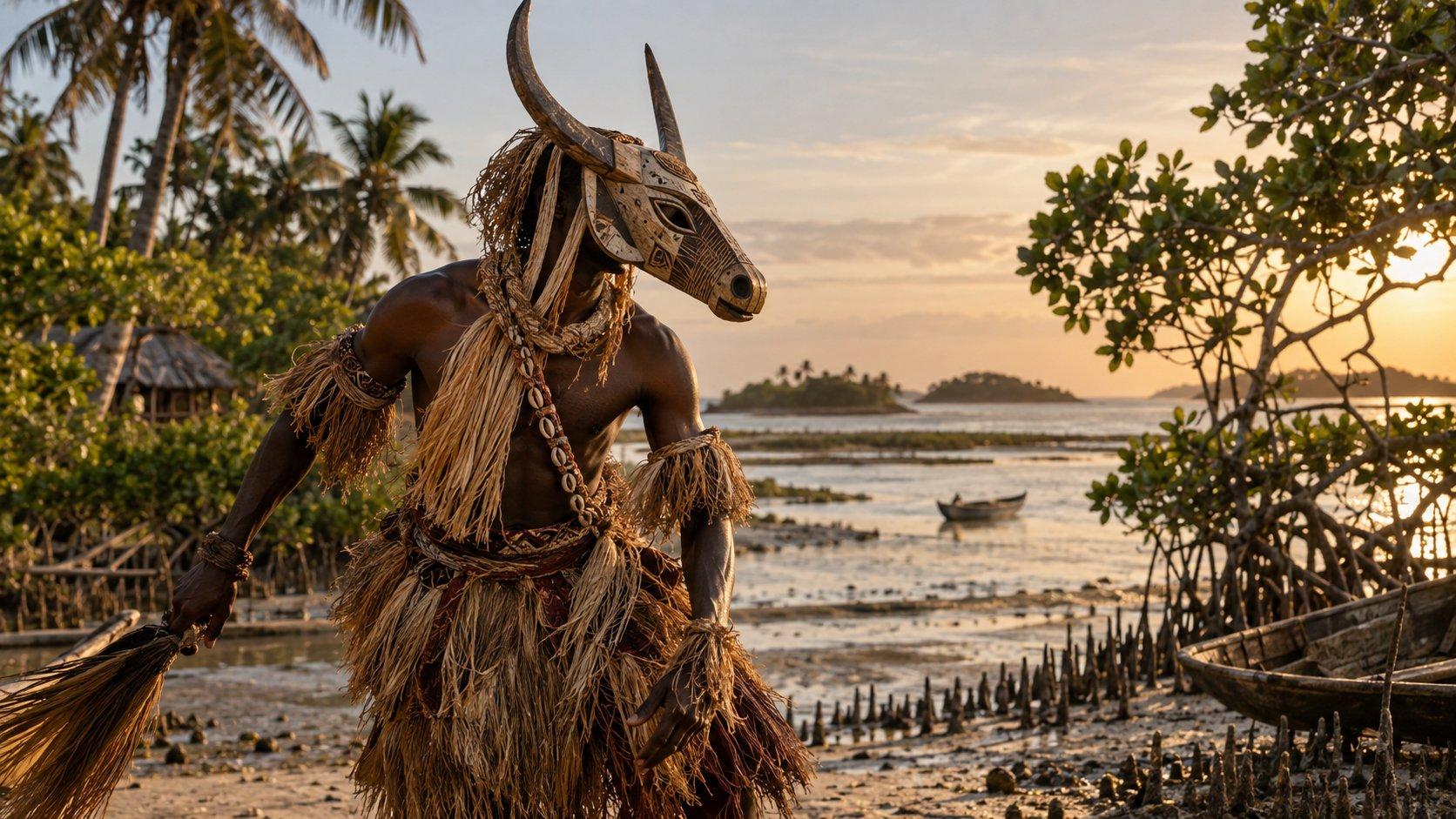
The Festival in the Desert, launched in 2001 near Timbuktu and later forced into exile because of security conditions in northern Mali, brought together Tuareg musicians, Malian stars, and international acts in a setting that became internationally known before instability made the original desert festival impossible to continue. Ci wara, an antelope-shaped headdress used in masked dances associated with Bambara farming communities and agricultural knowledge, remains one of the most recognized art forms from Mali, its sculptural style referenced by Malian visual artists and designers well beyond its original agricultural context.
Clothing, textiles, and craft
In this section
The cloth can be used for everyday clothing as well as elaborate costumes worn during masked dance performances.
Bogolan, widely known as mud cloth, is one of Mali’s best-known textile traditions. It is made by treating cotton cloth with plant-based dyes and prepared mud, often through repeated applications and drying. The process produces fabrics in dark brown, black, ochre, and other earthy tones, usually decorated with geometric patterns. Traditionally, different parts of the work were often divided between men and women, including weaving, dyeing, applying the mud designs, and sewing. Bogolan developed among several communities in Mali, particularly Mande-speaking peoples, and some patterns carry meanings connected to proverbs, important events, occupations, or group identity. What was once mainly used for clothing and other everyday or ceremonial purposes has also become part of contemporary fashion, with bogolan now sold internationally as a design closely associated with Mali.
In Dogon communities, cotton weaving and indigo dyeing have also long been part of textile traditions. The cloth can be used for everyday clothing as well as elaborate costumes worn during masked dance performances. Wood carving is another important tradition. Carved wooden doors and granary shutters may feature human figures, animals, or symbols connected to Dogon beliefs and traditions. These objects were made for practical use but are also valued as works of art. Many have entered international collections, however, raising questions about how and when they were removed from Mali and whether some should be returned.
Festivals, ceremonies, and rites of passage
The Dogon Sigui ceremony, held only once every sixty years, commemorates what Dogon tradition describes as the first death and is among the most distinctive ceremonial traditions associated with Dogon communities. The ceremony involves a sequence of rituals, dances, masks, and processions across communities, meaning that most Dogon people will witness a complete Sigui cycle only once in their lifetime. Smaller Dogon mask ceremonies, called dama, are held more frequently as funeral rites, intended to help mark the transition of the deceased and restore social balance, with dancers wearing wooden masks representing ancestors, animals, and other figures, performing movements that require extensive training.
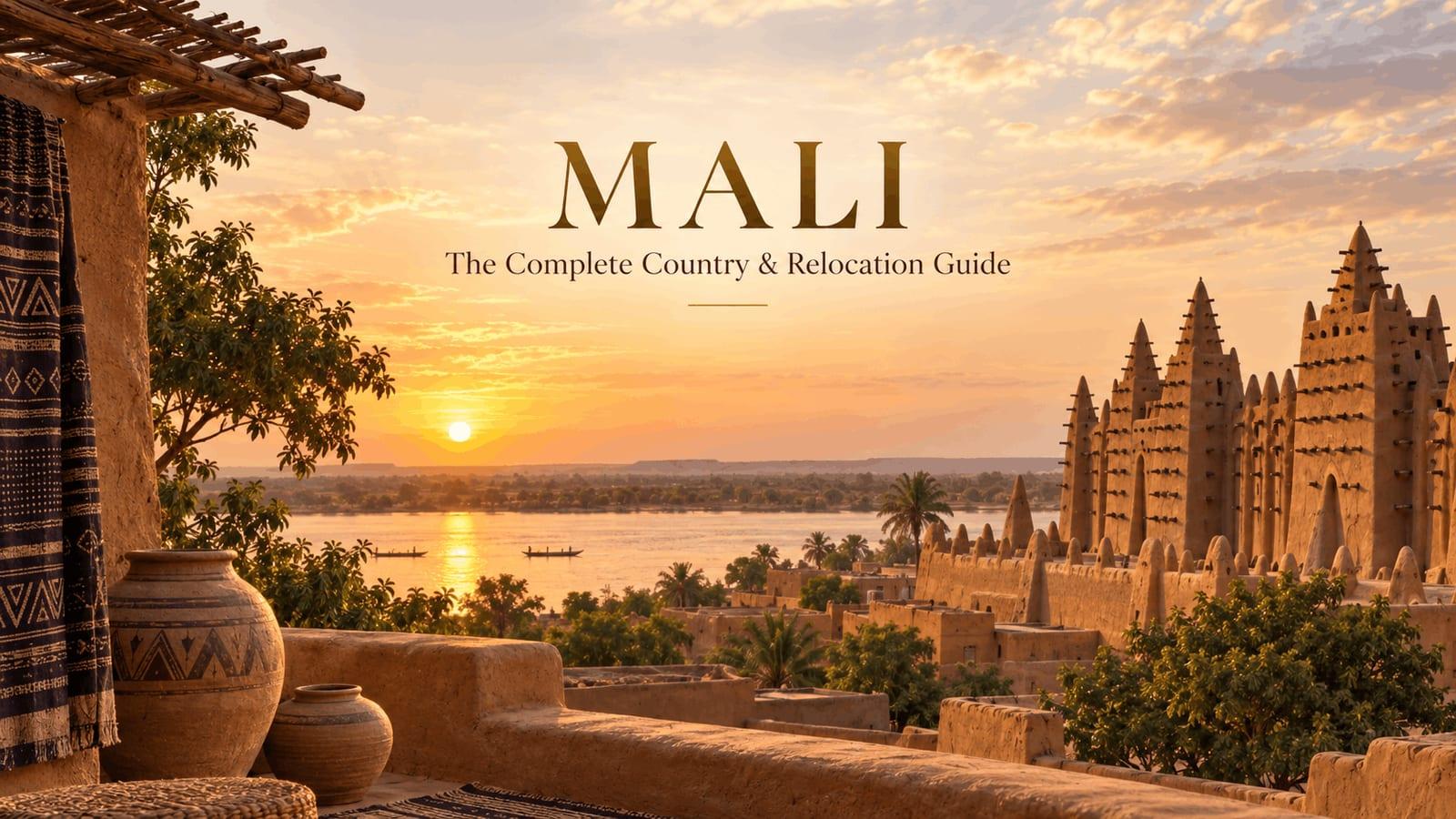
In Djenné, home to the largest earthen building in the world, the Great Mosque, an annual community event called the crépissage brings much of the town together to replaster the mosque's exterior with fresh mud after seasonal weather wears away the previous coat, treated as both practical maintenance and a genuine communal festival, with younger participants helping to carry and apply the mud while elders and community leaders organize the work. Tabaski and the end of Ramadan (Eid al-Fitr) function as among the country's most important nationwide celebrations, marked with new clothes, communal prayers, family gatherings, and, for Tabaski specifically, the sacrifice and sharing of an animal among households able to participate.
The Social World Behind the Jeli
In traditional Mande society, jeliw were part of a recognised social group with their own roles and responsibilities. They belonged to the wider group known as nyamakalaw, which also included blacksmiths and leatherworkers, and were traditionally distinguished from farming and noble families.
That position helped shape the kind of knowledge jeli families were expected to carry. A jeli could preserve family genealogies, praise histories, accounts of political events, and long historical stories, passing them from one generation to the next through training and performance. Their knowledge existed alongside written histories, particularly the Arabic manuscripts produced by scholars across West Africa.
So while a jeli could certainly entertain an audience, entertainment was only one part of the role. In Mande communities, the jeli tradition was also tied to family history, social relationships, public memory, and the preservation of knowledge.
The Tradition Is Still Being Made
In this section
The manuscripts of Timbuktu tell perhaps the sharpest written version of this same story.
The griot tradition has not stayed frozen as a historical curiosity. Contemporary Malian musicians descended from griot lineages, including members of the extended Diabaté, Kouyaté, and Kanté families, continue to release music internationally, adapting kora and ngoni playing into collaborations with jazz, electronic, rock, and other musicians abroad while still performing praise songs and historical narratives at weddings, naming ceremonies, and other gatherings back home. Ali Farka Touré's blues-inflected guitar style, once startling to Western audiences who heard strong similarities with American blues, remains part of the musical legacy carried forward by his son, Vieux Farka Touré. Even amid the political instability and security concerns that have limited outside access to parts of the country over the past decade, bogolan cloth keeps appearing in international fashion, the Great Mosque at Djenné continues to be replastered by hand each year, and somewhere in Bamako, a jeli is teaching a child songs and stories passed down through generations, because in Mali, that has long been one of the ways important things are kept.
The manuscripts of Timbuktu tell perhaps the sharpest written version of this same story. When armed Islamist groups including Ansar Dine and al-Qaeda in the Islamic Maghreb took control of Timbuktu in 2012 and began destroying shrines and other heritage sites they considered unacceptable, librarians and ordinary residents helped move tens of thousands of manuscripts out of the city to safety, transporting them by road and river to Bamako and elsewhere, often at considerable personal risk. UNESCO and other preservation organizations later documented the enormous scale of the rescue, with estimates that around 300,000 manuscripts were successfully removed from Timbuktu while thousands of others were lost or destroyed. It is the same instinct that has kept the griot tradition alive for centuries, just aimed, for once, at paper instead of memory: the conviction that some things are too important to let disappear.