Explore Nigeria’s rich cultural diversity, from its 250+ ethnic groups and languages to its history, religion, food, music, festivals, fashion, and traditions.
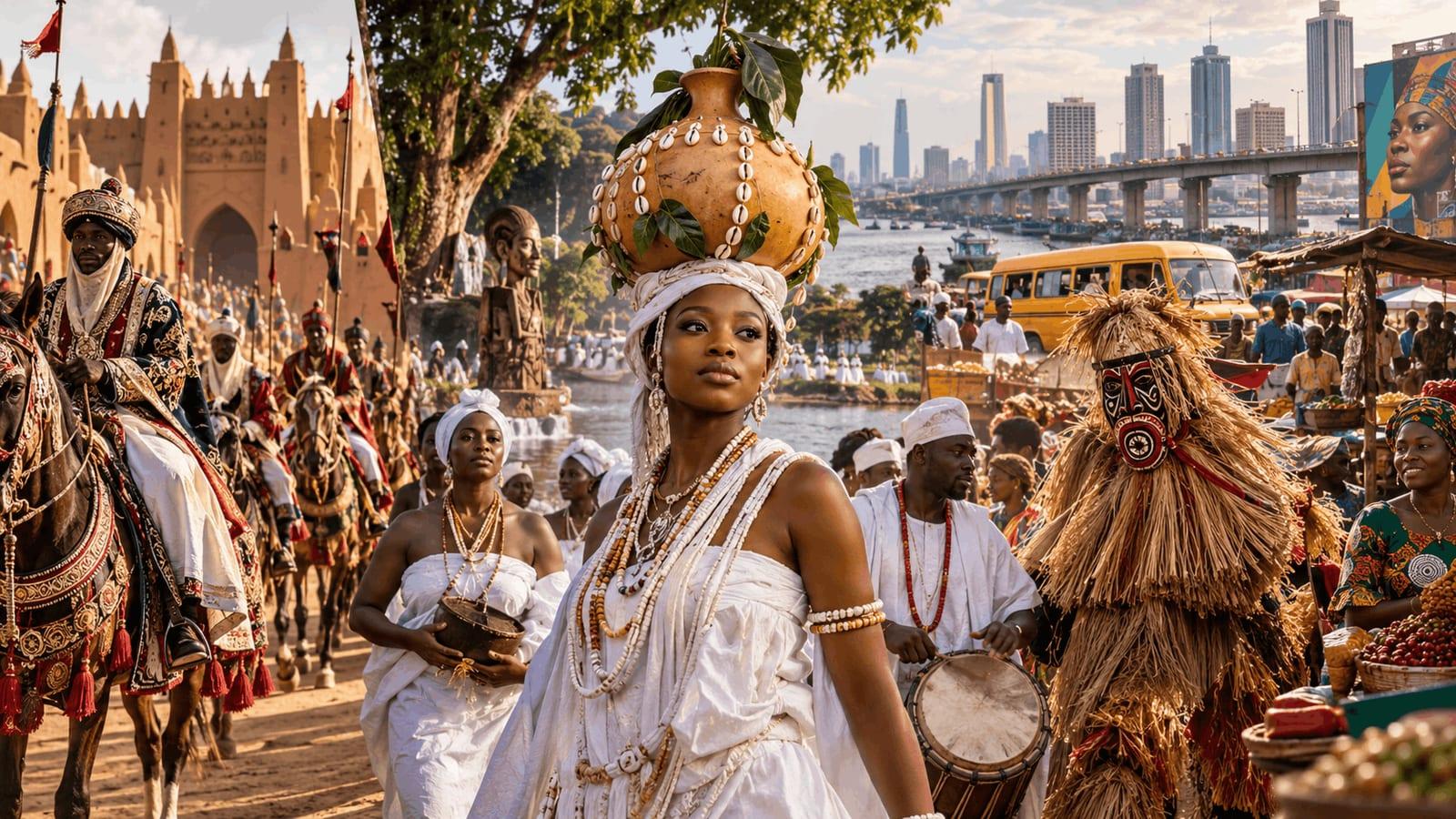
In Osogbo, during the annual Osun-Osogbo festival, which takes place at the end of July and into August, a young girl carries a calabash on her head through a crowd of thousands. She is the Arugba, a young woman chosen through Ifa divination from the royal lineage of the Ataoja, the traditional ruler of Osogbo. Traditionally, she is also required to be a virgin. She walks toward the Osun River to make an offering to Osun, the Yoruba goddess the river and festival are named after. Priests, drummers, and devotees dressed in white follow behind her, while others gather along the riverbanks to watch.
The festival runs for twelve days and brings together religious devotees, cultural visitors, and people connected to Yoruba communities outside Nigeria. That connection stretches back across the Atlantic. When Yoruba people were forcibly taken from West Africa during the transatlantic slave trade, they carried their religious traditions with them. In places such as Brazil and Cuba, their descendants preserved and adapted aspects of those traditions, including the worship of Yoruba deities, sometimes under different names and in different forms.
And this is happening in one town. One festival brings together history, religion, gender, ritual, and connections between people in Nigeria and communities thousands of kilometres away. Osogbo is only one town, in one part of one state, in a country of thirty-six states.
Nigeria is not one culture wearing one country's name. It is a country of more than 250 ethnic groups, hundreds of languages, and communities shaped by vastly different histories, political systems, and beliefs. Many of these societies had their own kingdoms, governments, economies, and systems of authority long before the modern Nigerian state existed. They were eventually brought under British colonial rule and, in 1914, into one political territory. Since independence, Nigerians have had to work out what it means to build one country out of all these different histories, identities, and ways of life.
Each emirate was governed by an emir, while the Sultan of Sokoto held the highest authority across the caliphate.
Long before anyone called it Nigeria, the region was home to some of the most organized and politically sophisticated societies in precolonial Africa. These societies did not all govern themselves in the same way. Some concentrated political power around kings and other rulers, while others distributed authority among families, community leaders, councils, and other institutions.
In the northern part of the region, across the grasslands known as the savanna, the Hausa built walled city-states such as Kano, Katsina, and Zaria. These cities became major centres of trade, connecting West Africa to North Africa through the trans-Saharan trade routes. Traders moved leather, textiles, salt, and other goods across these routes, linking the northern cities with communities further south.
In the early 1800s, a religious scholar named Usman dan Fodio led what is known as a jihad. In this context, jihad was a religious and political movement aimed at reforming Muslim societies and establishing governments based on Islamic principles. His movement defeated several Hausa rulers and established the Sokoto Caliphate in 1804. It became one of the largest political states in 19th-century Africa, with a system of government made up of several emirates. Each emirate was governed by an emir, while the Sultan of Sokoto held the highest authority across the caliphate. Fulani political leadership became particularly influential within this system, although Hausa and other communities also lived and governed within it.
Further west, in what is now southwestern Nigeria and parts of neighbouring Benin and Togo, Yoruba societies developed a different political system. Rather than forming one single kingdom, the Yoruba lived in numerous cities and kingdoms, each with its own ruler and institutions. Many placed great importance on sacred kingship, where the ruler was not only a political leader but also had important religious responsibilities. The Oyo Empire eventually became the most powerful of these Yoruba states. By the 18th century, it controlled important trade routes and exercised influence over smaller kingdoms across a large area of what is now southwestern Nigeria and parts of present-day Benin and Togo.
Ife was another major Yoruba centre. Yoruba tradition describes Ife as the place where the world was created and where human life began. The city was also an important centre of artistic and technological achievement. Its terracotta heads and highly detailed brass and copper sculptures, many dating from roughly the 12th to 15th centuries, demonstrate an extraordinary level of craftsmanship centuries before European colonial rule.
Further west of the Yoruba heartland, in what is now southern Nigeria, the Benin Kingdom developed a highly organized and centralized system of government. And to avoid a common confusion, this is the historic Kingdom of Benin, whose capital was Benin City, not the modern Republic of Benin next door.
The Oba, or king, stood at the centre of the kingdom's political and religious system, but he did not govern alone. He was supported by a larger system of advisers, chiefs, officials, military leaders, and other people who helped run the kingdom. Benin became known for its strong administration, military power, trade, and extraordinary metalworking tradition. Its brass plaques, sculptures, and other works recorded kings, battles, religious beliefs, ceremonies, and important events, making them some of the most important surviving records of the kingdom's political and social history.
In the southeast, the Igbo developed a very different political system. Many Igbo communities did not have a single king or central government ruling over everyone. Instead, authority was spread among village assemblies, councils, family and lineage structures, age grades, and people who had earned respected traditional titles. Decisions were often made collectively, with different groups having different responsibilities and forms of influence.
This mattered when the British later tried to govern these communities. In a centralized kingdom, colonial officials could often deal with a king or other clearly recognized ruler and use that person's authority to administer the population. Many Igbo communities did not have an equivalent single ruler for the British to work through. In response, British officials introduced a system of "warrant chiefs", appointing local men to exercise authority on behalf of the colonial government. In many places, these appointed chiefs did not hold the same kind of authority in their communities before colonial rule, creating serious tensions between the British system of government and existing Igbo political structures.
These tensions contributed to unrest in eastern Nigeria, including the 1929 Aba Women's War. Thousands of women from Igbo, Ibibio, Annang, and other communities organized mass protests against colonial taxation and the warrant chief system. They drew on established traditions of collective women's protest, using methods that colonial officials struggled to understand and control.
Further south, along the coast and waterways of what is now the Niger Delta, the Ijaw and other communities developed political and economic systems around the region's extensive network of rivers, creeks, and waterways. Local knowledge was essential for navigating these waterways, and communities became important intermediaries in trade between European merchants and inland markets.
City-states such as Bonny and Opobo grew wealthy first through the Atlantic slave trade and later through the palm oil trade. Their rulers could negotiate directly with European trading companies and governments as independent political actors. King Jaja of Opobo, for example, became a powerful palm oil trader and political leader who resisted British attempts to control his trade. British expansion eventually brought these independent delta states under colonial rule, often through military force.
British colonization happened gradually throughout the 19th century. Britain was interested in the region for several reasons, including trade, access to resources, and the growing importance of palm oil after Britain moved against the transatlantic slave trade. In 1885, European powers met at the Berlin Conference and agreed on rules for claiming and recognizing territory in Africa. The conference did not literally divide the entire continent between them in one meeting, but it helped establish the rules under which European powers expanded their control. The actual takeover of African territories happened over the following decades through treaties, negotiations, commercial pressure, and military force.
In 1914, the British administrator Frederick Lugard merged the Northern and Southern Protectorates into one colony, which became known as Nigeria. A protectorate was a territory controlled by a foreign power while some local rulers and institutions were allowed to remain in place under that power's authority. The merger brought together the Muslim-majority emirates of the north with societies in the south that had developed very different political and religious systems. The decision was made largely for British administrative and economic reasons, not because these different societies had decided they wanted to form one country.
Nigeria became independent from Britain in 1960. But the political tensions created by the country's different histories, combined with disputes over power and control, did not disappear with independence.
In 1967, the southeastern region, where the Igbo were the dominant ethnic group, declared independence as the Republic of Biafra. This followed years of political instability and violence, including massacres in northern Nigeria in which large numbers of Igbo civilians were killed. The declaration triggered the Nigerian Civil War, which lasted from 1967 to 1970.
The war killed up to an estimated two million people, many from starvation and disease during the devastating famine and blockade in Biafra. Biafra surrendered in 1970, but the experience left deep scars, particularly among Igbo communities in southeastern Nigeria. Memories of the war continue to influence political identity and support for separatist movements in parts of the southeast.
Nigeria then entered decades marked by oil wealth, military coups, and political instability before returning to civilian rule in 1999. Since then, the country has maintained continuous civilian democratic government, its longest uninterrupted period of civilian rule since independence.
Ethnic groups and languages
In this section
The Igbo are concentrated mainly in the southeast, where cities such as Enugu, Onitsha, and Aba are major population centres.
Nigeria has more than 250 ethnic groups and hundreds of languages. The exact number of languages varies depending on how linguists classify closely related languages and dialects, but the U.S. State Department, for example, identifies 395 languages. No single ethnic group makes up a majority of the country. The Hausa, Igbo, and Yoruba are the three largest ethnic groups and together account for roughly half of Nigeria's population.
The Hausa are concentrated mainly in the north, the large region stretching across the upper part of the country, while Fulani communities are also widespread across the north. The two groups have been deeply connected for centuries through political alliances, intermarriage, shared Islamic traditions, and the development of the Hausa-Fulani political systems that dominated much of northern Nigeria. The Yoruba are concentrated mainly in southwestern Nigeria, including cities such as Lagos, Ibadan, Osogbo, and Ife, with Yoruba communities also found in neighbouring countries such as Benin and Togo. The Igbo are concentrated mainly in the southeast, where cities such as Enugu, Onitsha, and Aba are major population centres.
But the three largest groups are only part of the picture. The Niger Delta, the river-and-creek region in the south where the Niger River spreads toward the Atlantic Ocean, is home to large populations of Ijaw and other ethnic groups. Elsewhere in the country are the Kanuri, Tiv, Ibibio, Edo, Efik, and many other peoples, each with their own languages, histories, and traditions. These groups can disappear from simplified descriptions of Nigeria that stop at Hausa, Yoruba, and Igbo.
English, inherited from British colonial rule, is Nigeria's official language and the main language used to communicate across ethnic and linguistic boundaries. Nigerian Pidgin plays a different but equally important role in everyday life. It is widely used in markets, music, popular culture, and casual conversation, allowing people from different ethnic backgrounds to communicate without sharing the same first language. Hausa, Yoruba, and Igbo are among Nigeria's most widely spoken indigenous languages and have important roles in broadcasting, education, politics, and public life. So a person from Lagos speaking with someone from Kano, for example, may use English or Nigerian Pidgin rather than either person's first language.
Ethnic identity also overlaps heavily with regional politics. Nigeria is divided into thirty-six states and a Federal Capital Territory, and the creation of many of these states was partly intended to give different communities greater political representation and reduce the concentration of power in the hands of a few larger groups. But dividing the country into states did not remove competition over who gets political power.
One of the ways this competition is managed is through what Nigerians commonly call "zoning." This is an informal political practice in which political parties try to distribute major positions across Nigeria's different regions, particularly the presidency. One of the most familiar forms of this is the expectation that political power should rotate between northern and southern parts of the country. These regions are not politically or religiously uniform, but the distinction often matters because the north has a larger Muslim population while Christianity is particularly strong across much of the south. Zoning is therefore openly debated during election periods, with arguments over whether a particular region has had its turn, who should be next, and whether regional balance should take priority over other political considerations.
Religion and belief
In this section
Christianity arrived much later, spreading mainly through 19th-century missionary activity along the coast and river routes.
Nigeria is overwhelmingly Muslim and Christian, with Islam making up a modest national majority and Christianity a large minority. Pew Research Center estimates that in 2020, Muslims made up 56.1 percent of the population and Christians 43.4 percent, with other groups making up the remainder. Islam is concentrated mainly in the north, while Christianity is particularly strong in the south. Between these broad regions is what is often called the Middle Belt, a group of states running across central Nigeria where Christian and Muslim communities live alongside each other, sometimes uneasily.
Islam arrived in the north through trade and contact with North Africa beginning around the first millennium and became deeply established under successive Muslim states, eventually becoming the dominant religion across much of the region. Christianity arrived much later, spreading mainly through 19th-century missionary activity along the coast and river routes. It took particularly strong root among Yoruba, Igbo, Niger Delta, and other southern populations, contributing to the large Christian populations found across southern Nigeria today.
Alongside both religions, older belief systems survived. Among the Yoruba in particular, these traditions remain a living and organized form of religious practice rather than simply a memory of the past. Yoruba traditional religion centres on a supreme creator, Olodumare, and a group of powerful spiritual beings known as orisha. These include Sango, associated with thunder and justice; Ogun, associated with iron, metalworking, and war; Yemoja, associated with water and motherhood; and Osun, associated with fresh water, fertility, and healing.
One important part of Yoruba religious practice is Ifa, a system of divination used to seek guidance and understand the will of the spiritual world. It is based on a vast body of verses and teachings that are interpreted by specially trained priests known as babalawo. UNESCO first proclaimed Ifa a Masterpiece of the Oral and Intangible Heritage of Humanity in 2005 before formally placing it on its Representative List of the Intangible Cultural Heritage of Humanity in 2008. It continues to be practised among Yoruba communities in Nigeria and among Yoruba-descended communities across the Americas and Caribbean.
Religion in Nigeria is not always as neatly divided as the statistics suggest. Some Yoruba Christians and Muslims continue to engage with aspects of indigenous traditions or attend cultural and religious festivals connected to the orisha, including Osun-Osogbo. For some people, these traditions are part of their cultural identity even when their primary religious affiliation is Christianity or Islam. Others practise them as a distinct religious tradition.
Traditional belief systems also survived among the Igbo, Edo, and other southern Nigerian communities, although they differ from Yoruba traditions. Beliefs involving spirits, ancestors, and masked figures continue to appear in some communities, particularly during funerals, festivals, traditional title ceremonies, and other communal events.
Food
In this section
Across many Nigerian cuisines, everyday meals are built around soups and stews eaten with a starchy accompaniment.
Jollof rice, a tomato and pepper-based rice dish, is one of Nigeria's most internationally recognizable foods. It is also at the centre of an ongoing, mostly good-natured rivalry with Ghana and Senegal over whose version is the original and whose is better, a debate Nigerians tend to consider settled in their own favour without much room for argument. But jollof is closer to a party dish than an everyday staple.
Across many Nigerian cuisines, everyday meals are built around soups and stews eaten with a starchy accompaniment. In Yoruba cuisine in the southwest, one of the best-known combinations is amala, a soft dark-coloured swallow made from yam flour, served with ewedu, a smooth soup made from jute leaves, and gbegiri, a light soup made from peeled beans. The combination is often served with meat and a rich stew or pepper sauce, creating a meal that is distinctly Yoruba. Other common staples include pounded yam and eba, made from cassava flour. These foods are traditionally eaten with the hands: a small piece of the starch is pinched off, shaped, and used to scoop up the soup or stew.
Egusi soup is another widely eaten Nigerian dish, made with ground melon seeds and usually cooked with leafy vegetables, meat, or fish. It is eaten across different parts of the country, although the ingredients, preparation, and combinations vary between communities.
Suya, thin strips of beef or ram coated in a ground peanut and pepper spice mixture called yaji and grilled over an open flame, has roots in Hausa food culture in northern Nigeria. It has since become one of the country's most recognizable foods, sold from roadside stalls and street vendors late into the night in cities across Nigeria.
In the southeast, dishes built around palm oil and stockfish, such as ofe akwu, reflect the ingredients and food traditions of the region's wetter forest environment. Further south, in the Niger Delta, where rivers, creeks, and coastal waters provide abundant fish, Ijaw, Efik, and other communities have developed cuisines that make extensive use of fresh and smoked fish. Dishes such as afang soup and Calabar-style pepper soup are examples of the distinctive food traditions found in this part of the country.
The result is a food culture that changes noticeably from region to region. The ingredients available in the dry northern savanna are not the same as those found in the southern forests and river systems, and the foods people eat reflect those differences.
Music, dance, and art
In this section
Afrobeat is distinct from Afrobeats, the plural term now used for a much broader contemporary African pop sound.
Nigerian music has produced some of the continent's most globally recognized sounds. Afrobeat, the genre associated with Fela Kuti, emerged in the late 1960s and 1970s through the work of Fela, drummer Tony Allen, and other musicians. They brought together Yoruba rhythms and West African highlife with American funk and jazz, creating long, heavily rhythmic songs that were often openly political. Fela used the music to criticize corruption, military rule, and abuse of power in Nigeria. His activism made him a target of the authorities, with his compound raided repeatedly and Fela arrested and imprisoned at different points.
Afrobeat is distinct from Afrobeats, the plural term now used for a much broader contemporary African pop sound. Afrobeats developed from the 1990s and 2000s onward, drawing from Nigerian and Ghanaian popular music alongside dancehall, hip-hop, R&B, and other West African rhythms. Unlike Fela's politically charged Afrobeat, Afrobeats is not one single genre with one defined sound. It is a broad pop movement that has produced music designed for clubs, radio, streaming, and increasingly international audiences. Artists such as Wizkid, Burna Boy, Davido, and Tems have taken different versions of that sound onto international charts, major award stages, and global festival lineups. Afrobeats is now part of mainstream international pop culture rather than being treated simply as "world music."
Traditional instruments and musical traditions remain important beneath Nigeria's modern sounds. The Yoruba dùndún, often called a talking drum, is an hourglass-shaped drum with tension cords running along its body. By squeezing those cords while playing, a skilled drummer can change the drum's pitch and reproduce patterns that resemble the tones of spoken Yoruba. The instrument has long been used in communication, music, ceremonies, and other communal occasions.
Fuji, another Yoruba musical tradition, developed in the 1960s from Muslim Yoruba performance traditions and earlier forms of popular music. It is driven heavily by percussion and vocals and became particularly associated with social gatherings, weddings, parties, and other celebrations in southwestern Nigeria. It remains a major part of Yoruba popular culture.
Then there is Nollywood, Nigeria's film industry. Nigerian filmmakers produce around 2,500 films a year, making Nollywood one of the world's most prolific film industries by volume. Much of its early growth came from relatively inexpensive productions made quickly for video distribution rather than traditional cinema release. Over time, Nollywood became much more than a film industry. Its stories, accents, fashion, humour, family dynamics, and everyday Nigerian expressions have helped carry Nigerian culture across Africa and, increasingly, around the world.
Clothing, textiles, and craft
In this section
Women may wear a wrapper with a matching blouse called a buba and a head tie called a gele.
Everyday wear across Nigerian cities looks like everyday wear anywhere, but ceremonial dress remains distinct by region and carries real social meaning. Among the Yoruba in southwestern Nigeria, aso oke is a handwoven textile traditionally produced on narrow looms and sewn together in wider strips. It is often made into garments for important occasions, including agbada, a flowing, wide-sleeved robe worn over a matching shirt and trousers. Yoruba men commonly wear agbada for weddings, chieftaincy ceremonies, funerals, and other important social occasions.
Women may wear a wrapper with a matching blouse called a buba and a head tie called a gele. The gele can be tied in increasingly elaborate shapes and has become an art form in its own right, with professional gele tiers sometimes hired specifically to create intricate styles for weddings and other celebrations.
Adire is another important Yoruba textile tradition. Traditionally produced by Yoruba women, particularly in towns such as Abeokuta, adire is an indigo-dyed cloth made using resist-dyeing techniques. Different materials and methods, including tied fabric, wax, and cassava starch, are used to prevent parts of the cloth from absorbing the dye, creating distinctive patterns. Adire remains a living craft rather than simply a historical textile, and contemporary Nigerian designers increasingly use it in modern clothing and fashion collections.
In northern Nigeria, men's traditional clothing includes the babban riga, a large, flowing robe often decorated with detailed embroidery around the neckline and worn over a shirt and trousers. It is commonly paired with a soft cap, sometimes called a hula, while turbans are also worn, particularly for religious, ceremonial, or royal occasions.
Festivals, ceremonies, and rites of passage
In this section
Traditional title-taking is another important part of social life in many Igbo communities.
The Osun-Osogbo festival, described at the start of this piece, takes place every year in July and August. It reaches its central ritual when the Arugba, carrying a ceremonial offering in a calabash, is led in procession to the sacred grove and the Osun River, where the offering is presented to Osun. The Sacred Grove is a protected forest along the Osun River that Yoruba tradition regards as a sacred home of Osun, the orisha associated with the river. It contains shrines and other sacred spaces where rituals and offerings are performed. The Osun-Osogbo Sacred Grove is also a UNESCO World Heritage Site and has become an important symbol of Yoruba cultural and religious heritage, including among Yoruba-descended communities outside Nigeria.
The Kano Durbar, held during Eid celebrations in the northern city of Kano, brings the Emir and thousands of mounted horsemen through the streets in a procession rooted in the city's long history of cavalry, Islamic tradition, and royal ceremony. UNESCO describes the Durbar as a procession involving about 10,000 men on horseback, alongside men and women on foot, and inscribed the tradition on its Representative List of the Intangible Cultural Heritage of Humanity in 2024. The event remains both a major religious and cultural celebration and a public expression of the historical relationship between the Emir, the city, and the communities around it.
In southeastern Nigeria, masquerade festivals remain an important part of Igbo cultural life, particularly during the Christmas and New Year period in many communities. Men from title-holding families may dress in elaborate costumes made from raffia, wood, cloth, and other materials, representing ancestors, spirits, animals, or other supernatural figures. The masquerades perform through village squares, sometimes incorporating elaborate choreography and acrobatics, so the events can be highly entertaining while still carrying serious religious meaning. In some Igbo traditions, a masquerade is not understood simply as a person wearing a costume but as the physical manifestation of an ancestral or spiritual presence.
Traditional title-taking is another important part of social life in many Igbo communities. Men may earn and assume increasingly prestigious titles over the course of their lives, often through contributions to their community, achievement, wealth, or participation in communal institutions. These titles can carry significant social responsibilities as well as status, and ceremonies marking them can be major community events, celebrated with a seriousness comparable to other important life milestones.
How Nollywood Changed African Entertainment
One of the reasons Nollywood became so influential was not simply the number of films it produced, but how those films reached people. During the industry's early video-film era, filmmakers could produce movies quickly and distribute them directly to audiences without depending on the expensive cinema infrastructure that dominated Hollywood and other established film industries.
Many early Nollywood films were shot on digital cameras in a matter of days and released directly on video rather than through cinemas. Copies moved through informal markets, video shops, television stations, and later digital platforms, allowing Nigerian stories to travel far beyond the country's borders.
That distribution model helped Nigerian films reach audiences across Africa at a scale that would have been difficult through traditional cinema alone. A viewer in Accra, Nairobi, or another African city could become familiar with Nigerian family dynamics, humour, fashion, expressions, and social conflicts without ever having visited Nigeria.
Nollywood therefore did more than create a large film industry. It helped make Nigerian popular culture part of everyday entertainment across the continent.
What Nigeria looks like today
In this section
Foods, religious practices, music, clothing, and systems of community life have adapted rather than disappeared.
You can see Nigeria's cultural influence most clearly in things that are still happening now. Afrobeats has moved from Nigerian clubs and radio stations onto international charts, major festivals, and some of the world's biggest stages. Nigerian expressions have travelled too. "Wahala," a word used widely across West Africa, is now familiar far beyond the region, while "japa," derived from Yoruba, has become a common Nigerian term for leaving the country, particularly to seek opportunities abroad. Nollywood has followed a similar path, with Nigerian films and series now reaching international audiences through Netflix and other streaming platforms.
At the same time, older traditions have not disappeared simply because modern Nigeria has changed. The Osun-Osogbo festival continues to draw people to the sacred grove each year, while Yoruba religious and cultural traditions are also maintained by Yoruba-descended communities in Brazil, Cuba, the United States, and elsewhere in the Americas. The connection between those communities and Nigeria is part of a much longer history, shaped by the forced movement of millions of Africans across the Atlantic during the slave trade.
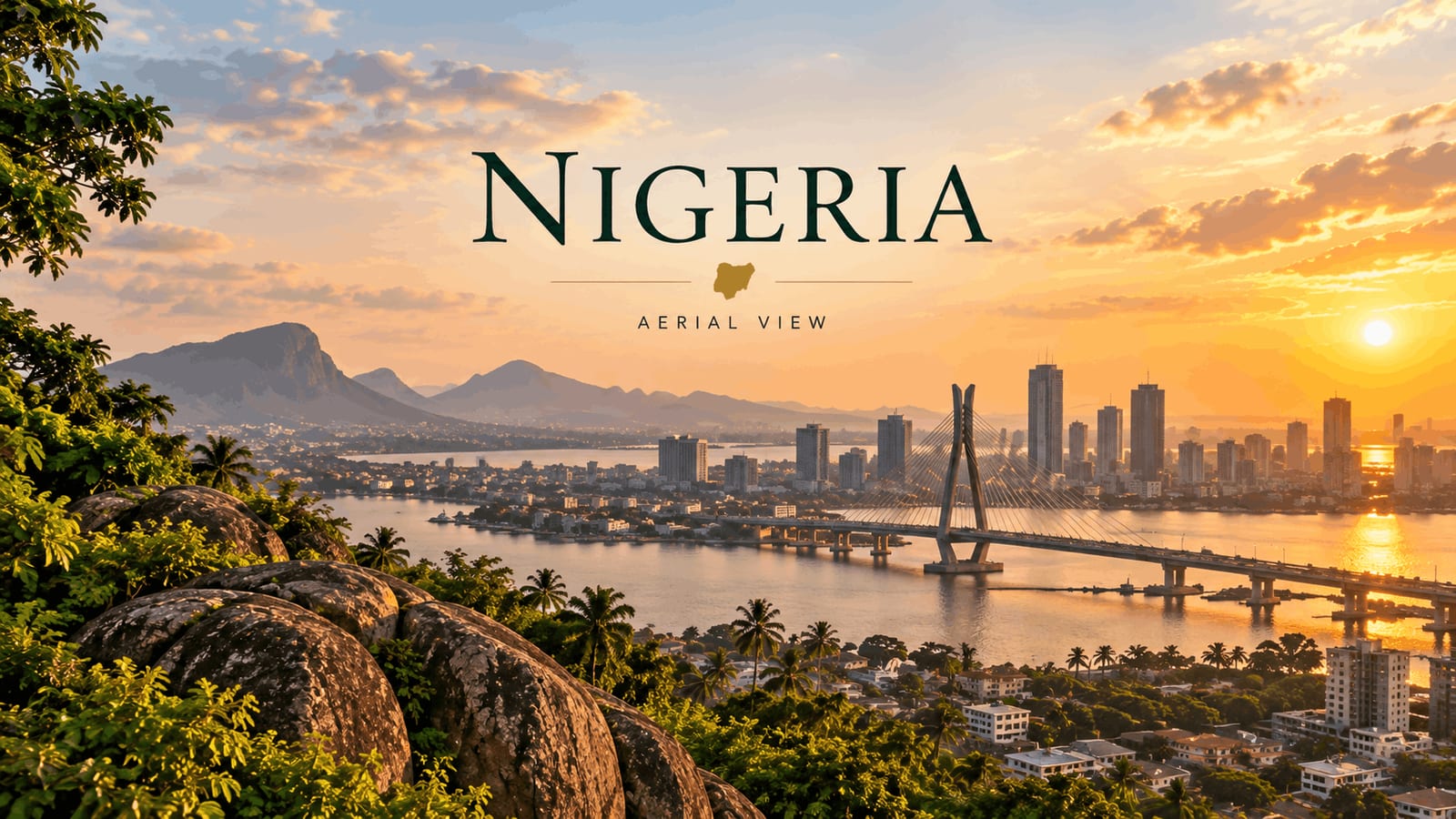
Lagos is probably the clearest example of what all of this looks like today. A city of roughly sixteen million people by recent UN urban estimates, it brings together people from across Nigeria and beyond. On the same morning, a Yoruba landlord, an Igbo trader, a Hausa security guard, and a Nigerian architect who studied in Britain might pass through the same danfo bus stop, speaking English or Pidgin, wearing everything from jeans and trainers to an agbada on the way to a wedding. An Afrobeats song plays from a nearby shop. A few streets away, another community is preparing a masquerade festival. By evening, a suya seller has lit his grill.
It is a modern city, moving at extraordinary speed, but the older Nigeria is still there inside it. Languages continue to mix. Traditional ceremonies continue to fill streets and family compounds. Foods, religious practices, music, clothing, and systems of community life have adapted rather than disappeared.
Nigeria is not a country where modernity replaced tradition, or where hundreds of different cultures somehow became one. Old identities and new influences continue to exist side by side, changing with the times while still carrying the histories that shaped them.