Explore Ethiopia's unique culture, history, traditional time system, Ethiopian calendar, coffee ceremony, food, religion, languages, music, festivals and ancient heritage, from Aksum and Lalibela to modern Ethiopian life.
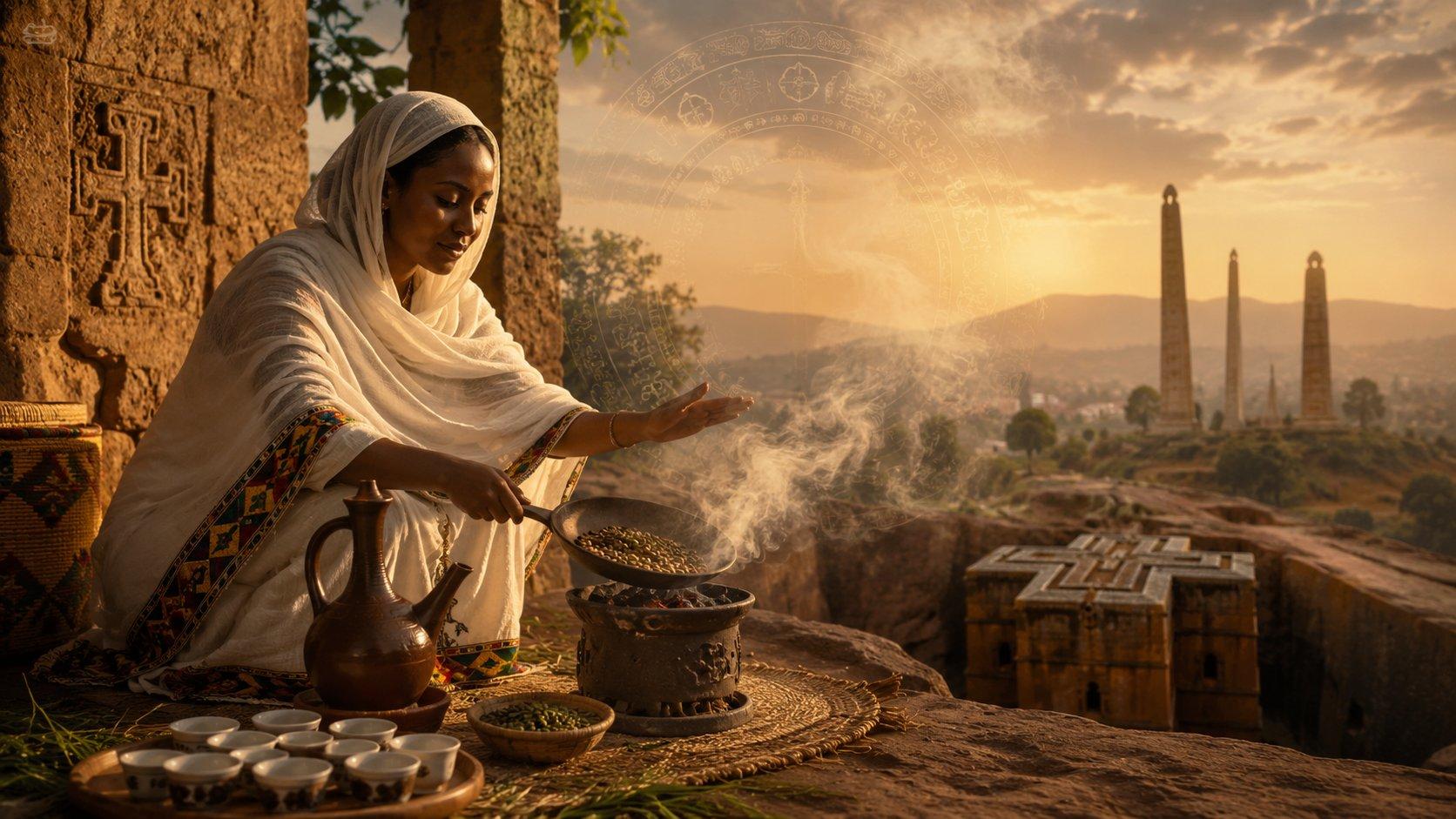
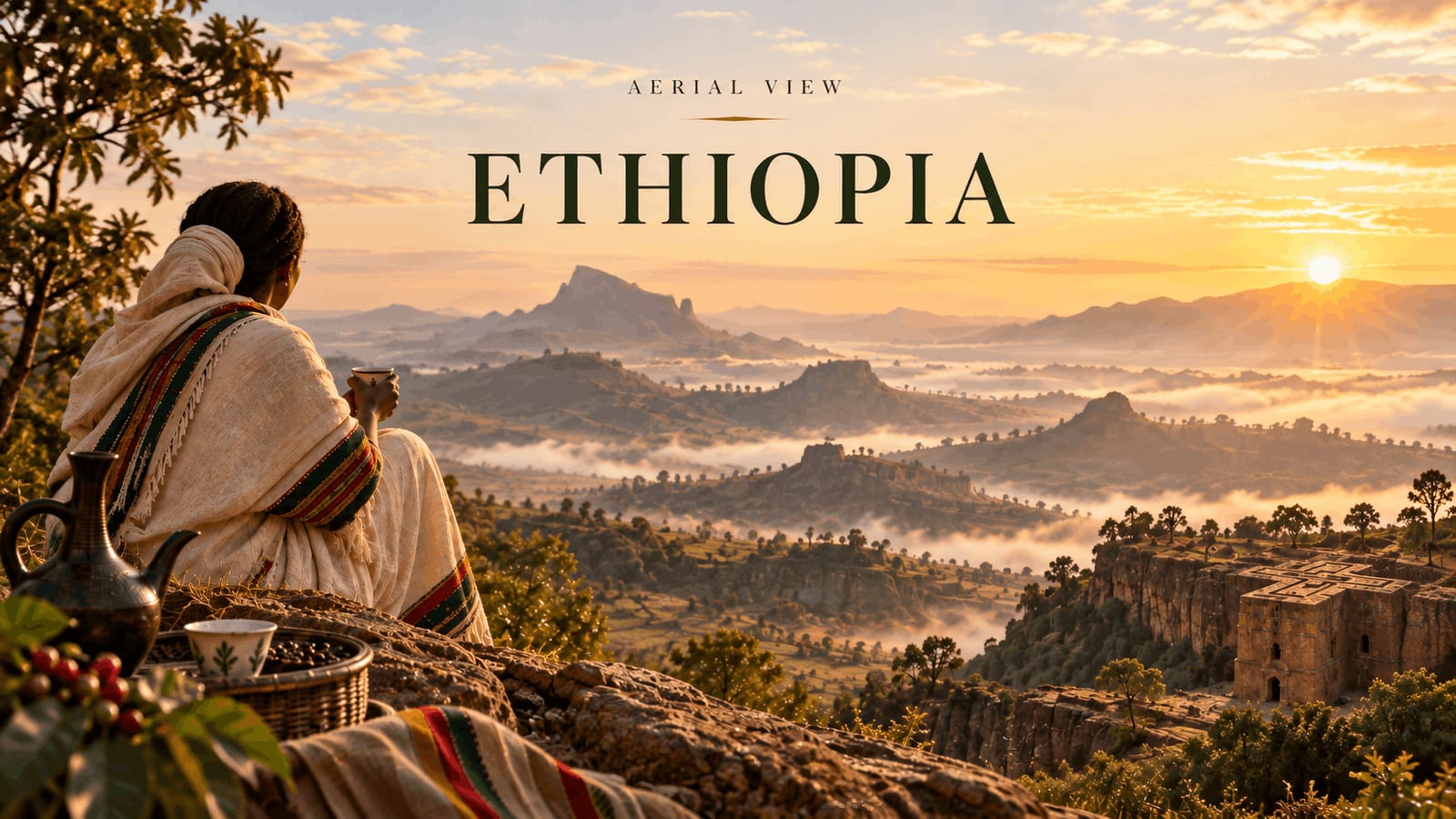
It is early morning in Addis Ababa, and a woman crouches over a small charcoal stove, roasting green coffee beans in a flat pan until the smoke turns sharp and sweet. She waves the smoke toward her guests with her hand, a gesture that means the roasting is going well. The beans are ground by hand, brewed in a clay pot called a jebena, and poured into small handleless cups. This happens three times. The first pour is called abol, the second tona, the third baraka, the one that carries the blessing. A coffee ceremony like this can run over an hour, and cutting it short can be considered rude. Nobody in the room is checking a clock, because in Ethiopia, the clock itself runs on different rules.
Ethiopia uses a traditional system of timekeeping in which the day begins at roughly 6 a.m., so what the rest of the world calls seven in the morning is one o'clock in Ethiopian time. It also runs on its own calendar, currently about seven to eight years behind the Gregorian one, with thirteen months instead of twelve. While much of the world marks New Year on January 1, Ethiopia celebrates Enkutatash, its own New Year, in September. The calendar and traditional time system have become powerful symbols of Ethiopia's distinctive historical continuity. It is using a different system that has been preserved for centuries.
Where the culture came from
In this section
Haile Selassie remained emperor until 1974, when a military junta known as the Derg overthrew the monarchy.
Ethiopia's story does not start with a colonial arrival. By the time Europe began dividing much of Africa among itself, Ethiopia already had centuries of political, cultural, and religious history behind it.
The northern highlands were home to the Kingdom of Aksum, which emerged as a major power by the first century AD and became one of the great trading kingdoms of the ancient world. The Persian religious figure Mani counted Aksum among the four great powers of his era, alongside Rome, Persia and China. Aksum played a major role in Red Sea trade, minted its own coins, and left behind towering carved stone obelisks that still stand in the town of Aksum today. In the mid-fourth century, King Ezana adopted Christianity, making Aksum one of the earliest states in the world to officially embrace the religion.
Ethiopian tradition connects this early period to an older legend: that the Queen of Sheba traveled from Ethiopia to visit King Solomon in Jerusalem, and that their son, Menelik I, later brought the Ark of the Covenant back to Aksum, where Ethiopian tradition holds that it still rests today, guarded by a single monk in a chapel that no outsider is allowed to enter. The historical evidence for these events remains uncertain, but the story has become deeply woven into Ethiopian religious and national identity.
Aksum eventually began to lose its power and influence, and over the centuries that followed, Ethiopia passed through several kingdoms and ruling dynasties. One of the most important was the Solomonic dynasty, whose rulers claimed to be descendants of Menelik I. The dynasty ruled Ethiopia, with interruptions, from the 13th century until Emperor Haile Selassie was overthrown in 1974.
Around this time, something extraordinary was happening in the Ethiopian highlands. At Lalibela, builders were creating churches in a way that sounds almost impossible today.
Most stone buildings are constructed by cutting rocks into blocks and stacking those blocks to form walls. At Lalibela, they did the opposite. The churches were carved directly out of the solid rock beneath the ground.
Imagine starting with a huge mass of rock and wanting to create a church inside it. Instead of bringing stones in and building upward, the builders carved downward into the ground, removing the rock around the shape of the church. As more and more stone was removed, the walls, doors, windows, pillars and other details of the church were revealed.
In other words, they did not build the churches by putting stones together. They carved the churches out of the stone that was already there.
The result is a collection of extraordinary rock-hewn churches that look almost as though they have been placed underground. They were built centuries ago, but they are not ruins. They are still active places of worship today, with people gathering there for religious ceremonies and pilgrimages.
The 19th and 20th centuries brought the moment most people associate with Ethiopia's reputation as a country that resisted European colonization. During the Scramble for Africa, when European powers were taking control of most of the continent, Italy tried to bring Ethiopia under its influence as a protectorate. Emperor Menelik II refused. He built a powerful modern army and, in 1896, Ethiopian forces defeated the Italian army at the Battle of Adwa. The victory was decisive, and the Treaty of Addis Ababa that followed recognized Ethiopia as an independent state.
But Ethiopia's independence did not mean Italy gave up. In 1935, Mussolini's Italy invaded Ethiopia, and Italian forces occupied the country from 1936 to 1941. Ethiopian resistance continued throughout the occupation, while British and Commonwealth forces fought the Italian army in East Africa alongside Ethiopian fighters. In 1941, the Italians were defeated, and Emperor Haile Selassie returned to the throne.
So Ethiopia's history is not one of having escaped European occupation completely. It is the story of a country that successfully resisted colonization at the height of the Scramble for Africa, was later occupied by Italy for five years, and then regained its independence. Ethiopia's political institutions, languages, religious traditions and cultural practices therefore developed largely outside the long periods of European colonial rule that shaped many other African countries.
Haile Selassie remained emperor until 1974, when a military junta known as the Derg overthrew the monarchy. The Derg established a Marxist-Leninist government that remained in power until 1991, during a period marked by political repression, civil war and devastating famine.
After the Derg fell, Ethiopia took a very different political direction. The 1995 Constitution established a federal system in which the country was divided into regional states largely organized around the different ethnic groups and languages found across the country. The idea was to give Ethiopia's many peoples, including the Oromo, Amhara, Tigrayan, Somali, Sidama and Afar, greater political recognition and a degree of self-government after a long history in which political power had been heavily concentrated in the northern highlands and imperial state.
That system still shapes Ethiopia today. It has given different groups greater formal recognition and regional authority, but it has also created new tensions over land, regional boundaries, political power, language and self-government. Different groups sometimes claim the same territory or disagree over who should control a particular area, and these disputes have contributed to political conflict and violence, including the Tigray war between 2020 and 2022. In Ethiopia, culture is not simply something preserved in museums or performed at festivals. The country's different peoples and languages are reflected in the way the country itself is organized. It is written into the map.
Ethnic groups and languages
In this section
Giving regional governments greater control over language was therefore about more than education.
Ethiopia is home to more than 80 distinct ethnic groups, and no single one makes up a majority of the population. The Oromo are the largest group, followed by the Amhara, then Somali, Tigrayan, Sidama, Welayta, and dozens of others, each with its own language and, often, its own regional state. Amharic historically dominated federal administration and remains a major language of government, media, and interethnic communication, while Ethiopia has also expanded its federal working languages to include Afaan Oromo, Somali, Tigrinya and Afar. Afaan Oromo, the language of the Oromo people, has more native speakers than any other language in the country, and its use in official settings has expanded significantly since the 1990s and again after 2018.
Language in Ethiopia is not just about communication. It also carries the history of who held political power, whose language was used by the state, and which communities felt excluded from it. The 1995 Constitution gave Ethiopia's regional states the right to determine their own working languages, which meant that local languages could be used in education, administration and government alongside the federal languages. A child in Tigray, for example, might grow up speaking and learning in Tigrinya, while a child in Oromia might learn primarily in Afaan Oromo. As people move between regions, schools, government offices and other institutions, they may also move between their local language, Amharic and English. Somali, Afar, Sidama and Harari are among the other languages that have official or working status in their respective regions.
This was a significant change from earlier periods when political power and state institutions were more heavily concentrated in the northern highlands, and Amharic played a particularly important role in government and public life. Giving regional governments greater control over language was therefore about more than education. It was also about allowing different communities to see their own languages and cultures represented in the institutions governing them.
But giving communities greater regional autonomy did not remove the underlying tensions. It sometimes created new questions about where regional boundaries should be drawn, which communities should control particular territories, which language should be used in mixed areas, and how much power should belong to regional governments versus the federal government. These questions can become especially difficult where different ethnic groups live across the same territory or where communities have competing claims to land and political representation.
Ethnic identity therefore remains one of the most contested subjects in Ethiopian public life. It is visible in debates over Oromo self-governance, in disputes involving regional boundaries and political representation, and in the Tigray conflict of 2020 to 2022. At the same time, Ethiopia has a strong national identity that exists alongside these ethnic, linguistic and regional identities. Being Oromo, Amhara, Tigrayan, Somali or Sidama does not necessarily replace being Ethiopian. For many people, both identities exist at once. How those identities share political power, territory and a sense of belonging remains one of Ethiopia's most complex social and political questions.
Ethiopia's religious landscape is dominated by Christianity, while Islam accounts for roughly a third of the population.
Ethiopia's religious landscape is dominated by Christianity, while Islam accounts for roughly a third of the population. The Ethiopian Orthodox Tewahedo Church is the largest single Christian denomination, concentrated in the northern and central highlands, while Islam is particularly prominent in the east, southeast, and parts of the south. The Ethiopian Orthodox Church is one of the oldest Christian institutions on earth, tracing its founding to the 4th century conversion of Aksum, and it developed largely independent of Rome and Constantinople, keeping its own saints, its own liturgical language (Ge'ez, still used in services though no longer spoken day to day), and its own fasting calendar that observant members follow for well over 180 days in some years.
Islam arrived early too. The city of Harar, in eastern Ethiopia, is considered one of the oldest and most significant Islamic centers in Africa, home to 82 mosques inside its historic walled town, three of them dating to the 10th century. Muslim traders and the Adal Sultanate shaped the eastern lowlands for centuries, often in tension and sometimes in open war with the Christian highland kingdoms, though daily coexistence between the two faiths has also been a longstanding feature of life in many parts of Ethiopia.
Beneath both religions, older belief systems never fully disappeared. Among the Oromo, the traditional religion centers on Waaqa, a single creator god associated with the sky, and it is tied closely to the Gadaa system, a form of social and political organization based on age sets that also functions as a spiritual and legal framework. Gadaa was inscribed on UNESCO's Intangible Cultural Heritage list in 2016, and it continues to function in conjunction with the state system, guiding aspects of leadership, conflict resolution, ritual life, and community organization in Oromo communities. Traditional beliefs tied to spirits, ancestors, and natural sites also persist in various forms among the Sidama, the Welayta, and smaller southern groups. Some are practiced openly, while others coexist with Christian or Muslim practice through beliefs about saints, healers, sacred places, or local ceremonies that may not be immediately recognizable to outsiders as expressions of older traditions.
Food
In this section
In Ethiopia, coffee is therefore as much an expression of hospitality and social connection as it is a beverage.
Ethiopian food is built around a few things that make the experience of eating as important as the food itself. Injera, a spongy, slightly sour flatbread made from fermented teff, a tiny grain indigenous to Ethiopia and cultivated there for thousands of years, is at the centre of many Ethiopian meals, particularly in the highlands. Injera is not a side item, it is the plate. Stews and vegetables get spooned directly onto a large round of it, and traditionally diners tear off pieces of injera with their hands to scoop up the food, often without cutlery. Sharing a single large platter is standard in many Ethiopian meals, and a common gesture called gursha, where one person hand-feeds a piece of injera and food directly into another person's mouth, is a sign of affection or respect, done between close friends, family, or with an honoured guest.
Doro wat, a chicken stew simmered for hours in berbere spice paste and clarified spiced butter called niter kibbeh, is among Ethiopia's most celebrated dishes, usually served with a boiled egg tucked into the stew and eaten at celebrations. Kitfo, minced raw or lightly warmed beef mixed with spiced butter and chili-based seasonings, is another signature dish, associated especially with the Gurage people. Berbere itself, a blend that can include chili, garlic, ginger, basil, and a dozen other spices depending on the household, is one of the defining flavours of Ethiopian cooking, and every family tends to insist theirs is the correct version.
Fasting food matters just as much as feast food. Because Orthodox Christians fast from animal products for a substantial portion of the calendar year, an entire category of vegetarian dishes, misir wat (spiced lentils), shiro (chickpea or bean powder stew), gomen (collard greens), exists not as a health trend but as a religious requirement that shaped the national diet long before "vegan" was a word anyone used. Fasting foods are widely available in Ethiopian restaurants, particularly during Orthodox fasting periods.
And then there is coffee. Ethiopia is widely regarded as the centre of origin of Coffea arabica, the species of coffee most closely associated with the country's coffee-growing tradition. The best-known story of how coffee was discovered tells of a goatherd named Kaldi, who noticed his goats becoming unusually energetic after eating berries from a coffee plant. There is no historical evidence that Kaldi actually existed, but the story remains one of Ethiopia's most famous coffee legends.
The history of the coffee ceremony is much easier to trace. In many Ethiopian households, coffee is still prepared through a ceremony in which green beans are roasted, ground and brewed fresh, often in the presence of guests. The coffee is traditionally served in several rounds, and the process can take considerable time. But that time is part of the experience. People sit, talk, welcome guests and spend time together. In Ethiopia, coffee is therefore as much an expression of hospitality and social connection as it is a beverage.
Music, dance, and art
In this section
In the mid-20th century, Ethiopian popular music absorbed influences from brass bands, jazz, soul, and Latin music.
Traditional Ethiopian music runs on distinctive modal and pentatonic systems, giving it a character unlike much of mainstream Western music. Tizita, one of the most recognized scales, is associated with longing and nostalgia, which has led some writers to compare its emotional role to that of the blues, and songs built on it are often about lost love or distant homelands. Instruments include the krar, a five- or six-stringed lyre played by plucking, the masenqo, a single-stringed bowed instrument often used by singer-poets called azmaris who improvise satirical or praise lyrics on the spot, and the washint, a simple flute used in both folk and religious contexts. The kebero, a double-headed drum, anchors much Ethiopian dance and church music.
The most recognized Ethiopian dance style outside the country is eskista, built around fast, isolated shoulder movements while the rest of the body stays relatively still, a technique that takes real skill to perform well.
In the mid-20th century, Ethiopian popular music absorbed influences from brass bands, jazz, soul, and Latin music. Out of that wider musical environment emerged Ethio-jazz, a genre most closely associated with Mulatu Astatke, who trained in London and at Berklee College of Music in Boston and became known for blending Ethiopian musical modes with jazz, Latin rhythms, soul and other influences. His recordings, along with a wave of golden-age Ethiopian pop from singers like Alemayehu Eshete and Mahmoud Ahmed, were reissued internationally through the Éthiopiques compilation series beginning in the late 1990s, introducing an entirely new generation of listeners abroad to a sound most had never heard. Astatke's music later reached an even wider audience through film, including Jim Jarmusch's Broken Flowers, which featured seven of his songs.
Ethiopian music today sounds very different from the music of the golden era, but the older influences are still there. Teddy Afro is one of the biggest names in contemporary Ethiopian music, and his songs often touch on Ethiopian history, identity and politics. His 2026 album Etorika showed just how large his audience has become. The album attracted enormous attention on YouTube and among Ethiopians at home and across the diaspora. Reports about the number of views in its first 24 hours vary, so the exact figure is difficult to verify, but reports put the album at more than 100 million YouTube views within its first week. That kind of reach would have been almost impossible for an Ethiopian artist a few decades ago. Today, a new release can travel from Addis Ababa to Ethiopians around the world almost instantly.
Clothing, textiles, and craft
Day to day, most Ethiopians in cities wear ordinary modern clothing, but traditional dress remains standard for church, weddings, holidays, and formal occasions. The habesha kemis, a long white dress worn in northern highland traditions, is typically made from a thin handwoven cotton called shemma and finished with a colorful woven border called tibeb, often patterned with small cross motifs, geometric shapes, or floral designs that can indicate region or occasion. Men's traditional clothing in the northern highlands also commonly features white cotton garments accented with woven borders, sometimes paired with a netela, a light cotton shawl also used by women, wrapped over the shoulders.
The gabi, a thicker white cotton blanket-like wrap, serves a more everyday purpose in the highlands, worn for warmth in the cool mountain mornings and evenings and doubling as a modest covering for elders and religious figures. Handweaving remains an active craft rather than a museum piece, with weavers producing shemma cloth for both local wear and export to the Ethiopian diaspora abroad who want traditional dress for weddings and holidays.
Festivals, ceremonies, and rites of passage
In this section
Meskel, usually celebrated in late September, commemorates the legendary discovery of the True Cross by Empress Helena in the 4th century.
Timkat, held annually on January 19 in the Gregorian calendar, celebrates the baptism of Jesus in the Jordan River and stands as one of the most visually dramatic events in the country. Priests carry replicas of the tabot, representing the Ark of the Covenant, from each church wrapped in ornate cloth and carried on their heads in a procession toward a nearby body of water, accompanied by chanting, drumming, and dancing that continues through the night. At dawn, priests bless the water and the crowd, and many people wade in or get sprinkled directly, a reenactment of the baptism itself. UNESCO added Timkat to its Intangible Cultural Heritage list in 2019.
Meskel, usually celebrated in late September, commemorates the legendary discovery of the True Cross by Empress Helena in the 4th century. The centerpiece is the Demera, a massive bonfire built from dried branches, often stacked into a shape resembling a cross or pyramid and topped with a golden cross, then set alight in front of large crowds while people sing and dance around it. Meskel also marks the end of the rainy season, when the highlands turn yellow with a flower called Meskel abeba, adding a seasonal, almost secular layer of celebration to the religious one.
Irreecha, the Oromo thanksgiving festival, happens around the same period, in the days following Meskel, and centers on gratitude to Waaqa for the past year's blessings and the arrival of the harvest season. Celebrants dress in white, carry fresh green grass and yellow flowers, and gather at lakes or riverbanks, most famously Hora Arsadi in the town of Bishoftu and Hora Finfinne in Addis Ababa, where they dip the grass in the water as an offering before the crowd disperses into music and dancing that can run late into the night. Irreecha functions as both a religious rite tied to Oromo cultural traditions and a broader statement of Oromo cultural identity, drawing enormous crowds from across Oromia and beyond.
The writing on the wall..
A lot of people do not know that Ethiopia uses a distinctive writing system known as fidel, or the Ethiopic script. Technically an abugida rather than a conventional alphabet, it developed from ancient Semitic writing traditions and is used today to write Amharic, Tigrinya, and several other Ethiopian languages. Ge'ez, meanwhile, is an ancient Ethiopian Semitic language that survives primarily as a liturgical language in the Ethiopian Orthodox Church. The script has remained in continuous use for close to two thousand years, making it one of the oldest writing systems still in active daily use anywhere in the world. Combined with the separate calendar and the traditional time system, this means an Ethiopian schoolchild can be operating with a different system of time and writing from many people they might meet outside the country, a fact most visitors don't register until their phone shows one date and a receipt shows another.
Ethiopia Today
In this section
Coffee is the clearest place where Ethiopian culture reaches the rest of the world without most people noticing its origin.
Coffee is the clearest place where Ethiopian culture reaches the rest of the world without most people noticing its origin. Coffea arabica is indigenous to the Ethiopian highlands, making Ethiopia central to the botanical history of one of the world's most important coffee species, and the country remains Africa's largest coffee producer, with the ceremony itself still practiced daily in many households as an ordinary act of hospitality rather than a performance for tourists.
Music tells the same story from a different angle. Mulatu Astatke, now in his eighties, continues to perform and record, including his 2025 album Mulatu Plays Mulatu, which revisits some of the music that made his name. Meanwhile a newer generation of Ethiopian musicians continues to mix traditional scales, instruments, and musical ideas with contemporary production for audiences at home and abroad. Teddy Afro's 2026 album Etorika, which generated tens of millions of reported YouTube views around its release, shows how a genre rooted in centuries-old musical traditions can still dominate a very modern platform.
And the culture travels through people as much as through sound or drink. Long-distance running, associated worldwide with Ethiopian and Kenyan dominance at the Olympic and marathon level, has been shaped by generations of athletes, rigorous training cultures and, for many runners, life and training at high altitude in the Ethiopian highlands. Champion runners like Haile Gebrselassie remain national figures whose success is talked about in the same breath as the country's older sources of pride, Aksum's obelisks, the victorious army at Adwa, the rock churches at Lalibela. Different centuries, same underlying idea: a place that has consistently built things, sounds, and achievements on its own terms, on its own calendar, and largely on its own timeline.