Discover Ghana's history, culture, traditions and people, from the Asante and Golden Stool to independence, festivals, food, music, and life today.
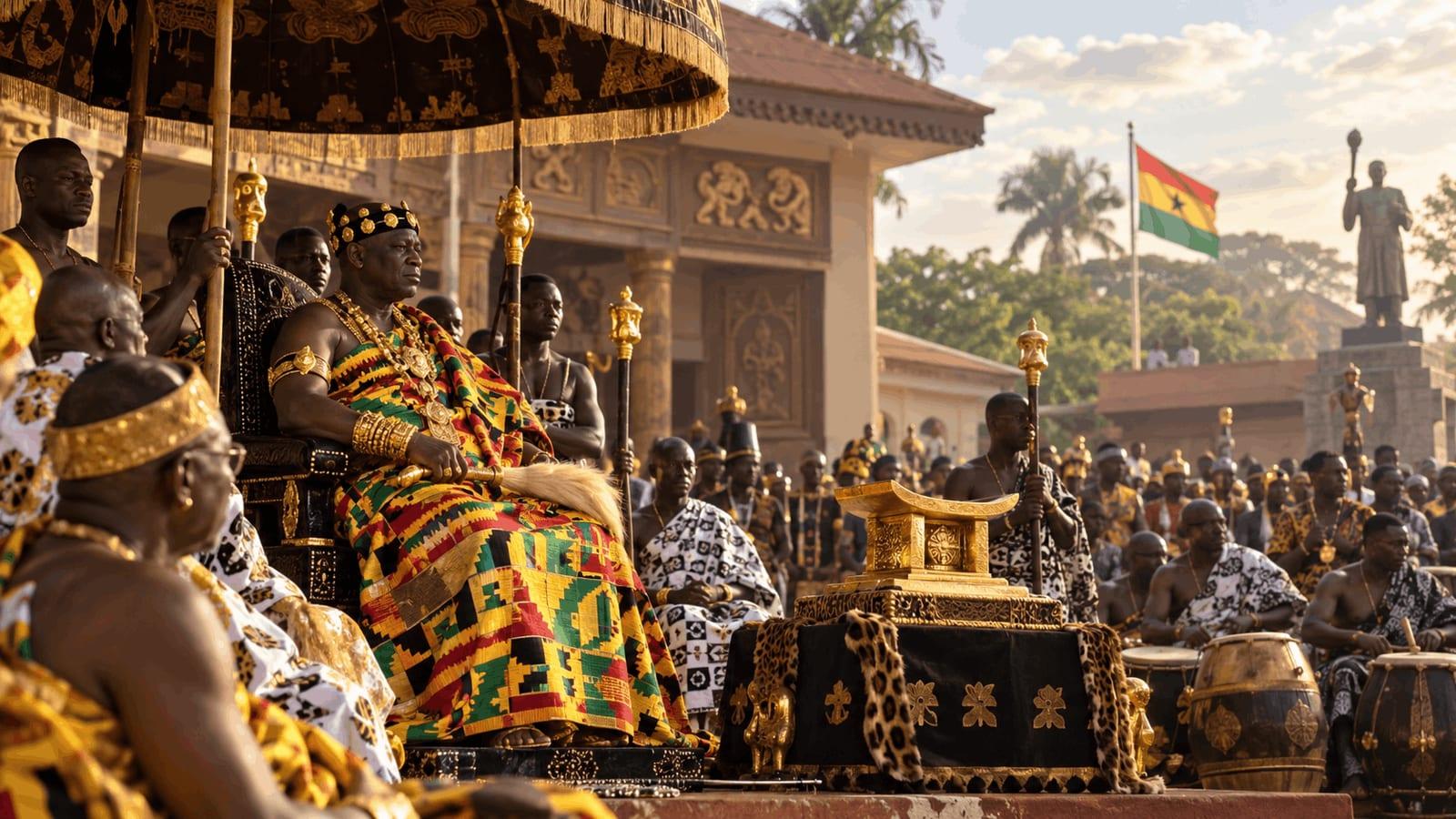
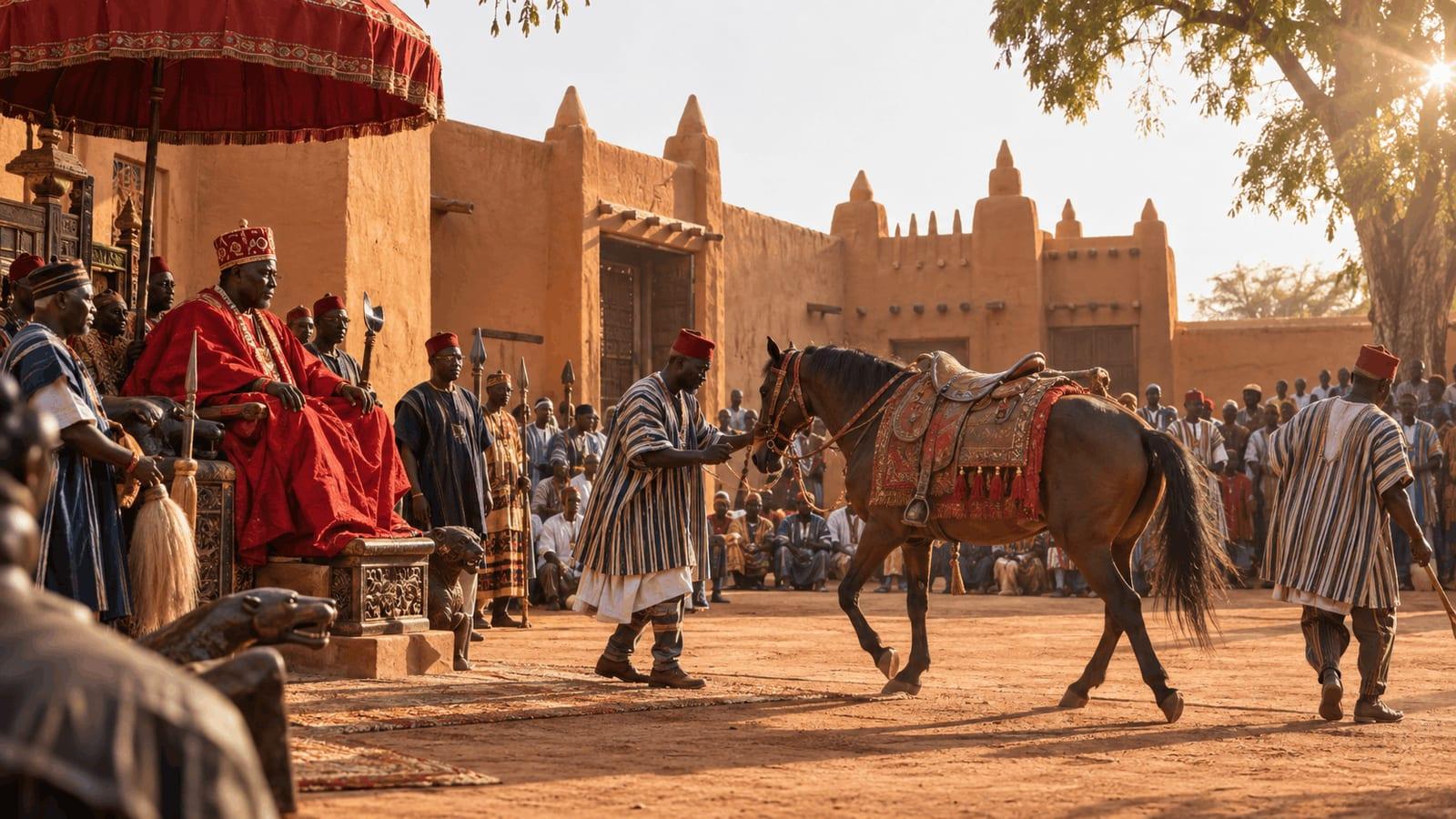
At Manhyia Palace in Kumasi, roughly every six weeks, the Asantehene sits in state for Akwasidae, one of the most important ceremonies in the Asante traditional calendar. He appears in richly woven kente and gold ornaments, beneath a ceremonial umbrella, while chiefs arrive to pay homage and drummers fill the courtyard with rhythms rooted in a centuries-old system of royal communication and praise. This is not a ceremony recreated for tourists. It is a living Asante tradition, still practiced today as part of the community's system of leadership, history, and cultural life. At its centre is the Golden Stool, the sacred symbol traditionally understood to embody the spirit and unity of the Asante people. It is never sat upon. The king may change, governments may rise and fall, and Ghana's political system may evolve, but the ceremony continues — a reminder that the country's history did not disappear when the modern republic was created. In Ghana, the authority of the modern state exists alongside older institutions of chiefs, stools, customs, and ancestral memory that still shape how communities understand leadership and belonging.
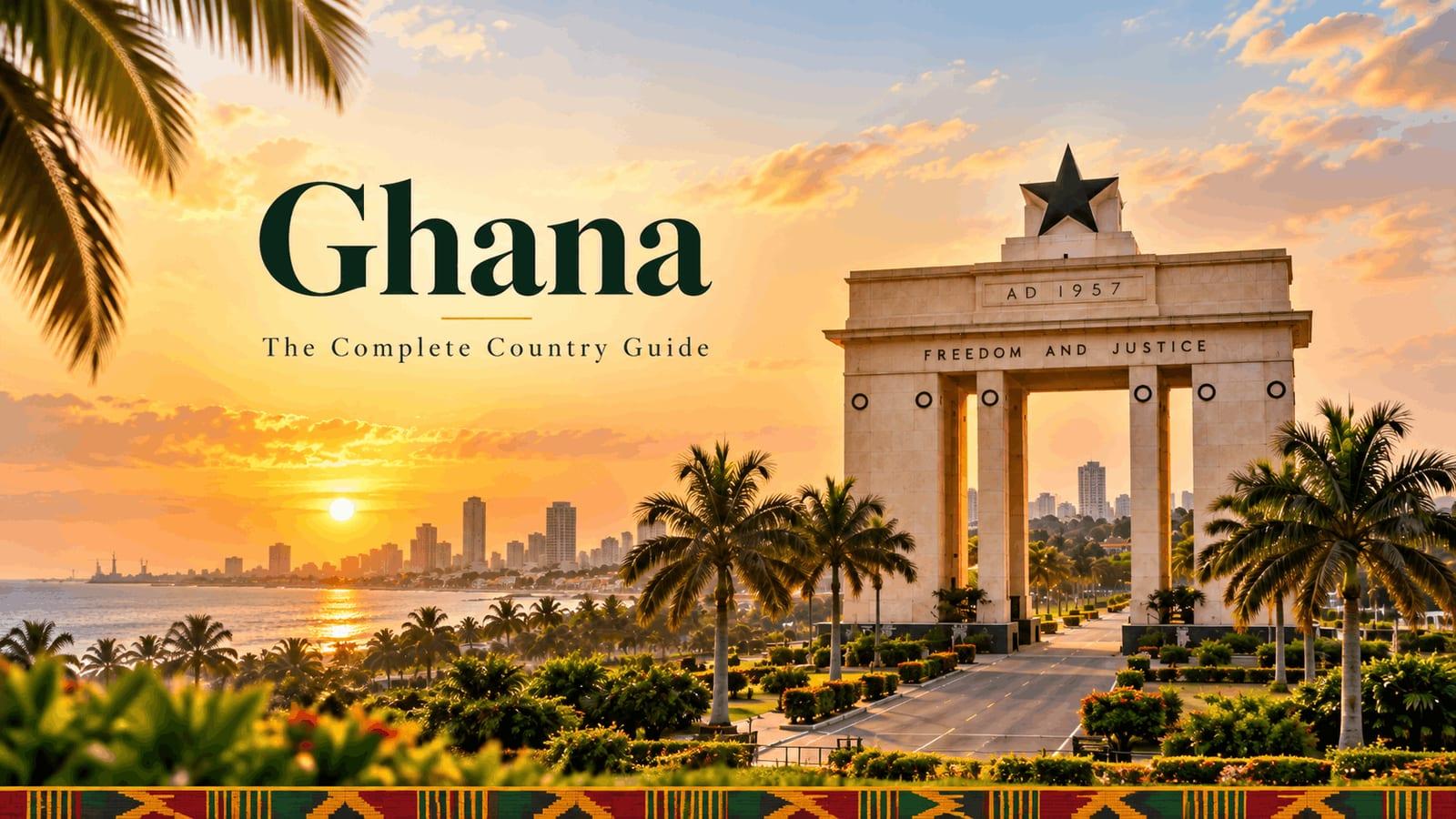
That ability to carry the past into the present is part of what makes Ghana so important in African history. On 6 March 1957, it became the first country in sub-Saharan Africa to gain independence from European colonial rule. The event mattered far beyond the new nation itself. Kwame Nkrumah understood Ghana's independence not as the conclusion of a national struggle, but as evidence that colonial rule across Africa could be challenged and eventually dismantled. His government deliberately used Ghana as a base for Pan-African politics, supporting liberation movements and arguing that Ghana's freedom had meaning only if other African peoples could achieve theirs too. That is why the story of Ghana cannot be reduced to the date it became independent. It is the story of a place that had already built powerful states around gold, endured the violence and exploitation of the transatlantic slave trade, resisted European expansion, and then became a political example for a continent still under colonial rule. Ghana did not simply become independent; its independence helped change what independence meant for Africa.
Where the culture came from
In this section
The story marks the founding of the Asante kingdom and the coming together of its people under one ruler.
Long before the name Ghana was attached to this part of West Africa, the region was home to powerful Akan states whose wealth was closely tied to gold. The forest belt and parts of the coastal hinterland contained some of West Africa’s richest gold-producing areas, and when European traders began arriving on the coast in the 15th century, the abundance of gold quickly became one of the defining features of their encounters with the region. Europeans came to call the coastline the Gold Coast, a name that eventually became the British colonial designation for the territory.
By the late 17th century, the Asante kingdom was emerging as the dominant power in the interior. According to Asante tradition, its political foundation began with Okomfo Anokye, a spiritual leader who caused the Golden Stool to descend from the sky onto the lap of Osei Tutu, the first Asantehene. According to Asante tradition, Okomfo Anokye, a powerful spiritual leader, caused the Golden Stool to descend from the sky onto the lap of Osei Tutu, the first Asantehene. The story marks the founding of the Asante kingdom and the coming together of its people under one ruler. But the stool itself was never understood as the king's personal possession. It came to represent the spirit, unity, and sovereignty of the Asante people as a whole. That is why, unlike an ordinary royal throne, the Golden Stool is never sat upon.
From that foundation, the Asante built one of the most powerful states in West Africa. Its strength rested on political organization, military power, agriculture, control of gold-producing areas, and trade networks linking the interior to the coast. The kingdom fought a series of wars to expand its influence, including its struggle against Denkyira, which had previously dominated much of the region. The Asante victory at the Battle of Feyiase in 1701 was decisive, breaking Denkyira's power and helping establish Asante dominance across much of the interior. The victory became part of the historical memory carried forward through Asante traditions and ceremonies, where political history, ancestry, and authority remain closely connected.
Along the coast, European trade was creating a very different history. In 1482, the Portuguese built São Jorge da Mina, now known as Elmina Castle, to secure their access to the region's gold. It became one of the oldest surviving European buildings outside Europe. Over the centuries that followed, European powers including the Dutch, British, Danish, and Swedish established forts and castles along the coastline, competing for access to gold and other trade. Many of these same sites later became deeply involved in the transatlantic slave trade. Captured Africans were confined in dungeons under the castles before being transported across the Atlantic, turning parts of Ghana's coastline into places where commerce, colonial power, and human exploitation existed side by side.
At Elmina and Cape Coast, the physical architecture of that history remains. The passages leading from the dungeons toward the coast became associated with the final stage of captivity, and the expression "Door of No Return" came to symbolize the point beyond which many captives would never see their homeland again. Today, these sites are places of remembrance as much as heritage attractions. Ghanaians visit them as part of learning the country's history, while members of the African diaspora travel to the coast to confront a history of enslavement, displacement, and ancestry that connects Africa to the Caribbean and the Americas.
British power expanded across the region during the 19th century, but expansion was repeatedly met with Asante resistance. British forces captured and burned Kumasi in 1874, and after further conflict, the Asante kingdom was eventually annexed as a British Crown Colony in 1902. The final confrontation was preceded by the War of the Golden Stool in 1900, after Governor Frederick Hodgson demanded access to the sacred stool. To the Asante, the demand was not merely an insult to a royal object; it was an affront to the institution that represented their collective sovereignty. Resistance was organized in part under Yaa Asantewaa, the Queen Mother of Ejisu, who became one of the most enduring figures of Asante resistance to British rule.
When independence came on 6 March 1957, Ghana's story changed again. Under Kwame Nkrumah, independence was presented as more than the transfer of political power from Britain to a new national government. Nkrumah treated Ghana as evidence that colonial rule could be defeated and as a platform from which to support liberation elsewhere in Africa. His most famous formulation captured the idea directly: "the independence of Ghana is meaningless unless it is linked up with the total liberation of the African continent." Ghana subsequently became an important centre of Pan-African politics, and Nkrumah was among the major African leaders associated with the creation of the Organisation of African Unity in 1963.
Nkrumah's own government ended in a military coup in 1966, and Ghana spent much of the following decades moving through periods of military and civilian rule. The country eventually returned to constitutional multiparty government in 1992.
Since returning to constitutional multiparty rule in 1992, Ghana has developed a strong record of competitive elections and peaceful transfers of presidential power. But the country did not leave its earlier history behind to become a modern democracy. The chiefs still hold their stools. Akwasidae is still observed. The Golden Stool remains a powerful symbol of Asante unity. Festivals still preserve histories of migration, famine, war, and survival, while the castles along the coast continue to confront the country with the legacy of the slave trade. Ghana's modern political system may be constitutional and democratic, but it exists alongside traditions and institutions that are centuries older. That coexistence is one of the clearest ways to understand Ghana: the past here is not simply remembered. It is still being practiced.
Ethnic groups and languages
In this section
The country is young as a modern nation, but many of the identities and institutions within it are much older.
Ghana is home to many peoples, with identities that are older than the country itself. The Akan are the largest broad ethnolinguistic grouping, accounting for 45.7 percent of the population in the 2021 census. They include the Asante, Fante, Akuapem, Akyem and other related communities, concentrated largely across the central and southern parts of the country. They share related Akan languages and, across many communities, cultural institutions such as the stool system and matrilineal forms of clan and succession.
The Ga maintain a distinct identity around the Greater Accra area, with a long history tied to the coast, fishing, farming, and trade. The Ewe are concentrated in southeastern Ghana and belong to a wider Ewe-speaking cultural world that extends across the border into Togo and Benin. Further north, peoples including the Dagomba, Mamprusi, and Gonja developed their own kingdoms and systems of political authority. Islam became particularly influential in many northern communities through centuries of trade and contact, alongside older indigenous religious traditions. The result is not one uniform Ghanaian culture, but a country in which different historical worlds have developed alongside one another.
English is Ghana's official language, inherited from British colonial rule, and serves as the common language through which people from different linguistic backgrounds communicate in national institutions, education, business, and public life. Akan, particularly Twi, is also widely spoken beyond Akan communities and is prominent in markets, music, media, and everyday interaction. Someone can therefore identify strongly as Ga, Ewe, Dagomba, Asante, Fante or another ethnic group while also participating fully in a broader Ghanaian national culture.
One of the most important features of many Akan societies is their system of matrilineal descent. In traditional Akan society, a person's clan membership is traced through the mother's line. This could have major consequences for succession: a man's traditional heir could be his sister's son rather than his own biological son. The principle was particularly important in Asante political life, where succession to the stool followed established royal maternal lines rather than a simple father-to-son inheritance.
Matrilineality did not mean that fathers were unimportant or that everything a person owned automatically passed through the mother. It meant that particular questions of clan membership, political succession, inheritance, and obligation were organized through the maternal line. Those traditions helped shape the structure of Akan families and political institutions for centuries, although modern law, Christianity, Islam, urbanization, education, and changing family structures have all influenced how inheritance and family relationships work today.
This is part of what makes Ghana's cultural landscape so interesting. The country is young as a modern nation, but many of the identities and institutions within it are much older. A Ghanaian can belong to a modern democratic state while also belonging to a family, clan, language group, stool, or traditional community whose history reaches back centuries.
Religion and belief
In this section
Islam has a much longer history in parts of Ghana than its position in the national statistics might suggest.
Ghana is predominantly Christian, but religion in the country is not a simple story of one belief system replacing another. According to the 2021 Population and Housing Census, 71.3 percent of Ghanaians identify as Christian, 19.9 percent as Muslim, and 3.2 percent as followers of traditional African religions. Christianity grew through centuries of missionary activity and later expanded rapidly through Pentecostal and charismatic churches, which became particularly influential from the 20th century onward. In Accra and other major cities, some of these churches have developed large congregations and sophisticated media operations, using radio, television, livestreaming, and social media to reach audiences far beyond their physical buildings.
Islam has a much longer history in parts of Ghana than its position in the national statistics might suggest. Muslim traders and scholars moved southward through established trade networks connecting the region with the Sahel and West Africa's interior, making Islam particularly influential in several northern communities. Muslim communities also became established in southern towns and cities through migration and commerce. Christianity and Islam therefore did not arrive in a cultural vacuum; both became part of societies that already had their own religious systems and ideas about the relationship between the living, the dead, nature, and the spiritual world.
Traditional Akan belief offers one example of that older religious landscape. Nyame is understood as the supreme creator, while the spiritual world also includes other beings and forces, and ancestors occupy an important place in the relationship between the living and the dead. Traditional priests, known as akomfo, have historically served as intermediaries within these religious systems. These beliefs have not simply disappeared with the spread of Christianity and Islam. Their influence can still be seen in ceremonies, family customs, festivals, traditional authority, and the importance attached to ancestors and funerals.
Funerals are particularly significant across many Ghanaian communities, although the customs differ between ethnic and religious groups. They can be occasions not only for mourning but also for bringing extended families and communities together, remembering the life of the deceased, and reaffirming relationships between generations. In this sense, death can become a communal event rather than a private one.
The same older worldview also appears in Ghana's visual culture. Adinkra symbols, associated particularly with Akan culture, function as visual expressions of proverbs, ideas, and values. One of the best known is Gye Nyame, commonly translated as "except for God," which expresses the supremacy of God and appears widely on cloth, buildings, artworks, and contemporary designs. What makes these symbols especially interesting is that they have moved beyond their original traditional contexts and into modern Ghanaian life.
Ghana's religious landscape is therefore not neatly divided between the old and the new. Churches can fill stadiums while traditional festivals continue. Muslims observe Islamic traditions alongside cultural practices inherited from older communities. Adinkra symbols rooted in Akan thought appear on modern buildings and products. Traditional chiefs continue to perform ceremonies within a constitutional democracy. Religion in Ghana is not simply a record of what people used to believe; it is part of how the country continues to understand family, community, authority, death, and the sacred.
Food
In this section
Ask a Ghanaian, and there is a very good chance you will hear that theirs is the one that gets it right.
Ghanaian food is built around a simple idea: staple foods are rarely eaten alone. They are paired with soups, stews, sauces, fish, meat, or vegetables, creating meals that are as much about texture and combination as they are about individual ingredients.
Fufu is one of the country's best-known traditional dishes. It is made by pounding boiled cassava and plantain together, although yam is used in some parts of the country, until the mixture becomes smooth, elastic, and soft. The finished fufu is served alongside soup rather than mixed into it. Traditionally, a diner tears off a small piece with the fingers, shapes it into a little scoop, and uses it to pick up the soup and whatever accompanies it. Light soup, a peppery broth often prepared with tomatoes and served with chicken, goat, or fish, is a common pairing, as is groundnut soup, made from ground peanuts.
Banku follows a different route to the same satisfying combination of starch, protein, and sauce. Made from fermented corn and cassava dough, it has a characteristic sourness and is commonly served with grilled tilapia and a hot pepper sauce. The combination is particularly associated with Ghana's coastal food culture, where fresh fish has long been central to everyday cooking.
Then there is kelewele: ripe plantain cut into pieces, seasoned with ginger, chilli, and other spices, and fried until the outside becomes caramelized while the inside stays soft. It is one of Ghana's most familiar street foods, commonly sold from roadside stalls and eaten in the evening as a snack or casual meal. It is difficult to describe kelewele without mentioning the smell first—the spice, hot oil, and sweet plantain announcing the food before you reach the stall.
Jollof rice brings a different kind of energy. Ghana, Nigeria, and Senegal all have their own versions, and the question of which makes the best jollof has become one of West Africa's favourite culinary arguments. Ghanaian jollof is commonly prepared with long-grain rice and a deeply seasoned tomato and pepper base, with the rice cooked in the sauce so that it absorbs the flavour. Ask a Ghanaian, and there is a very good chance you will hear that theirs is the one that gets it right. Ask a Nigerian, and you may hear exactly the opposite.
Waakye is another everyday staple, particularly visible in Ghana's urban food culture. Rice and beans are cooked together, traditionally with waakye leaves that contribute to the dish's characteristic colour, and the finished meal is often served with an assortment of accompaniments: boiled egg, fried plantain, spaghetti, meat or fish, and shito, a dark, intensely spiced pepper sauce. In places such as Accra, waakye is a familiar breakfast and lunch option, with vendors serving large portions to customers who may have come specifically for the combination of rice, beans, sauce, and whatever extras they choose.
Palm wine belongs to a different part of Ghana's food and drink tradition. Freshly tapped from certain palm trees, it is naturally sweet and begins fermenting soon after collection, gradually becoming more alcoholic and more acidic. It remains part of traditional drinking culture in some communities and is associated in some settings with social gatherings and ceremonies, although commercial alcoholic drinks are far more prominent in Ghana's cities today.
What ties these foods together is not a single Ghanaian recipe but a way of eating. Starches are paired with intensely flavoured soups and sauces; fermented foods sit alongside fresh ones; sweet plantain meets chilli and ginger; fish is matched with pepper; and meals are often built around combinations rather than a single centrepiece. Ghanaian cuisine makes sense when you stop looking for one dish that represents the country and start looking at how the dishes are eaten together.
Music, dance, and art
In this section
In the early 2010s, another Ghanaian cultural export, azonto, spread rapidly across Africa and the diaspora.
If Ghana has a soundtrack, highlife is one of the sounds at its centre. The genre emerged in Ghana in the early 20th century from an interaction between local musical traditions and influences arriving through coastal trade and colonial contact, including brass-band music, guitars, and other Western instruments. It gradually developed into a distinctly Ghanaian sound and became one of the earliest major modern African popular music genres, spreading across West Africa during the 20th century.
E.T. Mensah, often called the "King of Highlife," became one of the genre's defining figures during its golden era in the 1950s and 1960s. But highlife did not disappear when its golden age ended. Its rhythms and guitar patterns continued to influence generations of musicians, eventually feeding into newer forms such as hiplife, which combines highlife with hip-hop and Ghanaian languages. In the early 2010s, another Ghanaian cultural export, azonto, spread rapidly across Africa and the diaspora. The dance became known for quick, expressive movements that often mimic everyday activities, turning ordinary gestures into choreography.
Music in Ghana extends far beyond modern popular genres. In traditional Akan societies, drumming has long been closely connected to ceremony, dance, communication, and political life. The fontomfrom, a large set of ceremonial drums, is associated with royal and chieftaincy occasions, while talking drums can reproduce tonal and rhythmic patterns associated with spoken language. Skilled players can use these patterns to communicate names, praise, announcements, and other messages, turning the drum into something more than a musical instrument.
Kete, a formal drum-and-dance tradition associated particularly with Asante royalty and ceremonial occasions, is another example of how music and political life have historically been intertwined. In these settings, the performance is not simply entertainment. The rhythms, dancers, drummers, and accompanying words can carry history, honour titles, mark important occasions, and affirm the status of those being celebrated.
Then there is Anansi, the spider trickster whose stories are among the most recognisable elements of Akan storytelling. Anansi is clever, mischievous, sometimes selfish, and often successful precisely because he can outthink creatures more powerful than himself. Through the transatlantic slave trade, Akan people carried Anansi stories into the Caribbean and the Americas, where the character became part of wider African diasporic storytelling traditions. In Ghana, the stories remain part of the country's cultural memory, particularly as children's stories in which intelligence, humour, and cunning can overcome physical strength.
That continuity is important. Highlife can be sampled into contemporary music; traditional drums can still accompany a chief; a centuries-old trickster can still appear in a child's story. Ghanaian culture has repeatedly absorbed new influences without simply discarding what came before. Its music and storytelling are therefore not preserved relics of the past. They are traditions that have kept changing because the people carrying them forward have changed too.
Clothing, textiles, and craft
In this section
Kente is woven on narrow looms, producing strips that are later joined together to create a larger cloth.
Kente is probably the textile most immediately associated with Ghana outside the country. The brightly patterned cloth is particularly associated with the Asante and with weaving communities such as Bonwire, where weaving remains an important part of cultural heritage. According to Asante tradition, the craft's origin is connected to two hunters who watched a spider weaving its web and attempted to reproduce what they saw. Whether understood as an origin story or as part of the tradition's cultural memory, the story captures something important about Kente: the cloth has never been only about decoration.
Kente is woven on narrow looms, producing strips that are later joined together to create a larger cloth. Historically, weaving was particularly associated with men in some Asante communities, although both men and women participate in Kente production today. The patterns are not random. Colours and designs can carry meanings connected to proverbs, values, historical events, social status, and particular occasions, while some patterns were traditionally associated with royalty. What looks from a distance like a riot of colour is therefore also a visual language, with the cloth communicating things that words do not necessarily have to say.
That language has travelled far beyond its original setting. Kente is now worn at graduations, weddings, political and cultural events, and other significant occasions across the African diaspora. For many people wearing it outside Ghana, the cloth represents African heritage more broadly, even when the wearer has no direct connection to the Asante communities from which particular Kente traditions developed. The journey of Kente from a specific cultural tradition to a global symbol of African identity is itself part of the story.
Adinkra tells a different story through cloth. Associated with Akan culture, Adinkra textiles are decorated with stamped symbols that represent ideas, proverbs, values, and aspects of social life. Darker Adinkra cloth became particularly associated with funerals and mourning, while brighter versions are now also worn for celebrations and everyday occasions. Symbols such as Gye Nyame, commonly translated as "except for God," have become widely recognised far beyond their original contexts.
Then there are Akan goldweights: small brass objects originally used to measure quantities of gold dust in trade. Their practical purpose eventually made them something much more than measuring instruments. Many were cast in the shapes of people, animals, tools, and other objects, with some representing proverbs, occupations, moral lessons, or aspects of everyday life. Today they are valued as examples of Akan craftsmanship and visual storytelling.
Together, Kente, Adinkra and goldweights reveal something distinctive about Akan material culture: meaning was often built into objects people could see, wear, exchange, or use. A cloth could communicate status or a proverb. A symbol could express an idea without a sentence. Even a small brass weight used in a commercial transaction could carry a story. The objects were useful, beautiful, and meaningful at the same time.
Festivals, ceremonies, and rites of passage
In this section
In many Ghanaian traditions, death does not simply mark the disappearance of a person from the community.
Homowo, celebrated by the Ga people of the Greater Accra region, begins with a story about hunger. According to Ga tradition, a severe famine once struck the community, and when the rains eventually returned and the harvest was plentiful, the people celebrated their survival by "hooting at hunger"—the meaning behind the name Homowo. The festival still follows a sequence of traditional observances before the public celebrations begin. One of the most striking is a period in which drumming and loud noise are prohibited across Ga communities. The silence is deliberate: it creates a pause for ritual preparations and reflection before the sounds of celebration return.
When the festival reaches its public climax, the silence gives way to drumming, dancing, feasting, and ceremonies involving traditional leaders and communities. Food is central to the occasion. Kpokpoi, a dish made primarily from fermented corn dough, is prepared specifically for Homowo and is traditionally eaten with palm-nut soup. The preparation and sharing of food are not simply about feeding a crowd; they form part of the festival's ritual life, including offerings and ceremonies connected to ancestors and deities. Homowo is therefore both a celebration of survival and an annual retelling of how the Ga people remember surviving hardship.
The Asante have their own ceremonial calendar, in which the past is repeatedly brought into the present. Akwasidae is observed roughly every six weeks at Manhyia Palace in Kumasi, where the Asantehene, the Asante king, sits in state and receives homage from chiefs and others who come to the palace. Drummers perform ceremonial rhythms, attendants carry royal insignia, and people gather in elaborate traditional dress. The occasion is not simply a festival in the modern sense. It is an opportunity to honour ancestors, reaffirm relationships between the Asantehene and traditional authorities, and maintain an institution that predates the modern Ghanaian state.
Adae Kese belongs to the same broader Akan ceremonial tradition but is a larger and more exceptional observance rather than simply another name for Akwasidae. It has historically been associated with major occasions in Asante political and religious life, bringing together chiefs, royals, and communities on a scale beyond the regular Akwasidae ceremonies. Together, these observances show how Asante history is preserved not only in books or museums but through a calendar that continues to bring people together around kingship, ancestry, and collective memory.
Then there are Ghana's funerals, which can be among the most elaborate social gatherings in the country. In many communities, a funeral is not expected to happen immediately after a death. Families may take weeks to make arrangements, raise funds, notify relatives living elsewhere, and prepare the ceremony. Mourners often wear specially printed funeral cloth made for the occasion, sometimes bearing the name or image of the deceased, and the gathering itself can stretch across several days.
There may be prayers, speeches, drumming, dancing, food, music, the display of photographs, and large gatherings of relatives, friends, neighbours, colleagues, and members of the wider community. The financial burden can be considerable, particularly when families are expected to provide food, clothing, transport, accommodation, and other arrangements for large numbers of people. But the expense is also connected to the social importance attached to the occasion. In many Ghanaian traditions, death does not simply mark the disappearance of a person from the community. A well-conducted funeral is a final public farewell, a way of honouring the dead, bringing the living together, and, within traditional belief systems, marking the person's transition toward ancestorhood.
This helps explain why Ghanaian funerals can look so different from the private mourning practices familiar in many parts of the world. Grief is certainly present, but so are celebration, remembrance, family obligation, music, clothing, food, and community. The funeral becomes a public statement that a person's life mattered—and that their relationships do not simply end with death.
When the Stool Represented the State
In this section
The demand was profoundly provocative because control over the stool was inseparable from the question of Asante sovereignty.
The Golden Stool was more than a sacred object kept for ceremonial occasions. In the Asante political system, the stool was closely tied to the authority of the state itself. The Asantehene ruled in the name of the stool, but did not personally own it. When a king died, the stool remained. When a new king was installed, he inherited an institution and its authority rather than a possession that belonged to his family.
That idea helps explain why the Golden Stool became so important during the British conquest of Asante. In 1900, British Governor Frederick Hodgson demanded access to the stool as Britain sought to assert its authority over the Asante. The demand was profoundly provocative because control over the stool was inseparable from the question of Asante sovereignty. Yaa Asantewaa, the Queen Mother of Ejisu, became one of the leading figures in the resistance that followed, known as the War of the Golden Stool.
The episode reveals something easy to miss when looking at the Golden Stool from the outside. Its importance did not come from the gold alone. It represented an idea: the authority of the Asante state existed beyond the lifetime of any individual ruler. A king could die. A king could be removed. A king could be replaced. The stool remained.
That is why the British demand carried consequences far beyond a dispute over a royal object. They were dealing with a political system in which sovereignty had been given a physical symbol that could outlast the person sitting on the throne.
The Past Is Still Here
In this section
Highlife, which helped define Ghanaian popular music in the 20th century, has not been left behind by newer sounds.
The easiest way to see Ghana's history is to look at what people are still doing with it.
Kente, once woven within specific Akan communities and closely associated with Asante royal and ceremonial life, is now worn far beyond Ghana. Students at graduation ceremonies in the United States, Britain, and elsewhere may wear Kente stoles whether they have Ghanaian ancestry, another African heritage, or no African ancestry at all. Many may not know what individual patterns or colours traditionally signify, but the cloth has acquired a wider meaning: a visible connection to African heritage, achievement, and identity. Its journey from specific Ghanaian weaving traditions to a global symbol is itself part of the story.
Ghana's relationship with the African diaspora has also become increasingly visible. In 2019, the country launched the Year of Return to mark 400 years since the documented arrival of enslaved Africans at Point Comfort in Virginia in 1619. The initiative encouraged people of African descent to visit Ghana, learn about the history of the slave trade, and explore connections with the continent. Ghana recorded about 1.1 million international visitor arrivals that year, and in November 2019, 126 members of the African diaspora were granted Ghanaian citizenship as part of the wider programme.
The same pattern of continuity can be heard in music. Highlife, which helped define Ghanaian popular music in the 20th century, has not been left behind by newer sounds. Its rhythms and musical ideas continue to appear in contemporary Ghanaian music alongside Afrobeats, hip-hop, gospel, and other influences. Azonto, meanwhile, showed how quickly a distinctly Ghanaian dance and musical style could travel beyond the country, spreading through music videos, social media, parties, and phones across Africa and the diaspora.
And in Kumasi, the past continues according to its own calendar. Roughly every six weeks, the Asantehene sits in state at Manhyia Palace for Akwasidae. Chiefs come to pay homage. Drummers perform. Traditional authority is publicly affirmed. The Golden Stool remains sacred and is never sat upon. None of this is a reconstruction of something that disappeared centuries ago. The ceremony continues because the institution itself continues.
The same is true along the coast. Cape Coast Castle and Elmina Castle are not simply places where tourists go to look at old walls. They are places where different versions of Ghana's history meet. Ghanaian students encounter the castles as part of the history of their country. Visitors from the African diaspora may encounter the same rooms, dungeons, and passageways while trying to understand a history of enslavement and forced migration that disrupted families and erased countless individual stories.
That is perhaps what makes Ghana's history so striking. Its past is not confined to monuments with plaques explaining what happened here. It appears in the cloth people wear, the food they prepare, the festivals they observe, the music they make, the chiefs they still recognise, and the ceremonies that continue to fill courtyards in Kumasi. A country that became independent in 1957 can still carry institutions, traditions, and memories that reach back centuries.
In Ghana, history is not always something you go somewhere to see.