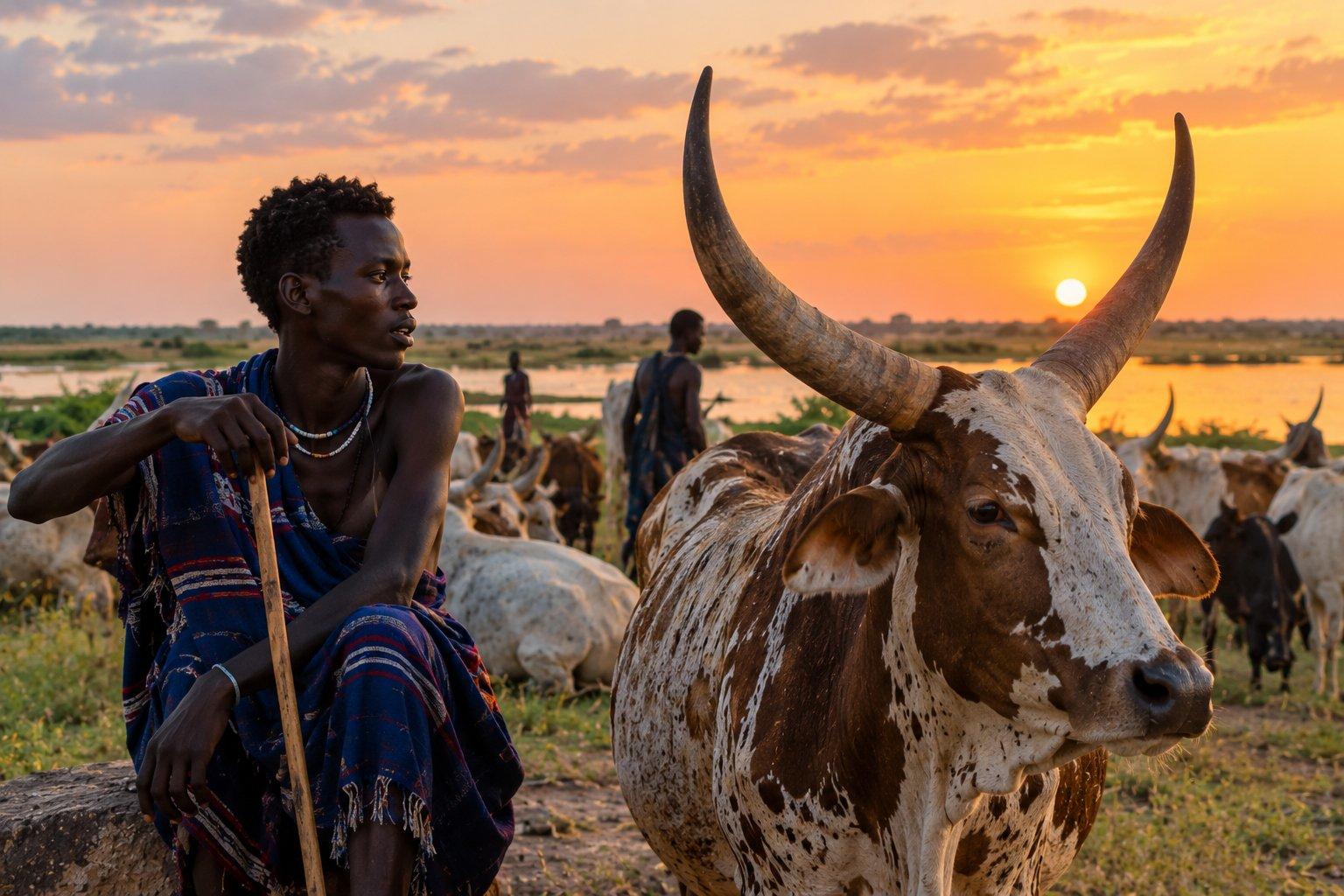
In the cattle camps of Jonglei, the dry season changes the rhythm of life. Families and herders move with their animals toward water and grazing, and young men spend long periods living among the cattle they have learned to care for since childhood.
Among the Dinka, a young man may choose a particular bull as his song ox. Its colouring, horns, markings, gait and temperament can all become material for poetry. He may compose verses praising the animal and perform them in the company of other young men. Cattle names can be elaborate too, drawing on colours, physical features, birds, wild animals and other images that make each animal recognizable to the people who know the herd.
The ox song is one of the best-documented forms of Dinka oral poetry. It turns an individual animal into a subject of art, memory and personal expression. A bull is still an animal that can be exchanged, inherited or slaughtered, but its value within the community can also be emotional, aesthetic and ceremonial.
For many pastoralist communities in South Sudan, cattle carry several kinds of value at once. They provide milk, meat and wealth. They form an important part of bridewealth, the livestock transferred between families in connection with marriage. They can be involved in sacrifice and other religious practices. They also shape the daily education of children who grow up learning how to identify, feed, protect and move animals.
This is one reason cattle camps remain such an important part of life among pastoralist communities in South Sudan. They are places where practical knowledge is taught, relationships are formed, disputes are negotiated and songs are remembered.
South Sudan became independent on July 9, 2011, after decades of war with Sudan. Its independence followed a referendum held in January that year in which 98.83 percent of voters chose separation.
Independence brought enormous celebration, but it did not end the country's political and communal conflicts. In December 2013, a political struggle inside the new government between President Salva Kiir and his former vice president, Riek Machar, erupted into armed conflict. The fighting quickly acquired an ethnic dimension, with Dinka and Nuer civilians among those targeted in large-scale attacks.
South Sudan's history therefore contains two stories that have to be read together. There is the long history of societies whose institutions, languages and artistic traditions developed before the modern state existed. There is also the much shorter history of a country that has spent much of its independence dealing with war, displacement, political rivalry and attempts to build functioning national institutions.
Where the culture came from
Long before the borders of Sudan and South Sudan existed, communities across the region developed their own systems of government, kinship, religion, farming, fishing and pastoralism.
The Dinka, Nuer and Shilluk are among the best-known groups in the country's Upper Nile and surrounding regions, but South Sudan has more than 60 ethnic groups in total. The country's cultural history cannot be reduced to its cattle-keeping societies, even though pastoralism has shaped the lives of some of its largest populations.
The Dinka are South Sudan's largest ethnic group according to commonly cited demographic estimates. Their communities have historically been spread across areas including Jonglei, Lakes and Bahr el Ghazal, with social organization built around clans, lineages, age groups and local communities rather than a single centralized kingdom.
The Nuer developed a different political system. The anthropologist E.E. Evans-Pritchard's research among the Nuer in the 1930s became one of the classic studies of a society without a centralized king or state bureaucracy. Authority was distributed through kinship, lineage, age-set relationships, elders and ritual figures.
One of those figures was the leopard-skin chief.
The title can be misleading to a modern reader because the leopard-skin chief was not a conventional chief who commanded a territory through an administrative hierarchy. The position carried ritual and moral authority, and historical accounts describe the chief receiving people seeking sanctuary after killings and helping negotiate compensation between families. Later anthropologists have questioned the idea that such chiefs were entirely outside politics, arguing that they could also exercise political influence by building alliances and mediating disputes.
The Shilluk developed another form of political organization altogether. Their kingdom was traditionally headed by the reth, a sacred king whose authority was tied to the history and spiritual identity of the Shilluk people. The institution no longer represents a sovereign state, but the reth remains a culturally important figure.
These societies were never frozen in place.
Dinka and Nuer communities have a long history of migration, cattle raiding, trade, intermarriage, alliance and conflict. Their relationship cannot be described accurately as either permanent ethnic hostility or centuries of uncomplicated cooperation. Boundaries between communities could change according to marriage, settlement, cattle ownership, political alliances and local circumstances.
Some oral traditions also describe shared ancestral histories among Nilotic peoples, including stories explaining how communities separated and became distinct. Those accounts belong to oral tradition and should not be treated as straightforward historical records.
British colonial rule changed the political environment in which these communities lived. Under Anglo-Egyptian rule, administrators governed through ethnic, territorial and chiefly structures, recording communities in categories that became part of the machinery of government. Colonial rule did not invent Dinka or Nuer identities, which had deep histories of their own, but administrative systems could make ethnic and territorial categories more fixed in official life.
The later governments of independent Sudan inherited and expanded many of these structures.
Sudan became independent on January 1, 1956. Southern political leaders had longstanding grievances over political representation, regional autonomy, economic marginalization and the concentration of state power in Khartoum. Religious and cultural policies also became major sources of conflict, especially during periods when successive northern governments promoted Arabization and Islamization.
The First Sudanese Civil War lasted from 1955 to 1972. The Second Sudanese Civil War began in 1983 and ended with the 2005 Comprehensive Peace Agreement. The wars caused enormous loss of life and displacement. More than two million deaths are commonly associated with the Second Sudanese Civil War and the humanitarian crisis surrounding it, while millions of people were displaced inside Sudan or became refugees.
The 2005 peace agreement created the political path toward the 2011 independence referendum. Southern voters overwhelmingly chose independence, and South Sudan became an independent country on July 9, 2011.
The new state was less than three years old when another war began.
A country born into another war
In December 2013, a political crisis inside the ruling Sudan People's Liberation Movement became an armed conflict. President Salva Kiir accused his former vice president, Riek Machar, of attempting a coup. Machar denied the accusation.
Government forces and opposition forces began fighting in Juba before violence spread to other parts of the country.
The conflict soon took on an ethnic character. Dinka civilians were attacked in some opposition-held areas, while Nuer civilians were targeted by government forces in Juba and elsewhere. Human Rights Watch and the United Nations documented killings, sexual violence, forced displacement and attacks on civilians.
The war was therefore not a straightforward Dinka-Nuer conflict. Political factions cut across ethnic lines, and other communities, including the Shilluk, Murle and many Equatorian groups, were also drawn into different forms of violence.
The fighting displaced millions of people.
A peace agreement signed in 2018 created a framework for power-sharing, security arrangements, reconciliation and a transitional government. Implementation has been slow. South Sudan's transitional period has been extended, with the current timetable running into 2027, while major parts of the peace agreement remain incomplete.
The country also remains deeply dependent on oil.
South Sudan's main oil-producing areas are associated with the Muglad and Melut basins, including parts of Unity and Upper Nile. The country's oil industry has an unusual vulnerability: most of the infrastructure needed to export the crude passes through Sudan, including pipelines leading toward Port Sudan on the Red Sea.
Disputes over areas such as Abyei and Heglig add another layer of tension to an already complicated relationship between the two countries.
Oil has generated government revenue, but it has not produced broad prosperity. South Sudan remains one of the world's poorest countries. The World Bank estimates that 92 percent of the population lived below the national poverty line in 2024, while more than 10 million people are projected to require humanitarian assistance in 2026.
The country has oil beneath the ground and cattle across its floodplains. Neither has been enough to give most households economic security.
Ethnic groups and languages
South Sudan has more than 60 ethnic groups.
The Dinka and Nuer are the two largest according to commonly cited population estimates, together accounting for roughly half of the population. The Shilluk live mainly along the White Nile and have their own history of kingship. The Azande, concentrated largely in the southwest, speak a Central Sudanic language rather than a Nilotic one. The Bari, Anyuak, Murle, Jie and many other communities have their own languages, political histories and cultural practices.
The country therefore contains several different cultural worlds within the same national border.
English and Arabic are both official languages under South Sudan's constitutional framework. English became central to government and education after independence, while Arabic remained widely spoken.
Juba Arabic has its own history. It developed in southern Sudan through prolonged contact among speakers of Arabic and many different African languages and became a widely used lingua franca in Juba and other areas. It is not simply standard Arabic transplanted from Khartoum. It developed its own vocabulary, grammar and patterns of everyday use.
Alongside English and Arabic are dozens of indigenous languages.
For many South Sudanese, the language heard at home is neither English nor standard Arabic. It may be Dinka, Nuer, Bari, Azande, Shilluk, Anyuak or another local language, with English and Juba Arabic entering daily life in different ways depending on education, location, work and community.
Religion and belief
Available estimates describe South Sudan as predominantly Christian, but the country's religious life is more complicated than a single percentage suggests.
A U.S. State Department estimate put Christians at about 60.5 percent of the population, followers of Indigenous religions at about 32.9 percent and Muslims at about 6.2 percent. These figures should be treated as estimates rather than census-quality measurements because South Sudan has not conducted a recent comprehensive population and religious census capable of producing precise national figures.
Christianity has a long history in the region, including Catholic, Anglican and other missionary activity. Churches also became important providers of education and social services during decades when the state was weak or absent.
Indigenous religious traditions remain present in many communities, sometimes alongside Christianity.
Among the Dinka, Nhialic is associated with the supreme creator. Among the Nuer, Kwoth refers to a supreme spiritual power. The details of these beliefs differ across communities and individuals, and contemporary religious identity does not always fit neatly into separate categories.
A person may identify as Christian while also retaining family customs, ceremonies or understandings of the world inherited from an older religious tradition.
Cattle can appear in that overlap. In some communities, animals remain part of ritual practices associated with blessing, sacrifice, family and social obligations.
Traditional authorities can also matter in places where state institutions are weak. Ritual specialists, elders and customary leaders may be involved in mediation and reconciliation alongside churches, government officials and international organizations.
This is one reason peacebuilding in South Sudan has often involved customary authorities as well as formal political institutions. A national agreement signed in a capital city does not automatically settle a cattle dispute between two communities several hundred kilometres away.
Food
South Sudanese food varies considerably by region and livelihood.
Among pastoralist communities, milk and livestock products have traditionally been important sources of food and wealth. Among farming communities, sorghum, millet, maize, cassava, groundnuts and other crops form important parts of the diet. Fishing is also central in communities living around the Nile, its tributaries and the country's enormous seasonal wetlands.
Sorghum is one of the country's major staple crops. It can be ground into flour and prepared as porridge or other dishes, while fermented sorghum preparations such as kisra are associated with the wider Sudanese culinary region.
Groundnuts appear in many dishes, including sauces and stews, while okra, leafy vegetables and locally available meat or fish are used in different regional preparations.
The country's food system has also been heavily affected by war.
Displacement can separate farming families from their fields. Insecurity can prevent traders from moving food between regions. Flooding can destroy crops and roads at the same time. A household may therefore face food insecurity even in a place where farming, fishing or livestock keeping would ordinarily provide a living.
The scale is severe. WHO estimated that about 7.55 million people could face crisis-level or worse food insecurity during South Sudan's 2026 lean season.
Food aid is consequently part of daily life for millions of people, while traditional systems of farming, fishing and livestock keeping continue wherever conditions allow.
Music, dance and art
The Dinka ox song is perhaps the clearest example of how cattle can become part of artistic expression.
A song may describe an ox's colour, horns, movements or temperament. The animal becomes a subject of praise, and the performance can become part of the young man's social identity.
Cattle songs are not the whole of South Sudanese music. The country's many communities have their own songs, dances, instruments and ceremonial performances.
Among some Dinka and Nuer communities, scarification has historically marked initiation into adulthood. Patterns cut into the forehead could identify a person's community and stage of life. These practices have changed over time, and they are not followed by every member of either group today.
The dry-season cattle camp has its own sounds.
There is the movement of animals, the calls of herders, the noise of bells, the songs of young men and the conversations that continue late into the evening. Historical photographs and ethnographic records from the twentieth century document young Nuer men living in cattle camps, covering themselves in ash and spending long periods in close proximity to their herds.
The camps have changed with the times. Firearms, displacement, Christianity, schools, markets, government security operations and veterinary medicine have all altered pastoralist life.
The cattle camp itself, however, remains.
Clothing, beadwork and craft
Historical accounts of Dinka and Nuer pastoralist communities describe clothing and body decoration that differed sharply from the dress commonly seen in South Sudan's cities today.
In some rural settings, men traditionally wore relatively little clothing, with body decoration, scarification, beadwork and other forms of adornment carrying social meaning. These practices were connected to age, status, courtship and community identity.
Beads could be used in necklaces, belts and other forms of decoration. The colours, arrangement and quantity could communicate social information.
These traditions have changed alongside the rest of South Sudanese life. Christianity, Islam, formal schooling, urban migration and access to manufactured clothing have all influenced what people wear.
The Shilluk royal tradition has its own ceremonial material culture associated with the reth and the history of the Shilluk kingdom.
There is no single South Sudanese style of dress. A young woman in Juba, a Shilluk royal official, a Dinka cattle keeper in Jonglei and an Azande farmer in Western Equatoria can all inhabit very different visual worlds while belonging to the same country.
Marriage, ceremonies and rites of passage
Cattle are central to marriage among many pastoralist communities.
Bridewealth refers to livestock or other valuable goods transferred by the groom's family to the bride's family as part of the marriage process. Among cattle-keeping communities, the number and condition of animals can become an important part of negotiations between families.
Marriage therefore connects households and wider kinship networks. The cattle exchanged are economic assets, but the transaction also creates obligations between families that can continue long after the wedding.
Initiation has also historically marked the transition into adulthood in many Dinka and Nuer communities. Among some groups, young men underwent forehead scarification as part of this transition.
These practices are changing. Some families no longer carry them out, while others maintain particular elements of older ceremonies alongside Christianity, formal education and urban life.
South Sudan's national calendar has its own major date too.
July 9 is Independence Day, marking the declaration of independence in 2011.
For pastoralist communities, the dry season creates another kind of recurring calendar. As water and grazing conditions change, people and cattle move. Camps form and disperse. Young people spend time with herds. Families negotiate marriages and livestock exchanges. The timing of these movements can influence social life as much as a date printed on a national calendar.
A history more complicated than “tribal rivalry”
The Dinka-Nuer relationship is often presented as though two ancient peoples have been enemies for centuries and the 2013 war was simply the latest expression of that hostility.
The historical record is harder to fit into that story.
Dinka and Nuer communities have lived near one another for generations. They have traded, intermarried, migrated, raided one another's cattle and formed alliances. People and families could move across social boundaries, while local identities could be shaped by lineage, settlement and political circumstances.
At the same time, conflict was not invented in the twentieth century. Cattle raids and disputes between Nuer and Dinka communities are documented in nineteenth- and twentieth-century accounts.
Colonial administration added another layer by governing through territorial and ethnic categories and recording communities within formal administrative structures. After independence, political competition over the state gave those identities another use.
The violence of the modern era therefore has several histories behind it: local disputes over cattle and land, older patterns of raiding and retaliation, the militarization produced by Sudan's civil wars, competition over political power, the weakness of state institutions and the use of ethnic identity by political and armed leaders.
There is no single historical switch that turned neighbours into enemies.
The cattle camps are still there
In September 2025, UNMISS reported on a cattle camp outside Bor in Jonglei where thousands of cattle were being kept. Indian veterinary peacekeepers were treating animals, providing medicines and working with local communities on livestock health.
The work continued into 2026.
In July 2026, the United Nations reported that Indian peacekeepers had treated more than 41,500 cattle and goats across remote areas of Jonglei during the preceding year. The work included vaccination, treatment and training for local animal-health workers.
It is an unusually concrete example of how cattle remain tied to everyday life in South Sudan.
For many young pastoralists, the cattle camp is still a place where they learn how to milk an animal, recognize its behaviour, protect a herd and understand the responsibilities that come with belonging to a pastoralist household.
And somewhere in a camp, a young man may still be singing about his favourite bull.
The song may describe the animal's colour, its horns or the way it moves through the herd. Someone listening may know exactly which animal he is singing about.
The country around that cattle camp has changed enormously. South Sudan has become independent, fought another civil war, displaced millions of people, built new institutions and watched much of its oil industry become entangled with political instability and war in neighbouring Sudan.
The ox song remains easier to recognize.
It is one small piece of an older cultural life that has survived alongside everything South Sudan has become.