In 1787, a small group of formerly enslaved Black Britons arrived on a stretch of coast in West Africa and founded a settlement they called the Province of Freedom. The settlement, later known as Granville Town, was devastated by disease, desertion, and conflict and did not survive in its original form. But the British abolitionists backing the project tried again, and again, bringing in Black Loyalists who had fought for Britain during the American Revolution and been resettled in Nova Scotia, Maroons who had waged a guerrilla war against slavery in Jamaica, and eventually tens of thousands of so-called recaptives, Africans pulled by the Royal Navy from illegal slave ships and released into the settlement rather than returned to slavery. The Black Loyalists established Freetown in 1792 on the site of the earlier settlement, and the Jamaican Maroons arrived in 1800. These groups came from different places, spoke different languages, and brought different cultural traditions. Over time, their interaction with one another and with surrounding African communities helped produce the Krio people and their language, one of the more unusual cultural formations to emerge from the history of the Atlantic slave trade and its aftermath.
Sierra Leone's story does not start or end with the Krio, who today make up only a small percentage of the national population despite the outsized influence their language and culture have had on the whole country. But that founding act, a settlement created to receive people who had been freed from slavery and resettled in West Africa, sets Sierra Leone apart from many other countries shaped by European colonialism. Its history began with a settlement whose population was deliberately assembled from people displaced by slavery and migration, before British rule expanded much further into the surrounding territory. That history shapes not just the country's founding story but also the texture of how Sierra Leoneans talk about national identity to this day.
Where the culture came from
Before Freetown existed, the region was home to established indigenous peoples, most significantly the Temne in the north and west and the Mende in the south and east, along with smaller groups including the Limba, Loko, and Kono. These communities were organised through chieftaincies and other local political structures, while powerful secret societies, particularly Poro for men and Sande, also known in some communities as Bondo or Bundu, for women, played important roles in initiation, education, social organisation, and political life. Their influence varied by community and period, but these institutions long predate the modern Sierra Leonean state and continue to operate in some communities alongside formal state structures. Muslim traders had also brought Islam into parts of the region well before European colonial rule, establishing it as a durable feature of religious life in many northern communities.
The founding of Freetown in 1792 by Black Loyalists from Nova Scotia, followed by the arrival of Jamaican Maroons in 1800 and, after Britain outlawed the transatlantic slave trade in 1807, the arrival of tens of thousands of recaptives freed from intercepted slave ships, created an unusually diverse population. These Liberated Africans came from Yoruba, Igbo, Efik, Fante, and many other West African backgrounds, alongside the Atlantic diaspora communities already settled in Freetown. Over generations, interaction among these populations helped produce Krio, an English-based creole language whose vocabulary is largely English but whose grammar and other features developed through contact among different languages and communities. The process was not simply the result of a British plan to make everyone culturally identical; it was also a product of sustained contact among people with different histories, languages, and cultural traditions.
Britain extended formal colonial control over the surrounding interior much later. In 1896, Britain proclaimed a Protectorate over most of the territory that now makes up Sierra Leone, while Freetown and the surrounding Crown Colony remained a distinct political and administrative unit. The distinction mattered. The Colony had developed around the settlement of formerly enslaved people and had different institutions and forms of political participation from the Protectorate, where Britain's rule was imposed over existing African societies and chieftaincies. The resulting divide between the Colony and Protectorate shaped Sierra Leonean politics for decades. That political history, alongside post-independence governance failures, corruption, economic inequality, and the country's diamond resources, contributed to the conditions surrounding the civil war that began in 1991 and ended in 2002. The conflict involved widespread abuses by several armed factions, including the use of child soldiers and campaigns of deliberate amputation, with the Revolutionary United Front (RUF) responsible for more amputations than any other faction. In 1996, the RUF's "Operation Stop Elections" involved the chopping off of hands and arms as a way of preventing people from voting. The war also became one of the most prominent examples of the problem of conflict diamonds: diamonds mined in areas controlled by armed groups and used to help finance warfare. The international response eventually included the Kimberley Process, which began in 2000 as a broader effort by diamond-producing states and other participants to prevent rough diamonds from financing rebel movements and violence. Sierra Leone has rebuilt substantially in the more than two decades since the war ended, holding repeated multiparty elections and peaceful transfers of power, although recent elections have also exposed serious political tensions. The country's post-war recovery has also included efforts to address the long-term consequences of the conflict, including the needs of people who survived deliberate amputation.
Ethnic groups and languages
The Temne, concentrated largely in the north and west, and the Mende, concentrated largely in the south and east, together account for about two-thirds of Sierra Leone's population. In the 2015 census, the Mende accounted for 31.9 percent of the population and the Temne 31.4 percent. They have historically anchored much of the country's political competition, since Sierra Leone's two major political parties have each drawn disproportionate support from particular regions and ethnic communities, although neither party is confined to a single ethnic group. The Limba, Kono, Loko, Fullah, Mandingo, Krio, Sherbro, and other communities make up the country's diverse ethnic population. The 2015 census enumerated 15 ethnic groups.
The Krio, despite comprising only a small share of the total population today, hold outsized cultural and historical influence, since Krio, the language, functions as Sierra Leone's principal interethnic lingua franca. It is the first language of a relatively small percentage of citizens, particularly in and around Freetown, but is widely understood across the country. One Oxford study describes it as a universal lingua franca known by as much as 95 percent of Sierra Leone's population. Krio culture, cuisine, architecture, particularly the distinctive wooden board houses still standing in parts of Freetown, and naming conventions, including surnames associated with the diverse West African backgrounds of Krio ancestors, remain visible markers of the country's founding story. Krio political and economic dominance has changed considerably since independence, while intermarriage and social interaction between Krio families and other ethnic communities have contributed to a more interconnected society, even though historical differences between Freetown and the wider country still appear in discussions of land, representation, and opportunity.
Religion and belief
Sierra Leone's population is majority Muslim, with Islam particularly strong in many northern communities, while Christianity is a substantial minority religion with especially strong historical roots among the Krio community and in Freetown. The 2019 Sierra Leone Demographic and Health Survey recorded 76.7 percent of women aged 15–49 and 77.9 percent of men aged 15–49 as Muslim, compared with 23.2 percent of women and 22.1 percent of men who identified as Christian. Sierra Leone is also known for extensive Muslim-Christian coexistence, including interfaith marriages, families containing members of both religions, and shared participation in one another's religious celebrations.
Beneath both major religions, Poro and Sande, also known in some communities as Bondo or Bundu, continue to exercise important social and cultural influence in parts of Sierra Leone. Their roles include initiation, moral education, community organisation, and the transmission of traditional knowledge, although their influence varies considerably between communities. Traditional healers and spiritual practitioners also remain part of health-seeking practices in some communities, sometimes alongside formal Muslim or Christian practice. This overlap is part of a broader pattern in which religious identity and older cultural practices can coexist rather than functioning as completely separate systems.
Food
Rice sits at the centre of Sierra Leonean cuisine, commonly served with sauces made from cassava leaf, potato leaf, groundnuts, or other ingredients and cooked with fish, meat, or smoked fish. Cassava leaf stew, made by pounding cassava leaves and cooking them with ingredients such as palm oil, fish, meat, and, in some recipes, groundnut paste, is one of the country's best-known dishes. Groundnut stew, made from ground peanuts cooked into a thick savoury sauce and commonly served with rice, is another familiar part of Sierra Leonean cooking.
Along the coast, fresh and smoked fish are important ingredients in everyday cooking, prepared with pepper and spices in combinations found across much of the wider West African coastal region. Pepper soup, a light, intensely spiced broth typically made with fish, chicken, or beef, is also popular and is sometimes traditionally regarded as restorative food during illness or cold weather, although those beliefs should not be confused with established medical evidence. Ginger beer is a traditional drink, while poyo refers to locally tapped palm wine, which ferments naturally after the palm sap is collected. Poyo spaces have historically also functioned as informal places for socialising. Fufu, made from pounded cassava, and plassas, a broad term for leafy stews served with rice or other staples, round out the everyday food traditions, with specific recipes varying by region and household.
Music, dance, and art
Sierra Leone's musical history includes several traditions that developed through interaction among African, Caribbean, European, and Creole influences. Gumbe is particularly associated with the Krio community and with the Jamaican Maroons who settled in Sierra Leone in 1800. The gumbe is a square drum played in a variety of ways, and the instrument became part of Creole musical culture in Sierra Leone. Gumbe later influenced several Sierra Leonean popular styles, including maringa and Milo jazz.
Milo jazz developed as a Sierra Leonean variation of gumbe, particularly associated with musician Olofemi Israel Cole, known as Dr. Oloh. The name refers to the use of empty Milo malt tins filled with stones as percussion instruments. Palm-wine music also became important in Sierra Leone, particularly through musicians such as Ebenezer Calendar and his Maringar Band, and formed part of a wider coastal West African musical tradition in which acoustic guitars, local rhythms, and other influences came together.
Bubu music is another traditional Sierra Leonean form, particularly associated with Temne communities, while masked performance connected to Poro and Sande/Bondo societies remains an important part of traditional ceremonial culture. The famous sowei mask associated with the women's Sande or Bondo/Bundu societies is a carved wooden helmet mask traditionally worn by a high-ranking female member during ceremonial performance. The masks typically have a polished black finish, elaborate hairstyles, and dignified facial expressions representing ideals of womanhood. These performances and objects are connected to societies whose ceremonies are not ordinarily open to outsiders.
Country cloth, a handwoven cotton textile produced on narrow traditional looms and historically worn across much of Sierra Leone before the widespread adoption of imported and later locally produced printed fabrics, remains a significant craft tradition, particularly among the Mende. Specific woven patterns and colours can carry regional and social meaning, as they do in other West African textile traditions.
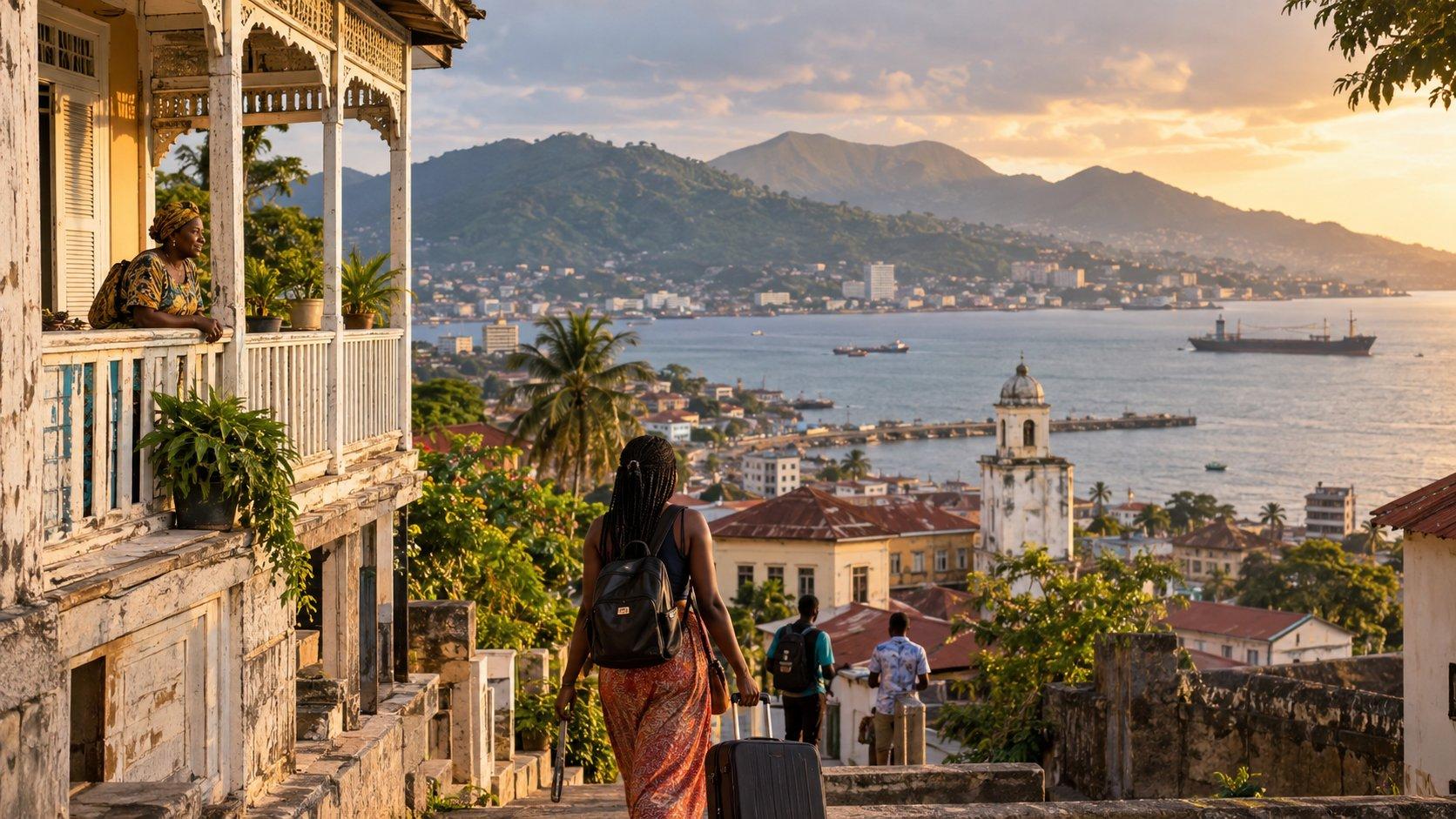
Krio architecture, particularly the distinctive wooden "Old Bode Ose" or "Bod Ose" board houses still standing in parts of central Freetown, reflects a combination of West African, British, and Caribbean architectural influences associated with the communities that settled the city. These houses commonly feature wooden construction, raised foundations, decorative fretwork, and verandas. Many surviving examples face pressure from urban development, neglect, and limited preservation resources.
Festivals, ceremonies, and rites of passage
Poro and Bondo or Sande initiation ceremonies remain important rites of passage in parts of Sierra Leone. These societies have traditionally marked the transition into adult social life through periods of seclusion, instruction, community responsibilities, and the transmission of knowledge. In the case of Bondo/Sande, female genital cutting has historically been associated with initiation and remains widespread in Sierra Leone, although the practice has generated significant domestic and international human-rights concern and campaigns for its reduction or elimination. The 2019 Sierra Leone Demographic and Health Survey provides data on the continuing prevalence of the practice among women and girls.
Ramadan and Eid celebrations are major nationwide observances given Sierra Leone's Muslim majority, while Christmas and Easter are important Christian celebrations. Families and communities may mark these occasions across religious lines, reflecting the country's extensive Muslim-Christian interaction. Independence Day, celebrated on April 27, commemorates Sierra Leone's independence from British colonial rule in 1961.
About Krio
The Krio language, though built primarily on an English vocabulary base, is not simply broken or simplified English but a fully developed language in its own right, with its own grammar, sound system, and structure. Its development reflects contact among the many African and Atlantic communities that settled and lived around Freetown. Linguists have studied Krio extensively, and the language has become Sierra Leone's principal interethnic lingua franca even though it is the first language of a much smaller proportion of the population.
The exact history of Krio's development is more complicated than a single origin story. Linguists have debated the extent to which its grammatical structure developed from earlier West African contact varieties, from the English-based creoles spoken by settlers from the Atlantic world, or through the interaction of several such varieties in Freetown. What is clear is that the language developed through sustained contact among populations displaced and resettled through the history of slavery, abolition, and colonial migration. Krio later spread beyond its original Freetown setting and became an important interethnic language within Sierra Leone, while also participating in wider networks of English-based contact languages across West Africa.
Sierra Leone now...
Krio remains Sierra Leone's principal interethnic lingua franca today, widely understood across the country regardless of a person's specific ethnic background. That makes the language a living connection to Freetown's history, even though modern Krio society is not simply a continuation of the original settler community. The language that developed through contact among different populations eventually became one of the country's most important tools for communication across ethnic and regional lines.
Freetown's surviving Old Bode Ose houses, though increasingly rare and under preservation pressure, continue to anchor efforts to document and protect the city's distinctive architectural history. These houses are physical records of the communities that built Freetown and of the Atlantic connections that shaped the city from its earliest years.
And the country's post-war recovery continues through institutions, communities, and individuals working to rebuild civic life after the 1991–2002 conflict. Sierra Leone's Truth and Reconciliation Commission documented the abuses committed during the war and made recommendations intended to support reconciliation, while survivor and amputee organisations have continued advocacy and community work in the years since.
Amputee and war-affected communities have organised advocacy groups, sports programmes, and other forms of community support, turning survival into an ongoing part of public life rather than something the country simply moved past. The history is still visible, but so is the work of the people who lived through it and continue to build lives after it.