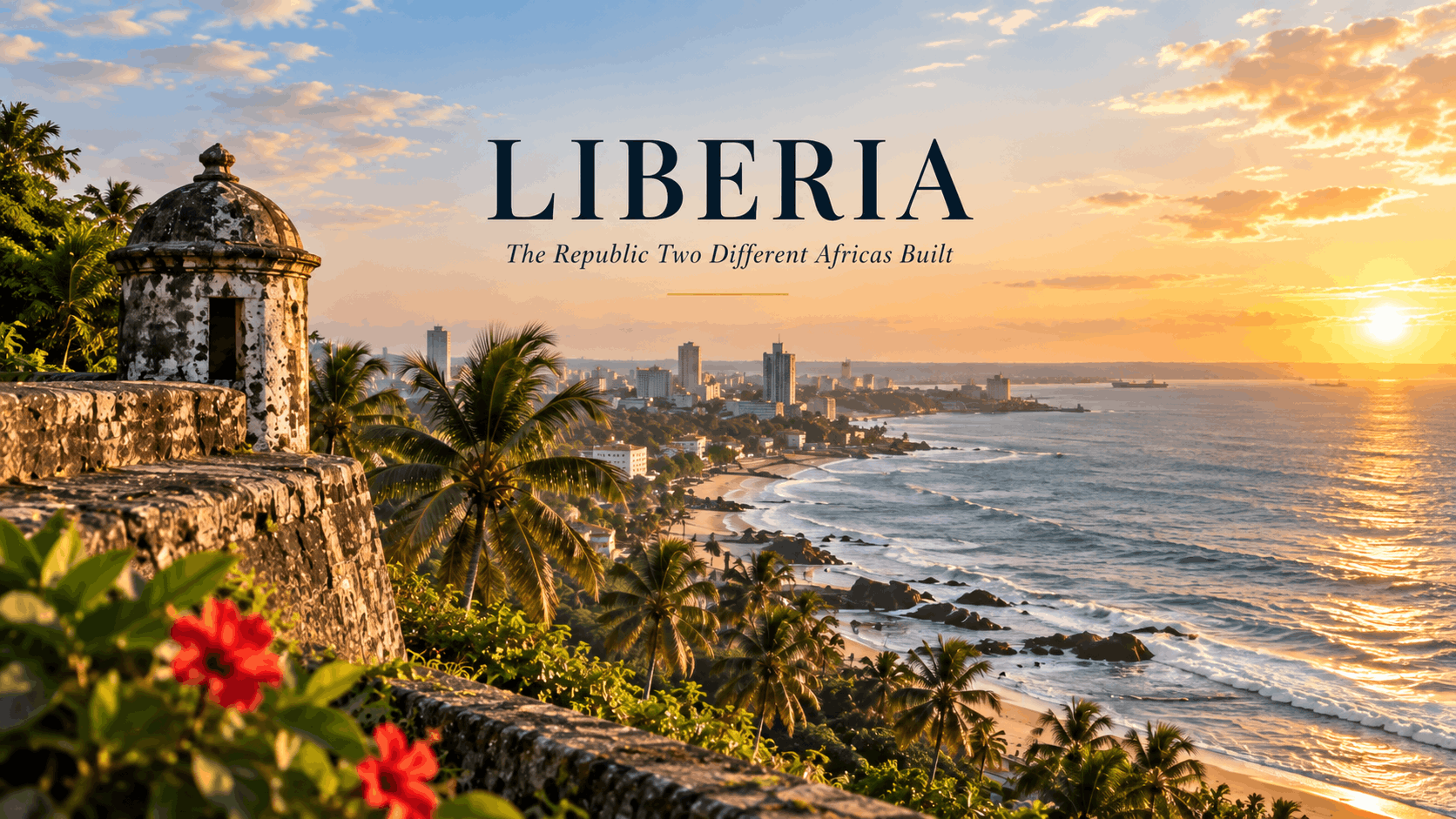
In 1847, a group made up mostly of freeborn and formerly enslaved Black Americans declared Liberia an independent country on the coast of West Africa. Many of them had arrived through the American Colonization Society, an organisation created in the United States in 1816 whose supporters had very different reasons for backing the project. Some were white slaveholders who did not want a growing population of free Black people living in the United States because they feared what that might mean for a society built around slavery. Others opposed slavery but still believed Black Americans would have a better chance of building independent lives in Africa than achieving equality in the United States. Some supported the project for religious reasons. What connected these groups was the belief that free Black Americans should leave the United States and establish communities in Africa rather than become equal citizens in America.
The people who moved to Liberia are often described as settlers, meaning people who moved from one place to another and established permanent communities there. In Liberia, however, they did more than build homes. They created towns, formed a government and eventually established a new country. The first permanent American-backed community was established on the Liberian coast in 1822, and more than 13,000 Black Americans eventually migrated through the American Colonization Society's programme.
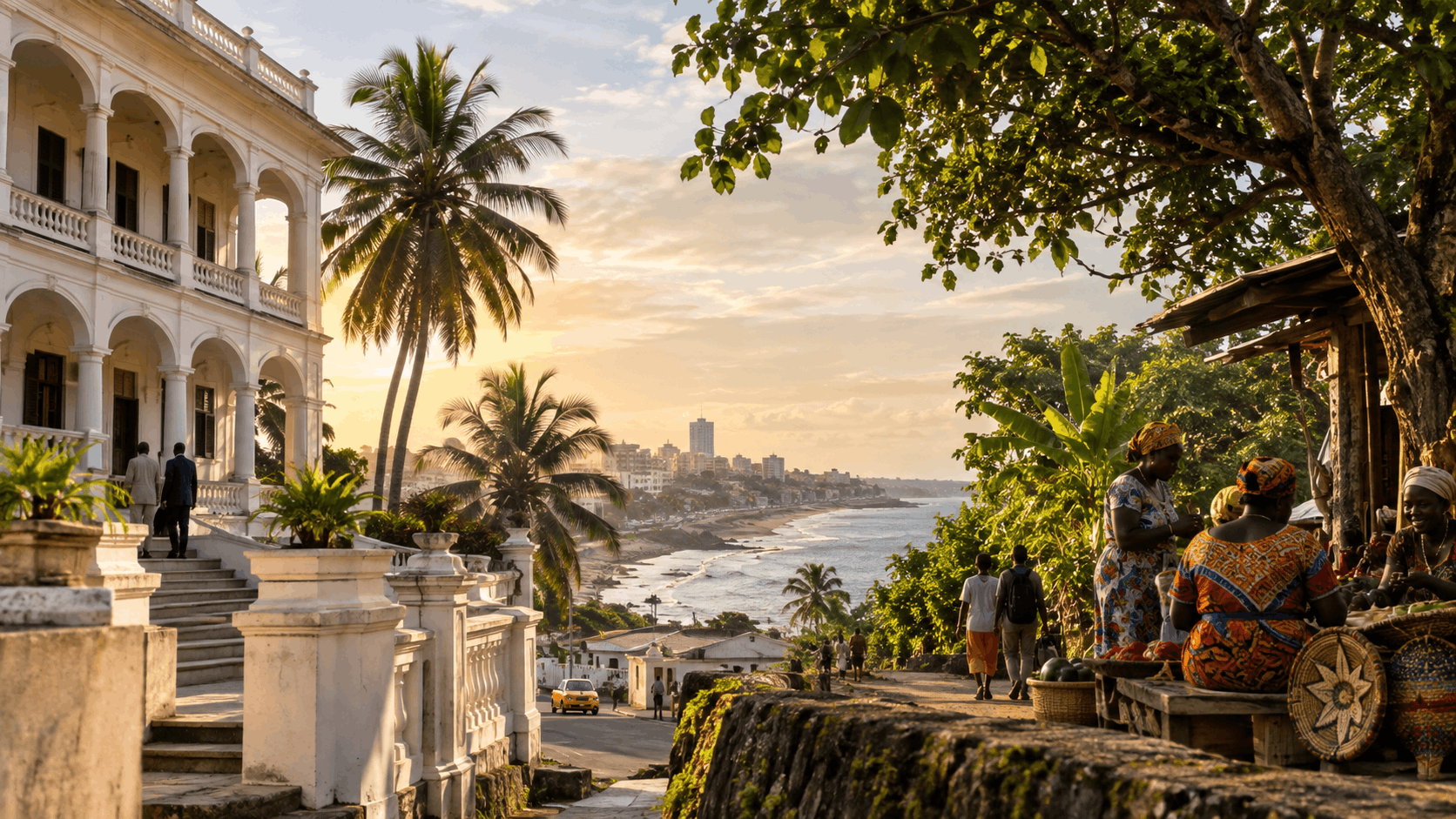
The influence of the United States was easy to see in the country they built. Liberia's capital, Monrovia, was named after U.S. President James Monroe, while its flag was modelled on the American flag and its constitution borrowed heavily from the American political system. English became the official language, and Protestant churches, schools and social organisations followed traditions the migrants already knew from the United States. Even the built environment reflected this history. Wealthier families constructed homes influenced by architecture from the American South, with stone foundations, wooden upper floors and large porches or porticos.
The migrants and their descendants became known as Americo-Liberians, meaning Liberians whose families came from the United States. They were always a small share of the country's population, but for more than a century they controlled most of Liberia's political power. This created one of the central problems in the country's early history: the people who founded the republic had come from a society where Black people lived under slavery and racial discrimination, yet the government they created did not give Liberia's indigenous African population equal access to political power.
These indigenous communities, including the Kpelle, Bassa, Kru, Grebo, Vai, Mano, Gio and others, had lived across the region for generations and already had their own languages, political systems, farming traditions, religions and trade networks before Liberia existed as a country. Liberia was therefore independent from European colonial rule, but independence did not mean that everyone inside the country had equal influence over how it was governed.
Some historians compare the Americo-Liberian system to colonial rule because a small group controlled government institutions, political participation and much of the country's formal economy while the much larger indigenous population had far less influence. We believe that this comparison needs to be reviewed again because Liberia was not a European colony, and its history was not identical to British, French or Portuguese colonial rule elsewhere in Africa. Still, the inequality inside the country was real, and it shaped Liberian politics for generations. It later became one part of a much larger story involving military rule, ethnic violence, political repression and two devastating civil wars.
Where the culture came from
The territory that became Liberia was already home to many communities before the republic was created in the nineteenth century, and those communities did not all speak the same language or organise society in the same way. Some, including the Kpelle, Mano and Dan, whose Liberian members are often called Gio, speak languages from the Mande language family. Others, including the Bassa, Grebo and Kru, speak languages from the Kru family.
These language families extend beyond Liberia because the borders that define Liberia, Guinea, Sierra Leone and Côte d'Ivoire today came much later than the communities themselves. Groups now divided between different countries often share older cultural and family ties, which means a modern border may separate communities that had traded, married and moved between the same areas for generations. A line between Liberia and Côte d'Ivoire, for example, did not erase the relationships that already existed between people on both sides.
There was also no single kingdom governing all the territory that later became Liberia. Different communities developed their own systems of authority through chiefs, elders, family networks and local institutions, and farming was central to many of these societies. Rice became one of the most important crops, especially varieties of African rice grown in fields that depend mainly on rainfall rather than irrigation. This is what is meant by upland rice, and rice remains at the centre of Liberian food today.
In parts of northern, western and central Liberia, another important part of community life developed through organisations known as the Poro and Sande societies. Poro is traditionally associated with men and boys, while Sande is traditionally associated with women and girls. They are sometimes described as secret societies, but that label can make them sound more mysterious than they need to be. Historically, they have served as places where members learned about community responsibilities, behaviour, adulthood, religion and cultural knowledge, with initiation sometimes involving a period away from ordinary village life while instruction took place. In some communities, these societies also played roles in leadership and dispute resolution.
Poro and Sande, however, are not traditions shared by every Liberian group. Other parts of the country, especially in the southeast, have their own cultural and religious institutions, so they should not be treated as if they represent one single indigenous Liberian belief system.
Along the coast, another type of life developed around the sea. Kru communities became well known for maritime work, with Kru men working as canoe operators, sailors, pilots and labourers on ships travelling along the West African coast and beyond. European ships depended on local workers who understood the coastline and could move people and goods between large vessels and the shore, and over time Kru sailors became part of wider Atlantic shipping networks.
Their history is sometimes told as though the Kru simply escaped the slave trade while other African communities did not, but the evidence is more complicated. Kru sailors worked inside commercial systems connected to the slave trade, while some later worked on ships involved in suppressing it. What can be said with confidence is that seafaring became an important part of Kru history and identity and connected Liberian coastal communities to a much wider maritime world.
Beginning in the 1820s, Black Americans arriving through the American Colonization Society added another cultural and political layer to this existing landscape. They established communities along the coast and brought English, Protestant Christianity and social customs shaped by life in the United States. In 1847, Liberia declared independence, but creating an independent country did not immediately create equal citizenship.
For decades, indigenous communities remained outside much of the national political system. In 1904, the government introduced a more formal system for administering indigenous areas, but political participation remained limited. It was not until 1946 that indigenous Liberians were formally given the right to vote and take part in national elections, and even after that change, Americo-Liberians continued to dominate national politics through the True Whig Party.
That political order lasted until April 12, 1980, when Master Sergeant Samuel Doe led a military coup in which President William Tolbert was killed. The coup brought 133 years of Americo-Liberian political dominance to an abrupt end, and Doe, who was from the Krahn ethnic group, became Liberia's first indigenous head of state. At first, the change appeared to open political power to people who had historically been excluded from it, but Doe's government became increasingly authoritarian. Political opponents were suppressed, while members of Doe's Krahn community gained influence inside the state and security forces.
The situation became worse after a failed coup against Doe in 1985. Government forces carried out violent reprisals against members of the Gio and Mano communities, who were accused of supporting the attempt to remove him, and this violence helped create the conditions for another conflict. On December 24, 1989, Charles Taylor and fighters from his National Patriotic Front of Liberia entered the country from neighbouring Côte d'Ivoire, beginning Liberia's first civil war.
The conflict involved several armed groups and became more complicated as different factions fought for territory and political control. A peace process eventually led to elections in 1997, which Taylor won, but Liberia did not remain at peace for long. Another armed rebellion began against his government in 1999, and Taylor remained president through most of this second conflict before resigning in August 2003.
By the time the fighting ended, more than 250,000 people were estimated to have been killed during Liberia's years of conflict, most of them civilians. Many more fled their homes, either moving to other parts of the country or crossing into neighbouring states, while the wars damaged schools, hospitals, roads, businesses and government institutions. A generation of Liberians grew up during years when basic public life had repeatedly broken down.
The peace agreement signed in 2003 opened a different period in Liberia's history. In 2005, Ellen Johnson Sirleaf won the presidential election and became the first woman elected president of an African country. She later shared the 2011 Nobel Peace Prize with Liberian peace activist Leymah Gbowee and Yemeni journalist and activist Tawakkol Karman. Sirleaf is sometimes described as a Harvard-trained economist, but a more accurate description is that she studied public administration at Harvard and built a career across finance, government and international institutions.
Liberia has held several national elections since the war, and one of the strongest tests of its postwar political system came in 2023, when President George Weah narrowly lost the presidential runoff to Joseph Boakai. Weah conceded the election, and Boakai took office in January 2024. For a country where political competition had once helped fuel armed conflict, another peaceful transfer of power mattered because it showed that losing an election no longer had to mean fighting for control of the state.
Ethnic groups and languages
Liberia is commonly described as having 16 major indigenous ethnic groups, including the Kpelle, Bassa, Gio, Mano, Kru, Grebo, Krahn, Vai, Gola, Mandingo, Lorma, Kissi, Mende, Gbandi, Belle and Dei. The Kpelle are the largest group, but these names should not give the impression that the country contains sixteen completely separate communities with clear boundaries between them.
People marry across ethnic groups, families move between regions, and cities bring people from different backgrounds together. The civil wars also displaced large numbers of Liberians from areas where their families had traditionally lived, which further changed older patterns of settlement. Some ethnic groups also live across national borders. Dan communities, for example, can be found in Liberia and Côte d'Ivoire, while Mano communities live in both Liberia and Guinea. A person can therefore be Liberian while belonging to a cultural community whose history extends into another country.
English is Liberia's official language, which reflects the influence of the Americo-Liberian founders who arrived from the United States speaking English. The English used in everyday Liberian life, however, developed in its own direction. One common form is Kolokwa, or Liberian colloquial English, which is not simply American English spoken with a Liberian accent.
Kolokwa developed through contact between different forms of English already spoken along the West African coast, the English used by the American settlers and Liberia's indigenous languages. Its grammar, pronunciation, expressions and rhythm developed inside Liberia, while indigenous languages continue to be spoken alongside it. A Liberian may use English or Kolokwa in one setting and an ethnic language at home or with members of the same community.
One social custom found across many parts of Liberia is a handshake that ends with the fingers snapping against each other. It has become one of the country's recognisable forms of greeting, although, like most social customs, it is not something every Liberian uses in every situation.
Religion and belief
Most Liberians identify as Christian. According to figures from Liberia's 2022 census, 84.9 percent of the population identified as Christian and 12 percent as Muslim, while a much smaller share identified their religion as a traditional African religion and others reported having no religion. Muslim organisations have argued that the official percentage of Muslims is too low, so the exact religious balance remains debated.
The numbers also do not explain how religion works in everyday life. Religious identity in Liberia does not always fit into separate boxes, and someone may identify as Christian while still taking part in cultural practices passed down through an indigenous community. The same can be true in a Muslim family.
This is one reason Poro and Sande cannot be understood simply as religions competing with Christianity or Islam. They can involve religious belief, but they have also been connected to education, initiation, community authority and ideas about adulthood. Practices differ between regions and ethnic groups, and there is no single traditional Liberian religion followed in the same way across the country. Different communities have their own beliefs about ancestors, spiritual forces, sacred places and religious authority, so treating all of them as one belief system would hide the differences between them.
Food
If there is one food that makes sense as a starting point for Liberian cuisine, it is rice. Rice is Liberia's main staple and provides a large share of the calories people eat, while cassava is another major source of food. A typical meal may pair rice with soup or stew made from vegetables, leaves, fish or meat, and many dishes use ingredients that are common across the wider West African region.
One familiar dish is palm butter, a rich soup or stew made from the fruit of the oil palm. The fruit is cooked and pounded so the oily pulp can be used as the base of the dish, after which fish, meat and seasonings may be added. Cassava leaves are also cooked into stews, while okra, peppers and leafy vegetables appear in many meals. Jollof rice is eaten in Liberia too, although, as with jollof across West Africa, recipes differ between countries, households and individual cooks.
Along the coast, fish and seafood are an important part of many meals, while cassava appears in several different forms. It can be boiled or roasted, but it can also be processed into soft, starchy foods eaten with soup. One example is dumboy, in which cassava is turned into a smooth, heavy dough-like food that can be eaten with soup or stew. Fufu serves a similar purpose, although its ingredients and preparation can vary, so it should not be treated as one fixed recipe made only from fermented cassava.
Liberia also celebrates Thanksgiving on the first Thursday of November, and the holiday has been part of Liberian law since the nineteenth century. Its American origin is clear, but the Liberian version developed inside the country's own religious and national life. Government proclamations describe it as a day for giving thanks to God, attending worship and reflecting on the country, making it one of the clearest examples of a custom introduced by the founders becoming part of Liberian public life.
Music, dance, and art
Masks are an important part of art and performance in several Liberian communities, but a ceremonial mask is not simply an object carved to be displayed. In some traditions, much of its meaning comes from what happens when it is worn, because the dancer, costume, music, movement and ceremony all form part of the experience.
Different masks can also serve different purposes. Among the Dan, whose communities extend across Liberia and Côte d'Ivoire, masks have been connected to entertainment, initiation, leadership, competition and religious practice. There is therefore no single type of "Dan mask" with one meaning, and the purpose of a mask depends on the community and ceremony in which it is used.
Sande societies also use helmet masks sometimes called sowei masks, which cover the dancer's head rather than only the face. These masks have become well known internationally because examples are held by major museums, but they were created for use within particular ceremonies and communities rather than simply as decorative art.
Liberia's history at sea also shaped its music and oral traditions. Kru sailors worked on ships travelling far beyond Liberia, and, like sailors in many parts of the world, maritime workers used songs and rhythm during labour and social life aboard ships. Their history belongs to the wider story of African sailors working across Atlantic shipping routes.
Liberia also developed an important written literary tradition. One example is Bai T. Moore, a Liberian writer, poet and folklorist whose work drew from Liberian oral traditions and indigenous culture while using English as a written language. Writers such as Moore show how Liberia's different cultural influences did not remain completely separate but could appear together in literature, storytelling and national public life.
Clothing, textiles, and craft
One well-known Liberian textile is country cloth, which is made by weaving narrow strips of cotton and sewing them together to create a larger piece of fabric. The technique is not unique to Liberia because strip weaving appears in several parts of West Africa, but Liberian communities developed their own patterns and uses for the cloth. Examples produced by Vai weavers from Liberia's Mano River area are held in museum collections today.
Liberia also has traditions of wood carving, pottery, basket making, mask carving and other forms of craft, although these practices should not be treated as though every ethnic group produces the same objects in the same way. Techniques may belong to particular regions, families or communities and can carry different meanings depending on where they are practised.
Americo-Liberian architecture tells another part of the country's history. In nineteenth-century Monrovia, wealthier families built homes that resembled houses they knew from the southern United States, with some using stone lower floors, wooden upper sections and large porticos at the front. Even Liberia's presidential residence was once described as resembling a Southern plantation house.
These buildings made the American influence visible in a very direct way. People living in parts of Monrovia were not only in a country created by Black migrants from the United States; some of the buildings around them also reflected architectural ideas those migrants had brought across the Atlantic.
Festivals, ceremonies, and rites of passage
For communities that practise them, Poro and Sande initiations have historically marked the movement from childhood towards adult responsibilities. An initiation can involve leaving ordinary home life for a period and receiving instruction about behaviour, community expectations and cultural knowledge.
Sande initiation has also been linked to female genital mutilation, or FGM, which means cutting or altering female genital tissue for reasons that are not medical. The practice can cause serious health problems and has become the focus of campaigns by Liberian women's rights organisations, health advocates and international human rights groups.
The debate is complicated because Sande itself is larger than FGM. For many communities, it has also been connected to education, identity, women's social organisation and ideas about adulthood. The question is therefore not simply whether an entire cultural institution should exist or disappear, but whether harmful practices can be ended while communities keep other parts of their cultural life.
The Liberian government has tried to regulate these societies, and in 2025 authorities suspended Poro and Sande activities across the country until January 2026 while new rules were being developed.
Liberia also has many other ceremonies and celebrations. Funerals, agricultural events, religious celebrations, dances and community gatherings differ between ethnic groups and regions, which is why there is no single traditional festival that can represent all Liberian cultures.
The national calendar contains another set of celebrations. Independence Day is held on July 26 and marks Liberia's declaration of independence in 1847, while National Unification Day is held on May 14. The latter was introduced in 1960 during efforts to bring indigenous Liberians and the Americo-Liberian political system closer together. National Thanksgiving Day is celebrated on the first Thursday of November, and Muslim Liberians also observe holidays including Eid al-Fitr and Eid al-Adha.
Taken together, these dates come from different parts of Liberia's history. Some grew out of the republic founded by Black Americans, others came from attempts to create a country in which indigenous communities had a stronger political place, and others belong to religious communities with their own long histories in the region.
You need to know this...
Liberia was never formally colonised by a European country, but freedom from European colonial rule did not mean that political power was shared equally inside Liberia.
For much of the country's early history, Americo-Liberians were a small minority but controlled the national government and had much stronger access to schools, government jobs, international contacts and political institutions. Indigenous Liberians had far less influence over decisions made in Monrovia, and this political gap did not disappear at once.
The government began building a more formal administrative system for indigenous regions in 1904, but indigenous Liberians did not receive full voting rights in national elections until 1946. Even after that change, the True Whig Party and the Americo-Liberian political elite remained in power until the 1980 coup.
Liberia's history is therefore more complicated than the familiar sentence that it was "never colonised". The country avoided formal European colonial rule, but it still had to confront its own system of political exclusion. Those are two different facts, and understanding both gives a much clearer picture of how power worked inside the republic.
Liberia today
Liberia has now lived without civil war for more than two decades, but that does not mean every question left by the wars has been settled. One of the biggest is accountability for the killings, torture, sexual violence and other abuses committed during the conflicts.
People accused of these crimes were not immediately tried in Liberia after peace returned, and survivors and campaigners have spent years calling for a special court to deal with war crimes and economic crimes connected to the conflict. By 2026, work towards creating those courts was still moving forward, which means Liberia is still deciding how to deal with crimes committed during a war that ended more than twenty years ago.
The country is also still debating how traditional institutions should operate inside a modern state. Poro and Sande remain important to some communities, but questions around children's rights, education, initiation and FGM have pushed the government and traditional leaders to reconsider how some practices should continue.
Language tells another part of the same story. Kolokwa is spoken in daily life across Liberia, and its development came from contact between the English associated with Black American settlers, earlier forms of English spoken along the West African coast and Liberia's indigenous languages. It is difficult to divide the language neatly into "American" and "African" parts because it developed from both and has become distinctly Liberian.
The national calendar has followed a similar path. Liberians celebrate an Independence Day created by the nineteenth-century republic, a Thanksgiving holiday with roots in the American migrant community and a National Unification Day introduced more than a century later as the government tried to address divisions between indigenous Liberians and the political system built by the country's founders.
None of this means those divisions simply disappeared. Liberia today carries the histories of Kpelle, Bassa, Kru, Vai, Gio, Mano and other indigenous communities, alongside the history of Black Americans who crossed the Atlantic and built a new republic. It also contains Christian and Muslim histories, local religious traditions, farming communities, coastal sailors, merchants, writers and people whose lives were shaped by years of war.
These stories did not begin in the same place, and they did not always fit together easily. Over the past two centuries, however, they have become part of the history of the same country. That is why Liberia is difficult to explain through one simple founding story. To understand it properly, you have to look at who built the republic, who was already living on the land, who controlled political power, who was excluded from it and how all of these histories gradually became part of what it means to be Liberian.