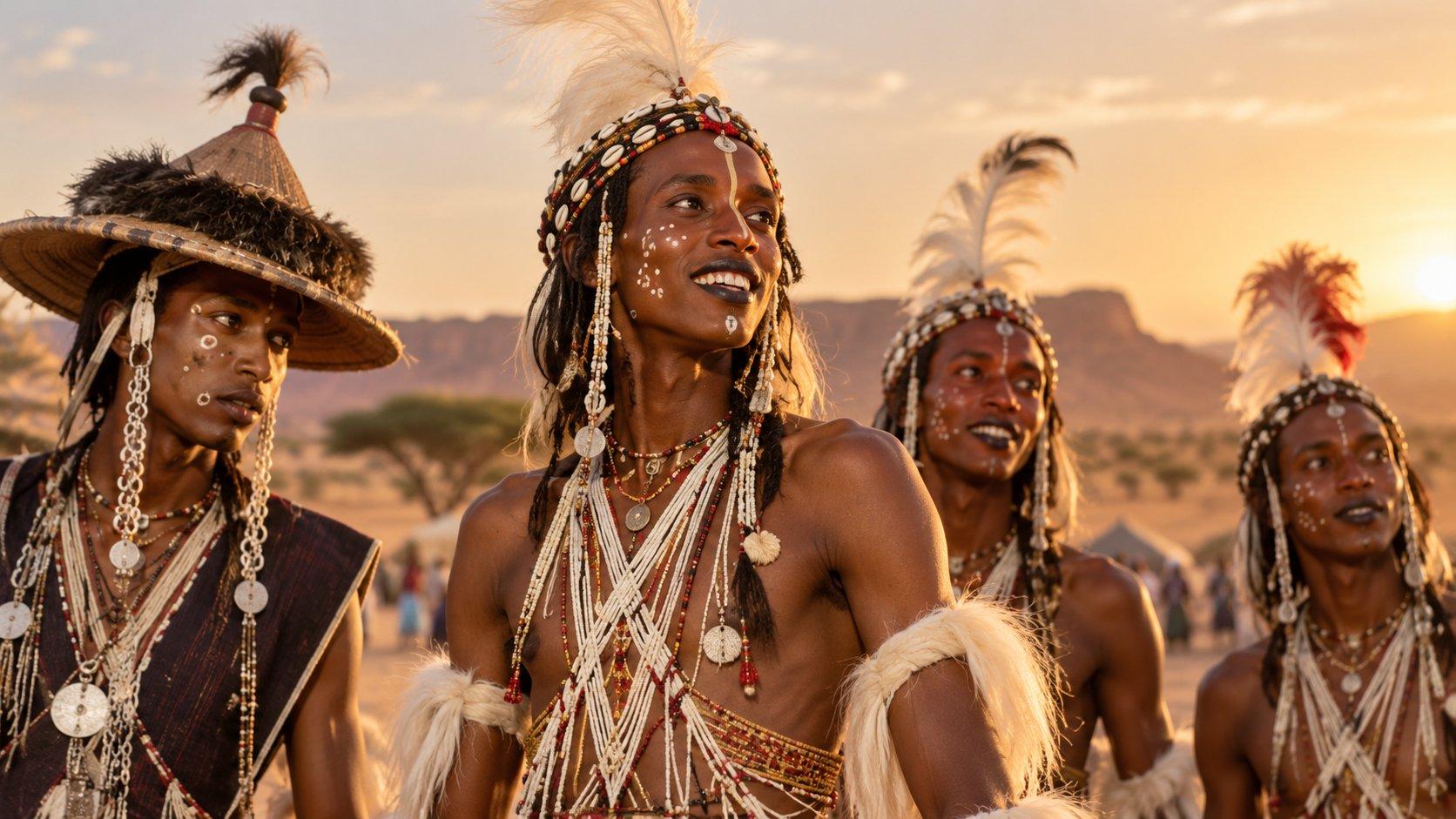
Among the Wodaabe of Niger, preparation for a major dance can begin long before the dancing itself. Young men dress carefully, decorate their faces with coloured pigments and use dark lines around their eyes and mouths to create a stronger contrast with the whites of their eyes and teeth. When they eventually stand together to sing and dance, their facial expressions become part of the performance. They widen and roll their eyes, expose their teeth and move in ways designed to draw attention to the features that are admired within Wodaabe ideas of male beauty.
The performance most associated with this tradition is Gerewol, also written as Geerewol or Jeerewol. It is often described outside Niger as a male beauty contest, which is not completely wrong, but the description leaves out much of what is happening. Gerewol combines courtship, dance, singing, appearance, competition and relationships between Wodaabe lineages. Smithsonian records from Niger describe the performers as mainly young men and refer to selected young women, known as suboyoobe, who stand before the dancers and make their choices. The women are not simply spectators watching a show prepared for tourists. Their role forms part of the ceremony itself.
Gerewol has become closely associated with Cure Salée, the annual gathering of pastoral communities around In-Gall in northern Niger, but they are not two names for the same event. Gerewol belongs specifically to Wodaabe cultural life and can take place when Wodaabe communities gather in different locations, while Cure Salée brings together a broader range of pastoral communities and includes livestock, cultural performances, meetings and government activities. The 2026 edition of Cure Salée, officially described by Niger's national news agency as the annual gathering of the country's nomadic herders, is scheduled to take place in In-Gall from 25 to 27 September.
The images from Gerewol are striking, which partly explains why they have travelled so widely through documentaries, photography and tourism. They can also create a very narrow impression of Niger if they are separated from the country that produced them. Wodaabe traditions developed within a much larger Sahelian world shaped by livestock, migration, trade, Islam, farming, changing political states and relationships that crossed the borders of what eventually became modern Niger. Understanding that background makes Gerewol more than a photograph of painted men standing in the desert.
A country shaped before its modern borders existed
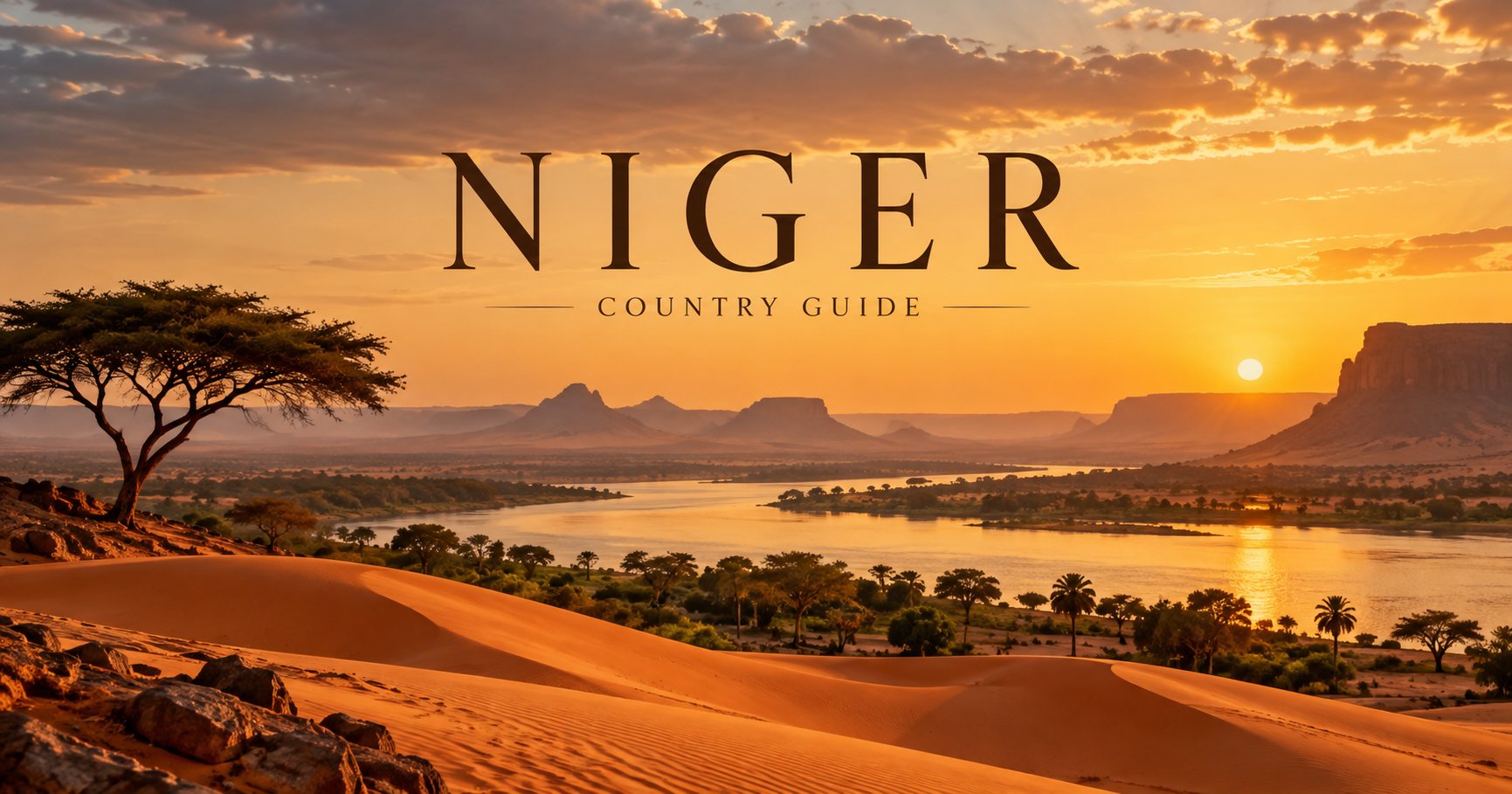
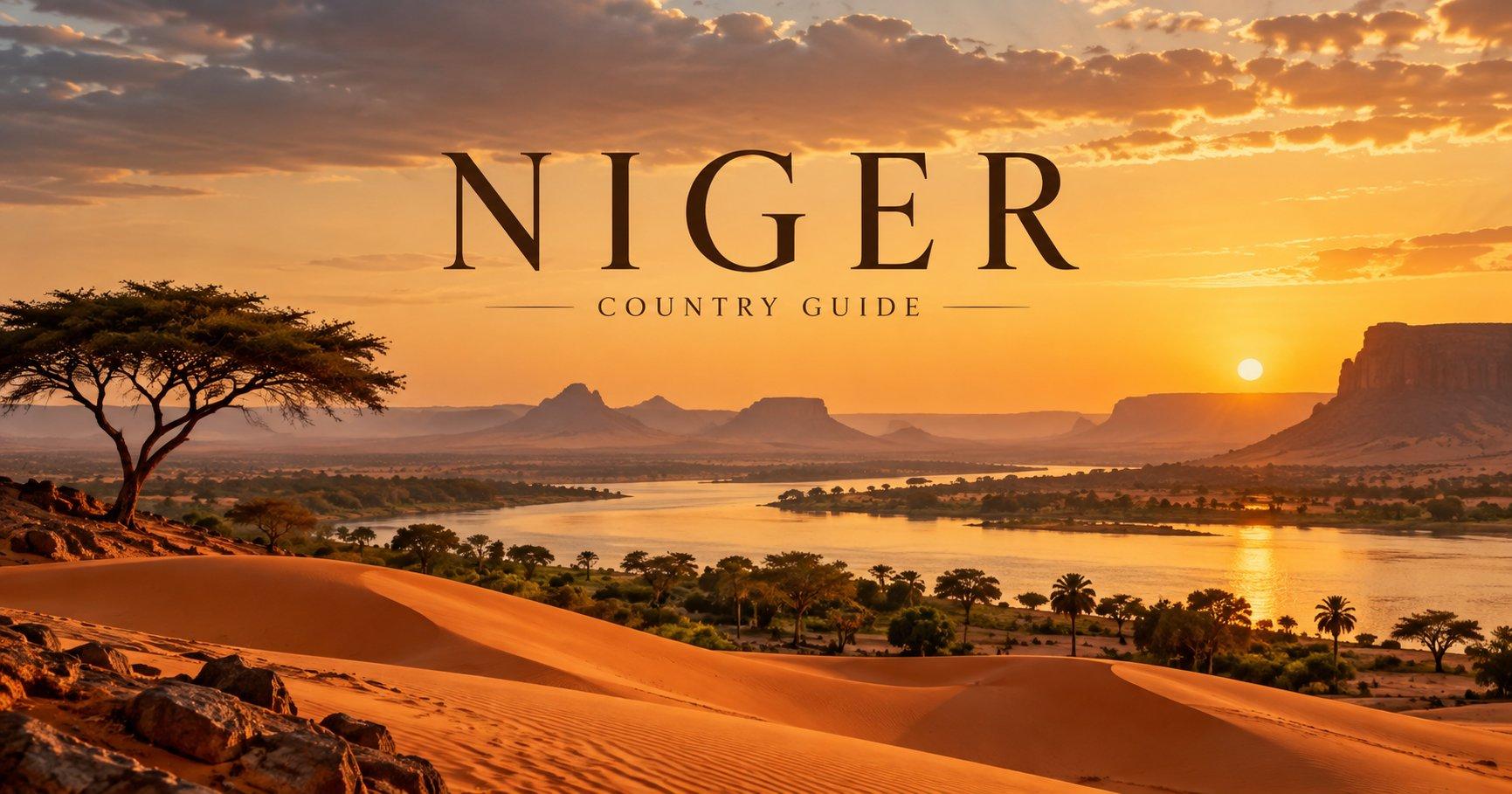
Niger is a landlocked country in the Sahel, the wide semi-arid belt that stretches across Africa between the Sahara to the north and wetter regions further south. Its territory covers about 1.27 million square kilometres and extends from the Niger River in the southwest into large Saharan areas in the north. Rainfall, agriculture and population are concentrated more heavily in the southern part of the country, while pastoralism has long been important in areas where people must move livestock between grazing land and water sources as environmental conditions change.
The Republic of Niger is relatively young, but the communities living within its borders have histories that extend much further back. Before European colonisation, different parts of what is now Niger were connected to several African kingdoms, empires, trading networks and political systems rather than belonging to a single state that resembled the country on today's map.
The western part of the region came under the influence of Songhai, whose empire reached the height of its power during the fifteenth and sixteenth centuries. Songhai controlled important sections of the Niger River and benefited from commercial routes through which goods, people and ideas moved between West Africa and North Africa. Its imperial power weakened sharply after Moroccan forces invaded in 1591, but political life in the region did not disappear with the fall of the empire. Smaller states and local systems of authority continued, while other political centres remained powerful elsewhere.
Further east, Kanem and later Kanem-Bornu shaped life around the Lake Chad basin over several centuries. Hausa-speaking states and trading communities were influential across the south, linking areas of modern Niger with communities that are now in northern Nigeria. In the north, Tuareg confederations controlled territory and participated in the long-distance commercial networks that crossed the Sahara. Agadez developed into an important centre on those routes, connecting pastoral communities, traders and settlements across a region that was never isolated from the rest of West and North Africa.
These older relationships remain visible today because ethnic and linguistic communities do not fit neatly inside national borders. Hausa speakers live on both sides of the Niger-Nigeria border. Tuareg communities are spread across Niger, Mali, Algeria, Libya and other parts of the Sahara and Sahel. Fulani communities, of which the Wodaabe form one part, extend across a vast area of West and Central Africa, while Kanuri communities are found in Niger, Nigeria, Chad and Cameroon. Colonial boundaries created separate countries, but they did not erase older languages, kinship systems, trading relationships or pastoral routes.
French rule and the creation of modern Niger
French military expansion into the territory that became Niger took place around the end of the nineteenth century and the beginning of the twentieth, and control was established gradually rather than without resistance. Tuareg groups in the north resisted French authority, including during the Kaocen revolt of 1916 and 1917 in the Aïr region, which became one of the important episodes of armed resistance to colonial rule in Niger.
French administration eventually incorporated Niger into French West Africa, a federation that also included several other French-controlled territories in the region. The colonial system introduced new administrative borders and political institutions, but those structures were imposed over societies that already had their own authorities, languages and economic relationships. Niger became a separate French colony in 1922 and remained under French sovereignty until the political changes that followed the Second World War gradually expanded African representation and local self-government.
The country became an autonomous republic within the French Community in 1958 and gained full independence on 3 August 1960, with Hamani Diori becoming the first president of independent Niger.
Independence did not produce a stable political system immediately. Niger has experienced civilian governments, military governments and repeated coups, alongside rebellions involving Tuareg groups in the north. The rebellions of the 1990s and the renewed conflict that began in 2007 were connected to several grievances, including political representation, regional development, land, access to state resources and arguments over how communities in northern Niger should benefit from mineral wealth generated in their regions. Uranium became especially prominent in discussions surrounding the later rebellion because Niger had become an important producer, but the conflicts were shaped by a wider set of political and economic concerns rather than uranium alone.
Niger entered another period of military government in July 2023 when President Mohamed Bazoum was overthrown by the presidential guard and General Abdourahamane Tiani emerged as the country's leader. The coup led to a confrontation with the Economic Community of West African States, or ECOWAS, while relations with France and the United States deteriorated. French troops eventually left the country, and the United States completed the withdrawal of its military forces in September 2024.
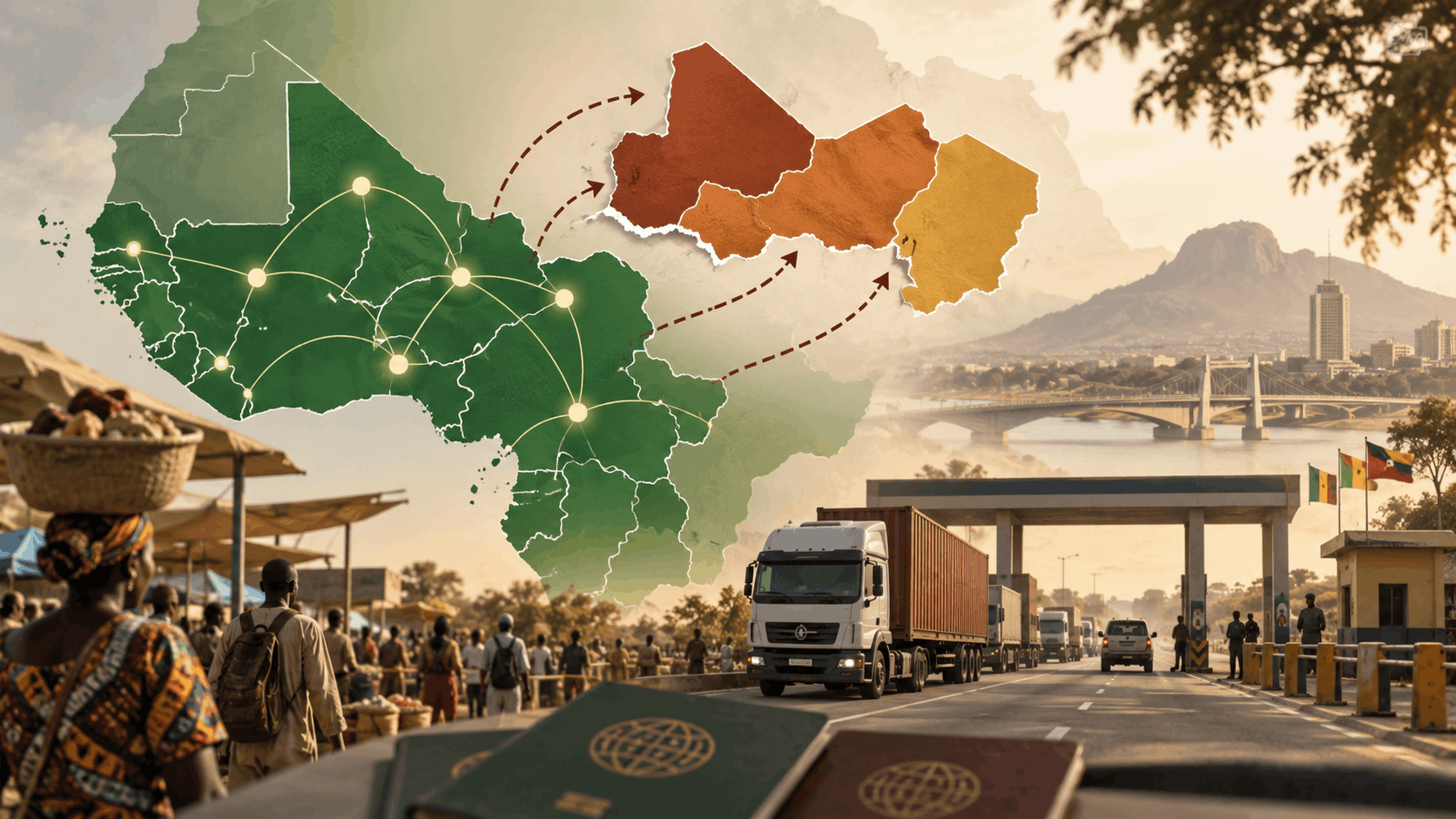
Niger also moved closer to Mali and Burkina Faso, which were under military governments of their own, and the three countries developed the Alliance of Sahel States. They announced in January 2024 that they intended to leave ECOWAS, but their departure did not become legally effective until 29 January 2025, following the one-year notice period required under the bloc's rules. ECOWAS has continued to recognise passports carrying its logo and has maintained some free-movement and trade arrangements while discussions over the practical consequences of the withdrawal continue.
The people and languages of Niger
Modern Niger contains several large ethnic and linguistic communities whose histories overlap but are not identical. The Hausa are generally identified as the country's largest ethnic group and are concentrated particularly in the south and centre, where Hausa-speaking communities have long been involved in farming, commerce and craft production. Their language and cultural networks extend well into neighbouring Nigeria, which has a much larger Hausa population.
Zarma-Songhai communities are concentrated more heavily in western Niger, including areas around Niamey and the Niger River. Tuareg communities are associated especially with northern and central regions, although many Tuareg today live settled or partly settled lives rather than following the older image of permanent desert nomadism. Fulani communities are spread across several regions and include groups with different degrees of pastoral mobility, among them the Wodaabe. Kanuri populations are concentrated further east toward the Lake Chad basin, while Toubou, Arab, Gourmantché and other communities form smaller parts of the national population.
Language policy in Niger changed significantly in 2025. For decades after independence, French held official-language status even though it was not the language most Nigeriens used in everyday life. Under Article 12 of the Charter of Refoundation adopted in March 2025, Hausa is designated as the national language, while French and English are designated as working languages. The charter also lists Arabic, Buduma, Fulfulde, Gourmancema, Hausa, Kanuri, Tagdal, Tamajaq, Tassawaq, Tubu and Zarma-Songhai among the languages spoken in Niger.
The legal change brought government terminology closer to a linguistic reality that had existed for much longer. Hausa is widely spoken in several of the country's most populated regions and is used across the border in Nigeria, while Zarma-Songhai, Fulfulde, Tamajaq and other languages continue to structure everyday life within their respective communities. A person may therefore be a Nigerien citizen while also belonging to a linguistic and cultural network that stretches far beyond Niger's borders.
Islam and religious life
Islam is the dominant religion in Niger and has been present in the wider region for centuries through trade, scholarship, migration and the growth of Muslim states and communities. According to figures cited by the former Nigerien Ministry of Interior, more than 98 percent of the population is Muslim, with most Muslims belonging to Sunni traditions and the Maliki school of Islamic jurisprudence that is widespread across West Africa. Christian communities, followers of Indigenous religious traditions and other groups make up a small minority.
Religion influences family life, holidays, education, dress and social relationships, but practice varies between communities and individuals. Indigenous cultural traditions have also continued in different forms alongside Islam, and official religious-freedom reporting has noted that some Muslims incorporate practices with older local origins into their religious lives. Describing communities such as the Wodaabe simply as either Muslim or followers of traditional religion therefore misses the way religious identity and cultural customs can coexist.
The scale of Niger's education challenge also affects the institutions through which people acquire knowledge. UNICEF reports that more than half of children between the ages of seven and sixteen are out of school, with children in rural and poorer households facing some of the greatest barriers to attendance. Religious instruction, family teaching and community structures operate within that wider environment, although they should not be treated as substitutes for formal schooling or described as the primary education system for every rural child.
Food shaped by farming and pastoral life
Nigerien food reflects the country's climate as much as its ethnic diversity. In much of the south, rainfall is seasonal and farmers have historically depended on grains capable of growing under hot and relatively dry conditions. Millet and sorghum therefore occupy an important place in food production and everyday meals, and current FAO reporting continues to treat them as major locally produced cereals alongside maize and rice.
Millet can be ground into flour and prepared in different forms, including thick porridges commonly described as tuwo in Hausa-speaking areas. Such dishes are usually eaten with a sauce or soup rather than on their own, while other preparations turn millet into thinner porridges or drinks. Rice is also widely eaten, although Niger's domestic rice production is concentrated in areas where irrigation makes cultivation possible, including parts of the Niger River valley.
Pastoral communities have historically depended more heavily on livestock products, especially milk, which produces a different food pattern from that of settled farming households. Smithsonian records documenting Wodaabe communities in central Niger describe a seasonal relationship between milk and millet. Milk becomes more plentiful during the rainy season when cattle have better grazing conditions, while millet and other grains become more important during periods when milk production falls.
The result is not one uniform national diet but several food traditions shaped by geography, livelihoods and access. A household living in Niamey, a millet-growing village in the south and a Wodaabe family moving cattle through central Niger can all be Nigerien while relying on different combinations of grains, livestock products, vegetables, meat and purchased food.
Music, dance and performance
Music in Niger follows the same pattern of overlapping traditions. Hausa, Zarma-Songhai, Tuareg, Fulani and other communities have their own musical forms, instruments and performance settings, while musicians have also borrowed from one another over long periods of contact.
Among Tuareg communities, tende is one of the best documented musical traditions. Smithsonian records describe performances in which women use a wooden mortar covered with skin as a drum, combining the rhythm with clapping and singing. Historical recordings made in Niger and neighbouring Saharan areas during the twentieth century preserve performances by Tuareg women using tende and water drums, including songs connected to weddings, camel culture and other social occasions.
Modern Tuareg guitar developed within the wider Tuareg world rather than inside one country. During the late twentieth century, musicians from communities affected by displacement, rebellion and migration began using electric guitars alongside older melodic and poetic traditions. The style eventually became internationally known as Tuareg guitar or desert blues, although musicians themselves have worked in a range of sounds that cannot be reduced to one genre.
Niger has produced some of the best-known contemporary musicians associated with this music, including Bombino and Mdou Moctar, whose careers have taken sounds connected to Tuareg musical traditions into international rock venues and recording studios. Their music is modern, amplified and global in its reach, but it exists alongside older forms such as tende rather than replacing them.
Wodaabe dance belongs to another part of Niger's performance culture. During Gerewol and related dances, singing, movement and appearance function together, which is why focusing only on the face paint gives an incomplete picture. Men perform as part of groups, and the performance can communicate lineage identity as well as individual attractiveness.
Clothing, beauty and craft
Tuareg craft traditions are strongly associated with silverwork, leatherwork and objects designed for a society in which portability once had considerable practical importance. Bags, saddles, jewellery and other belongings could be carefully decorated while still serving everyday purposes, and many of these crafts later developed markets among travellers, collectors and customers outside Tuareg communities.
The Cross of Agadez has become one of the most recognisable examples of Tuareg silver jewellery associated with Niger. It belongs to a wider family of geometric pendants whose forms differ across regions and communities. Popular explanations sometimes describe the pendant as a protective object passed from a father to his son or give it a single fixed symbolic meaning, but researchers have documented several competing interpretations. It is therefore more accurate to describe the Cross of Agadez as an important Tuareg jewellery form whose exact origins and symbolism are not universally agreed upon.
Wodaabe ceremonial appearance is organised around a different set of visual choices. Face paint, clothing, jewellery and headdresses work together during major dances, while eye and mouth movements draw attention to particular facial features. The familiar photographs of men showing their teeth and widening their eyes make more sense when seen within this complete performance, because those expressions interact with the colours and markings already placed on the face.
The standards of attractiveness expressed during Gerewol belong to Wodaabe cultural practice, but they should not be described as an untouched aesthetic system that somehow developed without contact with other societies. Wodaabe communities have traded, migrated, practised Islam and interacted with neighbouring peoples for generations. Their ceremonial traditions have continued through that contact rather than because they were protected from it.
Cure Salée and the pastoral calendar
Cure Salée developed around the seasonal movement of pastoralists and livestock toward the In-Gall and Ighazer area toward the end of the rainy season. Herders bring animals into a landscape known for saline soils, mineral-rich water and grazing conditions that are valuable for livestock, creating a large concentration of people and animals that also provides an opportunity for trade, social meetings and cultural events.
Over time, the Nigerien state built official programmes around this pastoral gathering. Government involvement is older than is sometimes suggested, and historical documentation shows authorities using the gathering by the 1970s to communicate with pastoral populations and organise activities such as animal vaccination. In later decades, public authorities, traditional leaders, development organisations and pastoral communities continued to use Cure Salée as a meeting point for discussions about livestock, health, pastoral development and public services.
The event is often associated with September, but its dates can move because they depend on organisation, seasonal conditions and government decisions rather than a fixed annual calendar. In 2025 the festivities took place in early October, while the 2026 edition is scheduled for 25 to 27 September in In-Gall.
Gerewol performances may take place within this wider gathering, but the Wodaabe ceremony is not simply an entertainment programme created for Cure Salée. Its social life extends beyond the official festival, just as Wodaabe identity extends beyond Niger itself.
How Gerewol works
The men seen in Gerewol photographs are participating in a performance that can require considerable preparation and physical endurance. They decorate themselves before joining lines of other performers, after which singing and repeated movements may continue for long periods. Smithsonian records describe Gerewol as one of the most serious Wodaabe dances and identify the young women who act as choosers during the ceremony.
The judging is only one part of what takes place. A performer is being seen both as an individual and as part of a family and lineage, while the dance itself involves rhythm, posture, singing and sustained participation. Beauty is therefore expressed through movement and presentation rather than through facial appearance alone.
Outside descriptions often present Gerewol as remarkable because women judge men, but that framing can make a Wodaabe institution sound as though it exists mainly as the reverse of a Western beauty pageant. Within the community, the practice has its own history, rules and social meaning, and the female choosers are participating in a system that belongs to Wodaabe courtship and ceremonial life rather than performing an inversion designed for outsiders.
The practice has also changed over time, as living traditions usually do. Wodaabe communities are affected by schooling, migration, new technology, urban life, climate pressure and changes in pastoral livelihoods. People can maintain a ceremony while changing other parts of their lives, and participation in modern institutions does not automatically require abandoning cultural practices inherited through families and communities.
Niger today
Niger enters the second half of the 2020s with a population that is exceptionally young. UNFPA reported in July 2026 that young people account for nearly 69 percent of the population, with people below the age of twenty-five forming a large majority.
Such a young population is growing up during a period of considerable change. The country is under the political system created after the 2023 coup and the 2025 Refoundation Charter. Its relationship with France has changed sharply, it has left ECOWAS alongside Mali and Burkina Faso, and it is building regional cooperation through the Alliance of Sahel States. Education remains difficult to access for millions of children, while insecurity continues to affect communities in parts of Tillabéri, Diffa and other regions.
Climate and food security add another layer to those pressures. FAO's August 2026 assessment reported that the 2026 rainy season had generally begun favourably in major cereal-producing areas, but it also recorded localised early-season dryness and continuing insecurity. About 2.4 million people were estimated to have faced severe acute food insecurity between June and August 2026.
For pastoral communities, changes in rainfall, grazing conditions, security and access to markets can directly affect the ability to keep livestock and move between seasonal grazing areas. A cultural ceremony may appear separate from those economic questions when viewed through photographs, but the people who perform it still depend on functioning communities and livelihoods. Gerewol survives because Wodaabe people continue to gather, raise families, maintain social relationships and create space for the ceremony within lives that are changing in other ways.
When Cure Salée returns to In-Gall in September 2026, the people arriving will not be stepping into an untouched version of the past. They will be arriving in a Niger that has changed politically, economically and socially, just as previous generations lived through changes of their own. Some will carry mobile phones. Some will have relatives living in towns or abroad. Some younger people will combine pastoral life with education or other forms of work. The music heard in the wider Tuareg world may include both tende and electric guitar, while government officials and veterinary workers will operate alongside activities whose histories began long before the modern state existed.
Among the Wodaabe who gather for Gerewol, young men will still prepare themselves for the dance, sing in line with other performers and use movement, clothing and facial decoration to present themselves before the women chosen to judge them. That continuity does not require pretending that nothing has changed around them. It shows how a tradition can remain recognisable while the people who practise it continue living in the present.