Explore Eswatini’s Umhlanga Reed Dance, its royal history, Swazi traditions, ceremonies, food, religion, music and cultural life today.
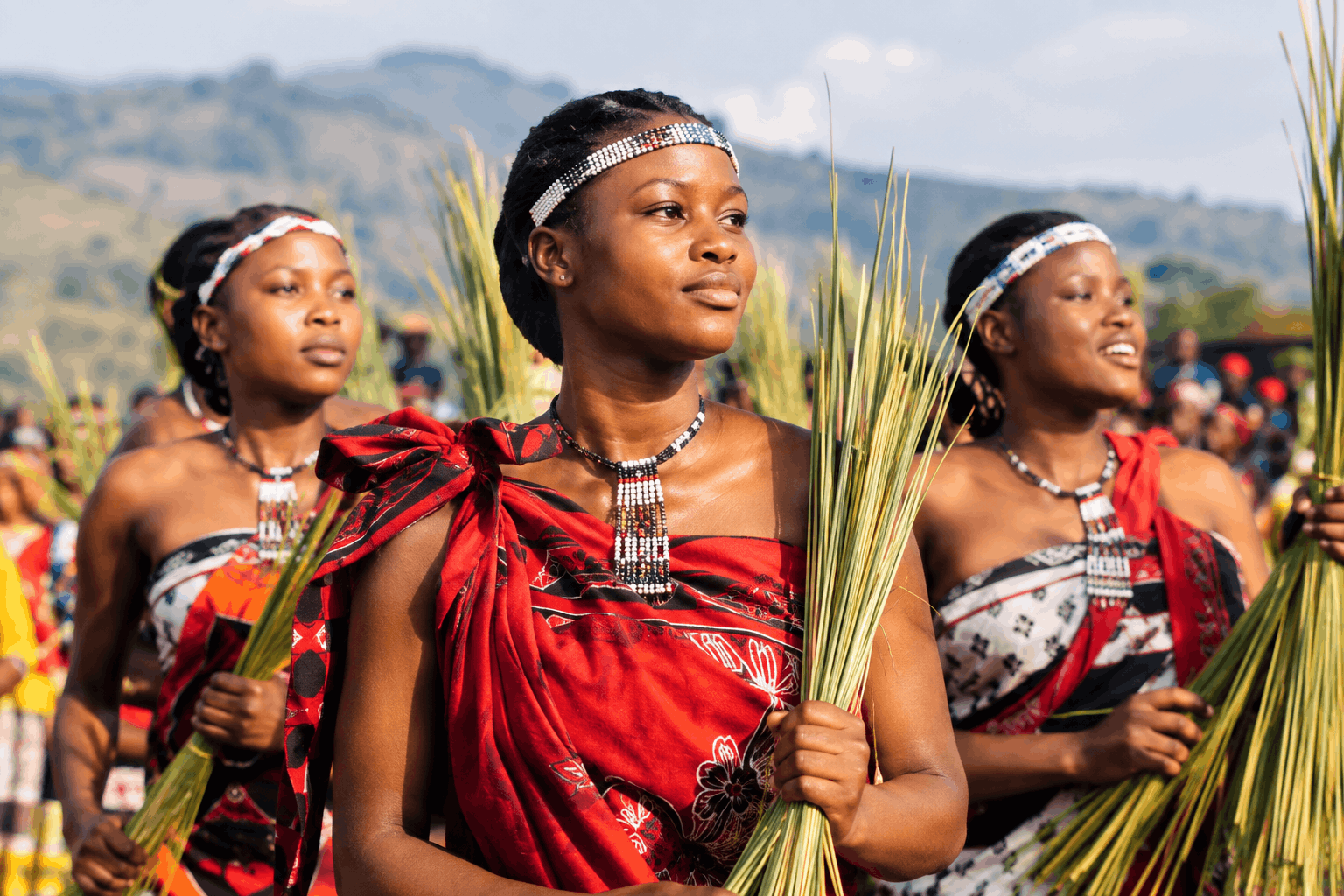
Every year around August or September, thousands of young unmarried women gather in Eswatini for one of the country's most recognisable ceremonies: Umhlanga, commonly known as the Reed Dance.
For several days, groups of girls, known as imbali, travel from different parts of the country to take part. The ceremony includes the cutting and carrying of reeds, communal work at the Queen Mother's residence, singing, dancing and formal appearances before the King and Queen Mother. The reeds themselves have a practical purpose. They are used in repairing and rebuilding the reed fence around the Queen Mother's residence at Ludzidzini.
The public spectacle comes later, when the girls enter the royal arena in their different regiments, carrying their reeds and dancing in formation. The singing and dancing are part of a ceremony centred on girlhood, communal identity, respect for the Queen Mother and the traditional organisation of Swazi society. The event also gives the King an opportunity to identify a prospective wife, although choosing a wife is not an automatic outcome of the ceremony.
The ceremony as people know it today has a more complicated history than the photographs of the dancing might suggest. Practices involving young women, reeds and royal ceremonies existed before the modern national event, but the national organisation of the ceremony was developed under King Sobhuza II. The Eswatini National Archives records that a national umcwasho ceremony was first performed in 1935 and that Sobhuza incorporated it into a wider effort to organise young people and strengthen support for the monarchy.
That history makes Umhlanga a useful place to begin understanding Eswatini, because the ceremony brings together several things that have shaped the country for generations: age-based organisation, the authority of the royal household, community labour, music and dance, and the idea that cultural life can also be part of national political life.
Where the Culture Came From
In this section
Eswatini now has a constitution, Parliament and elections, but the King retains substantial political authority.
Eswatini is a small, landlocked kingdom in southern Africa, bordered by South Africa on three sides and Mozambique to the east. The country was known internationally as Swaziland until 2018, when King Mswati III announced the adoption of the name Eswatini, meaning "land of the Swazi."
The country's history is closely connected to the Swazi kingdom that developed in the region during the 18th and 19th centuries. Political authority was built around the monarchy, chiefly institutions and networks of communities and regiments. These structures helped organise military defence, agricultural work, ceremonies and relations between different communities.
That organisation also helps explain why age and community groups continue to have such a visible place in public ceremonies. Umhlanga is organised through groups of young women, while other traditional ceremonies involve different age-based regiments. Participation is therefore not only about an individual standing in front of an audience. It places people within a much older system of communal organisation.
European colonial rule eventually altered the political environment around the kingdom. Britain established a protectorate over Swaziland in 1902 following the South African War. The monarchy continued to exist during this period, although political authority was increasingly shaped by colonial administration.
When Swaziland became independent on 6 September 1968, King Sobhuza II became the monarch of the newly independent state. By then he had already been king for most of his life. He inherited the throne in 1899, when he was just a baby, so his grandmother, Queen Labotsibeni, ruled on his behalf until he was old enough to take over. He was formally installed as king in 1921, according to the Eswatini government's historical account.
The political history that followed would become inseparable from the country's traditional institutions. In 1973, Sobhuza II suspended the constitution and banned political parties, concentrating political authority around the monarchy. Mswati III became King in 1986 after Sobhuza's death in 1982.
Eswatini now has a constitution, Parliament and elections, but the King retains substantial political authority. Political parties are not permitted to contest elections in the conventional party-based way, and traditional institutions continue to operate alongside the formal state.
This combination of modern state institutions and longstanding royal structures is part of what makes everyday political and cultural life in Eswatini difficult to understand through the framework of a standard parliamentary system. The monarchy is not simply a ceremonial institution sitting outside public life. It remains closely connected to national ceremonies, traditional authority and the organisation of the state.
The King, the Queen Mother and the Idea of a Dual Monarchy
The royal household has two particularly important figures: the King, or Ingwenyama, and the Queen Mother, or Indlovukazi.
They hold distinct positions within Swazi tradition. The King is associated with the nation and political authority, while the Queen Mother has her own important traditional and ritual responsibilities. This is sometimes described as a dual monarchy because the royal institution has historically been understood through these complementary positions.
The balance is not an equal division of political power. The King holds greater political authority in the modern state. But the Queen Mother's position is significant enough that one of the country's best-known national ceremonies, Umhlanga, is centred around her residence.
That is why the reeds carried by the young women are more than a visual part of the ceremony. The girls begin and end the ritual with communal work connected to the Queen Mother's homestead, including gathering materials used for fencing. The National Archives describes this labour as one of the defining elements of the ceremony.
The ceremony therefore connects something very ordinary, communal labour, with one of the most formal institutions in the country.
Christianity and Older Beliefs
Religion in Eswatini has developed through the meeting of Christianity with older Swazi religious traditions.
Christianity is the country's largest religious affiliation. In the 2017 census, 89.25 percent of the population identified as Christian. Zionist churches accounted for the largest Christian denomination, followed by evangelical and Pentecostal groups. The same census recorded 0.45 percent under the category of Traditionalist and 7.4 percent as having no religion.
Those figures tell us something useful about the country, but they do not capture every way people understand religion in daily life. Christian worship exists alongside cultural practices, ideas about ancestors and traditional approaches to healing and spiritual interpretation.
Traditional healers and diviners have historically occupied recognised roles within Swazi society. Their work can involve herbal knowledge, diagnosis, ritual and communication with the spiritual world. For some people, these practices exist alongside Christian belief rather than in a completely separate category.
This mixture can also be seen in the country's ceremonies. Christianity is deeply established in contemporary Eswatini, while the monarchy continues to participate in traditional rituals whose origins predate European missionary activity.
Religion, culture and public ceremony therefore overlap in ways that are difficult to divide neatly into separate categories.
What People Eat
In this section
Emasi, sour fermented milk, is also part of Swazi food culture and has traditionally been associated with cattle keeping.
Food in Eswatini is closely connected to agriculture, livestock and the crops that have traditionally been available in different parts of the country.
One of the best-known staple foods is sishwala, a thick porridge commonly made from maize meal, although other grains can also be used. It is often eaten with vegetables, meat, beans or other accompanying dishes.
Another traditional preparation is sidvudvu, a pumpkin-based porridge. Emasi, sour fermented milk, is also part of Swazi food culture and has traditionally been associated with cattle keeping.
Cattle have a significance that goes beyond the dinner table. They have historically been connected to wealth, status, marriage negotiations and ceremonial life. Livestock therefore sits within a much larger social system in which food, family relationships and community obligations overlap.
The country's agricultural economy has also influenced what is produced and eaten. Sugarcane became an important commercial crop during the colonial and postcolonial periods, with large sugar estates developing in the Lowveld. The Mhlume sugar estates, for example, were established during the colonial period with the involvement of the Commonwealth Development Corporation.
That history is useful when looking at food in Eswatini today. Traditional dishes remain part of household and ceremonial life, while commercial agriculture has also shaped the country's economy and food production.
Music, Dance and Art
Music and dance are central to many public ceremonies in Eswatini because they are not treated as performances that exist separately from community life.
During Umhlanga, groups of young women sing and dance together as part of the ceremony. During Incwala, men organised into regiments participate in songs, movement and ritual activity connected to the King.
One of the country's best-known traditional dances is sibhaca, a vigorous group dance traditionally performed by men. It is often associated with coordinated movement, singing and physical strength.
The arts also extend beyond the royal ceremonies. Beadwork, weaving, carving, pottery and other forms of craft continue to provide ways for artists and makers to express identity and produce goods for local and international audiences.
Contemporary festivals have created another setting for this creative work. The MTN Bushfire Festival, held at House on Fire in the Malkerns Valley, brings together music, theatre, film, workshops, food and other forms of cultural expression. In 2026, the festival reported more than 23,000 attendees from over 55 countries.
That makes the country's cultural calendar much broader than its royal ceremonies. Traditional performance remains highly visible, while contemporary artists have their own stages and audiences.
Clothing, Beads and the Meaning of Dress
Traditional clothing is especially visible during national ceremonies.
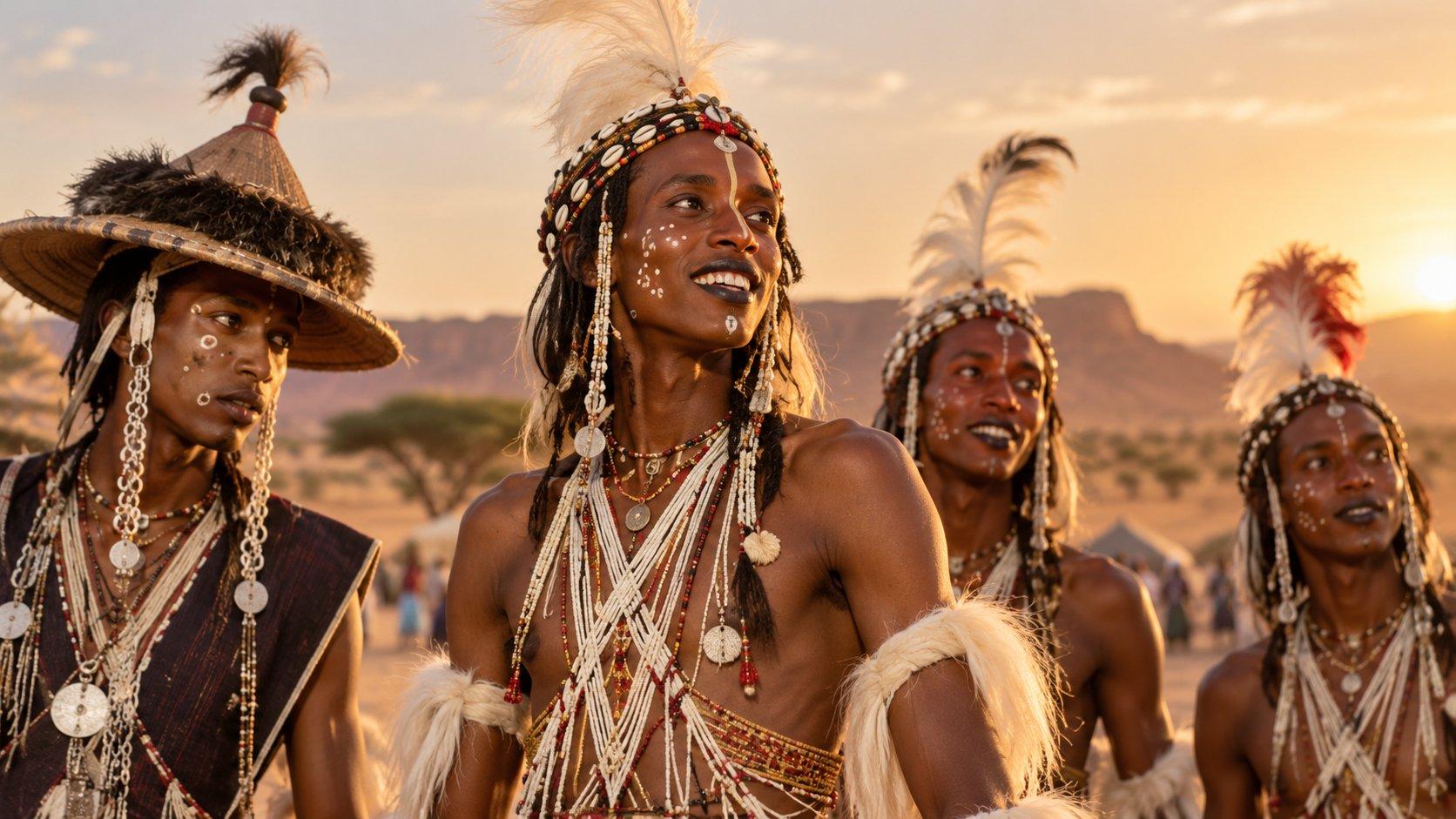
Women taking part in Umhlanga wear distinctive ceremonial dress, including beaded ornaments, skirts and accessories. Men participating in ceremonies may wear animal skins, feathers, shields and other traditional regalia.
These clothes are not merely costumes chosen for tourists. They are part of ceremonial identity and can communicate age, social position, participation in a particular group and the occasion itself.
Beadwork has a long history across southern Africa, and in Eswatini it appears prominently in both traditional dress and contemporary craft. Beaded jewellery and accessories are also sold as locally made products, creating a connection between cultural expression and the country's creative economy.
The meaning of particular garments or bead patterns can vary according to context, so it is better to understand Swazi dress as a living cultural practice than as a fixed code in which every colour has one universal meaning.
Festivals, Ceremonies and Rites of Passage
Umhlanga is only one part of Eswatini's ceremonial calendar.
Another major ceremony is Incwala, usually held around December and January according to the traditional calendar. It is closely centred on the King and is associated with renewal, cleansing and kingship. The ceremony includes different stages, including the Little Incwala, the gathering of regiments and the preparation and cutting of the sacred shrub known as lusekwane.
The symbolism is different from Umhlanga. While Umhlanga is associated with young women, the Queen Mother and the presentation of reeds, Incwala places the King at the centre of a ritual cycle concerned with renewal and royal authority.
Other customs involve marriage and family relationships. Lobola, the transfer of cattle or other agreed value in connection with marriage, has historically formed part of marriage negotiations among Swazi families, although the precise practice can vary between families and circumstances.
Together, these ceremonies show how age, marriage, family, royalty and community organisation have historically been connected in Swazi society.
A Detail Most People Don't Know
Sobhuza II holds one of the most extraordinary records in royal history.
He ruled for more than 82 years, from 1899 until his death in 1982, making his reign the longest verifiable monarchical reign on record.
His life spanned an extraordinary period of change. He was born during the late 19th century, became king as a child, lived through the establishment of British colonial rule, witnessed the development of modern political institutions and eventually became the monarch of an independent Swaziland.
That long reign also helps explain why Sobhuza II remains such a significant figure in the country's modern history. He was not only a traditional ruler whose authority survived colonialism. He was also the monarch who shaped the political system that emerged after independence and who used cultural institutions, including national ceremonies involving young people, as part of his effort to strengthen the monarchy.
Eswatini Today
In this section
A traditional ceremony can draw international visitors while remaining meaningful to the people taking part.
The ceremonies that made the country internationally recognisable are still part of public life.
Umhlanga continues to bring thousands of young women to the royal residence, while Incwala remains one of the country's major traditional ceremonies. In 2024, Eswatini's Parliament recorded an eight-day Umhlanga programme and estimated that around 100,000 spectators attended, while noting that spectator numbers vary from year to year.
The ceremonies also continue to change in how they are experienced. They remain rooted in traditional institutions, but they now take place in a country with modern schools, businesses, churches, media organisations, tourism companies, elected representatives and a population connected to the wider world.
That mixture is visible in the same cultural calendar. A young woman can participate in Umhlanga and live an otherwise thoroughly contemporary life. A traditional ceremony can draw international visitors while remaining meaningful to the people taking part. A country with a long royal history can have a modern Parliament while the monarchy continues to hold substantial political authority.
Eswatini's culture is therefore easiest to understand when these different layers are seen together. The reeds, the songs, the cattle, the beadwork, the royal residences, the churches, the ceremonies and the contemporary festivals all belong to a society that has continued to adapt while keeping many of its older institutions visible.
And at the centre of that cultural life, the royal household remains present. Umhlanga brings young women to the Queen Mother's residence each year. Incwala brings regiments and communities together around the King. Both ceremonies continue to make the monarchy something people encounter as part of national life, rather than something confined to history books.