Explore Lesotho’s history and culture, from Moshoeshoe I and Thaba Bosiu to Basotho blankets, music, food, traditions, wool and mohair.
There is a reason Lesotho is known as the “Kingdom in the Sky.”
The country sits at unusually high elevation. Its lowest point is about 1,400 metres above sea level, making Lesotho the only independent country in the world in which every part of its territory lies above 1,000 metres. Much of the country is higher still, rising into the Maloti and Drakensberg mountain ranges. Its highest point, Thabana Ntlenyana, reaches 3,482 metres.
Lesotho is also unusual in another way. It is completely surrounded by South Africa. There is no coastline and no international border with any other country. The mountains that give Lesotho its distinctive geography have therefore always been part of a much larger question: how does a small country maintain its own political identity when it is enclosed by a much larger neighbour?
That question has deep historical roots.
The modern Basotho kingdom emerged during one of the most unsettled periods in nineteenth-century southern Africa. In the early 1800s, warfare, migration and political upheaval were reshaping communities across the region. Out of this period, Moshoeshoe I built a political community that eventually became the Kingdom of Lesotho.
His achievement was not based on the mountains alone. The mountains provided protection, but political survival required something more complicated: military defence, diplomacy, alliances, the incorporation of displaced communities, control of livestock and land, and the ability to negotiate with much larger powers.
That combination still helps explain why Lesotho has such a strong sense of historical continuity.
The Land Before the Kingdom
Long before Lesotho became a kingdom, people were already living in the area.
The territory was inhabited by communities associated with the Khoisan before the arrival and expansion of Bantu-speaking peoples. Over time, Sotho-Tswana-speaking communities became established across the region. The Basotho therefore did not appear suddenly as a single people in the nineteenth century. The political community that came to be known as the Basotho developed through a much longer process of settlement, interaction and political consolidation.
The early nineteenth century brought particularly intense disruption.
This period is often described using the terms Lifaqane in Sesotho and Mfecane in other southern African historical writing. The terms refer broadly to a period of warfare, migration, displacement and political upheaval that affected large parts of the region. Older accounts sometimes explained the upheaval mainly through the expansion of the Zulu kingdom under Shaka, but historians have debated the causes and scale of these changes for decades. Competition over land and resources, drought, political consolidation and conflict between different groups all formed part of the wider picture.
It was within this unsettled environment that Moshoeshoe rose to prominence.
Moshoeshoe I and the Making of a Kingdom
In this section
The plateau rises above the surrounding landscape and has steep sandstone cliffs that make access difficult.
Moshoeshoe, later known as Moshoeshoe I, emerged as a political leader among Sotho-speaking communities during the early nineteenth century.
By the early 1820s, he had established a stronghold at Butha-Buthe. He later moved to the plateau now known as Thaba Bosiu, where he established a settlement that became the centre of his growing political community. Lesotho’s own government dates the emergence of the present kingdom as a unified polity to this period, with 1822 often given as the year associated with Moshoeshoe’s establishment of his mountain stronghold.
The choice of Thaba Bosiu was practical.
The plateau rises above the surrounding landscape and has steep sandstone cliffs that make access difficult. For a community facing repeated attacks, the physical shape of the mountain provided a defensive advantage. Thaba Bosiu became both a refuge and a political centre.
According to Basotho tradition, the name means “Mountain of the Night.” Stories associated with the mountain say that it appeared to grow taller during the night, making it even harder for enemies to conquer. That is a cultural tradition rather than a literal explanation of the mountain's geology, but it captures the way Thaba Bosiu entered Basotho historical memory.
The mountain was difficult to capture in practical terms as well.
Moshoeshoe faced attacks from several groups during this period. In 1828, forces associated with the Amangwane attacked the stronghold. The Batlokoa followed in 1829. In 1831, forces led by Mzilikazi, who had broken away from the Zulu kingdom and founded the Ndebele kingdom to the north, also attacked Thaba Bosiu and were repulsed.
The important point is not that every military threat disappeared. It is that no attacking force succeeded in capturing Thaba Bosiu during Moshoeshoe's lifetime.
The mountain gave Moshoeshoe time, but defence alone could not build a kingdom.
How Moshoeshoe Built Political Community
In this section
Moshoeshoe incorporated different Sotho-speaking communities and other displaced people into his growing polity.
Moshoeshoe's political achievement was partly military and partly diplomatic.
People displaced by the conflicts of the period sought protection in areas under his control. Moshoeshoe incorporated different Sotho-speaking communities and other displaced people into his growing polity. Accounts of his leadership also emphasise the use of alliances, marriage relationships, negotiation, generosity and the distribution of land and cattle.
This meant that the Basotho political community grew through more than conquest.
That distinction is useful because nineteenth-century southern African state formation was rarely a straightforward story of one ruler defeating everyone around him. Political authority could be built through protection, alliance, incorporation and negotiation as well as warfare. Moshoeshoe had to maintain relationships with communities that had their own leaders and histories while also responding to external military threats.
His reputation for diplomacy later became particularly important when European settlers and colonial authorities expanded their influence in the region.
Missionaries also became part of this changing environment. Moshoeshoe welcomed missionaries into his territory, and missionary activity contributed to the development of schools, literacy, translation and printing in the kingdom. Christianity eventually became deeply established among the Basotho, although traditional beliefs and practices did not disappear.
The relationship between Moshoeshoe's kingdom and European powers was complicated. The growing presence of Boer communities and the expansion of the Orange Free State created repeated territorial conflicts. By the middle of the nineteenth century, Moshoeshoe was negotiating with powers whose military and political resources were far greater than his own.
From Basutoland to Lesotho
The political survival of Moshoeshoe's kingdom eventually became tied to British colonial power.
In 1868, Basutoland became a British protectorate after Moshoeshoe appealed for British protection during conflict with the Orange Free State. The territory was later annexed to the Cape Colony in 1871 before being placed under direct British Crown control in 1884. It remained a separate British territory rather than becoming part of the Union of South Africa when that union was created in 1910.
That history is important when looking at the map of southern Africa today.
South Africa surrounds Lesotho, but Lesotho did not become a province of South Africa. Basutoland remained a separate colonial territory and eventually became the independent Kingdom of Lesotho on 4 October 1966.
Independence did not mean the country's relationship with South Africa suddenly disappeared.
The two countries share geography, transport routes, economic ties and a long history of migration. For generations, many Basotho men travelled to South Africa for work, particularly in the mining industry. This migration shaped household incomes, family arrangements and patterns of movement across the border.
Lesotho's geography also created another form of economic connection with South Africa: water.
A Country That Exports Water
In this section
The Lesotho Highlands Water Project was established through a treaty signed by Lesotho and South Africa in 1986.
The mountains that make Lesotho difficult to cross also contain an important resource.
The Lesotho Highlands Water Project was established through a treaty signed by Lesotho and South Africa in 1986. Its purpose is to harness water from the Lesotho highlands, transfer it through dams and tunnels to South Africa's Gauteng region, and use parts of the system to generate hydroelectric power in Lesotho. Phase I was completed in 2003 and inaugurated in 2004. Phase II is currently under construction.
The project is therefore much more than a series of dams.
It is a long-term bilateral infrastructure arrangement between two countries with very different sizes and economic structures. Lesotho receives payments for the water it supplies, while South Africa receives water for the Gauteng region, one of its most important industrial and urban areas.
Phase II is expanding the system around the Polihali area and involves new dams, tunnels and associated infrastructure. The project has also required compensation, resettlement and livelihood-restoration programmes for communities affected by construction.
The water project illustrates a recurring feature of Lesotho's modern history. The country's physical environment can be difficult and economically limiting, but the same mountains also provide resources that are valuable far beyond its borders.
The People of Lesotho
A person from Lesotho is a Mosotho. The plural is Basotho.
The population is relatively homogeneous compared with many African states, with Basotho forming the overwhelming majority. Sesotho is the principal language of everyday communication, while Sesotho and English are the country's official languages.
The word Basotho refers to more than nationality in the narrow legal sense. It also carries linguistic and cultural meaning, connecting people through language, historical memory, social practices and shared institutions.
Religion is another part of contemporary Basotho life.
Around 80 percent of the population is Christian, with the Roman Catholic Church the largest Christian denomination. Protestant and independent churches are also significant. Indigenous beliefs and practices continue to exist alongside Christianity, and traditional forms of healing remain part of cultural life.
For many Basotho families, therefore, Christianity and older cultural practices are not necessarily treated as completely separate worlds. Their relationship varies from family to family and from community to community.
Botho and Social Responsibility
One concept often discussed in Basotho culture is botho.
The word is related to ideas of humaneness, respect, responsibility and the recognition of other people's humanity. It is sometimes compared with the better-known southern African concept of ubuntu. The comparison can be useful, although the two traditions should not be treated as identical.
The important idea is that a person's conduct is understood partly through their responsibilities to other people.
This way of thinking can be seen in the importance placed on community, hospitality, respect for elders and collective participation in major events. These values are not unique to Lesotho, and they should not be presented as if every Basotho person behaves according to one fixed cultural code. They are better understood as recurring ideals within Basotho social and ethical traditions.
Food: Maize, Sorghum and Livestock
Food in Lesotho reflects the country's agricultural traditions and highland environment.
Papa, a stiff maize meal, is a staple food and is commonly eaten with vegetables, meat or other accompanying dishes. Sorghum also has an important place in Basotho food traditions. One traditional preparation is motoho, a fermented sorghum porridge.
Livestock have long been important for both food and wealth. Cattle, sheep and goats have economic and social value, and livestock can feature in marriage arrangements, ceremonies and household livelihoods.
Sorghum beer also has a place in traditional social life and ceremonies.
The importance of livestock becomes even clearer when looking at one of Lesotho's major economic industries.
Wool, Mohair and the Mountain Economy
Lesotho's highlands support large numbers of sheep and Angora goats, whose wool and mohair have become important export products.
According to the International Fund for Agricultural Development, wool and mohair account for almost two-thirds of Lesotho's agricultural exports and contribute significantly to the livelihoods of around 45,000 rural Basotho families. The industry is particularly important in rural and mountainous districts where poverty levels are high.
Mohair comes from Angora goats, while wool comes from sheep. Both fibres connect small-scale livestock farmers in Lesotho to international markets.
The industry has also developed a complicated relationship with South Africa. For years, Basotho producers have been connected to brokers, processing facilities and auction systems across the border. Efforts to strengthen local value chains have therefore focused not only on producing fibre but also on improving quality, processing, marketing and the income farmers receive from their animals.
This is one reason livestock remain so significant in the cultural imagination of Lesotho. They are part of food systems and rural livelihoods, but they are also tied to wealth, status and social obligations.
The Basotho Blanket
In this section
During the late nineteenth century, the trading firm Frasers became an important part of the blanket trade.
Few objects express Basotho identity as visibly as the blanket.
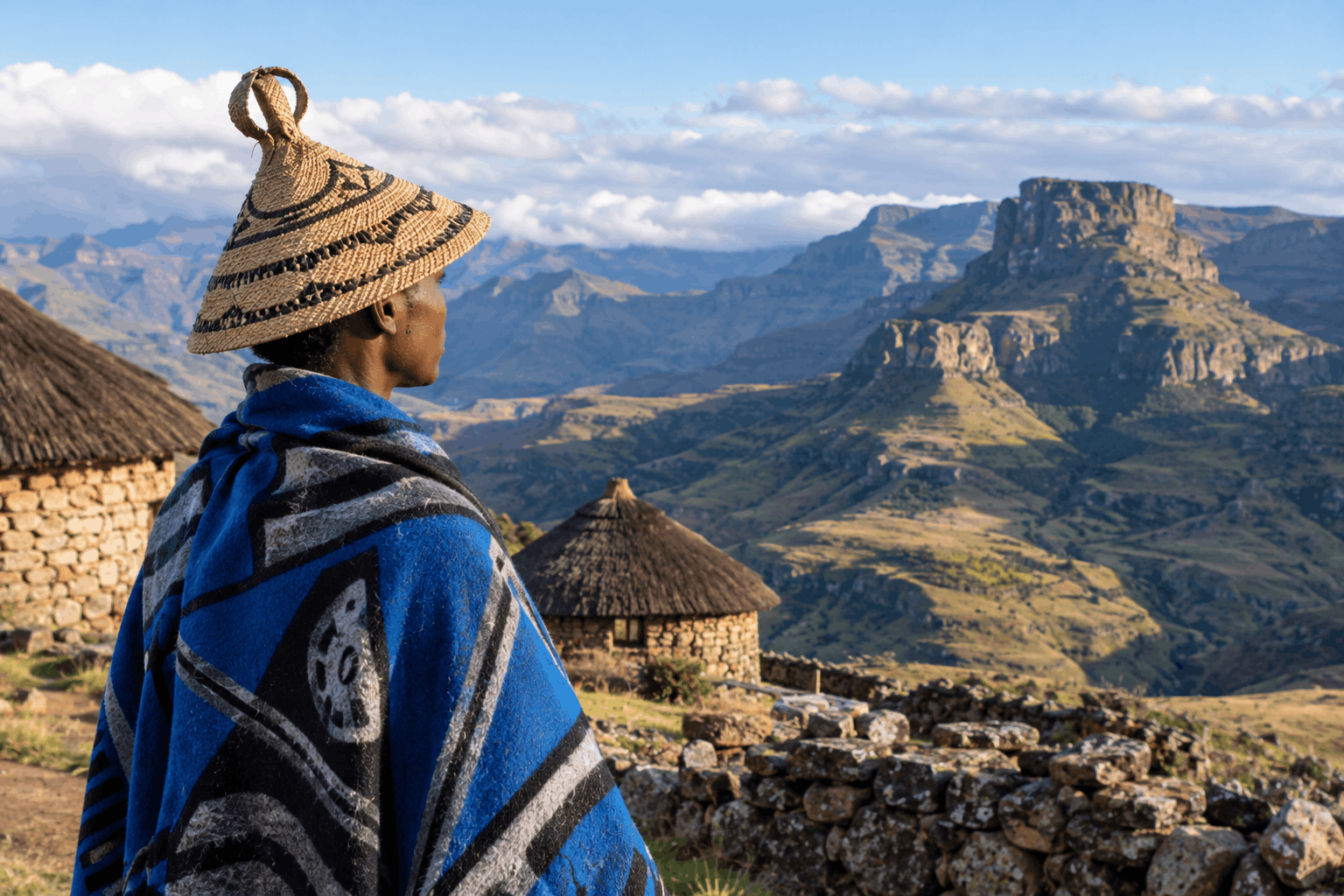
Blankets are worn for warmth, but their meaning goes far beyond protection from the cold. They appear in everyday life, ceremonies, celebrations and other important moments. Different designs and types of blankets can carry social meanings, and some are associated with particular occasions or forms of prestige.
The history of the blanket is older and less straightforward than the popular story sometimes suggests.
The British Museum describes the Basotho blanket tradition as dating back to the nineteenth century, with the history commonly associated with the 1860s and with a European-made blanket presented to Moshoeshoe I. Research into the early history is more cautious, however. Historical records indicate that European traders and missionaries were already bringing factory-made blankets into southern Africa in the decades before the 1860s, and several different stories exist about how blankets became established among the Basotho.
What is clearer is what happened afterwards.
Blankets gradually became part of Basotho dress and helped replace or supplement older forms of clothing made from animal skins. Over time, they acquired meanings that were specifically Basotho. A commercially manufactured European product became integrated into local social life and was given meanings that could not be reduced to its original purpose as a trade good.
One of the best-known types is Seana Marena, commonly translated as “King's Blanket.”
The British Museum identifies Seana Marena as a prestige range and records designs including the Poone, associated with maize, and Chromatic. The blanket tradition also includes ranges such as Victoria England, Malakabe, Morena, Sefate, Motlatsi and Kharetsa.
The commercial history is equally interesting.
During the late nineteenth century, the trading firm Frasers became an important part of the blanket trade. In the 1880s, it arranged for blankets specifically intended for Basotho customers to be manufactured by Wormald and Walker. The Victoria England brand was introduced in 1897. The blanket therefore developed through a combination of local cultural adoption and commercial adaptation by European manufacturers responding to a Basotho market.
Today, the blanket remains recognisable as a Basotho cultural symbol, although how it is worn depends on the occasion, generation and setting.
Music, Dance and Oral Tradition
Music in Lesotho includes instruments, dances and forms of oral poetry with long histories.
The lesiba is a traditional musical instrument associated particularly with pastoral communities. Historical descriptions connect it with shepherds and rural life, where it could provide entertainment while herders were with their animals.
Dance is also an important part of Basotho cultural expression.
Mokhibo, for example, is a women's dance traditionally performed while kneeling. Its distinctive posture is part of what makes it recognisable within Basotho performance traditions.
Another important form is lithoko, often translated as praise poetry. Lithoko can celebrate individuals, recount achievements, preserve memories of conflict and political leadership, and communicate social commentary. Because it is an oral literary tradition, the poems can preserve historical memory without functioning like modern written history. They can contain praise, interpretation and selective remembrance alongside references to real people and events.
Famo represents a much later musical development.
It is associated with Basotho migrant and urban life, particularly the experience of Basotho communities working and living in South Africa. Its history shows how cultural expression has continued to develop alongside migration, labour and changing urban life.
The Mokorotlo
The mokorotlo is one of Lesotho's most recognisable national symbols.
It is a traditional Basotho hat with a distinctive conical shape. Its form is commonly associated with Mount Qiloane, a small mountain near Thaba Bosiu whose shape resembles the hat.
The mokorotlo appears in national symbolism and is part of the visual language through which Lesotho presents itself.
The symbolism makes sense when viewed alongside the country's history. Thaba Bosiu, Qiloane and the mountains are not just geographical features in the national imagination. They are connected to the history of Moshoeshoe, the formation of the Basotho kingdom and the idea of a people whose political centre developed in the highlands.
Weddings, Initiation and Funerals
Some of the most important cultural traditions in Lesotho are connected to major stages of life.
Lebollo, traditionally described as an initiation institution, has historically marked the transition to adulthood for young men and women. Its form and importance have changed over time, particularly as Christianity, formal education, urbanisation and changing social expectations have influenced Basotho society.
Marriage traditions also vary.
Historically, marriage could involve negotiations between families and the transfer of lobola or bridewealth, with cattle playing an important role in many communities. Contemporary marriage practices are more varied, and cash and other forms of contribution can now be involved.
Funerals have a similarly strong communal dimension.
Migration across the border with South Africa means that family members may live and work far from their home communities. When a death occurs, relatives may travel significant distances to return home for funeral rites and family gatherings. In this way, movement across the Lesotho-South Africa border is part of the practical reality of many Basotho families.
Thaba Bosiu Today
Thaba Bosiu remains one of the most important historical sites in Lesotho.
The plateau contains the remains associated with Moshoeshoe I and the early Basotho kingdom, and its location near Maseru makes it an important site for understanding the country's political history. The Lesotho government describes the ruins there as dating from the nineteenth-century reign of Moshoeshoe I and identifies the nearby Mount Qiloane as an enduring national symbol.
The mountain also remains part of national remembrance.
Moshoeshoe's Day, observed on 11 March, commemorates the death of Moshoeshoe I in 1870. Independence Day is celebrated on 4 October, marking independence from British rule in 1966.
These dates place two different moments of Lesotho's history side by side: the nineteenth-century formation of the Basotho kingdom and the twentieth-century achievement of national independence.
What Lesotho Still Carries
In this section
Moshoeshoe built political authority through defence, alliances, diplomacy and the incorporation of communities.
Lesotho can look small on a map, but its history is not small.
The country emerged from a period of warfare and displacement in nineteenth-century southern Africa. Moshoeshoe built political authority through defence, alliances, diplomacy and the incorporation of communities. Thaba Bosiu provided a defensible centre from which that political community could survive repeated attacks. Later, British rule preserved Basutoland as a separate territory, and that territory eventually became the independent Kingdom of Lesotho in 1966.
The legacy of that history can still be seen in ordinary things.
A Basotho blanket can carry social and ceremonial meaning. A mokorotlo can represent a national identity that connects contemporary Lesotho with Thaba Bosiu and Mount Qiloane. Wool and mohair link mountain livestock farmers to international markets. Sesotho remains central to everyday communication. Lithoko continues to preserve forms of oral poetry and historical memory. And the highlands themselves continue to shape the country's economy, infrastructure and relationship with South Africa.
Lesotho's mountains therefore tell only part of the story.
The country was shaped by people who had to live with those mountains, defend themselves from the conflicts around them, build relationships across communities and negotiate with powers far larger than their own. The result is a country whose modern identity still carries visible traces of its nineteenth-century origins, while continuing to change through migration, religion, commerce and everyday life.