Explore Botswana culture through the kgotla, traditional leadership, food, music, languages, beliefs, crafts and the history shaping modern Botswana.
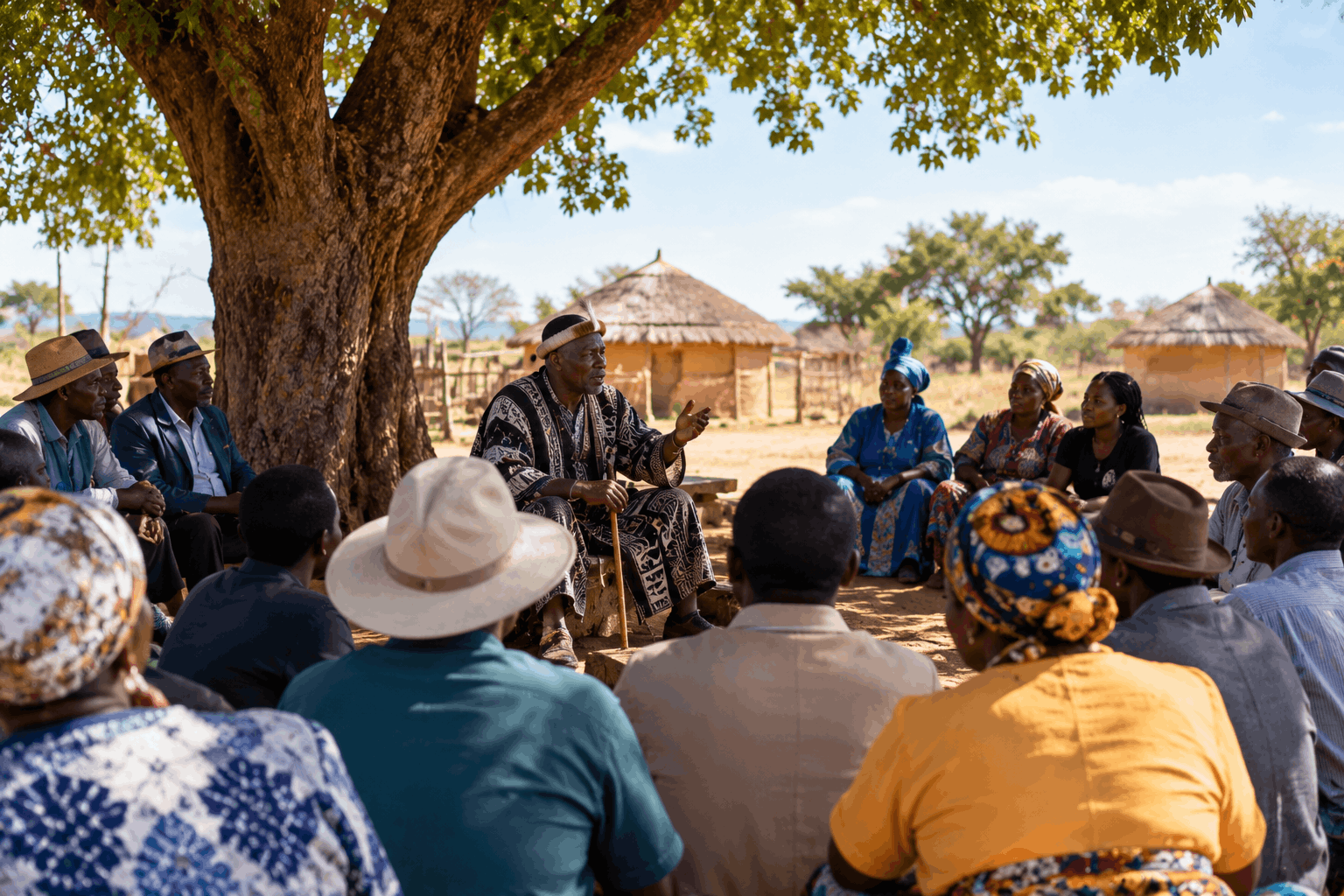
Beneath a large shade tree at the centre of a village, people gather at the kgotla.
The setting can look informal, but the meeting has a serious place in community life. The kgotla is a traditional public forum where people come together to discuss matters affecting their community, hear disputes, share information and present their views to the kgosi, the traditional leader. In Botswana today, the government still describes the kgotla as a place where community members can discuss, deliberate and make decisions about issues that affect them.
That does not mean every meeting waits until every person present has spoken. The important feature is the opportunity for public discussion. The kgosi or another person leading the meeting guides the proceedings, people speak in turn, and the views expressed become part of the discussion from which a decision may emerge.
For someone encountering Botswana for the first time, the kgotla offers a useful place to begin understanding the country. It brings together several parts of Botswana's history at once: the authority of traditional leaders, community consultation, customary law, social hierarchy and the country's modern system of representative government.
The institution is old, but the way it operates has changed.
Where the culture came from
In this section
The word Motswana is commonly used for an individual citizen of Botswana and Batswana for citizens collectively.
Botswana is a large, mostly dry country in southern Africa, bordered by South Africa, Namibia, Zimbabwe and Zambia. Much of its territory lies within the Kalahari Basin, and the country's communities developed ways of living around very different environments, from cattle-raising areas in the east and south to the wetlands of the Okavango in the north-west.
The country's name is closely connected to the Tswana-speaking peoples who became politically dominant across much of the territory. But Botswana was never culturally uniform. Different Tswana polities developed their own histories and institutions, while Kalanga communities, San communities, Wayeyi, Hambukushu, Herero, BaTlokwa, Balete and other groups also became part of the population of the territory that is now Botswana.
The word Motswana is commonly used for an individual citizen of Botswana and Batswana for citizens collectively. In that sense, being Batswana today is a national identity that includes people from different ethnic and linguistic backgrounds.
The political organisation of many Tswana communities historically centred on the kgosi, or chief, and the kgotla. The kgotla was more than a place where disputes were heard. It could function as a meeting place, a court, a venue for public announcements and a setting for discussing community affairs. The institution also helped connect the authority of the kgosi with the wider community.
This did not make the traditional system an equal forum in the modern democratic sense. Historical research shows that traditional dikgotla were strongly shaped by gender, age, status and political hierarchy. Women, young people and members of less powerful communities could have less access to decision-making than adult men from dominant groups. Research on contemporary dikgotla also shows that participation has changed, with women now attending and taking part in meetings, although patterns of participation can still vary.
That history helps explain why the kgotla has survived without remaining frozen in its older form.
When the British established the Bechuanaland Protectorate in 1885, they did not erase the authority of Tswana chiefs. The arrangement allowed traditional institutions to continue operating under colonial rule, although within a political system ultimately controlled by Britain.
The protectorate itself had an unusual beginning. Khama III of the Bangwato, Sebele I of the Bakwena and Bathoen I of the Bangwaketse sought British protection at a time when they faced pressure from surrounding colonial and settler interests. Their appeals helped lead to the creation of the Bechuanaland Protectorate. They wanted protection from external threats while retaining substantial authority over their own communities, although the resulting protectorate was still part of the British imperial system.
The three leaders later travelled to Britain in 1895, where they opposed proposals that could have brought their territories under the control of the British South Africa Company. Their mission became an important episode in the political history of what is now Botswana because it demonstrated the extent to which Tswana leaders were willing to negotiate directly with the British government to defend their authority.
The protectorate lasted for about 80 years. Bechuanaland became self-governing in 1965 and independent as the Republic of Botswana on 30 September 1966. Seretse Khama, a member of the Bangwato royal family, became the country's first president.
Seretse Khama's own life had already exposed some of the tensions surrounding race, colonial authority and traditional leadership.
He married Ruth Williams, a white British woman, in 1948. The marriage faced strong opposition in Bechuanaland and in neighbouring South Africa, where the apartheid government was deeply concerned about a neighbouring country having a Black African leader married to a white woman. Britain subsequently prevented Seretse Khama from returning to Bechuanaland for several years. He eventually returned in 1956, after which he entered national politics and later became president at independence.
By the time Botswana became independent, therefore, the country already had political institutions that connected traditional leadership, community consultation and the colonial administrative system. Independence introduced a constitutional state with elections, Parliament, an executive government and courts, while traditional institutions continued alongside it.
Botswana's Constitution and modern government did not grow out of the kgotla alone. The country's political system also reflects colonial administrative structures, constitutional development, elections, political parties, courts and the work of post-independence governments. At the same time, the continued presence of dikgotla means that traditional authority remains part of everyday public life. Botswana's government still maintains a Ministry of Local Government and Traditional Affairs, with responsibility for supporting traditional institutions and local governance.
This coexistence is one of the more distinctive features of Botswana's political history.
Ethnic groups and languages
In this section
Botswana's linguistic diversity is therefore greater than its national language arrangements might suggest.
The Tswana-speaking population is the largest cultural grouping in Botswana, but the country contains several communities with their own histories, languages and cultural traditions.
The major Tswana polities historically included the Bangwato, Bakwena, Bangwaketse, Bakgatla, Batawana, Barolong, Batlokwa and Balete. These communities were not identical. They had their own chiefly structures, settlements and histories, even though they shared closely related Setswana varieties and cultural practices.
The Kalanga are another major cultural community, particularly in north-eastern and central Botswana. Their language, Ikalanga, belongs to the Bantu language family but is distinct from Setswana. The country's north-west is also home to communities such as the Wayeyi and Hambukushu, whose histories are closely connected with the Okavango region.
Then there are the many communities commonly grouped under the terms San or Basarwa. These communities are linguistically and culturally diverse rather than a single people with one language or one tradition. Many San languages contain click consonants, but linguists do not generally treat "Khoisan" as one established language family in the same way that Bantu or Indo-European refers to recognised language families.
Botswana's linguistic diversity is therefore greater than its national language arrangements might suggest.
English is the official language of the country, while Setswana is the national language. Other languages are spoken within different communities, and many Batswana use more than one language in daily life.
This matters because language in Botswana can carry more than information. It can also signal community, family history and cultural belonging.
Religion and belief
In this section
The Setswana concept of Badimo, for example, refers to ancestral beings or spirits in traditional belief systems.
Christianity is widespread in Botswana, and churches are a visible part of community life. Missionaries became active in the region during the nineteenth century, and Christian institutions later became deeply connected with education, health services and public life.
Traditional religious ideas did not disappear alongside Christianity.
Among some communities, beliefs concerning ancestors, spirits and the moral responsibilities of the living remain part of cultural life. The Setswana concept of Badimo, for example, refers to ancestral beings or spirits in traditional belief systems.
There is also Botho, a concept associated with humaneness, respect, compassion, courtesy and responsibility toward other people. Botswana government institutions continue to use Botho as a national value. The Ministry of International Relations, for example, defines it through qualities including compassion, courtesy, selflessness and respect.
Botho is not a religion. It is better understood as an ethical idea about how a person should conduct themselves within society.
It can appear in ordinary interactions: greeting people properly, showing respect to elders, behaving with consideration toward others and recognising that individual conduct affects the wider community.
Traditional healing also remains part of cultural life for some Batswana. Traditional healers, often known as dingaka, may work with herbal knowledge, spiritual practices and other forms of indigenous healing. These practices exist alongside modern hospitals, clinics and biomedical medicine.
Among San communities, healing traditions can involve music, dance and altered states of consciousness. Practitioners and communities have their own understandings of these experiences, and anthropologists have documented their social and religious significance. They should be understood as cultural and spiritual practices rather than described as scientifically established explanations of illness.
Food
In this section
One of the most familiar staples is bogobe, a thick porridge generally made from grains such as sorghum or millet.
Botswana's food traditions developed around a relatively dry environment, cattle keeping, grain cultivation and the foods available in different ecological regions.
One of the most familiar staples is bogobe, a thick porridge generally made from grains such as sorghum or millet. It can be eaten with milk, vegetables, meat or other accompaniments.
Another well-known dish is seswaa, made from meat that is boiled until tender and then shredded or pounded. Beef is particularly associated with Botswana's food culture because cattle have long had economic and social importance.
For generations, cattle were more than a source of meat. They were a form of wealth, a source of milk and an important part of social life. Cattle could be involved in marriage arrangements, ceremonies and exchanges between families.
Meat therefore has a place in Botswana's cuisine that cannot be separated entirely from the country's history of cattle keeping.
In the Okavango region, food traditions also reflect the wetlands and floodplains. Phane, the edible mopane caterpillar, is traditionally collected and dried or cooked in different ways. It is seasonal, and its availability depends on local ecological conditions.
Other traditional foods include dikgobe, a mixture of beans and grains, and bogobe jwa lerotse, a sorghum-based preparation associated with the lerotse melon.
The food can tell you something about the country without needing to turn every dish into a symbol. Sorghum points toward long-established grain cultivation. Beef reflects the importance of cattle. Phane shows how people have made use of seasonal foods in woodland environments. In the north, fish and foods associated with the Okavango add another dimension.
Music, dance and art
Botswana's musical traditions vary considerably between communities.
The segaba is one of the country's best-known traditional string instruments. It is played with a bow and has long been associated with Tswana musical traditions. Other instruments include the setinkane, a small thumb piano, and different drums, whistles and percussion instruments.
Vocal music is also important. Songs can accompany ceremonies, work, celebrations and social gatherings. Praise poetry, known as praise singing in English descriptions and connected with traditions of public praise and performance, has historically been used to honour chiefs, leaders and other people.
Kalanga communities have their own musical traditions, while San communities maintain distinctive forms of singing, dancing and musical performance. These traditions can serve different purposes, including ceremony, healing, social gatherings and the transmission of knowledge.
Music and dance therefore cannot be reduced to a single national style.
They are part of the way different communities remember, celebrate, teach and participate in collective life.
Clothing, textiles and craft
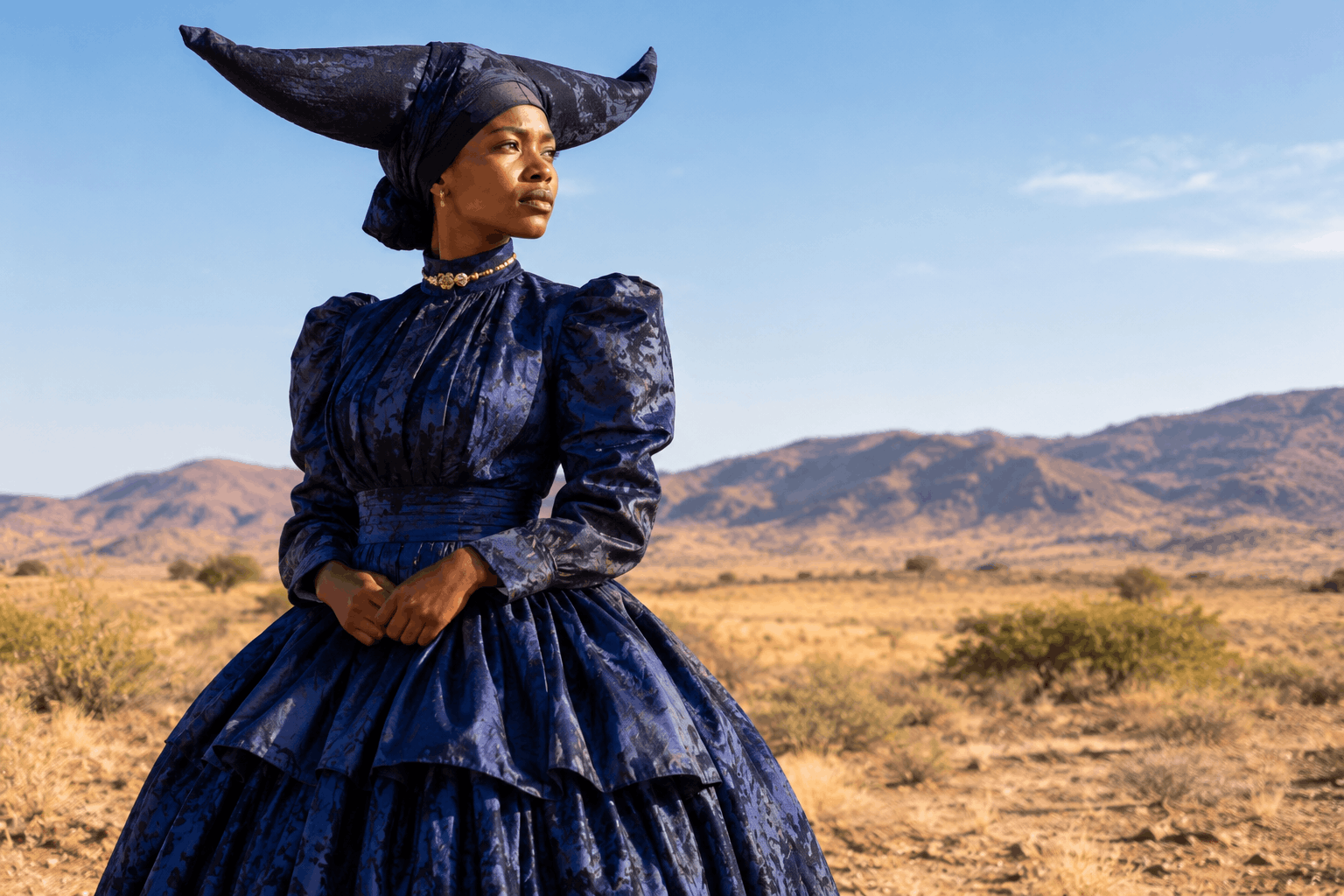
There is no single outfit that represents all of Botswana.
Leteisi, a printed fabric also widely known elsewhere in southern Africa as shweshwe or German print, is commonly used for dresses and other clothing. It can appear at weddings, celebrations, cultural events and formal gatherings. Different colours and patterns are chosen for different occasions, and contemporary designers have incorporated the fabric into modern clothing.
Craft traditions are equally varied.
In northern Botswana, especially around the Okavango region, basket weaving is an important craft associated with communities including the Bayei and Hambukushu. Baskets are traditionally made from plant materials such as mokola palm and may be decorated using natural dyes. They can be used for storage, carrying, winnowing and display.
The designs can also carry cultural associations, with forms and patterns drawing on animals, plants and features of the surrounding environment. Basketry has developed as a living craft, shaped by local knowledge as well as changing markets and tourism.
That combination is worth noticing. A basket made for sale to a visitor can still be produced using techniques and visual knowledge that belong to a much older local craft tradition.
Festivals, ceremonies and rites of passage
Ceremonies have long provided ways for communities to mark important stages of life.
Among Tswana communities, bogwera and bojale historically served as initiation institutions for boys and girls. They were associated with coming of age and could include instruction about social responsibilities, history, customs, relationships and expected behaviour.
The practices were disrupted during the colonial and missionary period, when Christian missionaries often opposed traditional initiation institutions. Their importance later declined in many communities, although aspects of these traditions have survived or been revived in some places.
Weddings and funerals remain significant social occasions in Botswana, often involving extended family and community participation. The scale of these events can reflect the importance placed on kinship and community responsibility.
The kgotla can also become part of major community events because it remains a recognised public gathering place.
There is a practical reason this institution has survived. People know where it is, who traditionally presides over it and what kind of public business belongs there. In modern Botswana, the kgotla can sit alongside elected local government structures, government officials and contemporary administrative systems.
A detail most people don't know
Far north-west in Botswana, the Tsodilo Hills rise from the Kalahari landscape as a group of enormous quartzite rock formations.
The site has an archaeological record stretching back at least 100,000 years, although that record is not continuous. It contains evidence of successive human occupation, environmental change and cultural activity over thousands of years.
Tsodilo is particularly famous for its rock art. UNESCO records more than 4,500 paintings, together with numerous engravings and other archaeological remains. Some of the paintings are associated with imagery of animals, people and activities, while the meanings of many individual works remain uncertain.
The significance of Tsodilo extends beyond the paintings themselves.
The hills continue to have spiritual importance for local communities, and UNESCO recognises their religious and symbolic significance. The archaeological record also shows that different human communities used and revisited the area over very long periods.
This is why it is difficult to describe the rock art as belonging to one single moment in history. Tsodilo preserves traces of repeated human presence, while the site's meaning continues to develop through the communities that live around it.
The history behind the Kalahari
In this section
Historically, access to traditional public decision-making was shaped by gender, social position and political status.
Botswana's story also includes difficult questions about land, ethnicity and whose knowledge counts in national institutions.
San communities have faced long-term economic and political marginalisation. They are not a single ethnic group, and the term Basarwa is used in Botswana for a number of different communities. Their traditional relationships with land have often been difficult to reconcile with state systems of land administration and wildlife conservation.
One of the most contested examples is the Central Kalahari Game Reserve.
The reserve was established in 1961, and some residents were later relocated outside it. The Botswana government has presented the relocations in terms of conservation, settlement policy and the cost of providing services to scattered settlements. Human-rights bodies, however, raised serious concerns about the process and about the impact on residents' cultural and economic ties to the reserve.
The issue became the subject of prolonged legal and political disputes.
It is an important part of understanding Botswana because the country's reputation for stable institutions does not mean every community has experienced those institutions in the same way.
The kgotla itself has also had limits. Historically, access to traditional public decision-making was shaped by gender, social position and political status. Research on kgotla participation has found that women and members of some minority communities historically had less opportunity to participate, while contemporary meetings have become more inclusive.
That history sits alongside the institution's continuing importance.
Diamonds changed the country
In this section
Government revenues from diamonds helped finance infrastructure, education, health services and public administration.
When Botswana became independent in 1966, it was one of the world's poorer countries. Agriculture and livestock were important sources of livelihood, and the new government had a very small domestic revenue base.
Then diamonds changed the economic picture.
The Orapa diamond mine began production in the early 1970s, followed by other major mines including Letlhakane and Jwaneng. Government revenues from diamonds helped finance infrastructure, education, health services and public administration.
The economic story is sometimes reduced to the discovery of diamonds, but the way the resource was governed also mattered. Botswana negotiated substantial state participation in the diamond industry through Debswana, its joint venture with De Beers, allowing a significant share of mining revenues to flow into public finances.
The results were substantial. Botswana moved from a very low-income economy at independence to an upper-middle-income country.
The benefits have not been evenly distributed, and diamonds have also left Botswana highly dependent on a single export sector. The World Bank now describes the extractives-driven model as reaching its limits, while recent weakness in global diamond demand has put pressure on government revenue and economic growth.
That gives the country's present economic debate a very different shape from the early decades after independence. The question now is how Botswana can diversify while maintaining the public services and living standards built during the diamond era.
A country still negotiating its traditions
In this section
The setting may still be recognisable, but the conversations taking place there belong to the present.
Botswana's political life has also continued to change.
For 58 years after independence, the Botswana Democratic Party governed the country. In the October 2024 election, the Umbrella for Democratic Change won a parliamentary majority, bringing the first change of governing party since independence. Duma Boko was sworn in as president on 1 November 2024.
That transition happened through the country's established electoral system and constitutional institutions.
It also happened at a time when the country was dealing with weaker diamond revenues, high unemployment and pressure to diversify the economy.
The kgotla remains part of this changing political landscape.
It has survived colonial rule, independence, the growth of Parliament and political parties, the expansion of local government and major changes in Botswana's economy. The people who attend it today are not living under the same social conditions as those who attended a kgotla a century ago. Women participate. Government officials attend. Modern development programmes are discussed. Community members use the institution to raise local concerns and receive information.
The setting may still be recognisable, but the conversations taking place there belong to the present.
That may be the most useful way to understand Botswana's culture. Its traditions have endured because people have continued to use, reinterpret and sometimes contest them. The kgotla remains a public meeting place. Botho remains a recognised national value. Traditional music, food, craft and ceremony continue alongside churches, schools, Parliament, businesses and modern cities.
Botswana's culture is therefore easier to understand when its older institutions are seen in motion, shaped by the people who continue to live with them.