Christianity has been part of African history for nearly two thousand years. It was established in parts of North and Northeast Africa centuries before European colonialism. The New Testament itself includes people from Africa among the earliest followers and witnesses of the Christian movement. Simon of Cyrene, a man from North Africa, carried Jesus' cross. An official from the kingdom of Kush was baptised after hearing the Gospel from Philip. Christians from Egypt and Cyrene were also among the people who helped spread the faith beyond Jerusalem.
Christian communities grew quickly in the centuries that followed. Alexandria became one of the most important centres of early Christian scholarship. North African cities such as Carthage produced influential Christian writers, while Egypt became a major centre of Christian monasticism. By the fourth century, Christianity had become established in the kingdom of Aksum, and by the sixth century Christian kingdoms had developed along the Nile in Nubia.
The Christianity that became dominant across much of sub-Saharan Africa came much later. From the nineteenth century onward, European missionaries established churches, schools and mission stations across large parts of the continent, often within the wider colonial system. The expansion was enormous. It also produced African teachers, translators, clergy and church movements that went on to shape Christianity in their own right.
The history of Christianity in Africa begins long before the missionary era, but the missionary era transformed its reach across the continent. Its history stretches from the early Christian communities of Egypt and North Africa to Aksum and Nubia, Kongo, the missionary era and the African churches that emerged from it.
Africans in the pages of the New Testament
Africa is present in the New Testament from the beginning of the Christian movement. In Matthew, Joseph takes the infant Jesus to Egypt to escape King Herod. Later, when the apostles preached in Jerusalem at Pentecost, Acts says that people from Egypt and from the parts of Libya around Cyrene were among those who heard them. These passages do not show that Christian churches had already been established in Africa. They do show that people from Africa were present in the early Christian movement.
One of those people was Simon of Cyrene. Matthew, Mark and Luke all mention him as the man who was made to carry Jesus' cross. Cyrene was a major city in North Africa, in what is now Libya. Mark also says that Simon was the father of Alexander and Rufus, which may mean that the family was known to the people for whom his Gospel was written. Paul later sends greetings to a man named Rufus in his letter to the Romans, and some scholars have suggested that he may have been Simon's son. But the Bible does not give us enough information to know whether they were the same person. It also does not describe Simon's appearance or tell us whether he was Jewish or Gentile. What it does tell us clearly is that he came from Cyrene in North Africa.
Acts later tells the story of another man from Africa. Philip meets an official from the kingdom of Kush who was travelling home from Jerusalem. The man was responsible for the treasury of the Kandake, a title used by the queens of Kush. He was reading the book of Isaiah when Philip approached him and explained the passage. The official then asked to be baptised, and Philip baptised him.
The word "Ethiopian" in this passage can be misleading to a modern reader. The "Ethiopia" mentioned in Acts is generally understood to refer to the ancient kingdom of Kush, south of Egypt, in the region of present-day Sudan. It does not necessarily mean the modern country of Ethiopia.
The passage also does not clearly tell us what the man's relationship to Judaism was. He had travelled to Jerusalem to worship, which suggests that he was already interested in the Jewish faith. He may have been a Gentile who worshipped the God of Israel, or he may have had another connection to Judaism. Because of this uncertainty, some scholars describe him as the first Gentile convert in Acts, while others avoid making that claim.
The Book of Acts does not tell us what happened to the man after his baptism. We therefore cannot say from the biblical account whether he returned to Kush or helped spread Christianity there.
Africa appears again when Acts describes the Christian community in Antioch. Among the leaders of that church were Simeon, who was called Niger, and Lucius of Cyrene. Lucius is specifically associated with Cyrene, while the meaning of the name Niger is less certain. Niger is the Latin word for "black", but that does not by itself prove that Simeon was African. He may have had an African background, but the text does not tell us enough to establish his origin.
People from North Africa were also involved in spreading Christianity beyond its earliest Jewish communities. Acts says that Christians from Cyprus and Cyrene were among those who began preaching about Jesus to Greeks in Antioch. Cyrene was in North Africa, so this places people from an African city among those helping Christianity spread beyond its original Jewish setting.
Africa was also home to people who became active members and teachers in the early Christian movement. Acts tells us about Apollos, a Jew from Alexandria in Egypt. He was a skilled speaker who knew the Jewish Scriptures well and later taught Christians in Corinth. His story gives us an early example of someone from a major African city taking part in the spread of Christianity outside Africa.
In the centuries that followed, Alexandria became one of the most important centres of Christianity in the ancient world. Christians in the city developed important schools of Christian teaching, produced influential writers and debated major questions about Christian belief.
Alexandria and the Egyptian desert
Early Christian tradition says that Mark, who is traditionally associated with the Gospel of Mark, came to Alexandria around AD 43 and began preaching there. Historians cannot independently confirm this date because there are few surviving records from the earliest period of Christianity in Egypt.
By then, Alexandria had become an important centre of Christian teaching. Christians in the city studied the Bible, discussed questions about Christian belief and trained people to teach others. This included the Catechetical School of Alexandria, an institution associated with Christian education in the city. Later writers described it as one of the earliest Christian schools of its kind, although historians do not agree on exactly when the school began. One of its most famous teachers was Origen, who was born in Alexandria around AD 185. He became one of the most influential Christian thinkers of the early centuries and wrote extensively on the Bible and Christian theology.
Christianity in Egypt was also developing outside the cities. From the third century, some Christians began moving into the Egyptian desert to live lives of prayer, fasting and self-denial. These early monks and hermits became known as the Desert Fathers and Mothers. Anthony the Great, who lived from about AD 251 to 356, became one of the most famous of them. Another Egyptian Christian, Pachomius, developed communities in which monks lived and worked together rather than living entirely alone. He established several monasteries for men and women and helped develop this form of communal monastic life.
The Egyptian desert became one of the most important centres of early Christian monasticism. Monastic communities also developed in places such as Syria and Palestine, but the practices that developed in Egypt had a major influence on Christian monasticism in both the eastern and western parts of the Christian world.
Carthage, Hippo and the Latin West
In present-day Tunisia, Algeria and parts of Libya, Christianity became established during the Roman period. The Roman province of Africa was centred on what is now Tunisia and also included parts of neighbouring Libya and Algeria at different points in its history. Christian gravestones found in Algeria have been dated to AD 227 and 238. By the early third century, Christian communities existed in both towns and rural areas and included people from different social classes.
The size of these communities can also be seen in the number of bishops attending church councils. About 18 bishops from Numidia, a region of present-day Algeria and Tunisia, attended a council at Carthage around AD 220. More than 80 bishops attended another council in 256. By the early fourth century, there were at least 70 bishops in Numidia alone, according to Britannica. These figures do not tell us exactly how many Christians lived in the region, but they show that Christianity had developed an extensive network of churches and leaders.
North Africa also produced some of the most influential Christian writers of the Latin-speaking world. Tertullian, who lived in Carthage, became the first major Christian writer in Latin. His writings helped establish theological vocabulary that later became important in Western Christianity. He used the Latin word trinitas when writing about the Father, Son and Holy Spirit. The idea and the Greek word for the Trinity had appeared earlier in Christian writing, but Tertullian is the earliest known writer to use the Latin form.
Cyprian, who became bishop of Carthage in AD 248, was another major North African Christian writer. He wrote extensively about the unity of the church and the responsibilities of Christian leaders. He was executed during the persecution of Christians under the Roman emperor Valerian in AD 258. He is sometimes described as being of Berber ancestry, although the evidence for his ethnic background is not certain.
The lives of ordinary Christians in North Africa are also preserved in some remarkable early records. In AD 203, Perpetua, a young Christian woman, and Felicity, an enslaved Christian woman who was pregnant, were executed in Carthage. Their imprisonment and execution are described in a surviving account that includes writing attributed to Perpetua herself. It is one of the earliest surviving Christian texts associated with a woman writer.
Christianity in North Africa also faced serious internal disputes. One of the most important was the Donatist controversy, which began after the persecution of Christians under the emperor Diocletian. The dispute centred partly on whether Christians and clergy who had surrendered sacred books or otherwise cooperated with the authorities during persecution could later return to church leadership. Donatus Magnus became one of the movement's leading figures, and the dispute divided North African Christians for generations.
By the fourth and fifth centuries, North Africa had produced another figure whose influence reached far beyond the region. Augustine was born in Thagaste, in what is now Algeria, and later became bishop of Hippo. He wrote extensively about Christianity, the Bible, human nature, society and the relationship between faith and reason. His works became enormously influential in Western Christianity.
North African churches also took part in discussions about which books should be recognised as Scripture. The Synod of Hippo in AD 393 and later councils at Carthage in AD 397 and 419 recorded lists of biblical books that became influential in the Latin-speaking church. These were regional councils, not gatherings that settled the biblical canon for all Christians, and the process had developed over a much longer period in different Christian communities. Their lists nevertheless show the important role North African churches played in the development of Latin Christianity.
The kingdom of Aksum and the first Christian coins
Further south, Christianity became established in the kingdom of Aksum, which covered parts of present-day northern Ethiopia and Eritrea. Aksum was an important trading kingdom on the Red Sea, with connections to the Roman Empire, Arabia and India.
The story of how Christianity reached Aksum is preserved in accounts written by early Christian historians. Rufinus and Socrates Scholasticus tell of a young man named Frumentius from Tyre who was shipwrecked and taken to the Aksumite court. He became a Christian and eventually became a teacher to the royal family. According to Rufinus, Frumentius later travelled to Alexandria, where Athanasius, the bishop of Alexandria, appointed him bishop and sent him back to Aksum. King Ezana, who had known Frumentius, later became a Christian.
The exact date of Ezana's conversion is uncertain. Historians generally place it sometime in the fourth century, with proposed dates ranging from around AD 333 to the middle of the century. By the middle of the fourth century, Christianity had become established at the Aksumite court and was being publicly supported by the king.
There is also physical evidence of this change. Earlier Aksumite coins carried a disk and crescent symbol. Under Ezana, the coins began to carry the Christian cross instead. These coins are among the earliest surviving examples of royal coinage to use the cross as a public symbol of Christianity. Aksum was already connected to Christian communities through its trade and diplomatic relationships, but the appearance of the cross on the kingdom's coins shows that Christianity had become part of the kingdom's public identity.
Aksum's Christianity was not simply directed by the Roman Empire. Around AD 356, the Roman emperor Constantius II wrote to Ezana asking him to support a different church leader instead of Frumentius. Ezana did not follow the request. This shows that the Aksumite kingdom had its own Christian leadership and made its own decisions about the church.
Archaeology provides further evidence of early Christianity in the kingdom. Remains of early church buildings have been found at Aksum, Matara and Adulis. Some were built in the basilica style used by Christians elsewhere in the Roman world, showing that Aksum was part of a much wider Christian architectural tradition.
Christianity continued to develop in Ethiopia long after the time of Ezana. Later Ethiopian tradition tells of nine monks who arrived from the eastern Roman world around the end of the fifth century and helped establish monasteries. One of them was associated with Abba Garima, whose monastery is connected with the famous Garima Gospels, among the oldest surviving illuminated Christian Gospel manuscripts.
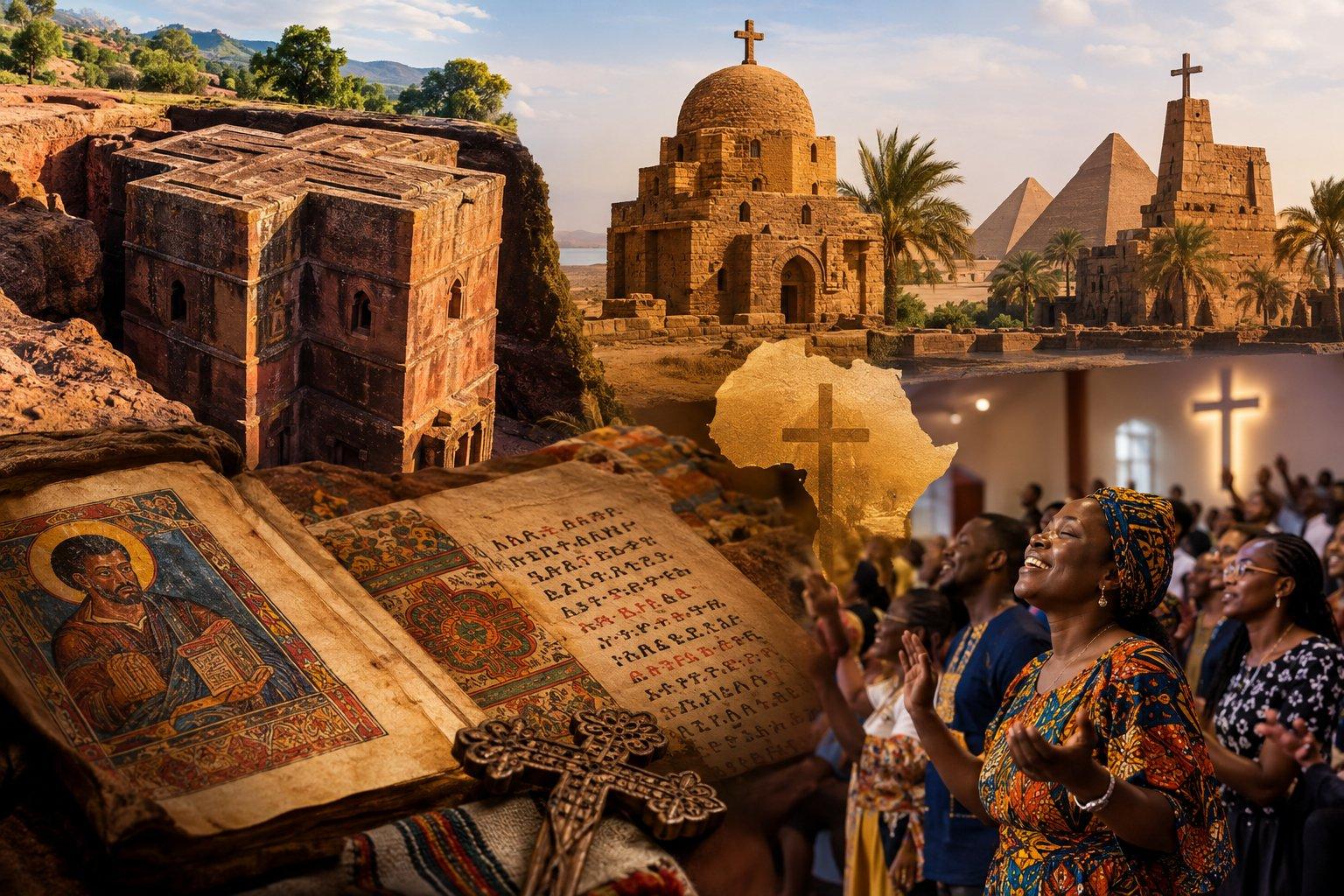
Centuries later, during the twelfth and thirteenth centuries, King Lalibela of the Zagwe dynasty is associated with the construction of eleven churches carved directly into the rock. UNESCO describes the churches as a "New Jerusalem." Their construction took place during a period when travel to Jerusalem had become more difficult, and the churches became an important centre of pilgrimage in Ethiopia. They remain places of pilgrimage today.
The Garima Gospels
The monastery associated with Abba Garima holds three Ge'ez manuscripts known as the Garima Gospels. They contain the four Gospels of the New Testament. For many years, Western scholars believed the manuscripts were produced around the eleventh century or later. Radiocarbon testing changed that picture. Samples from Garima 2 produced dates ranging from about AD 390 to 570, while samples from Garima 1 produced dates ranging from about AD 530 to 660.
Radiocarbon dating measures the age of the parchment rather than the exact moment when the manuscript was written or painted. The results therefore do not give a precise date for when the books were produced. Even so, they show that the parchment used for Garima 2 is remarkably old. The manuscript is among the oldest surviving illuminated Christian Gospel books and has sometimes been described as a possible candidate for the earliest complete illuminated Gospel manuscript. Another major early example, the Rabbula Gospels from Syria, is dated to AD 586.
The Garima manuscripts contain the four Gospels, not the whole Bible. The oldest surviving complete Bibles are much earlier Greek manuscripts from the fourth century. Codex Sinaiticus, dating to around the middle of that century, contains the oldest surviving complete copy of the New Testament, while Codex Vaticanus is also generally dated to the fourth century.
The early dating of the Garima Gospels has also changed how scholars think about the history of Christianity in Ethiopia. The manuscripts suggest that the Ge'ez translation of the Gospels may have been produced considerably earlier than was once assumed. They therefore provide important evidence for the age and development of Ethiopian Christian literary culture.
The Nubian kingdoms of the Nile
North of Aksum, along the Nile, several kingdoms in Nubia became Christian during the sixth century. The region was home to Christian communities before this period, but Christianity became closely tied to the ruling kingdoms during these centuries. The Nubian kingdom of Nobatia converted around AD 543 after a mission led by a monk named Julian, who was supported by the Byzantine empress Theodora. Her husband, Emperor Justinian, supported a rival mission. Makuria became Christian later in the sixth century, probably around AD 570, while Alodia, farther south along the Nile, adopted Christianity around the same period. Bishop Longinus is associated with the conversion of Alodia.
Christian rulers then governed much of the Nubian Nile Valley for centuries. Makuria, whose capital was Dongola, became the most powerful of these kingdoms. When Arab forces moved south from Egypt after the Muslim conquest of Egypt, Nubian armies resisted them. Arab campaigns against Nubia in 641 and 652 did not result in conquest. The two sides eventually reached an agreement known as the baqt, which established a long period of diplomatic and economic relations between Nubia and Egypt. The exact terms of the agreement and how it operated over the centuries remain subjects of historical debate.
Christian kingdoms continued to rule parts of Nubia for hundreds of years. Archaeological research has documented churches, monasteries, paintings, inscriptions and other evidence of Christian life across the region. The Christian period is generally dated from the sixth century until the fourteenth century, when the Nubian kingdoms declined and Muslim rulers gradually took control. In other words, Christianity was not a brief episode in Nubian history. Christian kingdoms existed along the Nile for roughly eight centuries, from the sixth century into the fourteenth.
What happened in Egypt and the north
If Christianity had been established in Africa for so long, why are most of the continent's Christians now found in sub-Saharan Africa?
The answer is partly that Christian communities in North Africa and parts of the Nile Valley became smaller over the centuries, while Christianity expanded much more widely across sub-Saharan Africa from the nineteenth century onward.
Egypt is the clearest example. When Arab forces conquered Egypt in AD 641, most Egyptians were still Christian. Britannica notes that the new rulers did not initially try to force Egyptians to convert and that the churches were generally allowed to continue. The process of Arabization and conversion to Islam took place gradually over several centuries. Egypt did not become a Muslim-majority country immediately after the conquest. Historians generally place the transition to a Muslim majority around the thirteenth or fourteenth century, although the exact timing cannot be established with certainty.
Christianity nevertheless remained in Egypt. The Coptic Orthodox Church survived through these changes and remains a major Christian community in the country today. Estimates of the Coptic population vary considerably, with figures often placed around 10 percent of Egypt's population. The exact proportion is disputed because Egypt does not regularly publish detailed official religious census data. Across the Middle East and North Africa as a whole, Pew Research Center estimates that Christians make up about 4 percent of the population.
Ethiopia followed a different path. The Ethiopian Christian tradition continued from the Aksumite period and developed into one of Africa's oldest continuously existing Christian communities. In Nubia, however, the Christian kingdoms eventually declined. By the fourteenth century, the Christian kingdoms along the Nile had largely disappeared.
Meanwhile, Christianity was spreading into other parts of the continent on a much larger scale. European missionary activity expanded rapidly from the nineteenth century, establishing churches, schools and mission stations across West, Central, East and Southern Africa. African Christians also became teachers, translators, clergy and church leaders, and local Christian movements developed alongside the missionary churches.
The Kingdom of Kongo provides an important earlier example of Christianity taking root in Central Africa before the nineteenth-century missionary expansion.
Kongo in 1491
The Kingdom of Kongo, centred in west-central Africa around the lower Congo River, provides an important example of Christianity taking root in sub-Saharan Africa before the nineteenth-century missionary expansion.
Portuguese contact with Kongo began in the late fifteenth century, and in 1491 King Nzinga Nkuwu was baptised, taking the Christian name João I. The Oxford Research Encyclopedia of African History describes the adoption of Christianity in Kongo as a decision made by Kongo's political leadership, followed by a longer process in which Christian ideas were interpreted and incorporated within Kongo society.
João I later moved away from Christianity and returned to established religious practices. His son Afonso I, who ruled from 1509 until 1543, took a much stronger interest in Christianity and supported its expansion in the kingdom. Schools were established in the capital, Mbanza Kongo, and members of the royal family received Christian education. Afonso's son Henrique was sent to Portugal for further education and was consecrated as a bishop in 1518, becoming the first known Kongo bishop.
Afonso also left an unusually detailed written record of his relationship with Portugal. In letters sent to Portuguese officials and church authorities between 1509 and 1541, he discussed Christianity, education, trade and the treatment of his kingdom by Portuguese merchants. Some of his letters strongly criticised the Portuguese slave trade and the actions of Portuguese traders operating in Kongo.
Christianity therefore became established in Kongo through a process that involved African rulers, institutions and political decisions, as well as Portuguese missionaries and advisers. Kongo became a Christian kingdom more than three centuries before the formal European partition of Africa in the late nineteenth century.
The missionary era and how it shaped memory
The largest expansion of Christianity in sub-Saharan Africa took place during the nineteenth and twentieth centuries. Two Pew Research Center datasets give an idea of its scale. Pew's 2011 report estimated that Christians made up about 9 percent of the population of sub-Saharan Africa in 1910 and about 63 percent in 2010. Pew's 2025 report, using updated methods and a different historical reconstruction, puts the Christian share at about 62 percent in 2020. It also estimates that Christians in sub-Saharan Africa accounted for only about 1 percent of the world's Christian population in the early twentieth century.
Missionary activity in sub-Saharan Africa began before most European governments established formal colonial rule. Missionaries were working in Sierra Leone and along parts of the West African coast in the early nineteenth century, and similar efforts developed elsewhere during the century. Economic historian Nathan Nunn describes a major expansion of missionary activity during the late nineteenth and early twentieth centuries. He also argues that the spread of colonial rule played an important role in the missionaries' later success.
The relationship between Christianity and colonialism was therefore complicated. Some missions were established before colonial governments arrived, but colonial rule later created political and economic conditions that made missionary work easier in many places. Churches, mission schools, colonial administrations, commercial networks and Western education increasingly operated alongside one another. Nunn cites anthropologist Robin Horton, who argued that Europeans came to be associated with political and technological power and that Christianity became associated with a wider system that included Western education, colonial government, commerce and industry.
By the time European powers met at the Berlin Conference in 1884 and 1885 to establish rules for their claims in Africa, Christian missions had already been active in parts of sub-Saharan Africa for decades. The expansion and consolidation of colonial rule that followed changed the environment in which many missions operated. In some territories, missionaries gained greater access to communities and worked alongside colonial institutions. In others, African Christians and local rulers negotiated, resisted or reshaped the work of missionaries.
Some African historians have therefore examined Christian missions as part of the wider history of European expansion. Walter Rodney, in How Europe Underdeveloped Africa (1972), argued that missionary activity could serve European interests and should be understood alongside colonial economic and political structures. His argument forms part of a broader African critique of the relationship between Christianity, colonialism and European power.
The way this history has been written has also changed. Scholars such as Thomas Oden have criticised what they regard as Eurocentric approaches to African Christian history, particularly approaches that place European missionaries at the centre of the story. Older accounts could give disproportionate attention to the nineteenth-century missionary expansion while treating the much older Christian traditions of Egypt, Ethiopia and Nubia separately. When the earlier history is left out, the nineteenth-century missionary period can appear to be the beginning of Christianity in Africa rather than a major later phase in a much longer history.
What the research says about missions and conversion
Researchers have also tested the relationship between missionary activity and later Christian affiliation using historical data. Nathan Nunn's 2010 paper in the American Economic Review used a map of missionary stations published in 1924 and compared historical missionary activity with modern survey data. He found a positive relationship between the presence of missionaries in a region and the likelihood that people from the groups studied identified as Christian generations later. The historical map also recorded the languages into which missionaries had translated the Bible, allowing Bible translation to be included in the analysis.
The finding is consistent with the historical timeline. Areas that had greater missionary activity in the late nineteenth and early twentieth centuries tend to have larger Christian populations today. But the data has limits. Nunn's study concerns the last two centuries, so it cannot tell us anything about the Christian kingdoms of Nubia in the sixth century or the much older Christian communities of Egypt and North Africa. It also measures missionary presence and related historical factors more easily than it measures how African Christians understood, adapted or reshaped Christianity themselves. A statistical relationship between two things does not, on its own, establish that one caused the other.
Other research has examined education. Economic historians have found long-term relationships between missionary activity, the expansion of schooling and later educational outcomes. Felix Meier zu Selhausen has shown that the spread of mass education depended not only on missionary activity but also on local conditions, including demand for schooling and the availability of African teachers. African teachers made up much of the teaching workforce in mission schools and played an important role in expanding education beyond the small number of European missionaries themselves.
Africans leading the way
African Christians were active participants in the missionary era, not simply recipients of European missions. Samuel Ajayi Crowther is one of the clearest examples. Born around 1809 in Yorubaland, he was captured by slave raiders as a child and sold to Portuguese slave traders. A British naval patrol intercepted the ship and freed him. He was taken to Sierra Leone, where he was baptised and educated through the Church Missionary Society.
Crowther became a linguist, translator and Christian leader. He translated the New Testament and the Book of Common Prayer into Yoruba and published a Yoruba vocabulary and other language materials. He also produced works relating to Igbo and Nupe. In 1864, he was consecrated as an Anglican bishop and became the first African bishop of the Anglican Church in West Africa. His appointment was significant, but it did not mean that African control of the missions followed. The Dictionary of African Christian Biography describes the resistance Crowther faced from some European missionaries and the eventual dismantling of parts of the African-led mission structure he had helped build.
African Christians also established independent churches and movements of their own. In the Belgian Congo, Simon Kimbangu, a Baptist mission catechist, began preaching and conducting healing services in 1921. His movement attracted large numbers of followers, which alarmed the Belgian colonial authorities. Kimbangu was arrested later that year, convicted of charges including sedition and sentenced to life imprisonment. His followers continued the movement, which eventually developed into the Kimbanguist Church. The church was admitted to the World Council of Churches in 1969.
Other major African-founded Christian movements developed during the same period. In South Africa, the Zion Christian Church became one of the country's largest African-initiated churches. In Nigeria, the Aladura movement produced churches that placed strong emphasis on prayer, healing, prophecy and direct spiritual experience.
Historians of world Christianity have drawn attention to this longer process of African participation and leadership. Andrew Walls was an important figure in the development of the academic study of world Christianity and wrote extensively about the movement of Christianity's demographic centre towards the Global South. Lamin Sanneh likewise argued that Christianity was reshaped as it moved across cultures. European missionaries brought institutions, translations and particular theological traditions, but African communities interpreted Christianity in their own languages and social settings and eventually produced churches, leaders and theological traditions of their own.
Christianity in Africa by the numbers
The most recent large Pew Research Center dataset covers the period from 2010 to 2020. During those years, the population of sub-Saharan Africa grew by 31 percent, reaching about 1.1 billion people. The number of Christians rose to about 697 million, representing 62 percent of the region's population. Muslims numbered about 369 million, or roughly one-third of the population.
Sub-Saharan Africa also accounted for a growing share of the world's Christians. In 2020, about 30.7 percent of the world's Christians lived in the region, compared with 22.3 percent in Europe. In 2010, the figures were 24.8 percent and 25.8 percent respectively. On these measures, sub-Saharan Africa moved ahead of Europe during that decade. Nigeria and the Democratic Republic of the Congo each had more than 92 million Christians in 2020.
Demographic change is an important part of this growth. Pew points to the region's younger population and higher fertility rates as major factors. The median age in sub-Saharan Africa was about 19 in 2020. Religious switching also affects the numbers, while Christian populations in some parts of Europe have declined through a combination of ageing, lower fertility and people leaving Christianity.
Other estimates produce different totals. The Center for the Study of Global Christianity, cited by Lifeway Research, estimates that Africa had fewer than 10 million Christians around 1900, more than 383 million by 2000 and about 734 million in 2020. These figures should not be treated as directly interchangeable with Pew's estimates because the organisations use different methods, definitions and geographic boundaries.
There is also an important limitation to what these numbers tell us. Pew's figures are based primarily on people's religious self-identification. They tell us how many people identify as Christian, but they do not measure how frequently those people attend church, how strongly they hold Christian beliefs or how they practise their faith.
Reading the two chapters together
Taken together, these periods give a much longer history of Christianity in Africa. Christianity appears in the continent's earliest Christian records, and established Christian communities developed in parts of Africa within the first centuries of the faith. Aksum had a Christian court by the mid-fourth century, while Christian kingdoms ruled parts of the Nubian Nile Valley from the sixth century onward. Christian writers in Alexandria and North Africa contributed to the development of Christian theology, and Egypt became one of the most important centres of early Christian monasticism. These developments took place within African societies long before the nineteenth-century European missionary expansion.
The later missionary era was a different stage of that history. Most Christians in sub-Saharan Africa today belong to communities whose major growth took place during the nineteenth and twentieth centuries, when missionary activity expanded alongside, and sometimes ahead of, European colonial rule. Historical research finds a relationship between missionary activity and later Christian affiliation. At the same time, African Christians were not simply passive recipients of missionary work. They translated the Bible, taught in mission schools, became clergy and church leaders, and established independent Christian movements. The Christianity that became widespread across sub-Saharan Africa was shaped by both European missions and African communities.
For readers who want to explore the history further, several works provide useful starting points. Thomas Oden's How Africa Shaped the Christian Mind argues for a much greater African contribution to early Christian thought than is often recognised, although some of its broader claims have been debated by scholars. Lamin Sanneh's work on Bible translation and Christianity in Africa examines how translation allowed Christian ideas to take root in African languages and communities. Andrew Walls' The Missionary Movement in Christian History provides a broader history of Christian expansion through missionary movements and the changing demographic centre of Christianity. For a shorter introduction to early Ethiopian Christianity, the Metropolitan Museum of Art's essay on Christianity in Ethiopia provides an accessible overview of the Aksumite period and later Ethiopian Christian art.