Discover the history of the Herero dress, from colonial-era clothing and the 1904–1908 genocide to its place in Herero identity and Namibia today.
There is a particular dress that can make a Herero woman immediately recognisable.
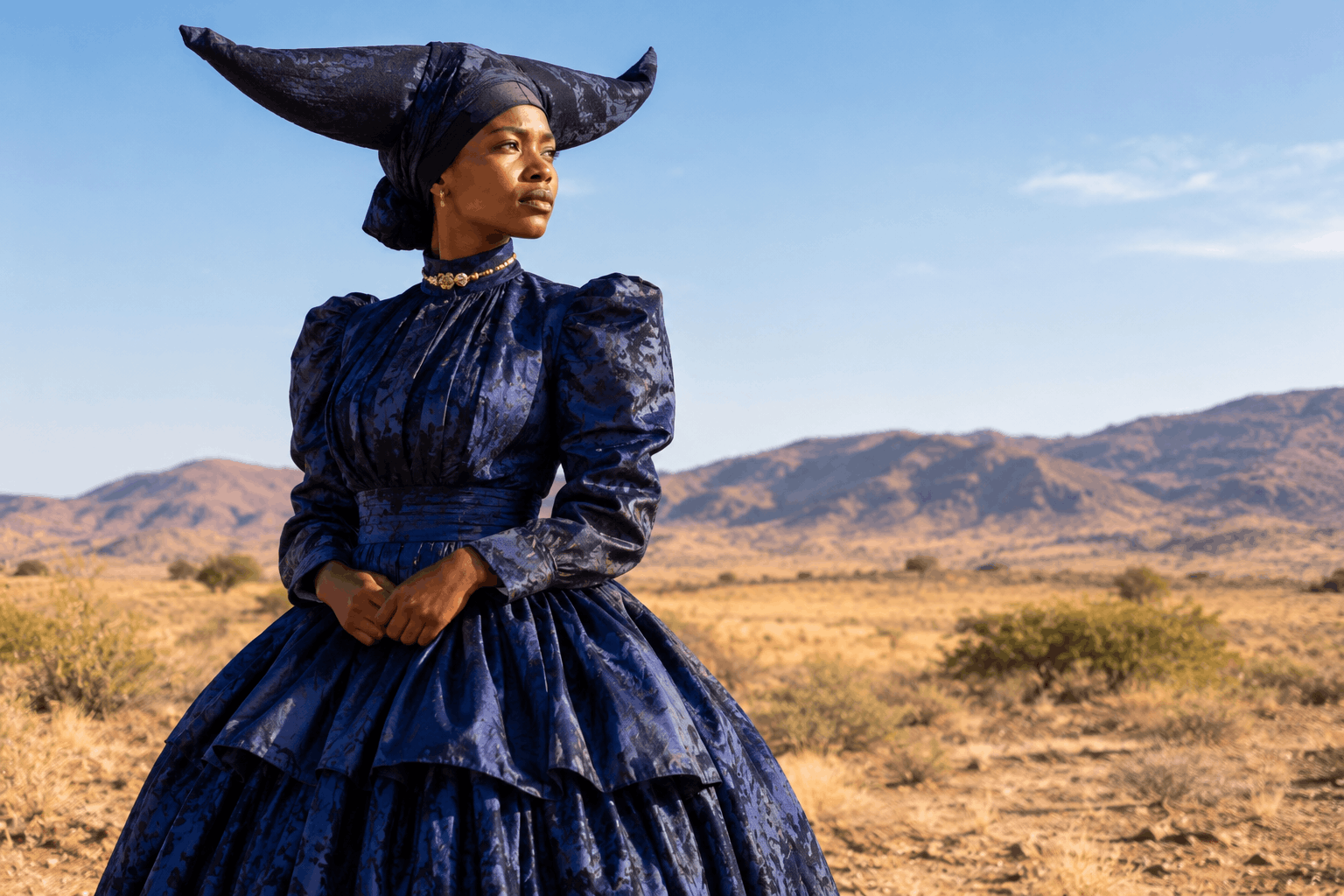
It is long, full and gathered into several layers, with a high neckline, covered arms and a skirt that reaches the ground. The headpiece worn with it is shaped to resemble the horns of cattle. At first glance, the dress looks unmistakably Victorian or European, and that is part of what makes its history so unusual. Herero women adopted European-style clothing in the late 19th century, influenced by missionaries and traders working in what was then German South West Africa. Over time, the dress was adapted into Herero life and came to represent Herero women's cultural identity.
The cattle-horn-shaped headdress gives the clothing another layer of meaning. Cattle have long held an important place in Herero society, including as a source of wealth, food and social status. The dress therefore developed into something that could carry several histories at once: European clothing styles, Herero cultural identity and the importance of cattle within Herero life.
That becomes particularly striking when you know what happened to the Herero people in the years that followed.
When Germany Took Control
In this section
Tensions between Herero communities and German colonial authorities eventually became an armed conflict in 1904.
Namibia's colonial history began long before independence in 1990. During the late 19th century, Germany established control over the territory it called German South West Africa. German settlers arrived, land was taken, and colonial authorities imposed new political and economic arrangements on communities that already had their own systems of authority, trade, land use and pastoral production.
For the Herero, whose economy was strongly connected to cattle, the loss of land was especially serious. Cattle needed grazing areas and access to water, so restrictions on land and movement affected much more than property ownership. They affected the ability of families and communities to maintain their livelihoods.
Tensions between Herero communities and German colonial authorities eventually became an armed conflict in 1904. The conflict was followed by a campaign of extreme violence against the Herero and Nama. German commander Lothar von Trotha issued an extermination order against the Herero in October 1904. A similar order was issued against the Nama in 1905. People were killed in battle and through deliberate expulsion, while others died from thirst, starvation, exposure and the conditions imposed in colonial camps.
The period from 1904 to 1908 is now widely described as the Herero and Nama genocide. Germany formally recognised the events as genocide in 2015, and its government later stated that it accepted moral and political responsibility for the crimes. The German government describes the period as a war of extermination and estimates that about 100,000 Herero and Nama people died.
The exact death toll is difficult to establish because colonial records were incomplete and the population had already been disrupted by war, displacement and disease. Historical estimates nevertheless indicate catastrophic population losses, particularly among the Herero.
The violence also changed the economic and social position of survivors. Land had been seized, cattle herds had been devastated and many people who survived were forced into systems of labour controlled by the colonial authorities.
That history gives the Herero dress another dimension. A European-style garment that was originally adopted during the colonial period became part of a cultural identity that survived the destruction of Herero communities and the loss of much of their land.
The Diamonds Came Later
In this section
The genocide and the diamond rush belong to the same broader colonial history, but they were separate developments.
There is another part of Namibia's colonial history that is often placed too close to the genocide: diamonds.
Diamonds were first discovered near Lüderitz in 1908, several years after the Herero uprising and the beginning of the genocide. A railway worker named Zacharias Lewala is credited with finding a stone near Kolmanskop, which he showed to his German supervisor, August Stauch. The discovery triggered a rush of prospectors into the area.
The location was extraordinarily difficult for mining. The region around Lüderitz is dry, windy and almost completely lacking in surface water. Yet the discovery transformed the southern coastal desert into a major diamond-producing area.
Within months, the German colonial government declared a huge restricted zone known as the Sperrgebiet, meaning "forbidden area", in order to control access to the diamond fields. The restricted area eventually stretched for hundreds of kilometres along the coast.
The timing matters. Diamonds did not cause the 1904 genocide because the major diamond discovery happened in 1908. The genocide and the diamond rush belong to the same broader colonial history, but they were separate developments.
By then, the German colonial state had already violently reorganised land, labour and political authority across much of the territory.
A Colony Became a Laboratory for Racial Ideas
In this section
The development of Nazi racial ideology involved many people, institutions and intellectual traditions.
The colonial period also produced another legacy that would later become significant in the history of European racial science.
In 1908, German physician and anthropologist Eugen Fischer travelled to what was then German South West Africa to study the Rehoboth Baster community. His research was conducted within the racial theories of his time and treated human populations through ideas about heredity, racial classification and "mixed" ancestry.
Fischer's work later became part of the history of German racial anthropology. He went on to hold an influential academic position in Germany and became associated with racial science during the Nazi period.
It would be too neat to describe his 1908 study as a direct blueprint for Nazi policy. The development of Nazi racial ideology involved many people, institutions and intellectual traditions. What can be documented is that colonial research such as Fischer's formed part of a wider European tradition of racial classification, and that some of the people and ideas involved in German colonial anthropology later existed within German academic and political institutions during the Nazi era.
Namibia therefore appears in the history of racial science in a way that extends beyond the violence of the colonial battlefield. The colony was also a place where Europeans classified, measured and studied African populations according to theories that treated race as a biological hierarchy.
Namibia Has Never Had Just One Culture
In this section
Namibia is home to more than eleven major ethnic communities, with different languages, histories and cultural practices.
It is easy to talk about "Namibian culture" as if the country has one shared tradition.
Namibia is home to more than eleven major ethnic communities, with different languages, histories and cultural practices. The Herero are one of these communities. The Nama, Damara, San and the various Aawambo communities have their own histories, while communities such as the Himba have developed distinctive traditions within the wider Herero-speaking world.
The Himba and Herero are closely related and share linguistic and historical connections, but their histories developed differently. The Himba became particularly associated with pastoral life in the Kunene region, while Herero communities experienced extensive displacement, colonial violence and later political changes.
That difference can be seen in clothing.
Himba women are widely recognised for their use of otjize, a mixture of red ochre and fat traditionally applied to the skin and hair. Their distinctive appearance is connected to local ideas about beauty, presentation and protection from the environment. Married women may also wear elaborate leather headpieces known as erembe. These traditions have continued while Himba communities have also adapted to schooling, tourism, wage work, drought and other contemporary pressures.
The visual contrast between Herero and Himba clothing can therefore be misleading if it is treated as evidence of completely separate origins. The two communities have historical connections, while their different environments, histories and social practices have produced distinctive forms of cultural expression.
The Aawambo Communities of the North
Northern Namibia has another major cultural centre in the Aawambo, also commonly written as Ovambo.
Aawambo is a broad grouping that includes several communities rather than a single homogeneous ethnic group. Among them are the Aakwanyama, Aandonga, Aakwambi, Aambalantu, Aangandjera, Aambadja and others.
Many Aawambo communities historically lived in the north of present-day Namibia, in an area where seasonal water, agriculture and cattle shaped everyday life. Mahangu, a type of pearl millet, has traditionally been one of the most important crops in the region. It can be ground into flour and used to make staple foods such as oshifima.
Food traditions also show how older practices continue alongside newer ones. Mahangu remains important, while modern Namibian food culture includes dishes such as kapana, grilled meat commonly sold at informal markets and food stalls.
This is also one of the places where Christianity became deeply connected with social change. Finnish Lutheran missionaries began arriving among Aawambo communities in the late 19th century. Their influence affected education, religion and social practices, including attitudes toward some traditional initiation ceremonies.
One example is Olufuko.
Olufuko and the Question of What Cultural Revival Means
In this section
The festival combined cultural displays and commercial activities with the revival of the initiation ceremony.
Olufuko is a female initiation tradition associated with Aawambo communities. Historically, the ceremony involved preparing girls for adulthood through instruction in domestic work and social expectations. The practice varied across communities and changed over time.
Christian missionaries strongly opposed female initiation. By the middle of the 20th century, the practice had disappeared from some communities and survived in more limited forms in others.
In 2012, the tradition became the centre of a national debate when the Olufuko Cultural Festival was launched in Outapi in the Omusati Region. The festival combined cultural displays and commercial activities with the revival of the initiation ceremony. Girls from several Aawambo communities participated.
Supporters presented the festival as a way of preserving cultural heritage and teaching younger generations about traditional practices. Critics, including the Evangelical Lutheran Church in Namibia and human-rights organisations, raised concerns about the treatment and representation of girls, including earlier practices associated with virginity and marriage.
The debate is useful because it shows that cultural preservation is not always a straightforward process. A tradition can carry history and community identity while also raising difficult questions about age, consent, gender and how an old practice should be adapted in contemporary society.
Olufuko is therefore more than a festival story. It shows how Namibians themselves continue to debate which traditions should be revived, which should change and who gets to decide what cultural preservation looks like.
The San and Namibia's Deep Archaeological Record
Long before the arrival of European colonists, pastoralists and later modern states, southern Africa was home to hunter-gatherer communities whose histories extend deep into prehistory.
Namibia contains some extraordinary evidence of these earlier societies.
At Twyfelfontein, known in the local Damara language as /Ui-//aes, thousands of rock engravings depict animals including rhinoceroses, elephants, giraffes and ostriches, along with human and animal footprints. UNESCO identifies the rock art in the site's core area as the work of San hunter-gatherers and describes the site as a record of ritual practices extending over at least 2,000 years. More than 2,000 figures have been documented.
The engravings are not just pictures of animals. Their arrangement and subject matter provide evidence about how hunter-gatherer communities understood animals, water, ritual and the surrounding environment. Some human and animal forms appear in ways that researchers have connected to ritual transformation and spiritual practices.
That makes Twyfelfontein particularly valuable. It gives researchers evidence of belief and social life from a period for which there are no written colonial records.
It also places Namibia's cultural history much further back than the arrival of European powers.
Music and Oral Memory
In this section
The country has long traditions of singing, drumming, dance and praise performance, with styles varying between communities.
Written archives tell only part of Namibia's history.
Oral traditions have preserved genealogies, historical memories, praise poetry, songs and accounts of migration and conflict. These forms of memory can preserve details that were never recorded by colonial officials, while also reflecting the perspective and priorities of the communities that transmitted them.
Music is particularly important across Namibia's cultural traditions. The country has long traditions of singing, drumming, dance and praise performance, with styles varying between communities.
Among Nama communities, for example, traditional musical practices include the use of the musical bow and other instruments, as well as forms of group singing and dance. Some of these traditions have been documented as part of Namibia's intangible cultural heritage.
These traditions are also living practices. People adapt them for churches, festivals, schools, recordings and contemporary performances. A song can carry an older form while being performed for a completely different audience.
That is one reason oral history is valuable alongside written archives. Colonial documents can tell us what officials recorded. Oral traditions can preserve memories and interpretations from communities that were being governed, displaced or described by those same officials.
Neither source is automatically complete. Reading them together gives a fuller historical record.
A Dress That Survived the Colonial System
In this section
Some outfits are worn for ceremonies and commemorations, while others are part of everyday cultural presentation.
The Herero dress now makes more sense when placed against this longer history.
European-style clothing arrived through colonial contact. Herero women adopted and adapted it, eventually turning a European-inspired form of dress into something strongly associated with Herero identity. The voluminous gown and cattle-horn-shaped headdress became especially recognisable elements of Herero women's ceremonial clothing.
The clothing has also changed over time. Contemporary Herero women may wear dresses in different colours and fabrics, with variations in sleeves, decoration, aprons and headwear. Some outfits are worn for ceremonies and commemorations, while others are part of everyday cultural presentation.
Herero men also developed distinctive ceremonial clothing. Following the war of 1904, Herero men adapted elements of German military uniforms for ceremonial use within Herero political and cultural movements. The result is another example of a colonial object being taken out of its original context and given a different meaning.
Clothing can preserve memory in a way that written history sometimes cannot.
A person wearing the dress is not necessarily recounting the entire history of colonialism. But the garment carries references to the period in which Europeans entered Herero society, to the transformations that followed, and to the community's continued existence after extraordinary loss.
The Past Is Still Part of Namibia's Politics
In this section
For many Herero and Nama representatives, the question was not only whether Germany would recognise the genocide.
The history of the Herero and Nama genocide is not confined to museums or history books.
It remains part of discussions about land, recognition, representation and reparations.
In 2021, Germany and Namibia announced a draft agreement in which Germany formally recognised the colonial atrocities of 1904 to 1908 as genocide and offered an apology. Germany also proposed €1.1 billion over 30 years for projects focused on reconstruction and development, particularly in areas affected by the genocide. The German government explicitly stated that the programme was not a payment from which legal claims for compensation could be derived.
That wording became one of the central issues in the debate.
For many Herero and Nama representatives, the question was not only whether Germany would recognise the genocide. It was also who had been represented in the negotiations, how descendants of affected communities would participate, and whether development funding could adequately address the consequences of genocide, land dispossession and economic marginalisation.
The proposed agreement therefore became controversial within Namibia itself. Different political leaders, traditional authorities and genocide-affected organisations have expressed different views about the negotiations and the proposed settlement.
The process remains unfinished. Germany's government continues to describe reconciliation as an ongoing process, and official German statements in 2025 and 2026 continued to refer to further discussions between the two countries.
This is why the history of the Herero dress cannot be separated completely from the present.
The garment belongs to contemporary Namibia. So do the arguments over land, historical recognition and how descendants of people affected by colonial violence should participate in decisions about their future.
Namibia's Culture Is Still Being Made
In this section
A headdress associated with cattle became part of a visual identity carried into ceremonies and public life.
Namibia's cultural history reaches from San rock art thousands of years old to traditions being debated and reshaped today.
It includes Herero women in elaborate gowns, Himba women wearing traditional hairstyles and otjize, Aawambo communities maintaining food and initiation traditions, Nama musical practices, oral histories and contemporary festivals. These traditions have passed through colonialism, Christianity, migration, war, independence, urbanisation and global tourism.
They have also changed.
That is part of what makes the Herero dress such a powerful object. Its history is not only about where the clothing came from. It is about what people did with it after it arrived.
A style introduced through colonial contact became a recognisable Herero form. A headdress associated with cattle became part of a visual identity carried into ceremonies and public life. Clothing associated with a violent colonial period survived that period and is now worn by descendants who continue to debate and remember what happened to their communities.
The dress does not tell the whole history of Namibia.
But it carries enough of it to make one thing visible: culture does not exist outside history. People inherit traditions, alter them, argue about them, teach them to their children and sometimes reclaim them in forms their ancestors could not have imagined.
In Namibia, the past is still being worn, sung, cooked, remembered and debated.