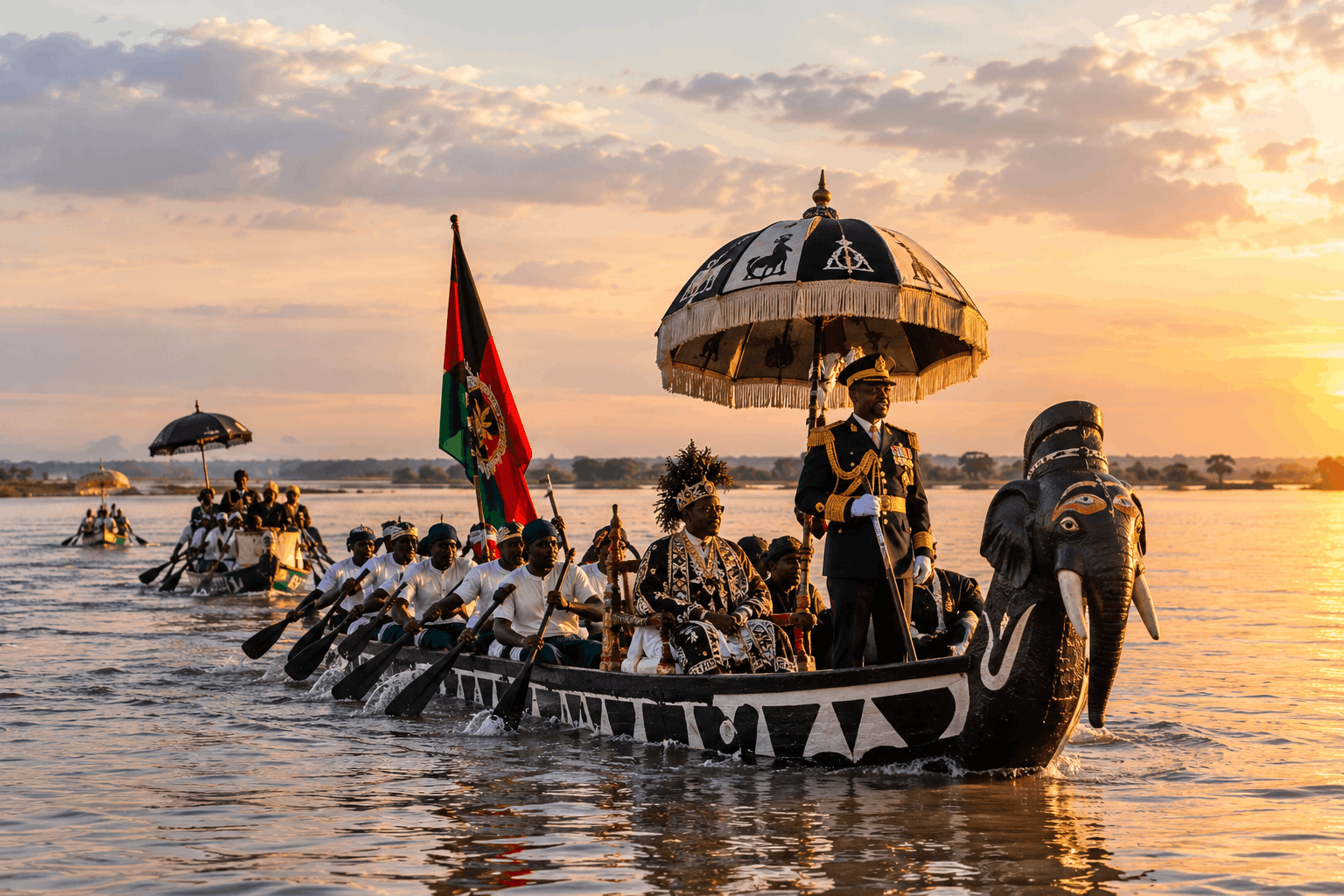
Explore Mozambican culture through marrabenta, Makonde art, Mapiko, timbila, food, languages, religion and the history that shaped modern Mozambique.
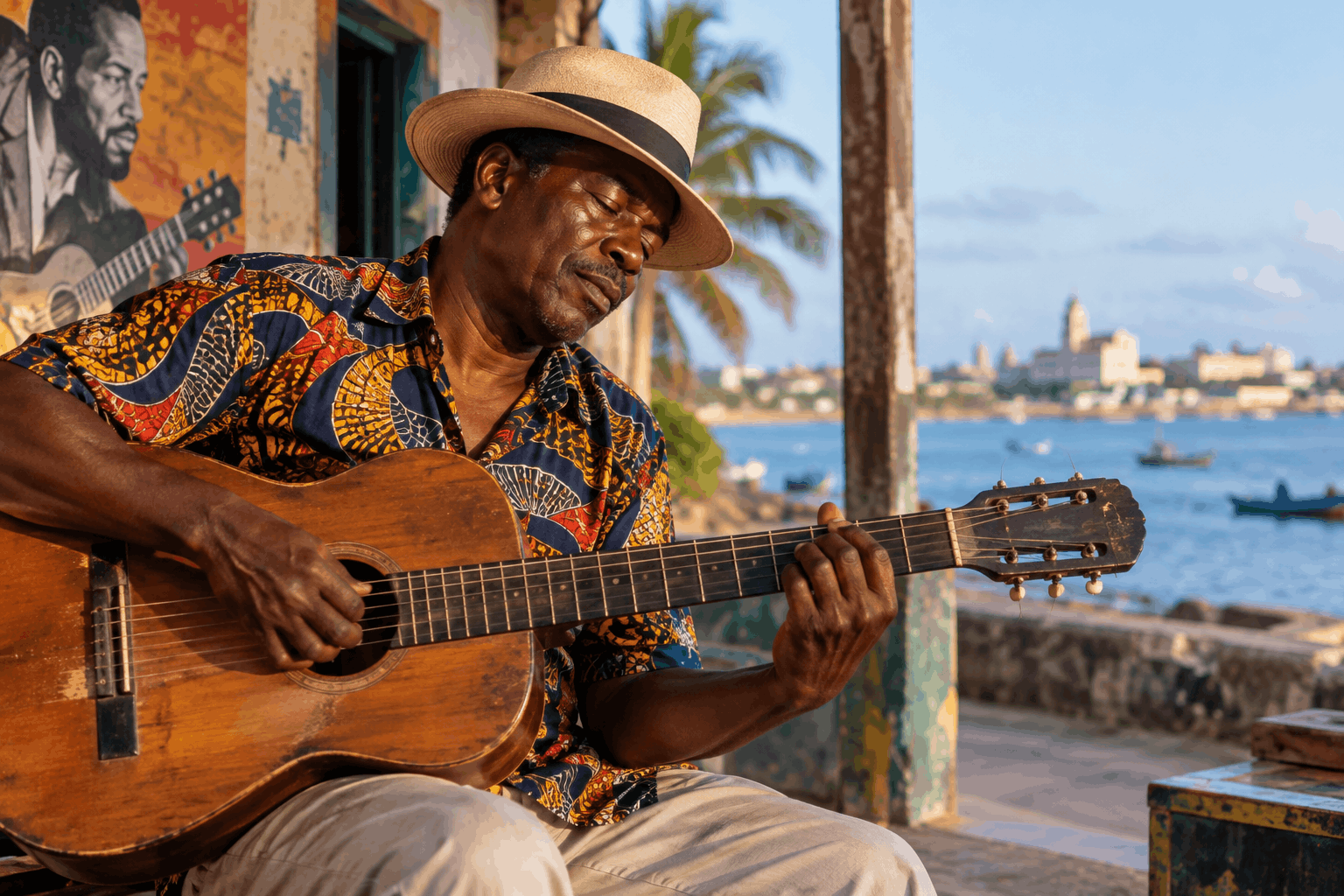
A three-string guitar made from an oil can may sound like an unlikely starting point for one of Mozambique’s best-known musical traditions. Yet that is exactly how Dilon Djindji, one of the early figures associated with marrabenta, began making music. In 1938, when he was 12 years old, Djindji built his own guitar from an oil can and fitted it with three strings. Three years later, he acquired a conventional guitar. By then, he was already experimenting with popular local styles such as zukuta and mágica.
His story captures something important about marrabenta. The genre did not emerge in isolation, and it did not begin with one musician sitting down and deciding to invent a new national sound. It developed in the urban environment of southern Mozambique during the first half of the twentieth century, as Mozambican musicians worked with local dance traditions while also encountering guitars, Western musical forms, church music, radio, Portuguese cultural influences and music circulating across southern Africa. The Mozambican Music Portal identifies local forms including magika, xingombela and zukuta among the traditions incorporated into marrabenta, alongside Western influence.
Even the name is uncertain. The most commonly repeated explanation connects marrabenta to the Portuguese verb rebentar, meaning “to burst” or “to break.” One explanation is that guitar strings were known to snap under energetic playing. Another is that the music itself was said to be de arrebentar, something so intense that it could “break” you. The Mozambican Music Portal explicitly notes that both the name and its origin remain controversial, so there is no single documented story that can settle the question.
What is much clearer is what happened after the genre appeared. Marrabenta became associated with the urban culture of southern Mozambique, particularly the world around Lourenço Marques, the colonial name for present-day Maputo. It gained wider popularity in the 1950s through groups such as Djambu, Hulla-Hoope, Harmonia and the João Domingos ensemble. Musicians including Fany Mpfumo and Dilon Djindji became important early figures, while later groups helped carry the music into new periods and audiences.
To understand why a style like marrabenta could develop in Mozambique, it helps to step back from the guitar.
A Country Built From Several Historical Worlds
In this section
Portugal gradually expanded its control through military campaigns, commercial concessions and administrative changes.
Mozambique occupies a long stretch of southeastern Africa, running along the Indian Ocean from the border with Tanzania in the north to South Africa and Eswatini in the south. Its geography has always made movement important. The country has a coastline of roughly 2,500 kilometres, while the interior connects the coast with regions that historically traded across the Zambezi Valley and further into southern and central Africa.
The people who live in present-day Mozambique have roots in successive Bantu-speaking migrations that took place over many centuries. The history is more complicated than a single migration date: different communities arrived and settled in different regions at different times, and they developed their own political systems, languages and relationships with neighbouring peoples. By the early second millennium, communities in the interior were connected to Indian Ocean commerce through coastal trading centres, while states in the interior controlled parts of the trade in products such as gold and ivory.
Along the northern and central coast, some communities became connected to the wider Swahili world. This was not a single political state stretching across Mozambique. The Swahili world was a network of coastal towns and trading communities linked by commerce across the western Indian Ocean. Merchants, goods, languages, religious traditions and ideas moved through these networks, connecting parts of the Mozambican coast with places across eastern Africa, Arabia, Persia and South Asia. Portuguese colonial expansion later entered an already established commercial world rather than creating coastal trade from nothing.
The Portuguese first reached the Mozambican coast in 1498, when Vasco da Gama's fleet stopped there during its voyage towards India. Portuguese attempts to control Indian Ocean commerce followed, including the establishment of settlements and trading posts. Mozambique Island became particularly important and served as the centre of Portuguese administration for much of the colonial period. Yet Portuguese control over what is now Mozambique was uneven for centuries. Large parts of the territory remained outside effective Portuguese administration until the late nineteenth and early twentieth centuries.
That distinction is important because “Portuguese Mozambique” was not always a territory governed from one centre in the way the modern country is. Portugal gradually expanded its control through military campaigns, commercial concessions and administrative changes. In the late nineteenth century, private companies were granted control over large areas, while the colonial government later strengthened direct administration. By the twentieth century, the colonial economy relied heavily on agriculture, cash crops, migrant labour and systems that extracted African labour for colonial and regional economies.
One of those systems was chibalo, the colonial use of forced labour. Mozambican workers were also recruited for mines in neighbouring South Africa. These movements had consequences beyond employment. Men travelled between rural communities, plantations, towns and mines, encountering new languages, musical forms, technologies and social environments. Music travelled with them.
That movement across southern Africa helps explain why Mozambican popular culture cannot be understood only within today's national borders. People, instruments and musical ideas crossed those borders long before the countries surrounding Mozambique became independent states.
Colonialism Changed the Conditions Under Which Culture Developed
In this section
Djindji later obtained a conventional guitar and became one of the musicians who helped popularise marrabenta.
Portuguese rule also created a complicated cultural environment. European instruments and musical forms circulated alongside African traditions, while Christianity, colonial education, radio and urban entertainment created new places where different musical practices could meet.
Lourenço Marques became one of those places. The city was the colonial capital by the late nineteenth century and developed into an important port and commercial centre. Its growing urban population included African workers, Portuguese settlers, Indian communities and other groups connected to the Indian Ocean and southern African economies.
For African musicians, urban life created opportunities that did not exist in the same form in rural communities. Weddings, private gatherings, neighbourhood entertainment, bars and other social spaces became places where musicians could experiment with instruments and styles. The guitar became particularly useful because it could reproduce melodies and rhythmic patterns associated with local music while also allowing musicians to work with musical structures circulating through colonial and church environments.
This is the setting in which marrabenta developed.
The story of Dilon Djindji's homemade guitar therefore matters for another reason. His instrument was not an isolated curiosity. It shows how musicians could adapt available materials to participate in a changing musical world. Djindji later obtained a conventional guitar and became one of the musicians who helped popularise marrabenta. His career also illustrates the mobility of Mozambican workers: in 1950 he went to South Africa to work in the mines before returning to Mozambique in 1954.
The genre continued to change as the country itself changed.
Independence Came With a New Political Order
In this section
Musicians moved between countries and communities, and styles continued to absorb outside influences.
Mozambique's independence was the result of an armed struggle against Portuguese colonial rule led by the Mozambique Liberation Front, known as FRELIMO. The organisation was formed in 1962, and the armed liberation war began in 1964 in northern Mozambique before spreading into other areas. Portugal's 1974 revolution weakened the colonial regime, and negotiations led to Mozambican independence on 25 June 1975.
Independence transformed the political system and the country's cultural institutions. FRELIMO established a socialist government, and the new state attempted to break with many structures inherited from colonial rule. Music and other forms of cultural production were drawn into the project of building a new nation.
That process was complicated by the outbreak of civil war in 1977. The armed opposition movement RENAMO received external support, first from Rhodesia and later from apartheid South Africa, while the conflict also drew on internal political, economic and social grievances. The war lasted until 1992 and devastated large parts of the country. Estimates of deaths vary, but the conflict is commonly associated with around one million deaths, alongside mass displacement, destruction of infrastructure and extensive landmine contamination.
Music did not disappear during this period, but the conditions for performing it changed. Musicians moved between countries and communities, and styles continued to absorb outside influences. After independence, Mozambican music also encountered new influences from socialist countries and later from global popular music.
By the 1980s, marrabenta experienced another period of visibility. The Orchestra Marrabenta Star of Mozambique became particularly important, while later groups such as Mabulu brought marrabenta into contact with rap. Djindji himself eventually performed internationally with Mabulu in the early 2000s.
The genre survived because it was never frozen in the period in which it was born. Its basic identity could remain recognisable while musicians changed the instruments, arrangements, languages and influences around it.
That same ability to absorb change appears throughout Mozambican culture.
Matrilineal does not mean that women automatically hold all political authority or that men have no authority.
Mozambique has more than twenty major ethnic and linguistic communities, with considerable regional variation. The Makhuwa are the largest broad linguistic community, particularly across northern Mozambique. The Makonde are strongly associated with Cabo Delgado and areas across the border in Tanzania. The Chopi are concentrated in southern Mozambique, particularly Inhambane Province, while Tsonga-speaking communities are prominent in the south.
These identities do not fit neatly into modern provincial borders. Communities have long lived across areas that are now divided by national boundaries, and people have moved because of trade, marriage, labour migration, war and political change.
The Makhuwa also provide an important example of why cultural terminology needs to be used carefully.
Makhuwa communities in northern Mozambique have historically maintained matrilineal systems in which descent and certain forms of belonging are traced through the mother's side of the family. Matrilineal does not mean that women automatically hold all political authority or that men have no authority. It describes how descent and kinship are organised. Contemporary research on Makhuwa communities also shows that matrilineal institutions can shape access to land and family belonging in ways that interact with Mozambique's national land system.
Further south, patrilineal systems have historically been more common, while central Mozambique contains a mixture of arrangements. Marriage practices, inheritance, residence and gender roles therefore vary considerably across the country. There is no single Mozambican family structure that can accurately be applied from Maputo to Cabo Delgado.
The same regional variation appears in language.
Portuguese is Mozambique's official language and is used in government, formal education and national communication. But it is spoken alongside more than forty indigenous Bantu languages and language varieties, depending on how they are classified. Emakhuwa, Xichangana, Elomwe, Cisena, Echuwabo, Xitsonga, Shimakonde and many others remain important in their respective communities. Swahili also remains significant in parts of the far north, particularly close to the Tanzanian border.
For many Mozambicans, therefore, language is not a choice between “Portuguese” and “African languages.” People may use different languages for different parts of their lives, moving between local languages, Portuguese and regional languages according to family, education, work, religion or location.
Religion Often Crosses Cultural Boundaries
Mozambique is constitutionally a secular state, and its population includes Christians, Muslims and people who identify with other religious traditions or no religion. The 2017 census reported Christians as the largest broad religious affiliation, with Catholics making up the largest single Christian denomination. Muslims represented roughly one-fifth of the population, with particularly strong historical connections in the north and along parts of the coast.
These categories do not always describe people's religious lives completely. In many communities, Christianity or Islam exists alongside older beliefs and practices concerning ancestors, healing, protection and the spiritual world. That does not mean every Christian or Muslim follows traditional practices, nor does it mean that traditional beliefs form one uniform religion. Practices differ substantially between communities.
Traditional healing is one example. Traditional healers, sometimes broadly described through terms such as curandeirismo, remain part of healthcare-seeking practices in many communities. The category covers different practitioners and forms of knowledge rather than one standardised medical system. People may consult traditional healers, clinics, hospitals or pharmacies at different points, depending on their circumstances and beliefs.
The coexistence of different religious and healing traditions is another reason Mozambican culture cannot be reduced to one regional pattern.
Food Carries the Same History
In this section
Piri-piri, the small hot chilli associated with Portuguese-speaking African cooking, is widely used as a seasoning.
Mozambican food reflects the country's geography and its connections across the Indian Ocean. Along the coast, seafood is important. Inland communities have their own agricultural traditions, while cassava, maize and other crops form important parts of the diet.
One of the country's best-known staple foods is xima, a firm porridge that can be prepared from maize flour, cassava or other starches depending on the region. It is commonly eaten with sauces, vegetables, meat or fish.
Matapa is another well-known dish, generally made from pounded cassava leaves cooked with ingredients such as coconut milk, garlic, peanuts or ground nuts, and often seafood depending on the preparation. Its ingredients show how local agriculture and coastal food traditions can meet in one dish.
Mozambique's long coastline also means coconut, fish, prawns and other seafood appear prominently in many regional cuisines. Piri-piri, the small hot chilli associated with Portuguese-speaking African cooking, is widely used as a seasoning.
Then there is the cashew.
Mozambique was once the world's largest producer of raw cashew nuts. Between the Second World War and the early 1970s, the country accounted for roughly 40–50 percent of global cashew production. The industry employed farmers, traders and processors, and raw cashews were initially exported heavily to India before Mozambique developed more domestic processing capacity.
The industry was badly damaged after independence by the departure of experienced commercial operators, economic disruption and, particularly, the civil war. Farmers were displaced, transport became dangerous and factories struggled with shortages of equipment and foreign exchange.
Cashews therefore tell another Mozambican story: an agricultural product can be both part of everyday life and connected to a much larger history of colonial trade, industrial policy, war and international markets.
In towns and cities, food culture also includes barracas, informal or modest eating and drinking establishments that can function as neighbourhood social spaces. Their importance is less about a particular menu than about the way food, conversation and everyday commerce meet in ordinary urban life.
Music Was Never Only Marrabenta
In this section
UNESCO added Ingoma Ya Mapiko to the List of Intangible Cultural Heritage in Need of Urgent Safeguarding in 2023.
Marrabenta may be one of Mozambique's best-known popular genres, but it is only one part of a much larger musical culture.
In southern Mozambique, the Chopi people are internationally known for timbila, an ensemble tradition built around wooden xylophones of different sizes and pitches. A timbila orchestra can contain between five and thirty instruments. The instruments are carefully made and tuned, with calabash resonators attached beneath the wooden keys. UNESCO inscribed Chopi Timbila on the Representative List of the Intangible Cultural Heritage of Humanity in 2008.
Timbila performances can involve complex compositions, singing, dancing and coordinated ensemble playing. The tradition is therefore much more than an instrument. It is a musical system involving performers, instrument makers, dancers and communities.
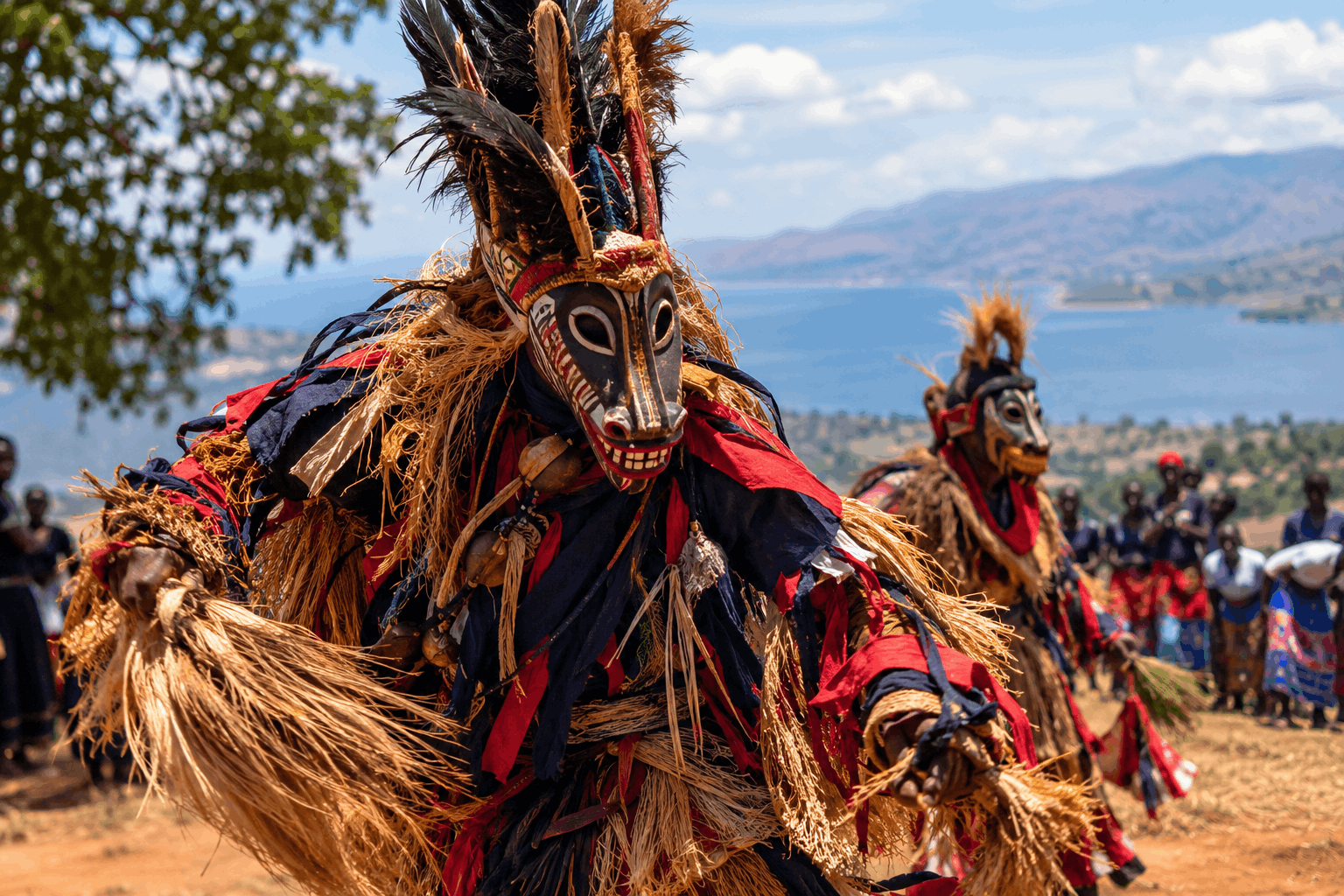
In Cabo Delgado, the Makonde perform Mapiko, a masked dance associated with initiation rites. During these rites, young people are introduced to aspects of adulthood, community values and inherited knowledge. The performance involves masked dancers, drums, singers and a wider community of participants. The masks may represent animals or people, while the performance can also include songs that challenge or provoke the masked dancers and neighbouring communities.
UNESCO added Ingoma Ya Mapiko to the List of Intangible Cultural Heritage in Need of Urgent Safeguarding in 2023. The listing recognises the tradition's importance while also acknowledging pressures on its transmission. Mapiko is connected to ideas of human spirit, harmony with the cosmos, overcoming fear and restoring balance between masculine and feminine. It is also performed on some occasions outside initiation, including funerals and entertainment.
Northern coastal Mozambique has another important tradition in tufo, a women's group dance associated particularly with Muslim communities. The performances combine singing, movement and percussion and belong to a broader coastal cultural world shaped by centuries of interaction across the Indian Ocean.
Taken together, these traditions show why calling marrabenta “Mozambican music” without qualification can be misleading. Mozambique has many musical worlds, each tied to particular communities and histories. Marrabenta became especially influential as an urban popular genre, while timbila, Mapiko, tufo and many other traditions carry their own histories and social functions.
Literature Gave the Country Another Way to Speak
Mozambique's cultural history is also expressed through literature.
José Craveirinha, born in Lourenço Marques in 1922, became one of the country's most important poets. His writing dealt with colonialism, identity, racism, political struggle and everyday life. He was imprisoned by the Portuguese colonial authorities during the independence struggle.
Mia Couto belongs to a later generation. His novels and short stories often explore Mozambique's history, memory, language and the tensions created by war and political change. He writes in Portuguese but frequently reshapes the language through Mozambican expressions, oral traditions and local ways of seeing the world.
The importance of both writers comes partly from what they reveal about language. Portuguese became the official language of an independent Mozambique, but Mozambican writers have repeatedly used it in ways that reflect local histories and speech rather than treating European Portuguese as the only legitimate cultural reference point.
Makonde Art Changed Through Contact With New Markets
In this section
The Makonde are known for carving masks, figures and other works from wood, including African blackwood.
Makonde woodcarving provides another example of how culture can change without losing its local foundations.
The Makonde are known for carving masks, figures and other works from wood, including African blackwood. Some internationally recognised forms of modern Makonde carving developed during the twentieth century, particularly from the 1950s onward, as artists encountered new commercial markets, missionaries, colonial officials, collectors and buyers.
This history needs some care. It would be wrong to say that colonial markets invented Makonde sculpture. Makonde communities had established carving traditions long before the international art market became interested in them. What changed was the context in which some artists produced their work, including the subjects, sizes and forms that could be sold beyond the community.
The shetani style, for example, became prominent in the twentieth-century art market. The term is associated with spirit figures, often characterised by unusual or exaggerated human forms. Researchers have documented how Makonde migration, artistic production and commercial markets interacted during the colonial period.
Another important form is ujamaa, a style associated with interconnected human figures. The term is also associated with the idea of family or unity and gained prominence during the post-independence period.
The result is a body of work that cannot be divided neatly into “traditional” and “modern.” Makonde artists have continued to use inherited knowledge while responding to changing markets, political circumstances and audiences.
Even the Cloth Tells a Long Indian Ocean Story
The capulana is another familiar part of Mozambican life.
Capulanas are printed cloths commonly worn by women and used in different practical and social ways. They can be wrapped around the body, used as head coverings, carried as part of dress or adapted for household purposes. Their patterns can also carry social meaning, although the meaning of a particular design depends on context.
Their history reaches beyond Portugal and Mozambique alone. Indian cotton textiles were traded extensively along the western Indian Ocean, and historical records show large quantities of Indian cloth reaching Mozambique Island during the eighteenth century. Merchants from South Asia and the wider Indian Ocean participated in these commercial networks.
Over time, imported textiles were incorporated into local systems of dress and social meaning. Research on capulanas in northern Mozambique shows that people did not merely receive foreign fabrics and copy foreign styles. Local consumers selected, adapted and gave meaning to the materials circulating through their communities.
That distinction helps explain why capulana is now so closely associated with Mozambican identity even though its history is connected to centuries of textile commerce across the Indian Ocean.
Maputo's Art History Also Has a Colonial Complication
Maputo has long been an important centre for artistic production.
The Núcleo de Arte was founded in 1936 in Lourenço Marques with the stated purpose of promoting artistic education and development. It organised exhibitions and courses in areas including painting, drawing, sculpture, architecture, music, theatre and literature.
Its early history also reflects the racial divisions of Portuguese colonial society. Black and mixed-race Mozambicans were initially restricted largely to roles as models or members of the audience. After the Second World War, however, Black artists and students gained greater access to the organisation. The institution later faced financial difficulties and moved premises several times before being reconstructed and reinvented after independence.
That history makes the Núcleo more than an art-school story. It shows how institutions created under colonial rule could contain both exclusion and spaces that later artists used to develop new forms of cultural expression.
Culture Changes With the Country
In this section
A sculpture produced for an expanding commercial market can draw on centuries of Makonde artistic knowledge.
Mozambique's cultural traditions have never existed outside history.
The country's northern coast was shaped by Indian Ocean trade long before Portuguese colonial rule. Portuguese expansion introduced new political structures, languages, religious institutions and economic demands. Colonial labour systems moved Mozambicans into mines and plantations across the region. Independence brought a socialist government and a new national cultural project. Civil war displaced millions and disrupted communities. Peace, migration, urbanisation, global media and international markets then created new conditions for cultural production.
The effects can be seen in ordinary things.
A guitar can be built from an oil can and become part of the history of a major musical genre. A textile arriving through Indian Ocean trade can become an everyday Mozambican garment. A sculpture produced for an expanding commercial market can draw on centuries of Makonde artistic knowledge. A xylophone ensemble can preserve an elaborate musical tradition while being recognised internationally as heritage. A masked dance can remain tied to initiation and community values while also requiring safeguarding because the conditions that once supported its transmission are changing.
Marriage practices show the same regional variation. Some communities in the north have matrilineal systems, while patrilineal systems have historically been more common in the south, with considerable variation in central Mozambique. Contemporary land rights are also shaped by both customary institutions and national law, so older kinship systems cannot be treated as though they exist unchanged outside the modern state.
Cabo Delgado adds another layer to the present.
Since 2017, the province has faced an armed insurgency linked to the Islamic State, alongside longstanding grievances involving poverty, limited economic opportunities, land and resettlement, distrust of government institutions and expectations surrounding the region's natural-gas wealth. No single factor explains the conflict.
The security response has also changed over time. The Southern African Development Community's SAMIM mission operated in Cabo Delgado from 2021 until its withdrawal in July 2024. Rwanda, which first deployed troops to Mozambique in 2021 at the government's request, continues to have forces in the province. In May 2026, Rwanda said Mozambique had secured funding for the continued deployment, although the amount and duration of that funding were not publicly disclosed. Insurgent attacks have continued despite improvements in security in some areas.
This matters culturally because Cabo Delgado is home to communities whose traditions are closely tied to the province, including the Makonde. When conflict displaces communities, it affects much more than homes and livelihoods. It can interrupt the places, relationships and teaching systems through which cultural knowledge is passed between generations.
The Guitar Was Never Just a Guitar
In this section
Dilon Djindji continued performing well into old age and eventually took the music to international audiences.
That is why the story of marrabenta begins with something as ordinary as a homemade guitar.
The instrument tells us about access to materials. The music tells us about urbanisation. The musicians tell us about labour migration. The languages in the songs tell us about a multilingual country. The genre's changes tell us about colonialism, independence, socialism, war, migration and global popular culture.
Marrabenta itself continued to evolve. The Orchestra Marrabenta Star helped give it renewed prominence in the 1980s, while Mabulu later combined marrabenta with rap. Dilon Djindji continued performing well into old age and eventually took the music to international audiences.
At the same time, timbila remains tied to Chopi communities in southern Mozambique, Mapiko continues among Makonde communities, tufo remains part of northern coastal cultural life, and Mozambican artists continue to work across music, literature, sculpture, textiles and contemporary visual art.
Mozambique's cultural history is a record of people adapting inherited knowledge to new circumstances, sometimes by choice, sometimes under pressure, and often while living through political and economic changes they did not control.
A three-string guitar made from an oil can happened to become part of that history.