Explore Malawi culture through Gule Wamkulu, Vimbuza, food, music, languages, religion, traditions, festivals and the history behind them.
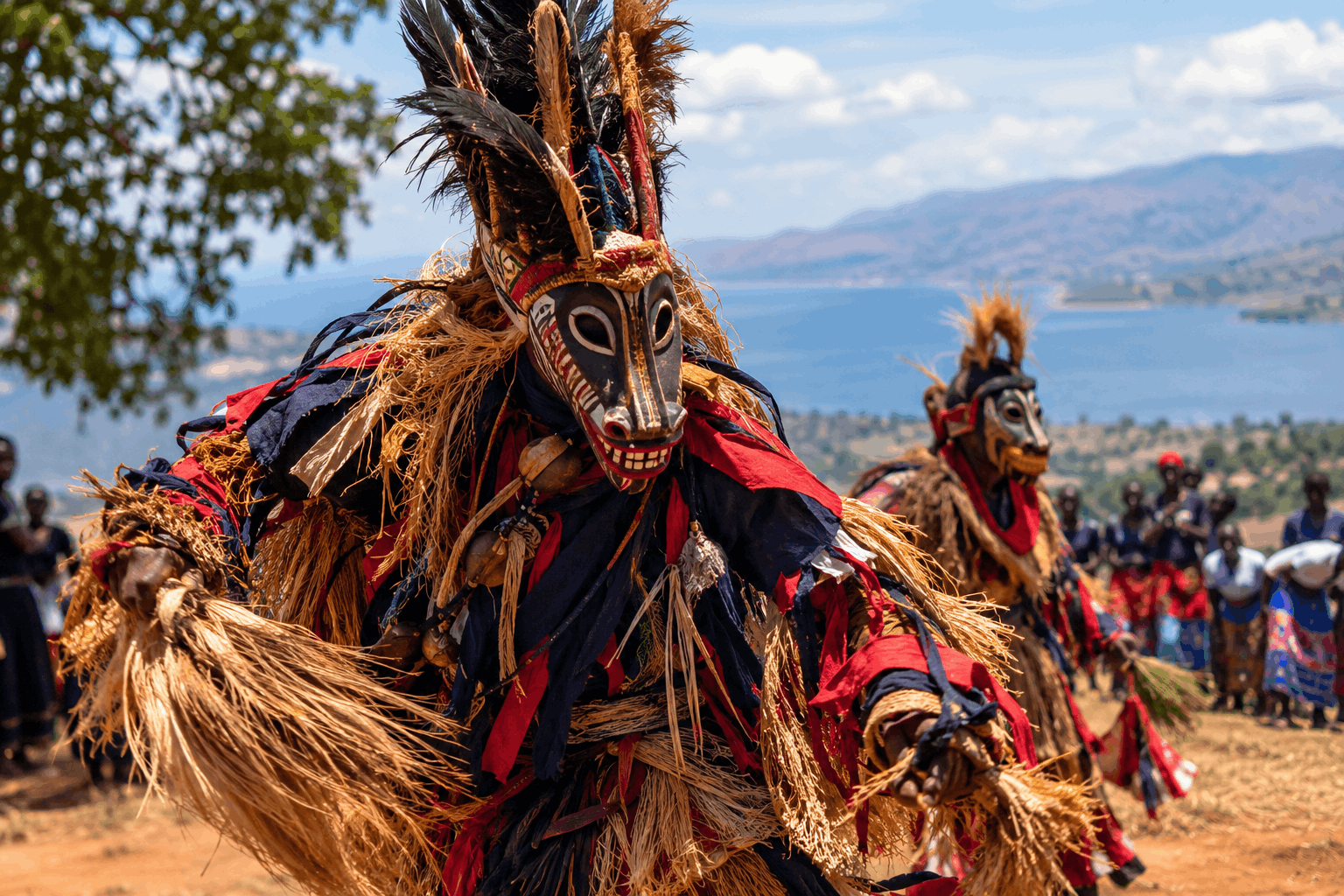
When word spreads through a Chewa community that Gule Wamkulu is about to appear, people know they are about to see something that cannot be understood as an ordinary dance performance.
Men wearing elaborate masks and costumes emerge as characters from the spirit world, animals, social life and the wider world around them. Some represent figures from the past. Others are deliberately recognisable as things from the present. A character might resemble a wild animal, a spirit of the dead, a slave trader, or even something as modern as a car or helicopter.
The performers belong to the Nyau brotherhood, a secret society of initiated Chewa men. For the people who practise it, Gule Wamkulu has purposes that go far beyond entertainment. It can mark important moments in community life, communicate social values, frighten or amuse an audience, and connect the living with a world of spirits and ancestors.
That is part of what makes the tradition difficult to separate into neat categories. It is dance, theatre, ritual, education, social commentary and spiritual practice at the same time.
Gule Wamkulu has been practised among the Chewa for centuries. UNESCO traces the tradition to the Chewa state of the seventeenth century, although the wider history of the Chewa and the political formations associated with them reaches further back. Today, the tradition crosses modern national borders, with related practice found in Malawi, Mozambique and Zambia. UNESCO added Gule Wamkulu to the Representative List of the Intangible Cultural Heritage of Humanity in 2008.
And Gule Wamkulu makes more sense once you understand the country in which it developed.
Malawi Is Small, But Its History Is Not
In this section
The country is home to several major ethnic communities, each with its own histories and cultural traditions.
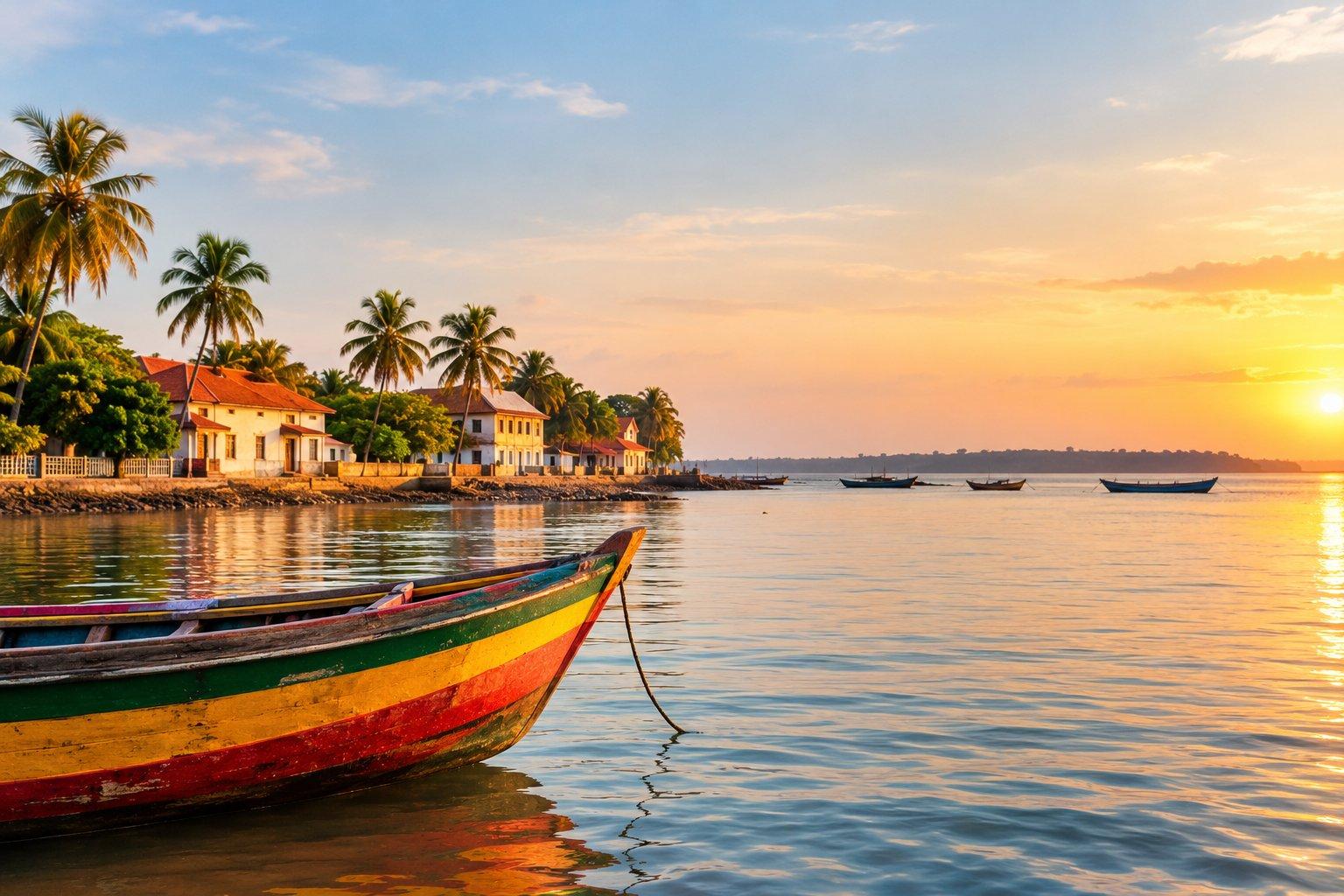
Malawi is a landlocked country in southeastern Africa, stretching along the western shore of Lake Malawi. The lake occupies a large part of the country's eastern side and has shaped settlement, fishing, transport and everyday life for generations.
The country is sometimes called the "Warm Heart of Africa", a nickname associated with the friendliness and hospitality for which Malawi is known. But Malawi's cultural history is considerably more complicated than the nickname suggests.
The country is home to several major ethnic communities, each with its own histories and cultural traditions. The 2018 Population and Housing Census recorded the Chewa as the largest ethnic group at 34.4 percent of the population. The Lomwe accounted for 18.9 percent, the Yao 13.3 percent, the Ngoni 10.4 percent and the Tumbuka 9.2 percent.
Those figures are useful because they make one thing clear: there is no single cultural tradition that can represent all of Malawi.
Gule Wamkulu, for example, is specifically associated with the Chewa. Vimbuza, another major traditional performance practice, comes from the Tumbuka communities of northern Malawi. The histories of the Yao, Ngoni, Lomwe and other groups also developed through different political, religious and migration histories.
Understanding those differences becomes even more important when you look at how Malawi itself came together.
A Country Built From Several Histories
In this section
European missionaries and traders also became increasingly present in the region during the nineteenth century.
Long before Malawi became an independent country, the region was home to political states, trading communities and shifting networks of power.
The Maravi political tradition became an important regional force, and the Chewa were part of the wider historical world associated with it. By the seventeenth century, Chewa political influence had expanded considerably.
Other communities arrived or expanded through different processes. Ngoni groups moved north from southern Africa during the upheavals associated with the Mfecane in the nineteenth century. They did not all follow the same route or form one single political community, but several established themselves in what is now Malawi.
The Yao had long-standing trading connections stretching across southeastern Africa. During the nineteenth century, Islam spread among Yao communities through these commercial and political networks, with some rulers and influential families converting. This was a gradual process rather than a single collective conversion.
European missionaries and traders also became increasingly present in the region during the nineteenth century. British colonial control eventually followed, and the territory became known as Nyasaland under British rule.
Colonial rule did not erase the older societies underneath it. It introduced new political institutions, Christian missions, schools, commercial agriculture and labour systems while existing communities continued to maintain their own languages, beliefs and social structures.
That coexistence produced some of the cultural tensions that are still visible today.
One Country, Many Languages
English is Malawi's official language, while Chichewa is the most widely used common language. Other major languages include Tumbuka, Yao, Lomwe, Tonga, Sena and several others.
Language in Malawi therefore does more than help people communicate. It can also signal where someone comes from, which community they belong to and which cultural history they carry.
Chichewa has a particularly wide reach, partly because of the historical and political influence of Chewa communities and the development of national institutions around the language. Tumbuka remains particularly important in the north, while other languages remain central to their own communities.
That diversity has sometimes created tensions over which languages receive the most space in education, broadcasting, government and public life. Recent research, for example, has documented concerns about the marginalisation of Tumbuka in some settings where Chichewa dominates.
The point is not that Malawians speak one language with a few alternatives around it. The country has several linguistic worlds operating alongside one another.
Religion adds another layer.
Christianity, Islam and Older Beliefs
Most Malawians today identify as Christian. According to the 2018 census, about 77.3 percent of the population was Christian, while 13.8 percent was Muslim. Smaller proportions identified with traditional religions, no religion or other religious groups.
Christianity became deeply established through missionary activity during the colonial period and through the growth of churches, schools and hospitals. Islam has a particularly strong presence in parts of southern Malawi, including areas around Mangochi and Machinga, and among communities with longstanding connections to Indian Ocean and inland trade networks.
But religious identity in Malawi does not always mean abandoning older cultural practices.
Some traditional practices continue within communities where most people are Christian or Muslim. In some cases, people understand these practices culturally; in others, they retain explicitly spiritual meanings.
Gule Wamkulu is a striking example. UNESCO notes that Chewa men may belong both to Christian churches and to the Nyau society. The two identities can exist within the same person's life rather than necessarily functioning as mutually exclusive worlds.
That helps explain why a tradition with precolonial roots could survive despite decades of missionary opposition.
And Gule Wamkulu is not the only Malawian tradition in which dance carries a deeper purpose.
When Dance Becomes Healing
In this section
UNESCO also notes that Vimbuza has been used to give expression to mental distress in a socially accepted form.
Among the Tumbuka of northern Malawi, Vimbuza is a healing tradition involving music, dance, possession and community participation.
UNESCO describes it as part of the wider ng'oma healing tradition and traces its development to the nineteenth century. Historically, it formed part of indigenous healthcare systems in which healers worked with people experiencing illnesses understood within the community's own spiritual and social framework.
A Vimbuza healing session can involve singing, drumming and dancing. A patient may enter a trance while people around them sing and play drums associated with helping spirits. The patient dances within the circle, sometimes over an extended period.
It is important to describe this on its own terms. The spiritual explanation belongs to the tradition and to the people who practise it; it should not be presented as a medical fact established by modern clinical science.
UNESCO also notes that Vimbuza has been used to give expression to mental distress in a socially accepted form. The practice developed under difficult conditions, including British occupation, and Christian missionaries later attempted to suppress it. Despite that pressure, it continues to be practised in some rural communities.
So when Malawian traditions use music and dance, the purpose is not necessarily performance for an audience. Sometimes the people involved are trying to heal, mark a transition, communicate with the spirit world or reinforce community relationships.
The same idea appears in something much more ordinary: food.
The Food on the Table
In this section
The connection between land, food and culture becomes even clearer when you look at Malawi's music and dance.
For many Malawian households, the centre of a meal is nsima, a thick porridge made from maize flour.
Nsima is more than a recipe. UNESCO describes it as part of a broader culinary tradition involving the preparation of maize, the selection and processing of flour, the preparation of accompanying dishes and the communal knowledge involved in serving it. The knowledge is generally passed through everyday family life rather than through formal culinary training. UNESCO inscribed the culinary tradition of nsima on the Representative List in 2017.
Nsima is commonly eaten with relishes that might include vegetables, beans, meat, fish or other ingredients available to the household.
Lake Malawi also provides an important source of fish. Chambo, a group of tilapia fish found in the lake, is particularly valued in Malawian cuisine, although pressure on fish stocks has made fisheries management increasingly important.
Food also reflects Malawi's agricultural history.
Tea became a major commercial crop during the colonial period, particularly in the southern districts of Mulanje and Thyolo. Tea cultivation became established there in the early twentieth century, and the tea estates remain a distinctive part of the region's economy and landscape.
The connection between land, food and culture becomes even clearer when you look at Malawi's music and dance.
Music Is Everywhere, But It Does Different Jobs
Malawi has a wide range of musical traditions associated with different communities and occasions.
Gule Wamkulu uses drums, movement and masks to create a world populated by characters that can be frightening, comic, moralising or spiritually significant. Vimbuza uses drumming and singing as part of healing. Other dances serve ceremonial, social or celebratory purposes.
One of the best-known traditional dances is Mwinoghe, associated with the Tumbuka people of northern Malawi. The name is commonly understood as an invitation to "let us enjoy ourselves", and the dance is performed at celebrations and cultural events. UNESCO inscribed Mwinoghe on its Representative List in 2018.
Tchopa, associated with the Lomwe of southern Malawi, has a different function. It is traditionally performed at important community events and can also be connected with communal work and occasions involving chiefs. UNESCO recognised Tchopa as intangible cultural heritage in 2014.
These traditions show why calling every Malawian cultural performance simply "traditional dance" misses a great deal. The movement may be only one part of what is happening.
The same is true of the objects worn by performers.
Masks, Cloth and Craft
The masks of Gule Wamkulu are among Malawi's most recognisable cultural objects, but they are not merely decorative.
The Nyau performers create characters through masks, costumes, movement and behaviour. Some characters represent animals or spirits. Others refer to social behaviour or historical experiences. UNESCO notes that more recent characters can even represent modern technologies and objects.
That ability to incorporate contemporary figures is one reason the tradition has remained capable of speaking to changing communities.
Outside Gule Wamkulu, Malawian communities also practise basketry, pottery, weaving, woodcarving and other forms of craft. Clothing varies across communities and occasions, with locally made and commercially produced fabrics existing alongside one another.
Architecture also reflects this diversity.
Older accounts and museum displays have sometimes presented one style of village architecture as if it represented Malawi as a whole. In reality, domestic architecture has varied among different communities and regions. Research into Malawian museum collections has pointed out how the round, thatched Chewa homestead came to be presented as a representative "Malawian village", even though the country contains several distinct architectural traditions.
That same problem appears when people talk about Malawian festivals as though there is one national ceremonial calendar.
Festivals That Belong to Particular Communities
Many of Malawi's cultural ceremonies are tied to specific communities and histories.
Among the Tumbuka, Gonapamuhanya is associated with the Chikulamayembe chieftaincy and serves as an important cultural gathering.
These ceremonies can bring together traditional leaders, dancers, musicians, families and visitors. They may include speeches, performances, food and displays of cultural heritage, but their significance comes from the communities that maintain them rather than from tourism alone.
This distinction matters because some ceremonies have also had to negotiate the pressures that come with being performed for wider audiences.
Gule Wamkulu offers one of the clearest examples. During the colonial period, Christian missionaries attempted to suppress it. The tradition survived, and UNESCO notes that it adapted in some circumstances by incorporating elements of Christianity. Today, however, performances staged primarily as public entertainment or tourism can risk separating the masks and movements from the social and spiritual functions that gave them meaning in the first place.
That tension between cultural practice and public performance is not unique to Malawi. But in the case of Gule Wamkulu, it is particularly visible because the tradition was never designed simply to be watched.
The Politics Behind the Modern Country
Malawi's twentieth-century history also shaped the country people know today.
After independence from Britain in 1964, Hastings Kamuzu Banda became the country's first prime minister and later its first president. His Malawi Congress Party dominated political life, and Malawi became a one-party state.
Banda's government was authoritarian. Human rights organisations documented political detention, restrictions on opposition and serious abuses during his rule. By the early 1990s, pressure for political reform was growing both inside Malawi and internationally.
In 1993, Malawians voted in a referendum on whether to retain the one-party system. About 63.5 percent voted for a multiparty system. The following year, Malawi held its first multiparty elections since independence, and Bakili Muluzi defeated Banda.
The transition changed Malawi's political system, but it did not erase the country's older institutions, community structures or cultural identities.
That is worth remembering when looking at traditions such as Gule Wamkulu. They did not emerge from the modern Malawian state. They existed before it, survived colonial rule and continued through several different political systems.
A Dance That Refused to Become Just a Dance
In this section
The country is not defined by one dance, one language, one religion or one ethnic history.
Gule Wamkulu has survived partly because it has been able to change while retaining its central place within Chewa society.
Its characters can reflect the world people recognise around them. Its performers can draw on old stories while introducing newer figures. Its masks can represent spirits, animals, historical experiences and modern objects. Its performances can take place at weddings, funerals, chiefly ceremonies and other important moments in community life.
But there is another reason the tradition remains so compelling.
You cannot fully understand the mask by looking at the mask.
You have to know who is wearing it, what the character represents, what occasion brought the performance there, what the audience understands, and what the Nyau society means within Chewa life.
That is why Gule Wamkulu is more complicated than the image of a mysterious masked dancer suggests.
It is a living cultural system with its own history, rules and meanings. And like many traditions that have survived colonialism, missionary pressure, political change and the modern tourism industry, it has had to keep negotiating what it means to remain itself while the world around it changes.
Malawi's culture works in much the same way.
The country is not defined by one dance, one language, one religion or one ethnic history. Its culture has been built through several communities living alongside one another, sometimes influencing each other, sometimes disagreeing, and carrying different histories into the same modern state.
Gule Wamkulu just happens to make that complexity impossible to miss.