How Niger makes its money through oil, uranium, livestock and agriculture. Explore its trade partners, routes to the sea, economic challenges and business opportunities.
How Niger makes its money
In this section
The country produced an estimated 98,000 barrels per day in 2025, according to the International Monetary Fund (IMF).
For many years, uranium was one of the main things Niger was known for in international trade. The country supplied uranium to the global nuclear energy industry, while agriculture and livestock supported much of its population. That picture began to change when Niger started exporting crude oil in 2024.
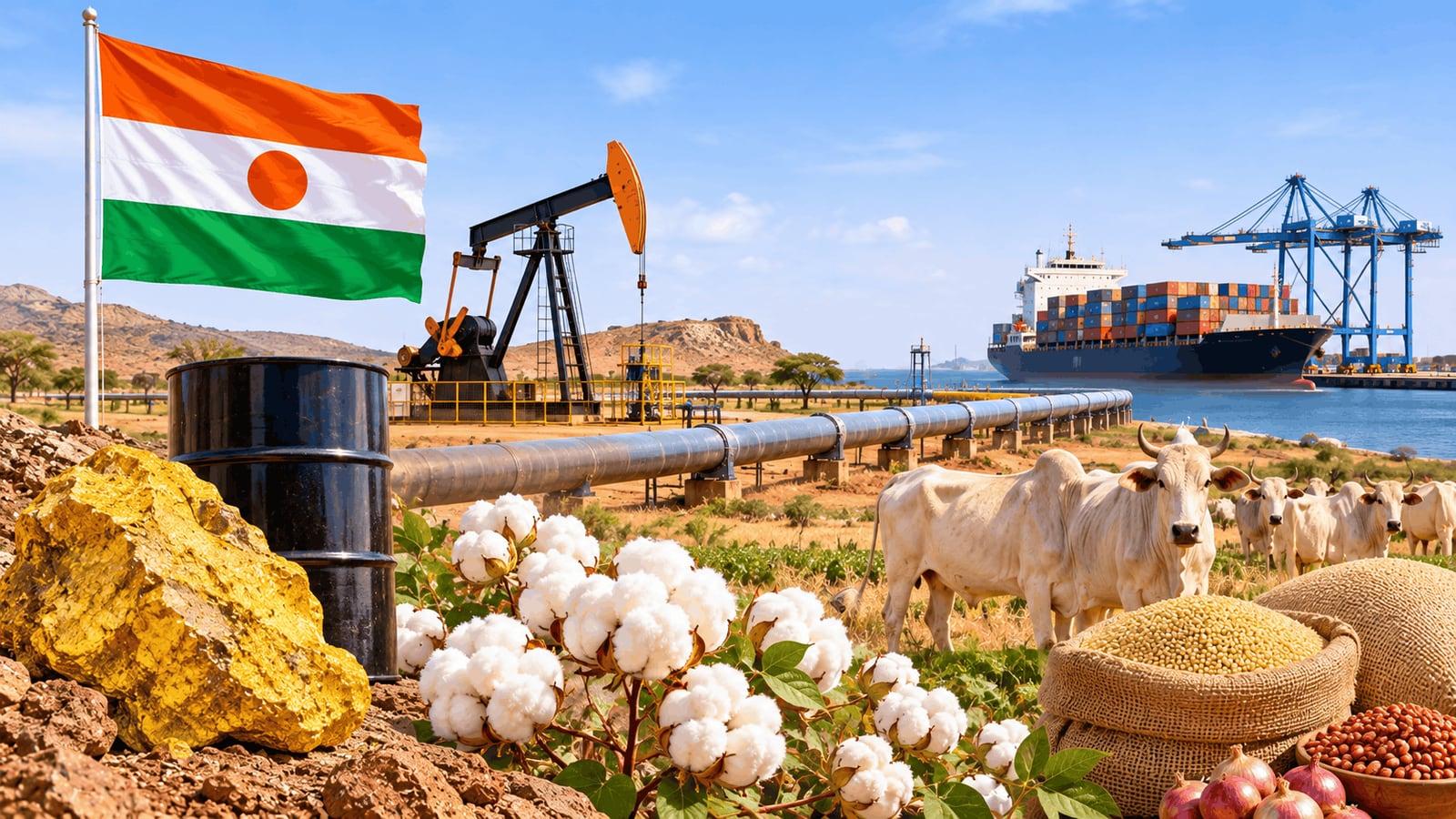
The oil comes from the Agadem fields in eastern Niger. It travels through a pipeline across Niger and Benin before reaching an export terminal at Sèmè-Kpodji on the Beninese coast. From there, it is shipped to international markets.
Oil has become an important source of export earnings for Niger. The country produced an estimated 98,000 barrels per day in 2025, according to the International Monetary Fund (IMF). Its oil exports have also helped improve government revenue and the country's external financial position. However, Niger still depends heavily on agriculture, and most of its population lives in rural areas.
This is the fourteenth country profile in our series, Africa's Markets, Country by Country, following our profile of Benin.
Niger is a landlocked country in West Africa, covering a large part of the Sahara and Sahel regions. It shares borders with Algeria, Libya, Chad, Nigeria, Benin, Burkina Faso and Mali. Its capital is Niamey.
The country had an estimated population of 27.9 million in 2025, growing by about 3.2% annually. Its nominal GDP was approximately US$21.65 billion in 2025, while GDP per person was about US$775. The World Bank recorded economic growth of 7% that year. The IMF's October 2026 assessment also expects growth to remain around 7% in 2026, supported by agriculture and the extractive industries.
Niger has been governed by a military administration since the July 2023 coup that removed elected President Mohamed Bazoum. It withdrew from ECOWAS in January 2025 but remains a member of the West African Economic and Monetary Union (WAEMU). It also continues to face disagreements with French nuclear company Orano over its uranium mining interests.
Oil is bringing in new export earnings, but the country still faces serious challenges involving security, transport, public finances and access to electricity.
Niger at a glance
Measure
Figure
Period and source
Nominal GDP
US$21.65 billion
2025, World Bank
GDP per person
US$775.40
2025, World Bank
Real GDP growth
7%
2025, World Bank
Expected GDP growth
7%
2026, IMF October outlook
Population
27.9 million
2025, World Bank
Annual population growth
3.2%
2025, World Bank
Tax revenue
9.1% of GDP
2025
Budget deficit
2.9% of GDP
2025
Oil production
Approximately 98,000 barrels per day
2025, IMF
Oil production forecast
Approximately 97,000 barrels per day
2026, IMF
Electricity access
21.3%
2024, World Bank
Currency
West African CFA franc (XOF)
Fixed euro peg
Trade and monetary membership
WAEMU, AfCFTA and Alliance of Sahel States
Current membership; left ECOWAS in January 2025
Sources: World Bank Niger data, IMF October 2026 assessment, IMF 2026 country report.
How Niger's economy is built
In this section
The three countries have been working together on security, political coordination and regional cooperation.
Niger's economy depends on agriculture, livestock, mining and oil. These sectors do not contribute to people's livelihoods and government revenue in the same way.
Agriculture employs a large share of the population, while oil and mining are important sources of export earnings. This means the country's economic performance can improve even when many households continue to face difficult living conditions.
Agriculture and livestock
Agriculture remains central to Niger's economy. The World Bank estimates that it contributes about 40% of GDP and provides work for more than 80% of the population.
Most farming takes place in the southern part of the country, where rainfall and access to water make cultivation more possible. Farmers grow millet, sorghum, cowpeas, groundnuts, onions and other crops. These products supply local markets and support trade with neighbouring countries.
Livestock farming is also important. Cattle, sheep, goats and camels are raised across the country, particularly in areas where farming is more difficult. Livestock is sold locally and across borders, with Nigeria serving as an important neighbouring market.
However, farming and livestock production face several challenges. Rainfall is uncertain, droughts and floods affect harvests, and many farmers have limited access to irrigation, storage facilities and modern equipment. These conditions affect how much farmers can produce and how much they can earn.
Mining and oil
Mining has long been part of Niger's economy, particularly through uranium production.
The country has produced uranium since 1971, mainly around Arlit in the north. It became an important supplier to the international nuclear industry, with much of its uranium historically sold to companies involved in the French nuclear power sector.
Oil has added another major export to the economy. Niger's Agadem oil fields were developed with the involvement of China's state-owned CNPC. The country also operates a domestic refinery near Zinder, which began production in 2011.
Gold is another mineral resource. It is mined in parts of western Niger, including the Liptako region, through industrial exploration and artisanal mining.
Although these resources generate export earnings, their contribution to employment and government income differs. Large mining and oil projects require substantial investment and equipment, while agriculture supports a much larger share of the population.
Economic growth and government revenue
Niger recorded 7% economic growth in 2025, according to the World Bank. The IMF's October 2026 assessment also projects growth of about 7% for 2026.
Oil production and exports have played an important role, alongside agricultural production and other extractive activities.
However, economic growth does not mean that the government collects enough revenue to meet all its spending needs. Niger's tax revenue was about 9.1% of GDP in 2025, showing that the government collects a relatively small share of national economic output through taxes.
The country also has a rapidly growing population. This means that improvements in total economic output have to be considered alongside the number of people who depend on public services, jobs, schools, healthcare and infrastructure.
The IMF has also highlighted the importance of controlling public spending, increasing domestic revenue and managing oil income carefully. Oil can improve the country's finances, but the government still needs other sources of revenue to support long-term development.
The political situation
Niger has been governed by a military administration since General Abdourahamane Tiani led the coup of 26 July 2023, which removed President Mohamed Bazoum.
In March 2025, Tiani was sworn in as transitional president under the Charter of the Refoundation. The charter provides for a five-year transition, and political parties were dissolved.
The coup also changed Niger's relationships with several international partners. French troops left the country in 2023, and US military cooperation ended in 2024. Niger has since strengthened security cooperation with Russia.
Niger also formed the Alliance of Sahel States (AES) with Mali and Burkina Faso. The three countries have been working together on security, political coordination and regional cooperation.
These political developments affect the economy because they influence foreign relations, international financing, security arrangements and the decisions of companies considering investment in the country.
Security remains a major concern, particularly in the western Tillabéri region and parts of the Lake Chad Basin. Armed groups continue to attack communities and security forces, while insecurity has also affected transport routes and infrastructure.
What Niger sells, buys and who it trades with
In this section
Cattle, sheep and goats are traded across borders, particularly with Nigeria and other neighbouring countries.
Niger's exports include crude oil, uranium, gold, livestock and agricultural products. Oil has become particularly important since the country began exporting it through Benin.
Oil
Crude oil is now one of Niger's most important exports.
The oil comes mainly from the Agadem fields in the east. The IMF estimated production at approximately 98,000 barrels per day in 2025 and projects an average of about 97,000 barrels per day in 2026.
The crude is transported through the Niger-Benin Export Pipeline, which runs for approximately 1,980 kilometres. About 675 kilometres of the pipeline are located in Benin. It ends at an export terminal at Sèmè-Kpodji, where crude oil is loaded onto ships for international markets.
Niger began exporting crude through this route in 2024. The pipeline gives the country access to international oil markets despite being landlocked.
World Bank WITS data records approximately US$1.89 billion in Nigerien crude oil exports in 2025. The largest recorded destinations by value were Italy and the Netherlands, followed by China, Singapore, the United Kingdom and Germany.
Destination
Recorded export value, 2025
Italy
US$858.1 million
Netherlands
US$628.0 million
China
US$163.4 million
Singapore
US$88.9 million
United Kingdom
US$85.4 million
Germany
US$67.0 million
These are recorded customs destinations. They do not necessarily show where all the oil was finally consumed, particularly when international trading and distribution hubs are involved.
Oil exports have helped strengthen Niger's external finances. The IMF reported that higher oil revenues improved the country's fiscal and external positions in 2026.
However, Niger's dependence on a single major pipeline creates risks. Disagreements with Benin, security incidents along the route, interruptions in transport and changes in international oil prices can all affect export earnings.
Uranium
Uranium has been one of Niger's most important mineral exports for decades.
The country has produced a cumulative 158,889 tonnes of uranium between 1945 and 2024, according to the World Nuclear Association. Its main historical mining area is around Arlit and Akokan in the north.
For many years, the French company Orano and its predecessors were major participants in Niger's uranium industry. Orano held a 63.4% stake in the SOMAÏR mining company, while Niger's state-owned mining company SOPAMIN held the remaining 36.6%.
Relations between Orano and Niger's military government deteriorated after the 2023 coup.
In June 2024, Niger withdrew Orano's mining permit for the Imouraren uranium deposit. In June 2025, the government nationalised SOMAÏR, the company operating the Arlit mine.
Orano challenged the government's actions through international arbitration. In September 2025, an International Centre for Settlement of Investment Disputes (ICSID) tribunal ordered Niger not to sell or transfer uranium produced by SOMAÏR that was covered by the dispute. This was an interim measure, not a final ruling settling the entire disagreement.
One of them is the Dasa project, developed by Canadian company Global Atomic. In September 2026, the US International Development Finance Corporation approved financing of up to US$414 million for the project.
The approval is subject to conditions. The financing should not be treated as money already disbursed or as confirmation that the mine has started production. The project also faces security and transport challenges because Niger is landlocked.
Another project is Madaouela. In September 2026, a new mining convention formalised a framework under which the Nigerien state holds a 40% stake in the project company, with the remaining 60% held by Atomic Eagle's Nigerien subsidiary. The agreement provides a framework for the project's development and future financing.
These projects show that uranium remains important to Niger's economic plans, even as the government seeks greater control over its mineral resources.
Gold
Gold is another mineral produced in Niger, particularly in the Liptako region in the west.
Both industrial companies and artisanal miners are involved in gold production. Artisanal mining provides income for local communities, although it can be difficult to measure because some production and sales take place outside formal reporting systems.
Gold offers another possible source of export earnings, but the sector needs investment in exploration, processing, transport and responsible mining practices.
Livestock and agricultural products
Livestock and agricultural products are important to Niger's regional trade.
Cattle, sheep and goats are traded across borders, particularly with Nigeria and other neighbouring countries. The trade supports livestock farmers, traders, transporters and market operators.
Onions are another important export. Niger is a major supplier to several West African markets, especially Ghana, Benin, Côte d'Ivoire and Togo.
World Bank WITS data shows that Niger exported approximately US$10.8 million worth of onions and shallots in 2024. Ghana and Benin were its largest recorded destinations that year. In 2025, Ghana remained the leading recorded destination, followed by Benin and Côte d'Ivoire. Nigeria's recorded share was much smaller than those markets.
Other agricultural exports include cowpeas, sesame and groundnuts. These products supply regional food markets and provide income for farmers and traders.
What Niger buys
Niger imports many of the goods it needs for households, businesses and infrastructure projects.
These include:
Food products such as rice, wheat, sugar and vegetable oil.
Machinery and industrial equipment.
Vehicles and spare parts.
Medicines and medical equipment.
Cement, steel and other construction materials.
Refined petroleum products.
Electrical equipment and consumer goods.
Despite producing crude oil, Niger still relies on imports of refined petroleum products. Crude oil and finished fuel are different products, and domestic refining capacity does not remove the need for imports in every circumstance.
Its suppliers include China, Nigeria, India, countries in the European Union and other regional trading partners.
The United Nations' 2024 trade analysis shows that food products accounted for about 38% of Niger's imports, while capital goods accounted for approximately 25%. This reflects the country's dependence on imported food supplies, equipment and machinery.
Trade agreements and how goods move
In this section
The prolonged border closure has affected trade and increased pressure on businesses that depend on the corridor.
Niger's trade depends heavily on its relationships with neighbouring countries. Because it has no coastline, goods must travel through other countries to reach international markets.
Its membership in regional organisations also affects how goods, people, money and businesses move across borders.
WAEMU and the Alliance of Sahel States
Niger remains a member of the West African Economic and Monetary Union (WAEMU), which brings together eight West African countries: Benin, Burkina Faso, Côte d'Ivoire, Guinea-Bissau, Mali, Niger, Senegal and Togo.
The union shares a common currency, the West African CFA franc, and operates a common external tariff and customs framework. The currency is pegged to the euro at CFAF 655.957 to €1.
Niger's continued membership means it remains part of the WAEMU monetary and customs arrangements despite its political withdrawal from ECOWAS.
In January 2025, Niger formally left the Economic Community of West African States (ECOWAS), alongside Mali and Burkina Faso. ECOWAS nevertheless announced transitional arrangements to maintain the treatment of goods and services, recognise national identity documents and preserve visa-free movement for citizens of the three countries while future arrangements were being discussed.
Niger is also part of the Alliance of Sahel States, formed with Mali and Burkina Faso. The three governments have been working towards closer cooperation in security, political affairs and regional development.
Niger is a party to the African Continental Free Trade Area (AfCFTA), which aims to reduce trade barriers and increase trade between African countries. However, the benefits businesses receive depend on the implementation of trade rules, customs procedures and the ability to move goods across borders.
Routes to the sea
Niger's landlocked position makes transport routes important to its economy.
Its traditional access to international shipping has depended heavily on the ports of Cotonou in Benin and Lomé in Togo. The ports of Lagos, Tema and Abidjan can also serve as alternatives, depending on the type of goods, transport costs and available routes.
The Cotonou-Niamey corridor has historically been important for Niger's imports. Goods arriving at the port of Cotonou travel north through Benin before entering Niger.
However, the political disagreement between Niger and Benin following the 2023 coup disrupted this route. The prolonged border closure has affected trade and increased pressure on businesses that depend on the corridor.
Relations between the two governments have improved. In June 2026, Beninese President Romuald Wadagni visited Niamey, and both governments agreed on a roadmap towards reopening the border.
The IMF's 2026 assessment also reported that a key Benin-Nigeria-Niger corridor had reopened, helping to ease supply constraints. This should not be confused with a full reopening of the Niger-Benin border, which the World Bank still described as closed in its 2026 country update.
Niger has also relied on alternative routes through Togo and Burkina Faso. These routes can involve longer journeys and additional transport costs, while insecurity in parts of the region creates further challenges for transport operators.
For importers and exporters, the availability of a reliable route can affect delivery times, the final price of goods and the ability to fulfil contracts.
The Niger-Benin oil pipeline
The Niger-Benin pipeline is different from the road corridors used to move most imported goods.
It was built to transport crude oil from Niger's Agadem fields to the export terminal at Sèmè-Kpodji in Benin.
The project is approximately 1,980 kilometres long, including its section through Benin. It gives Niger a direct route for exporting crude oil to international markets.
The pipeline is operated through WAPCO, a company involving CNPC and the project partners.
Its importance goes beyond oil production. It connects Niger's petroleum industry to international buyers and provides an export route that the country could not access on its own because it has no coastline.
However, the pipeline also exposes Niger to risks involving security, political relations with Benin and the commercial arrangements governing its operation.
Sectors with room to grow and doing business in Niger
In this section
Foreign investors should establish the rules that apply to their particular sector before committing funds.
Niger has several sectors that could attract investment, particularly those linked to food production, energy, mining and transport.
However, businesses need to understand the country's security situation, infrastructure limitations and changing investment environment before committing capital.
Oil refining and petroleum services
Niger already has a domestic refinery near Zinder, operated by the Soraz joint venture involving the Nigerien state and CNPC.
The refinery processes crude oil for the domestic market. Expanding refining capacity and improving petroleum distribution could help the country meet more of its fuel needs and reduce dependence on imported finished products.
There are also opportunities for businesses that provide equipment, maintenance, engineering, transport and other services to the oil industry.
A proposed refinery project near Dosso has also been discussed by the Nigerien government. However, a project agreement should not be confused with secured financing or an operating facility. Any assessment of this opportunity needs to establish the project's current financing, construction and regulatory status.
Uranium and other minerals
Uranium remains important to Niger's mining sector, and projects such as Dasa and Madaouela could add to future production if financing, security and transport arrangements are secured.
Gold also offers opportunities in exploration, responsible extraction and processing.
Other mineral resources, including coal and lithium prospects, may attract interest. However, the existence of a mineral deposit does not automatically make it commercially viable. Exploration results, infrastructure, financing, permits and access to export routes all affect whether a project can proceed.
Niger's recent disagreements with Orano also show that mining investors need to pay close attention to ownership arrangements, government agreements and the possibility of legal disputes.
Agriculture and livestock processing
Agriculture supports most of Niger's working population, but many agricultural products leave the country with little processing.
This creates room for investment in storage, irrigation, packaging, processing and distribution.
For example, onion farmers and traders could benefit from better storage facilities that reduce post-harvest losses and help maintain supply beyond the main harvest period.
Livestock processing also offers opportunities. Instead of selling animals only in live form, businesses could invest in abattoirs, meat processing, refrigeration, leather production and related services.
Cowpeas, groundnuts and sesame could also support food processing and packaging businesses.
These activities would require reliable electricity, water, transport and access to regional buyers.
Energy
Access to electricity remains a major challenge in Niger.
World Bank data shows that only 21.3% of the population had access to electricity in 2024. This leaves a large share of households and businesses without reliable access to power.
Solar power, mini-grids, battery storage and electricity distribution are possible areas for investment.
Businesses that can provide energy solutions to rural communities, farms, small manufacturers and commercial facilities could serve an important market.
However, project developers need to understand the country's electricity regulations, payment arrangements and the financial position of potential customers.
Doing business in Niger
Companies setting up in Niger operate under the country's business laws and the legal framework of the Organisation for the Harmonisation of Business Law in Africa (OHADA).
Company registration, investment approvals and sector-specific permits are part of the process. Businesses in mining and petroleum must also comply with the relevant industry laws and agreements.
Foreign investors should establish the rules that apply to their particular sector before committing funds. Mining, oil and other strategic industries may involve additional state participation, licensing conditions and contractual obligations.
Currency transfers and international payments are also subject to the applicable WAEMU and BCEAO foreign-exchange rules.
In practice, some of the biggest challenges for businesses are security, unreliable infrastructure, transport costs, access to finance and uncertainty around government policies.
Companies considering Niger should obtain local legal and tax advice, verify licences and ownership arrangements, and understand the conditions attached to any government agreement.
They should also assess how they will move goods, pay suppliers and protect staff and assets in areas affected by insecurity.
Risks and trade-offs
In this section
The security situation affects communities, transport routes, mining operations and infrastructure.
Niger has natural resources, a large population and access to regional markets. However, there are several risks that businesses and investors need to consider.
Insecurity and political instability
Niger continues to face attacks by armed groups, particularly in the western Tillabéri region and parts of the Lake Chad Basin.
The security situation affects communities, transport routes, mining operations and infrastructure. Attacks on the oil pipeline have also disrupted the country's crude oil exports.
The military government has also changed Niger's relationships with several international partners. These political developments can affect foreign assistance, investment decisions and cooperation with international institutions.
Government and contract risk
The disagreements between Niger and Orano show the difficulties that can arise when governments and foreign investors disagree over mining rights and ownership.
The nationalisation of SOMAÏR and the withdrawal of Orano's Imouraren permit have created legal disputes that remain important to the mining industry.
For investors, this means that licences, contracts, government agreements and ownership arrangements need careful examination. Businesses entering strategic sectors should understand the legal protections available to them and the procedures for resolving disputes.
Dependence on oil and one export pipeline
Oil has become a major source of export earnings for Niger, but the country depends heavily on one pipeline to transport its crude to international markets.
Any interruption caused by insecurity, political disagreements or technical problems can affect exports and government revenue.
Changes in international oil prices also affect how much the country earns. This makes it important for Niger to develop other sources of export income, including agriculture, livestock and mineral production.
Trade restrictions and transport costs
The difficulties surrounding the Benin border have shown how political disagreements can affect businesses that depend on regional trade.
Even when alternative routes are available, longer journeys and additional transport costs can make goods more expensive.
The IMF has identified prolonged border restrictions, reduced external financing and security problems as risks to Niger's economic outlook.
Poverty and population growth
Niger has a large and growing population, but income levels remain low.
The World Bank recorded GDP per person of approximately US$775 in 2025. This means that although the country has a sizeable domestic market, the ability of many households to spend on goods and services is limited.
The country also faces challenges involving access to electricity, healthcare, education, food security and other essential services.
For businesses, this means that demand exists, but pricing, distribution and customers' ability to pay must be considered when planning to enter the market.
What this means for an African business
In this section
For Nigerian businesses in particular, Niger's long border with Nigeria creates room for regional trade.
Niger offers opportunities for businesses that understand its market and the conditions under which companies operate.
For businesses in Nigeria, Benin, Togo and other neighbouring countries, Niger is a potential market for food, construction materials, medicines, machinery, vehicles and other consumer goods.
Its agricultural sector also creates opportunities for buyers and businesses involved in livestock, onions, cowpeas, sesame and other farm products.
Companies with experience in solar energy, agricultural processing, storage, logistics and petroleum services may also find opportunities in the country.
For Nigerian businesses in particular, Niger's long border with Nigeria creates room for regional trade. Livestock, agricultural products and manufactured goods already move between the two countries, although businesses must account for customs procedures, transport arrangements and security conditions.
The mining and oil sectors may also offer opportunities for equipment suppliers, engineering companies, technical service providers and logistics operators. However, these are sectors where government agreements, licensing conditions and political risks need careful attention.
The relationship with Benin is another important factor. A full reopening of the border would improve access to the port of Cotonou and make the movement of goods easier for businesses that depend on that corridor.
Niger is not a market that businesses should approach without preparation. Security, transport costs, limited infrastructure and uncertainty around some government agreements can affect operations. Companies considering entry should work with reliable local partners, obtain legal and tax advice, check the current status of transport routes and assess the risks before committing resources.
Niger's economy is changing as oil becomes a larger part of its exports. However, agriculture and livestock remain important to the livelihoods of most of its population. How the country manages its natural resources, improves transport links and develops other productive sectors will influence its economic future.
For African businesses, understanding these developments is important when assessing Niger as a market, a source of raw materials or a regional trading partner.
This completes the five West African profiles in this batch. The series continues with Togo, Sierra Leone, Liberia, Cabo Verde, Guinea-Bissau and The Gambia, followed by a West Africa round-up.
Sources and further reading
In this section
Forecasts and proposed projects are distinguished from completed developments.
The following sources provide the economic, trade, political and industry information used in this profile.
World Bank: Niger Country Data. GDP, population, GDP per person, population growth and electricity access.
World Bank: Niger Country Overview. Economic conditions, agriculture, security, political developments and infrastructure.
IMF: Niger Ninth Review Under the Extended Credit Facility. Oil production, public finances, border restrictions and economic risks.
IMF: October 2026 Economic Assessment. Economic growth, inflation, government revenue and the economic outlook.
World Bank WITS: Niger Crude Oil Exports, 2025. Oil export values and destinations.
United Nations: Niger's External Trade Structure. Export composition, oil dependence and imports.
Benin Ministry of Water and Mines: Niger-Benin Export Pipeline. Pipeline route, length and export terminal.
World Nuclear Association: Uranium in Niger. Uranium production, mining history, projects and resources.
International Centre for Settlement of Investment Disputes: Orano Mining v. Niger. Mining arbitration proceedings.
Orano: September 2025 Arbitration Decision. The dispute over SOMAÏR uranium.
Reuters: US Financing for Niger's Dasa Uranium Project. DFC financing approval and project challenges.
World Nuclear News: Madaouela Mining Agreement. September 2026 mining convention and state participation.
World Bank WITS: Niger Onion Exports, 2024. Agricultural exports and destinations.
World Bank WITS: Niger Onion Exports, 2025. Updated onion export values and destinations.
ECOWAS: Withdrawal of Niger, Mali and Burkina Faso. Withdrawal effective 29 January 2025, and transitional arrangements.
OECD: Intra-Regional Food Trade in West Africa. Niger's agricultural production and regional onion trade.
US Department of State: Niger Travel Advisory. Security conditions and travel restrictions.
Economic and trade figures are stated with their reference years. Forecasts and proposed projects are distinguished from completed developments. Information checked against sources available as of 2 November 2026.