Understand Senegal's economy, oil and gas exports, gold, trade partners, debt crisis, transport links and opportunities for businesses entering the market.
Senegal's oil boom comes with a debt problem
In this section
The revelations forced Senegal to revise its fiscal accounts and complicated its access to international financing.
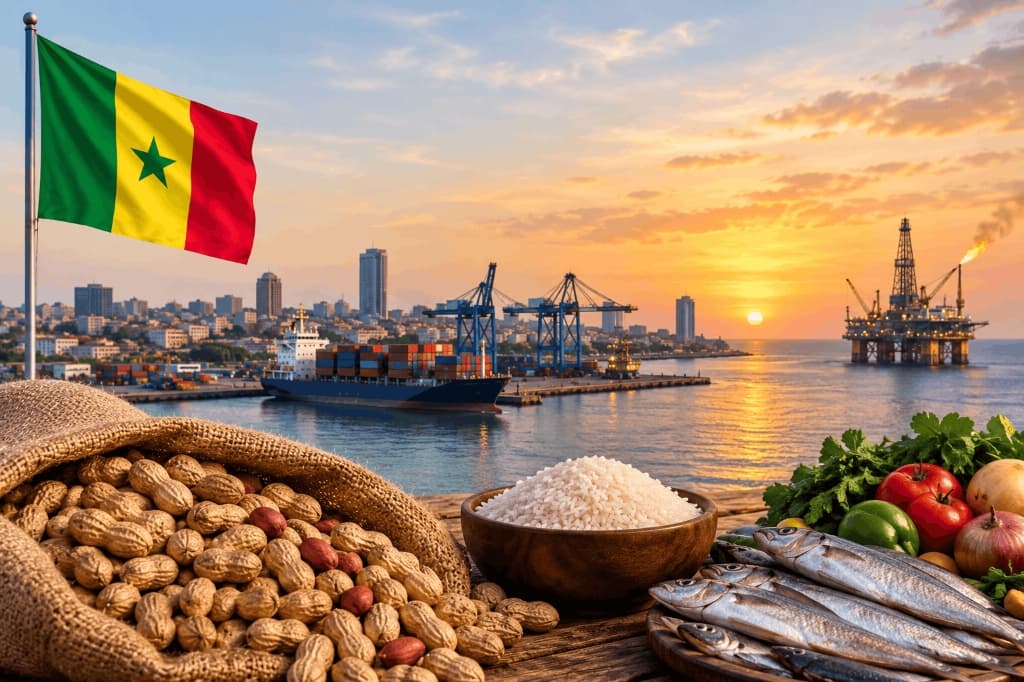
Senegal began producing oil in 2024 and exported its first liquefied natural gas from the Greater Tortue Ahmeyim project in 2025. These developments have added new export revenue to an economy that has long depended on services, agriculture, fishing, mining and trade.
Yet the country entered this new phase with a serious public finance problem. In September 2024, the government revealed that previous administrations had not fully reported the country's borrowing and budget deficits. An audit found that public debt was substantially higher than earlier official figures suggested. The revelations forced Senegal to revise its fiscal accounts and complicated its access to international financing.
The figures depend on which debt measure is being used. Central government debt stood at 99.7% of GDP at the end of 2023, according to the revised figures. At the end of 2024, government debt was reported at about 119% of GDP, while the IMF's broader measure, which includes additional public-sector liabilities, put the total at roughly 131% to 132%. These numbers refer to different dates and coverage, so they should not be treated as interchangeable.
The government has been working to restore confidence in its public finances. On 1 September 2026, the IMF announced a staff-level agreement on a proposed three-year programme worth about US$2.2 billion. The programme still requires approval by the IMF's management and Executive Board, as well as corrective action on the earlier misreporting and financing assurances from Senegal's partners.
Senegal's challenge is to manage its debt while making productive use of new oil and gas income. Oil exports have already contributed to stronger economic growth, but the benefits will depend on how much revenue reaches the public budget, how it is spent and how well the rest of the economy performs.
This is the ninth profile in Ria's Colony's Africa's Markets, Country by Country series, following Côte d'Ivoire. For businesses looking at West Africa, Senegal offers access to a market of nearly 20 million people, a major Atlantic port, regional transport connections and a growing energy industry. It also presents risks linked to public finances, slower non-oil growth and uncertainty over the terms of future debt payments.
Senegal at a glance
Measure
Figure or position
Population
Approximately 19.7 million
Economy
Services, agriculture, fishing, mining, manufacturing and energy
Real GDP growth
6.7% in 2025, according to the IMF
Growth excluding hydrocarbons
2.2% in 2025
2026 growth outlook
The IMF's August 2026 country page projects 2.2%
Currency
West African CFA franc (XOF)
Exchange rate
Fixed parity of CFAF 655.957 to €1
Regional organisations
ECOWAS and WAEMU
Continental trade agreement
African Continental Free Trade Area (AfCFTA)
Main commercial gateway
Port of Dakar
Figures refer to the periods and measures stated. GDP growth is an annual change in real output, not an increase in the value of exports.
How Senegal's economy works
In this section
Industry includes phosphate mining, fertiliser and chemical production, cement, food processing and petroleum refining.
Senegal has a diversified economy, although economic activity is concentrated around Dakar and its surrounding urban areas.
Services account for a large share of economic output. These include trade, transport, telecommunications, financial services, tourism, real estate and public administration. Dakar is also an important location for international organisations and companies operating across French-speaking West Africa.
Agriculture remains essential to employment and rural livelihoods. Farmers grow groundnuts, millet, rice, maize, vegetables and other crops, while livestock production supports households and domestic markets. Fishing supplies food and income to coastal communities and contributes to export earnings.
Industry includes phosphate mining, fertiliser and chemical production, cement, food processing and petroleum refining. Oil production has added a new export industry, while offshore gas offers the possibility of supplying both international markets and domestic electricity generation.
Infrastructure investment has also shaped Senegal's economy. Projects associated with the former government's Plan Sénégal Émergent included roads, the Blaise Diagne International Airport, the regional express train and the development of Diamniadio, a new urban centre outside Dakar.
These projects improved transport capacity and supported construction activity, but the debt revelations have raised questions about public borrowing, financial reporting and the cost of government investment.
The country's economic performance now depends on several things happening together: oil and gas production, stronger non-oil businesses, more productive agriculture, reliable infrastructure and better management of public finances.
What Senegal sells to the world
In this section
Industries Chimiques du Sénégal, commonly known as ICS, operates in phosphate mining and chemical processing.
Senegal's export earnings have grown as crude oil, refined petroleum products and gold have become more prominent in international trade.
ANSD's monthly trade bulletin recorded cumulative goods exports of CFAF 5,935.2 billion for 2025, up 51.8% from 2024. A separate annual trade series reports a lower total of CFAF 5,805.6 billion. Because these publications use different statistical series, the figures should not be combined. The annual series is useful for comparing destinations and suppliers, while the monthly bulletin shows how trade developed during the year.
Oil
The Sangomar offshore oil field began production in June 2024. It is operated by Australia's Woodside Energy, with Senegal's national oil company Petrosen participating in the project.
Oil production helped raise Senegal's overall GDP growth to 6.7% in 2025, even as growth outside the hydrocarbon sector slowed to 2.2%. The IMF has emphasised the importance of strengthening the wider economy so that growth does not depend too heavily on oil production.
Crude oil exports generate foreign exchange and can contribute to government revenue through taxes, royalties and the state's participation in the project. However, export earnings do not all go to the government. The amount available for public spending depends on the project's ownership arrangements, operating costs, fiscal terms and the price of oil.
Production from an offshore field can also change over time. Businesses considering the energy sector should assess the field's production outlook and contractual arrangements rather than assume that current output will continue indefinitely.
Natural gas
The Greater Tortue Ahmeyim project, developed by BP and its partners offshore Senegal and Mauritania, shipped its first liquefied natural gas cargo in April 2025.
The project is designed to supply LNG to international buyers. It also forms part of Senegal's plans to make greater use of domestic gas in electricity generation. If gas becomes available to power stations on suitable commercial terms, it could reduce reliance on imported fuels. The size of any savings will depend on infrastructure, production, supply contracts and the cost of converting power generation to gas.
For companies in energy services, engineering, equipment supply, maintenance and logistics, offshore production may create business opportunities. These opportunities depend on procurement requirements, local-content rules and the qualifications needed to work with the project operators.
Gold
Gold is another important source of export revenue. Senegal produces gold through mining operations in the country's south-east, including the Sabodala-Massawa complex operated by Endeavour Mining.
Gold is traded internationally, so export earnings depend partly on global prices and production levels. Switzerland is one of the markets associated with Senegal's gold exports, reflecting its role in international gold refining and trading.
The mining sector also creates demand for transport, equipment, engineering, security and other services. However, the value of mineral exports alone does not show how much income remains in the country. Ownership, operating expenses, taxation and local procurement all influence the domestic benefits.
Phosphates and fertiliser products
Senegal has significant phosphate resources. Phosphate rock is used in fertiliser production, while processed products such as phosphoric acid serve agricultural and industrial markets.
Industries Chimiques du Sénégal, commonly known as ICS, operates in phosphate mining and chemical processing. Its activities connect Senegal's mineral resources with international fertiliser supply chains, including markets in India.
Demand for phosphate products is affected by agricultural conditions, fertiliser prices, energy costs and competition from producers in other countries. This makes processing capacity and reliable logistics important to the sector's performance.
Fish and seafood
Fishing has long supported Senegalese diets, coastal employment and export earnings. Seafood is sold to markets in Europe, other African countries and Asia.
The sector faces serious pressures. Overfishing, competition for marine resources and the expansion of fishmeal and fish-oil production can affect the amount of fish available to local communities. Lower catches can reduce the incomes of fishers and make fish more expensive for consumers.
Processing, cold storage, refrigeration, packaging and efficient transport can help businesses preserve value along the seafood supply chain. However, investment needs to account for sustainable catch levels and the rules governing access to marine resources.
Groundnuts and other agricultural products
Groundnuts have played a major role in Senegal's agricultural and export history. They remain important for farmers, processors and domestic food markets.
The country also grows rice, millet, maize, vegetables and fruit. Horticultural exports include products such as green beans and mangoes, while agricultural processing creates opportunities to turn local crops into packaged foods, oils and other products with a longer shelf life.
Agriculture faces challenges involving rainfall, irrigation, storage, transport, processing capacity and competition from imported food. Expanding local production can create jobs and reduce some import needs, but results depend on yields, costs, product quality and access to buyers.
What Senegal imports and where it trades
In this section
Spain, Italy, the United States, Australia and the United Kingdom also appear among the leading destinations.
Senegal imports machinery, vehicles, petroleum products, food, medicines, construction materials and other manufactured goods. Some imports supply households directly, while others support transport, agriculture, industry and construction.
Rice is particularly important to the country's food supply. Domestic production contributes to consumption, but imports remain necessary to meet demand. Wheat, sugar, vegetable oil and dairy products are also part of the import bill.
For businesses elsewhere in Africa, this demand can identify possible markets for food products, pharmaceuticals, equipment and consumer goods. A large import category is not, on its own, proof that a new supplier can compete. Businesses need to compare landed costs, quality standards, distribution arrangements, payment risks and applicable tariffs.
Senegal's main trading partners
The ANSD-based annual trade series for 2025 identifies Mali as Senegal's largest export destination, followed by Switzerland, the Netherlands, China and India. Spain, Italy, the United States, Australia and the United Kingdom also appear among the leading destinations.
Mali is particularly important to Senegalese regional trade. As a landlocked country, it depends on transport corridors connecting it with coastal ports. Dakar is one of the gateways used to move goods into and out of the Malian market.
On the import side, China was Senegal's largest supplier in the same annual series, followed by France and Nigeria. Russia, India, the United Arab Emirates, Spain, the United States, Türkiye and the Netherlands were also among the leading suppliers.
These rankings can change from one year to another, especially when oil shipments, large equipment purchases or changes in commodity prices affect the value of trade. Businesses should consult current trade statistics before making decisions about a particular product or market.
Senegal's regional trade is important because neighbouring markets can be more accessible than distant destinations for some products. Yet distance is only one factor. Border procedures, transport costs, product standards, payment arrangements and the ability to distribute goods reliably all influence whether a trade opportunity is commercially viable.
Trade agreements and how goods move
In this section
Any plan that depends on rail freight should be based on confirmed operational services rather than proposals.
Senegal belongs to the West African Economic and Monetary Union (WAEMU), known by its French acronym UEMOA, and the Economic Community of West African States (ECOWAS). It is also a party to the African Continental Free Trade Area (AfCFTA).
Each arrangement serves a different purpose. WAEMU combines a shared currency with regional economic and customs arrangements. ECOWAS provides a wider framework for economic cooperation across West Africa. AfCFTA aims to expand trade between African countries by reducing trade barriers and improving access to markets.
Mali withdrew from ECOWAS in January 2025 alongside Burkina Faso and Niger, but remains a member of WAEMU. The distinction is relevant for Senegalese businesses trading with Mali because the two countries continue to share the CFA franc and participate in WAEMU's regional arrangements.
However, membership of a trade agreement does not mean every product can cross every border without conditions. Businesses must check rules of origin, customs documentation, product standards, taxes and any applicable restrictions before assuming that preferential tariffs apply.
Senegal also benefits from preferential access to certain international markets, subject to the terms of the relevant schemes. The European Union's Everything But Arms arrangement provides duty-free, quota-free access for eligible products originating in least developed countries, subject to applicable rules. US access under the African Growth and Opportunity Act (AGOA) depends on the scheme's current legal status and the country's eligibility at the time of export. Businesses should verify these conditions before building an export plan around them.
Dakar's port
The Port of Dakar is one of Senegal's most important commercial assets. It handles international cargo and serves as a gateway for goods entering Senegal and moving to other parts of West Africa, including landlocked Mali.
DP World operates Dakar's container terminal and is developing the Port of Ndayane with the Senegalese government and British International Investment. Ndayane is planned as a deep-water port south of Dakar, intended to accommodate larger vessels and provide additional capacity as regional trade grows. It is a development project, not a substitute for the existing port that is already handling cargo.
The new port could create demand for freight forwarding, warehousing, trucking, customs services, equipment maintenance and other logistics activities. The scale of these opportunities will depend on the project's completion, commercial demand and the supporting transport infrastructure.
For businesses serving Mali, Dakar offers an alternative to routes through other West African coastal countries. The choice of port depends on the origin of goods, the destination, transit arrangements, freight costs and the reliability of the road corridor.
The Dakar-Bamako corridor
Road transport is important to trade between Senegal and Mali. The Dakar-Bamako corridor connects Senegal's coast with Mali's capital and commercial centres, passing through the border area around Kidira in Senegal and Diboli in Mali.
The route is used to transport a range of goods, but distance, road conditions, border procedures, security and delays can affect delivery times and costs. Businesses should obtain current freight quotations and confirm transit requirements rather than base their plans on distance alone.
The historic Dakar-Niger railway was built to connect Senegal's coast with inland areas. Its freight role has been severely reduced, and the revival of rail transport has been discussed for years. Any plan that depends on rail freight should be based on confirmed operational services rather than proposals.
Airports and urban transport
Blaise Diagne International Airport, located near Diass, opened in 2017 and serves Dakar and the surrounding region. Air transport is useful for passengers, time-sensitive cargo and businesses that need connections to international markets.
Dakar's transport network also includes the Train Express Régional, which connects the capital with Diamniadio and the airport area, as well as a bus rapid transit system. These projects have expanded transport options within the metropolitan area.
The Senegambia Bridge, opened in 2019, crosses the Gambia River and improves road connections between northern Senegal and the southern part of the country, including Casamance. It also reduces dependence on the ferry crossing that previously served the route.
For businesses, transport infrastructure affects the cost of moving staff, raw materials and finished products. Its value depends on where a company operates, the condition of connecting roads and the availability of reliable freight and passenger services.
Sectors with room to grow
In this section
Entry can be difficult for businesses without specialist qualifications or established industry relationships.
Senegal has opportunities across several industries, although the country's debt position and the cost of financing need to be considered when assessing projects.
Energy and electricity
Oil and gas production creates demand for engineering, maintenance, transport, equipment, specialist services and infrastructure. Domestic gas could also support electricity generation if the required facilities and supply arrangements are developed.
Companies interested in this sector need to understand procurement procedures, local-content requirements, technical standards and the experience expected by major operators. Entry can be difficult for businesses without specialist qualifications or established industry relationships.
Renewable energy is another area to watch. Solar and wind projects can support electricity supply, but investment decisions depend on project costs, grid capacity, financing and the terms under which electricity can be sold.
Agriculture and food processing
Senegal imports food products that could offer opportunities for local producers and processors. Rice, wheat, sugar, vegetable oil, dairy products and poultry are relevant markets to investigate.
Expanding domestic production requires more than identifying an imported product. Farmers need suitable inputs, reliable water supplies where irrigation is required, storage, processing equipment, access to finance and buyers willing to pay sustainable prices.
Food processing can create additional value by extending shelf life and preparing products for retail, hospitality and institutional buyers. Businesses may also find opportunities in packaging, refrigeration, agricultural machinery, distribution and quality testing.
For companies elsewhere in Africa, Senegal can be both a destination market and a location from which to supply neighbouring countries. The commercial case depends on production costs, transport arrangements, market demand and applicable trade rules.
Logistics and warehousing
Dakar's port, airport and road connections support demand for freight forwarding, storage, customs services and distribution. The proposed Ndayane port and the development of Diamniadio could expand that demand if the projects attract sufficient commercial activity.
Companies considering logistics investments should examine existing capacity, the location of customers, access to roads and industrial areas, operating costs and competition. A planned infrastructure project may create future demand, but the timing and scale of that demand are not guaranteed.
Digital services and financial technology
Senegal has a growing market for digital services, including financial technology, mobile payments, software, communications and business services. Dakar is an important centre for technology companies and startups serving Senegalese and regional customers.
Digital financial services can help businesses collect payments, transfer money and reach customers who have limited access to traditional banking. Companies entering the market still need to understand licensing requirements, consumer protection rules, data obligations and the way customers prefer to pay.
The opportunity is not limited to financial technology. Businesses may also find demand for software, cybersecurity, digital marketing, online education, customer support and tools that help small companies manage their operations.
Tourism and cultural industries
Senegal attracts visitors to Dakar, Gorée Island, Saint-Louis, the Saloum Delta, the Petite Côte and Casamance. Its cultural industries include music, fashion, film, visual arts and contemporary design. Dakar's contemporary art biennale, Dak'Art, is an important event for the regional and international art community.
Tourism and culture create demand for accommodation, food services, transport, events, creative production and retail. Opportunities vary by destination and season, and businesses need to consider access, infrastructure, local regulations and visitor demand.
For companies working across African markets, Senegal's cultural industries can also provide partnerships in music, fashion, media, events and creative services.
Doing business in Senegal
In this section
Senegal's standard corporate income tax rate is generally 30%, while the standard value-added tax rate is 18%.
Entering Senegal requires an understanding of company registration, taxation, land arrangements, foreign exchange rules and the sector in which a business plans to operate.
Registering a company
APIX, Senegal's investment promotion agency, provides support to investors and operates a business registration one-stop shop. The steps required depend on the business structure, ownership, activities and licences involved.
Senegal is a member of the Organisation for the Harmonisation of Business Law in Africa (OHADA). OHADA establishes common business law frameworks across its member states, including rules relevant to commercial companies and business transactions.
A company entering Senegal should confirm its registration requirements with APIX or a qualified local adviser. Businesses operating in regulated sectors may need additional approvals beyond basic company registration.
Senegal permits foreign investment in many sectors, and foreign investors can own businesses in a range of industries. However, ownership rules, licences, local-content requirements and other conditions can vary by sector.
The government has reviewed major agreements in industries including oil, gas, mining and fishing, with an emphasis on state revenue and local participation. Businesses considering investments in these sectors should review the current legal and contractual framework rather than rely on general statements about foreign ownership.
Investment incentives may be available under the Investment Code or through designated economic zones, depending on the activity and eligibility requirements. An incentive should not be assumed to apply automatically to every new company.
Land and property
Land access requires careful due diligence. Senegal's land system includes different legal arrangements, and the rights attached to a particular plot depend on its status and registration.
Businesses planning to build a factory, warehouse, hotel or other facility should confirm ownership or lease rights, permitted land use, planning approvals and any restrictions before committing funds. A local legal adviser can help establish whether the documents provide the rights needed for the intended project.
Currency and moving money
Senegal uses the West African CFA franc, which has a fixed parity of CFAF 655.957 to the euro. This provides a stable nominal exchange rate against the euro, although it does not eliminate every currency or business risk.
Companies operating across WAEMU may find the shared currency useful for regional transactions. Transfers outside the monetary union are subject to applicable foreign exchange rules, documentation requirements and banking procedures.
Businesses should confirm the requirements for receiving foreign investment, paying overseas suppliers, repatriating profits and transferring dividends with their authorised bank and professional advisers.
Taxes and operating costs
Senegal's standard corporate income tax rate is generally 30%, while the standard value-added tax rate is 18%. Businesses should verify the current rules, exemptions, filing obligations and sector-specific taxes with the Senegalese tax authority or a qualified adviser before making financial projections.
Operating costs vary by industry and location. Electricity, imported inputs, transport, wages, rent and financing can all affect a company's margins.
Public finances are also relevant to businesses supplying government agencies or state-owned entities. Payment delays and changes to public spending can affect cash flow, particularly for companies that depend heavily on government contracts.
A business plan should therefore account for working capital, customer payment periods, tax compliance, import costs and the possibility of changes in public procurement.
Risks businesses should understand
In this section
Senegal has experienced changes in government priorities and a review of agreements in several strategic sectors.
Senegal offers access to a substantial domestic market and regional trading opportunities, but companies should assess the risks before committing capital.
Public debt and government spending
The debt reporting scandal has affected Senegal's access to financing and complicated its discussions with the IMF. In September 2026, Senegal was seeking to restore debt sustainability through a proposed IMF programme and changes to its debt repayment arrangements. The IMF agreement remained subject to approval at the time of its announcement.
The government has also acknowledged substantial payment arrears. Reuters reported in September 2026 that the authorities were working to address CFAF 1.956 trillion, equivalent to approximately US$3.5 billion, in arrears accumulated by March 2025.
For businesses, this creates a reason to examine public-sector customers carefully. Companies bidding for government contracts should assess payment terms, available funding and their ability to finance operations while waiting for invoices to be settled.
The debt situation does not mean every business operating in Senegal faces the same level of risk. Companies selling to private customers or exporting to other markets may have different exposures from those that rely heavily on public spending.
Dependence on oil production
Oil has contributed to Senegal's recent economic growth, but the country needs other sectors to generate employment and sustain activity.
Oil prices can change sharply, and production from an individual field will not remain at its highest level indefinitely. Revenue also depends on the terms of production agreements, operating costs and the government's share of the proceeds.
Businesses should distinguish between opportunities created directly by oil and gas projects and those supported by demand across the wider economy. A company that depends entirely on one major project may face a different risk profile from one that serves several industries.
Political and regulatory uncertainty
Senegal has experienced changes in government priorities and a review of agreements in several strategic sectors. Businesses operating in oil, gas, mining and fishing should pay particular attention to contractual obligations, licensing conditions and changes in regulation.
The government's efforts to increase public revenue and strengthen oversight may also affect how companies interact with tax authorities and public institutions.
Before investing, companies should obtain current legal advice, understand the relevant approval process and keep records of contracts, licences and regulatory correspondence.
Fishing, food security and employment
Fishing supports livelihoods and food supplies, but pressure on marine resources creates challenges for coastal communities and businesses that depend on consistent catches.
Senegal also relies on imports to meet part of its food demand. International price changes, transport disruptions and currency-related costs can affect the price of imported food and production inputs.
Agriculture and food processing may offer opportunities to reduce some of these dependencies, but businesses must account for local production costs, infrastructure, storage and the availability of reliable supplies.
Growth outside oil and gas
The IMF reported that Senegal's economy grew by 6.7% in 2025, while growth excluding hydrocarbons was 2.2%.
This difference is important when assessing the strength of domestic demand. A strong headline growth figure can coexist with slower activity in sectors that employ many people.
Businesses selling to households should assess incomes, prices and demand within their target customer groups rather than relying on national GDP growth alone. Companies selling to other businesses should examine the health of their customers' industries and the availability of credit.
What Senegal means for African businesses
In this section
Regional trade agreements may help, but the relevant rules and product requirements must be checked.
Senegal can be a useful market for companies looking to expand into West Africa. Its population, port infrastructure, regional connections and established service industries provide several possible routes into the market.
Three areas deserve particular attention.
First, consider Dakar as a regional trading gateway. Its port, airport and road connections support trade with Senegal and neighbouring countries. Companies serving Mali may find opportunities in transport, warehousing, distribution and the supply of goods that move through Dakar.
Second, investigate products Senegal already imports. Food, medicines, machinery, vehicles and industrial inputs are potential areas for market research. Businesses from Nigeria, Ghana, Côte d'Ivoire and other African countries can examine whether they have a cost, quality or delivery advantage. Regional trade agreements may help, but the relevant rules and product requirements must be checked.
Third, look at industries connected to local demand and production. Agriculture, food processing, logistics, digital services, energy services and cultural industries all offer areas to investigate. The right opportunity will depend on the company's capabilities, the customers it can reach and the amount of capital required.
Businesses should also account for the practical requirements of entering the market. French is widely used in government, business and formal administration, so French-language contracts, documentation and local professional support can be important. Companies should establish how their customers buy, how payments are made and what it takes to distribute goods or deliver services reliably.
Senegal's debt situation deserves attention, particularly for companies relying on government contracts or large public infrastructure projects. It should be assessed alongside the country's commercial strengths rather than used as the sole measure of its business potential.
The outlook for Senegal's economy
In this section
Higher oil exports do not automatically resolve debt problems, improve household incomes or create enough jobs.
Senegal is entering a period in which oil and gas will play a larger role in exports, while established industries such as agriculture, fishing, mining, transport and services remain important to employment and domestic demand.
The country has several advantages: a major Atlantic port, links to landlocked Mali, membership of regional economic arrangements and an established commercial centre in Dakar. Its new energy projects also offer opportunities for specialist suppliers and related industries.
The difficult task is to translate export earnings into lasting economic gains while restoring confidence in public finances. Higher oil exports do not automatically resolve debt problems, improve household incomes or create enough jobs. Those outcomes depend on government revenue, investment decisions, productivity and the performance of businesses outside the energy sector.
For companies considering Senegal, the strongest starting point is to identify a specific customer need, assess the cost of serving that market and understand the relevant regulations and payment risks. The country's trade figures can help identify potential demand, but commercial research is needed to establish whether a particular opportunity is viable.
Senegal's position in West Africa makes it worth examining for companies with regional ambitions. The decision to enter the market, however, should rest on current data, a clear understanding of the operating environment and a business case that can withstand changes in public spending, commodity prices and demand.
This is the ninth profile in Ria's Colony's Africa's Markets, Country by Country series. The series examines how African economies earn income, trade with one another and create opportunities for businesses.