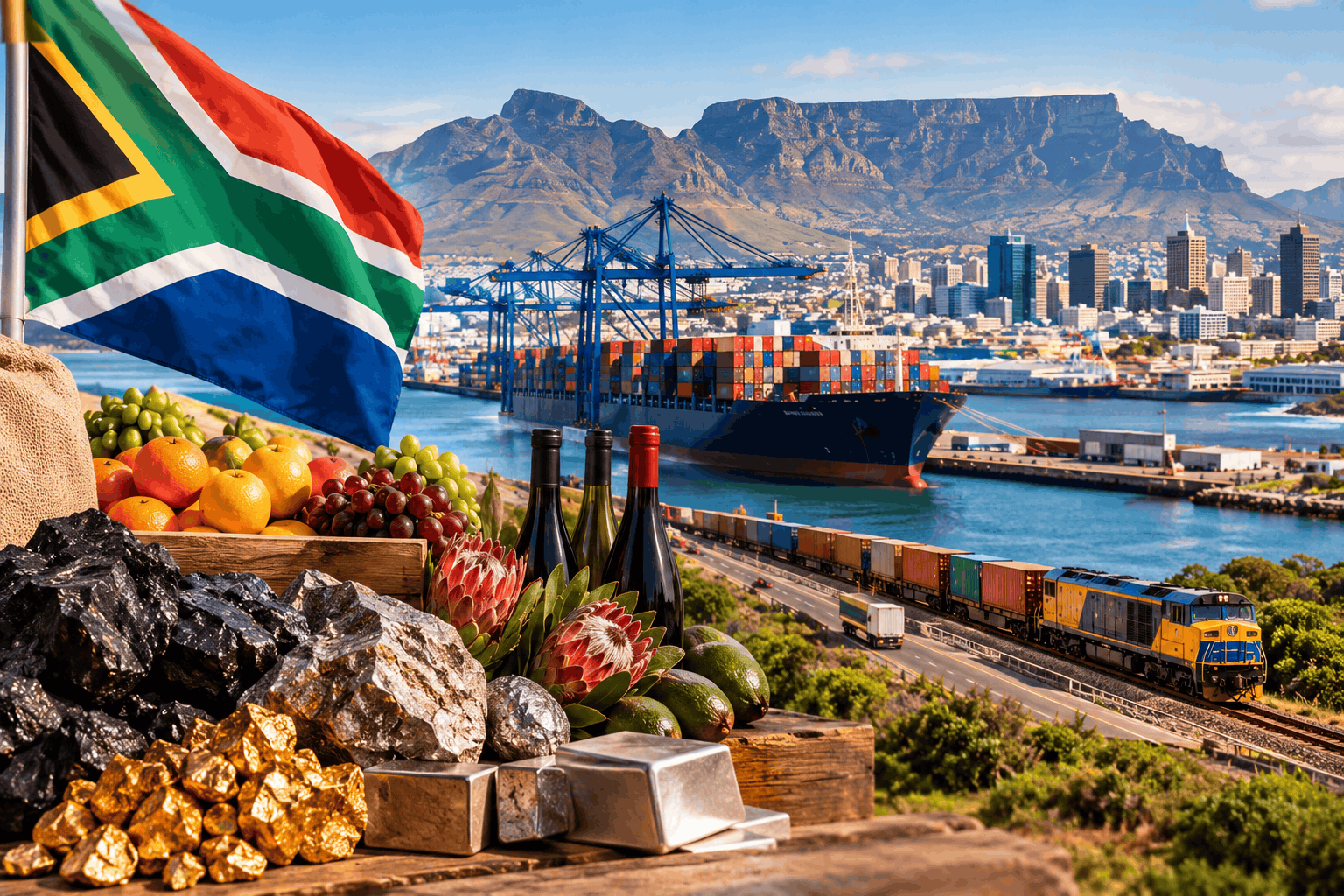
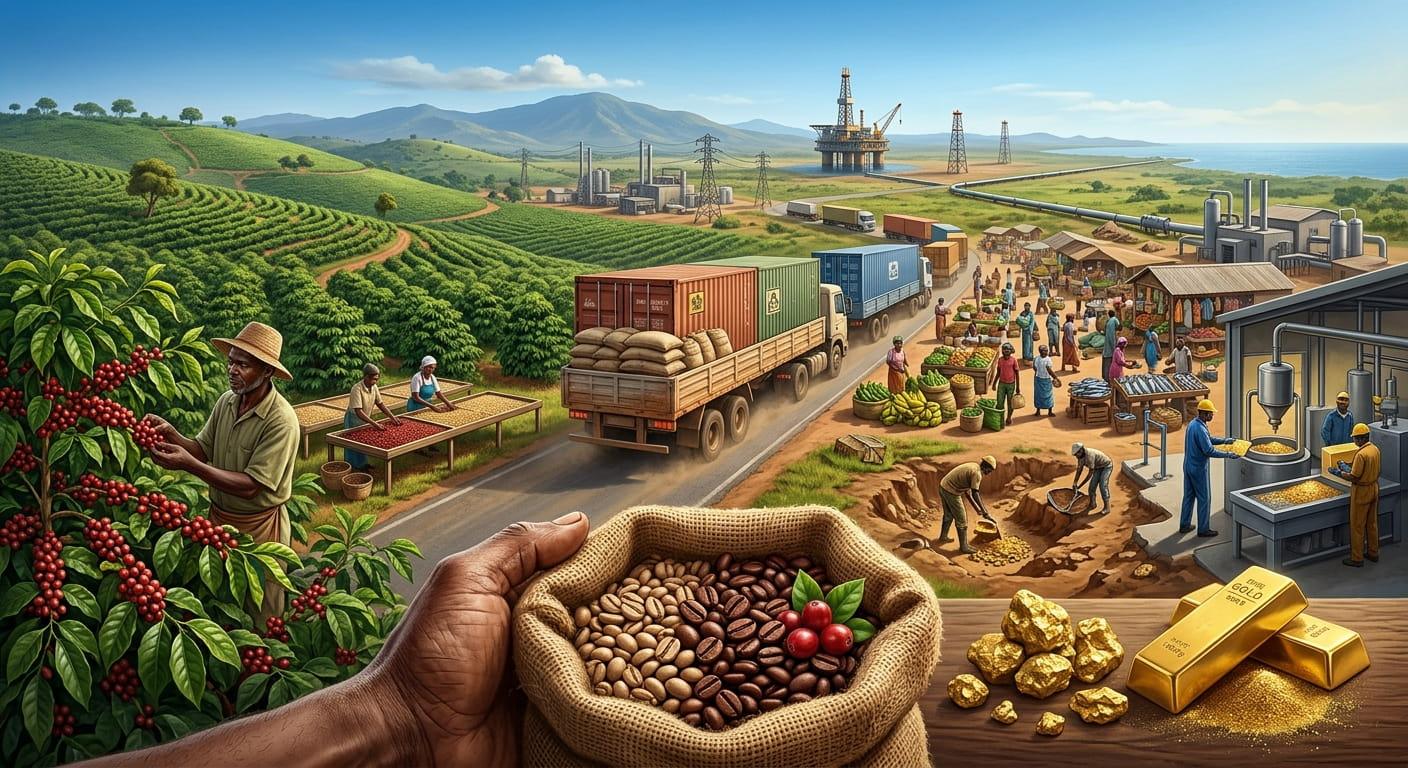
How South Africa earns, spends and trades through platinum, gold, coal, cars and fruit. Explore its trade partners, ports, growth sectors and business opportunities.
From car factories to global trade
In this section
The International Monetary Fund's April 2026 projections put its nominal gross domestic product at approximately US$480 billion.
South Africa's car industry offers a useful way to understand how the country's economy works. Manufacturers such as Mercedes-Benz, BMW, Volkswagen and Toyota operate production facilities in the country, supplying both domestic buyers and overseas markets. Their factories depend on imported components, skilled workers, reliable electricity, transport infrastructure and access to international customers. A change in trade policy in another country can affect production decisions and the jobs connected to them.
The automotive industry is one part of a much larger economy. South Africa produces minerals used in manufacturing and technology, exports agricultural produce to international markets, processes raw materials into finished goods and runs financial and business services that support companies across Africa. Its banks, insurers, retailers, telecommunications companies and industrial businesses have established operations beyond its borders.
This range of economic activity gives South Africa a different export profile from countries that depend heavily on a small number of commodities. It also exposes the country to several pressures at once. Commodity prices affect mining revenue, international tariffs influence manufacturers and farmers, and domestic electricity and transport problems raise the cost of doing business.
South Africa remains one of Africa's largest economies. The International Monetary Fund's April 2026 projections put its nominal gross domestic product at approximately US$480 billion. However, the country's size has not translated into strong economic growth or enough jobs for its population. Statistics South Africa reported real economic growth of 1.1% in 2025, while the economy contracted by 0.2% quarter on quarter in the second quarter of 2026.
The country's official unemployment rate reached 33.6% in the second quarter of 2026. These figures help explain why South Africa can have sophisticated financial markets, established manufacturers and major exporters while still facing serious economic pressure.
This is the seventh profile in our series, Africa's Markets, Country by Country, following Nigeria, Ghana, Kenya, Rwanda, Uganda and Tanzania. Here, we examine what South Africa sells, what it buys, how its trade agreements work and what businesses elsewhere in Africa should understand before entering its market.
South Africa at a glance
Measure
Figure
Period
Nominal GDP
Approximately US$480 billion
2026 IMF projection
GDP per person
Approximately US$7,500
2026 IMF projection
Real GDP growth
1.1%
Full year 2025
Real GDP growth
−0.2% quarter on quarter
Q2 2026
Growth forecast
1.2%
2026, SARB September forecast
Official unemployment rate
33.6%
Q2 2026
Headline inflation
4.5%
September 2026
Repo rate
7.25%
From 25 September 2026
Goods exports
Approximately US$122.45 billion
2025, WTO/UN Comtrade
Goods trade surplus
Approximately R202 billion
2025, reported figure
Major export destinations
China, United States, Germany, Japan and United Kingdom
2025 trade data
Currency
South African rand (R)
Floating exchange rate
Main regional trade arrangements
SACU, SADC and AfCFTA
Current memberships
Sources: IMF World Economic Outlook, Statistics South Africa, South African Reserve Bank, World Trade Organization and UN Comtrade. GDP figures are projections, while growth and trade figures refer to the periods stated. The trade surplus is a goods balance and should not be confused with the balance of trade in services.
How South Africa's economy is built
In this section
The programme focuses on areas such as electricity, freight logistics, water, visas and digital infrastructure.
Services account for the largest share of South Africa's economic output. Finance, real estate and business services are particularly important, alongside wholesale and retail trade, transport, government services and other activities. Manufacturing and mining provide a substantial industrial base, while agriculture contributes a smaller share of GDP but supplies export markets and supports employment in rural communities.
Johannesburg is a major financial centre, and the Johannesburg Stock Exchange is Africa's largest stock exchange by market capitalisation. South African banks, insurers, retailers and telecommunications companies also operate in other African countries. Their presence gives businesses in the region access to established financial, commercial and professional services.
Mining remains important because South Africa holds substantial deposits of platinum group metals, manganese, chromium, gold, iron ore and coal. These resources supply international industries and generate export earnings. Manufacturing adds value to some of the country's raw materials and produces vehicles, chemicals, machinery, processed foods and other goods for local and international buyers.
Agriculture adds another source of export income. Citrus, grapes, apples, pears, avocados and macadamia nuts reach markets across Europe, Asia, the Middle East and elsewhere. The country also produces wine, maize, sugar and meat products.
The combination of these sectors gives South Africa a broad economic base. However, the country has struggled to grow quickly enough to create jobs and raise living standards across its population. Growth has remained weak relative to the needs of the labour market, and per-person economic gains have been limited over much of the past decade.
Three problems help explain this performance: electricity, freight logistics and unemployment.
Electricity and industrial production
Eskom, South Africa's state-owned electricity utility, introduced extensive rolling power cuts, known as load shedding, during periods of electricity shortages. These interruptions affected factories, mines, shops and households, forcing businesses to spend money on backup power or adjust their operating hours.
Electricity supply improved substantially after the severe shortages of 2023 and the following years. Better performance from existing power stations, private solar installations and additional renewable generation helped reduce the frequency of interruptions. Businesses have also invested in rooftop solar and other alternatives.
However, improved supply does not mean electricity has become inexpensive. Rising tariffs and the cost of investing in independent power systems continue to affect operating expenses. Companies that rely on electricity for manufacturing, refrigeration, mining and data processing must account for both supply reliability and cost.
Freight and transport
South Africa's export industries depend on moving goods from mines, farms and factories to ports. Transnet operates the country's principal freight rail network and major commercial ports. Years of underinvestment, equipment theft, operational difficulties and maintenance problems reduced freight rail performance and contributed to delays.
When rail transport cannot move enough goods, companies turn to road freight. This increases pressure on roads, adds to transport costs and can make it harder for exporters to meet delivery schedules.
The government has begun reforms to allow greater private-sector participation in freight rail and port operations. These changes could improve capacity and efficiency, but their effects depend on implementation, investment and the performance of individual facilities.
For exporters, the practical concern is the full cost of getting a product to its customer. A competitive price at the factory or farm gate can lose its advantage if transport is slow, unreliable or expensive.
Jobs and household spending
South Africa's official unemployment rate was 33.6% in the second quarter of 2026. Youth unemployment is substantially higher, creating a persistent challenge for households and policymakers.
High unemployment limits the number of people earning regular wages and affects domestic demand. It also exists alongside major differences in income, access to services and economic opportunity. Businesses entering the country need to understand that a large national population does not mean every customer segment has the same purchasing power.
South Africa's economic outlook therefore depends on more than the performance of its biggest companies. Sustained growth requires investment, productive businesses and the creation of jobs across a wider range of industries.
Politics and economic reform
South Africa's political system changed after the May 2024 general election, when the African National Congress lost its parliamentary majority for the first time since the end of apartheid. The ANC subsequently formed a Government of National Unity with the Democratic Alliance and other parties.
The coalition has continued to work on economic reforms, including measures under Operation Vulindlela. The programme focuses on areas such as electricity, freight logistics, water, visas and digital infrastructure. Its progress matters to businesses because regulatory changes and infrastructure improvements can affect the cost of operating in the country.
South Africa was removed from the Financial Action Task Force's list of jurisdictions under increased monitoring in October 2025, following work to address deficiencies in its anti-money-laundering and counter-terrorist-financing systems. The removal was a significant regulatory development, although it does not eliminate the need for businesses and financial institutions to maintain their own compliance controls.
Inflation, interest rates and public finances
The South African Reserve Bank adopted a 3% inflation target in 2025. Headline consumer inflation stood at 4.5% in September 2026. On 25 September 2026, the Bank raised its repo rate, the benchmark policy rate, by 0.25 percentage points to 7.25%.
Interest rates affect borrowing costs for businesses and households. Higher rates can make expansion more expensive for companies that rely on loans and can reduce consumers' ability to finance major purchases.
Public finances are another concern. South Africa carries a substantial public debt burden, and interest payments take up a significant portion of government spending. The exact debt ratio depends on the measure and reporting period used, so businesses and investors should consult the latest National Treasury fiscal publications when assessing the government's position.
What South Africa sells
In this section
Standard Bank, Absa, MTN and Vodacom are among the companies with substantial operations beyond South Africa.
South Africa's goods exports reached approximately US$122.45 billion in 2025 according to WTO data based on UN Comtrade. Its export earnings come from a combination of minerals, manufactured products and agricultural goods.
Platinum group metals and other minerals
South Africa is a major producer of platinum group metals, which include platinum, palladium and rhodium. These metals are used in vehicle catalytic converters, jewellery, electronics and various industrial applications. Platinum also has potential uses in hydrogen-related technologies.
Much of the country's platinum group metal production comes from the Bushveld Complex, a mineral-rich geological formation in the northern part of the country. Mining also produces manganese, chromium, gold, iron ore and coal.
These commodities serve different international markets. Iron ore supplies steelmakers, manganese and chromium support metal production, and coal is used in electricity generation and industrial processes. Richards Bay Coal Terminal is a major export facility for coal shipped to international buyers, including markets in Asia.
Gold remains an important mineral export, although the industry has changed considerably from the period when gold mining dominated the economy. Some operations face deeper deposits, rising costs and other production challenges. Changes in global prices can therefore affect export earnings even when production volumes remain stable or decline.
Mining revenue brings foreign exchange into the country, supports jobs and creates demand for engineering, transport and other services. However, dependence on mineral prices also exposes the economy to changes in international demand and commodity markets.
Vehicles and automotive components
South Africa has an established automotive manufacturing industry. Companies including BMW, Mercedes-Benz, Volkswagen, Toyota, Ford, Nissan and Isuzu have operated manufacturing or assembly facilities in the country.
The industry produces vehicles and components for domestic and export markets. It also supports suppliers, logistics companies, engineering services and workers with specialised manufacturing skills.
Vehicle exports depend on access to major markets and on the cost of producing in South Africa. Tariffs imposed by trading partners can affect the competitiveness of locally manufactured vehicles. Changes in the United States' automotive trade policy since 2025 have created additional pressure for exporters serving that market.
The exact effect varies by manufacturer, model and destination. Claims about the number of vehicles lost or the percentage decline in exports should be tied to the relevant industry data and should distinguish the United States from the wider North American market.
South Africa's automotive sector also faces long-term questions about the transition to electric vehicles, changes in global production networks and the investment required to remain competitive. Suppliers that can meet international quality, cost and delivery requirements remain important to the industry's future.
Fruit, wine and other agricultural products
South Africa exports citrus fruit, apples, pears, table grapes, avocados and macadamia nuts. It also produces wine, maize, sugar, wool and meat products.
Citrus is an important export, with shipments serving customers in Europe, the United Kingdom, the Middle East and Asia. Other markets offer opportunities, but access depends on consumer demand, phytosanitary requirements, transport costs and the ability to deliver produce in suitable condition.
The country's agricultural exporters depend on reliable cold chains, suitable packaging, inspection systems and port capacity. Delays can reduce the quality of perishable goods and increase costs for producers and buyers.
Trade policy also affects agricultural sales. US tariffs introduced in 2025 created additional costs for some South African products. The actual tariff depends on the product and the measures in force at the time of shipment. Exporters should check current US tariff schedules rather than assume that all fruit faces the same rate or that a trade preference automatically removes every additional duty.
Machinery, chemicals and processed goods
South Africa manufactures machinery, steel products, chemicals, fuels, paper, plastics, pharmaceuticals, beverages and processed foods. These products serve domestic industries and are sold to customers elsewhere in Africa and beyond.
Manufactured exports are particularly important to regional trade. Neighbouring countries buy products used in construction, mining, retail, agriculture and industrial production. South African suppliers can often provide equipment, technical support and distribution networks alongside the goods themselves.
For businesses in other African countries, these industries represent both competition and potential partnerships. A local manufacturer might compete with a South African supplier for customers in its home market, while another business might find opportunities in supplying components, raw materials or specialised services to South African factories.
Goods are only part of South Africa's international economic activity. Tourism brings visitors to Cape Town, the Kruger National Park, the Garden Route, the winelands and other destinations. Visitors spend money on accommodation, transport, food, entertainment and other services.
South African companies also earn revenue through banking, insurance, telecommunications, retail, professional services and business operations in other African markets. Standard Bank, Absa, MTN and Vodacom are among the companies with substantial operations beyond South Africa.
These regional operations create commercial links across borders. They can support trade through financial services, mobile connectivity, payment systems, business networks and distribution channels.
However, income earned by South African companies in other countries should be distinguished from goods exports. A country can be an important regional service provider even when the value of those services is not captured in its merchandise export figures.
What South Africa buys and who it trades with
In this section
Mozambique, Namibia and Botswana are important destinations, alongside Zimbabwe, Zambia, Lesotho and Eswatini.
South Africa imports crude oil and refined fuels, machinery, electrical equipment, vehicles and components, chemicals, plastics, pharmaceuticals, electronics and some agricultural products. Its manufacturers need imported equipment and components, while households and businesses purchase a range of consumer and capital goods from overseas suppliers.
The country recorded a goods trade surplus of approximately R202 billion in 2025. A goods surplus means the value of merchandise exports exceeded the value of merchandise imports during the period. It does not mean the country has a surplus across every part of its external accounts, because services, income flows and financial transactions are measured separately.
China is one of South Africa's most important trading partners. The country buys South African minerals and other products while supplying machinery, electronics, manufactured goods and consumer products. Germany is also an important partner, particularly for industrial goods, vehicles and related supply chains. The United States, Japan, the United Kingdom and several European markets are significant destinations for South African exports.
The exact ranking of trading partners depends on whether the comparison uses exports, imports or total trade, and whether it measures individual countries or regional blocs. The European Union, for example, is a trading bloc rather than a single country. Published comparisons should make that distinction clear.
Trade with the rest of Africa
African markets are particularly important for South Africa's manufactured products. The country exports machinery, vehicles, processed foods, chemicals, steel and consumer goods to neighbouring economies and other markets across the continent.
Government trade data indicate that exports to the rest of Africa accounted for approximately 26.7% of South Africa's global exports in 2025. Mozambique, Namibia and Botswana are important destinations, alongside Zimbabwe, Zambia, Lesotho and Eswatini.
Geography plays a role in these trade flows. Neighbouring countries share road connections, established distribution networks and commercial relationships with South African suppliers. Some also depend on South African ports and transport corridors to move goods to international markets.
More than one regional arrangement influences this trade. The Southern African Customs Union and the Southern African Development Community support different forms of regional economic integration. South Africa is also a participant in the African Continental Free Trade Area.
Afreximbank's African Trade Report 2025 estimated that South Africa accounted for 19.1% of recorded intra-African trade in 2024. This shows the scale of the country's role in trade within Africa. A figure for 2025 should be used only when supported by the relevant report and its underlying data.
For businesses elsewhere in Africa, the importance of South Africa goes beyond the size of its domestic market. It is also a source of industrial goods, services, finance and potential commercial partners.
Trade agreements and how goods move
In this section
The United States introduced tariffs affecting imported vehicles and parts, alongside broader tariff measures.
Trade agreements influence tariffs, customs procedures and the conditions under which goods can enter a market. South Africa belongs to several regional arrangements, but each has its own rules and scope.
SACU and the Common Monetary Area
The Southern African Customs Union, or SACU, comprises South Africa, Botswana, Namibia, Lesotho and Eswatini. It is the world's oldest functioning customs union.
The members apply a common external tariff to many goods entering the customs area from outside the union, while qualifying goods can generally move within the union without internal customs duties. Customs revenue is pooled and distributed according to an agreed formula.
The Common Monetary Area is a separate arrangement involving South Africa, Lesotho, Namibia and Eswatini. The currencies of Lesotho and Namibia are pegged to the rand, while Eswatini maintains a currency arrangement linked to it. The rand also circulates in these economies.
These monetary links reduce some exchange-rate complications for businesses trading in the region. They do not remove every commercial risk, and companies still need to account for differences in regulation, payment arrangements, operating costs and market conditions.
SADC and AfCFTA
The Southern African Development Community, or SADC, promotes regional cooperation and trade among its member states. Its free trade arrangements provide preferential access for qualifying goods, subject to product coverage, rules of origin and applicable customs procedures.
South Africa also participates in the African Continental Free Trade Area, or AfCFTA. The agreement aims to reduce barriers to trade between African countries and create a more integrated continental market.
South Africa ratified the AfCFTA agreement in 2019 and took part in the Guided Trade Initiative, including shipments to Ghana in 2023. The initiative was designed to test the practical operation of AfCFTA trading arrangements.
For businesses, the existence of a trade agreement is only the first step. A product must qualify under the relevant rules of origin, and exporters must meet the destination country's regulatory requirements. Preferential tariffs do not automatically remove product standards, labelling rules, inspections or other import procedures.
Businesses considering regional expansion should check the tariff treatment of their specific products and confirm the documentation required before shipping.
Trade with Europe and the United Kingdom
The European Union is an important market for South African minerals, vehicles, agricultural goods, chemicals and other manufactured products.
Trade between the EU and South Africa is governed by the Southern African Development Community Economic Partnership Agreement. The agreement provides preferential treatment for many qualifying products, although the precise conditions depend on the product and the applicable rules.
The United Kingdom has its own trade agreement with the Southern African Customs Union and Mozambique following its departure from the EU's trading arrangements. Businesses should consult the relevant agreement and tariff schedule when planning shipments.
European market access can be valuable for South African exporters, but it does not remove the need to meet food safety, environmental, technical and other regulatory standards. Agricultural exporters, for example, must meet the requirements that apply to their particular products and destinations.
Trade with the United States
South Africa's trade relationship with the United States has faced considerable uncertainty since 2025. The United States introduced tariffs affecting imported vehicles and parts, alongside broader tariff measures. Subsequent legal and policy developments have changed the terms and scope of some of these measures.
A separate Section 301 measure was reported in 2026 in connection with allegations concerning the affected governments' enforcement against imports produced using forced labour. This should not be interpreted as a finding that all South African exports are produced using forced labour.
The African Growth and Opportunity Act, commonly known as AGOA, has been extended through December 2028 under the 2026 legislative developments described by the South African government. However, the terms of eligibility and the treatment of individual products must be checked against the applicable US legislation and official guidance.
AGOA preferences do not automatically override separate tariffs, including measures affecting vehicles. Businesses exporting to the United States should check the current tariff schedule, the product's classification and any applicable preference before calculating their landed costs.
For South African manufacturers and farmers, access to the US market can affect production plans, prices and investment. For businesses elsewhere in Africa, these developments also show why market diversification and a clear understanding of trade rules matter.
Ports, rail and road corridors
South Africa's ports connect its mining, manufacturing and agricultural industries to international markets. The Port of Durban handles a substantial share of the country's container trade. Richards Bay is an important export point for coal and other bulk commodities, while Saldanha Bay handles iron ore.
Cape Town, Gqeberha, Ngqura and East London also serve different combinations of container, agricultural, industrial and automotive cargo. Their roles vary by terminal and product.
Port efficiency remains an important issue. Delays and capacity constraints can raise costs for importers and exporters, particularly businesses shipping goods with strict delivery schedules or limited shelf life. Transnet has pursued changes intended to bring private investment and operating expertise into parts of the port and rail system. The status of individual partnerships and terminal agreements should be checked against current Transnet announcements.
Rail is particularly important for bulk goods that are expensive to move by road. South Africa has an extensive rail network, including dedicated heavy-haul routes for commodities such as coal and iron ore. However, reduced freight volumes and operational difficulties have pushed more cargo onto roads.
Private-sector access to parts of the freight rail network is part of the reform programme. Greater participation could create demand for logistics services, equipment, maintenance and terminal operations, but the commercial effects will depend on the pace of implementation and the reliability of the network.
Road corridors also connect South Africa to neighbouring markets. The N4 links the country to the Maputo Corridor, while routes through Botswana, Zimbabwe and other countries connect businesses to wider Southern and Central African markets.
OR Tambo International Airport in Johannesburg is an important passenger and cargo hub for Southern Africa. Air freight is particularly useful for high-value, time-sensitive or perishable goods, although it is usually more expensive than sea or road transport.
Sectors with room to grow
In this section
Tourism supports accommodation, transport, food services, tour operations, entertainment and other businesses.
South Africa's established industrial base creates opportunities in sectors that can improve productivity, reduce operating costs or serve demand in the country and the wider region. The scale of the opportunity varies by location, regulation, available infrastructure and access to customers.
Renewable energy
The country's electricity shortages encouraged businesses to invest in solar generation and other independent power solutions. Changes to the electricity market have also created more room for private generation and electricity trading, subject to the relevant rules.
Solar and wind projects require equipment, installation, engineering, maintenance, financing and grid connections. Battery storage is another area of interest because it can help manage the timing and reliability of electricity supply.
The main constraints include the capacity of the electricity grid, the cost of financing and the time needed to connect new projects. Companies considering entry should assess these issues alongside demand and policy conditions.
Green hydrogen and critical minerals
South Africa's mineral resources are relevant to several clean-energy technologies. Platinum group metals have applications in fuel cells and other industrial processes, while manganese and other minerals are used in batteries, steel production and related industries.
The country has explored green hydrogen projects and opportunities to process more minerals domestically. Green hydrogen is produced using renewable electricity to split water into hydrogen and oxygen. Its commercial viability depends on the cost of renewable power, water availability, transport infrastructure, financing and demand from industrial customers.
Projects in the Northern Cape and around port facilities have attracted interest, but planned capacity should not be confused with operating production. Businesses should distinguish announced projects from those that have reached construction or commercial operation.
Logistics and supply-chain services
Changes to rail and port operations could create opportunities for logistics companies, equipment suppliers, warehouse operators, freight forwarders and terminal service providers.
There is also demand for services that help businesses manage cross-border documentation, inventory, customs requirements and delivery schedules. Companies with experience in regional distribution may be able to support manufacturers and exporters seeking to reach more African markets.
These opportunities depend on actual improvements in freight performance and on whether new contracts are commercially viable. Businesses should assess the operational status of specific routes and facilities before committing capital.
Agriculture and food processing
South Africa has established agricultural export industries and a developed food-processing sector. Citrus, macadamias, avocados, berries and table grapes serve domestic and international markets.
There are opportunities to add value through processing, packaging, cold storage and distribution. Food manufacturers can also serve regional markets with products tailored to local demand.
Export growth depends on water availability, climate conditions, quality control, transport capacity and access to buyers. Companies entering the sector need to understand the requirements of their target markets and the costs of maintaining product quality across the supply chain.
Business process outsourcing and digital services
South Africa's cities support customer service, finance, technology and other business services for domestic and international clients. Cape Town, Johannesburg and Durban have attracted outsourcing operations serving companies in markets including the United Kingdom, Australia and the United States.
The sector depends on skills, telecommunications infrastructure, electricity, operating costs and the ability to meet clients' service requirements. Digital services and data infrastructure may offer further opportunities, although the size of the opportunity should be assessed using current industry employment and investment data rather than broad estimates.
Businesses in other African countries can also explore partnerships with South African providers for customer support, software services, payment operations and regional technology projects.
Tourism and film
Tourism supports accommodation, transport, food services, tour operations, entertainment and other businesses. South Africa's established visitor destinations include Cape Town, the Kruger National Park, the Garden Route and the Western Cape winelands.
Film and television production also create demand for locations, equipment, accommodation, technical crews and creative services. These industries can generate business for small and medium-sized enterprises as well as larger operators.
Growth depends on visitor demand, transport links, safety, visa procedures, infrastructure and the cost of operating. Policy changes may make travel easier for some visitors and skilled workers, but the applicable rules should be checked for each nationality and purpose of travel.
Doing business in South Africa
In this section
Foreign nationals generally need the appropriate visa or work authorisation to take up employment in South Africa.
South Africa has established company-registration procedures, a developed financial sector and formal legal and regulatory institutions. However, foreign businesses still need to understand the requirements that apply to their ownership structure, industry and intended activities.
Registering a company
The Companies and Intellectual Property Commission, or CIPC, administers company registration. Businesses must also meet applicable tax-registration and reporting requirements through the South African Revenue Service.
The steps depend on the type of entity and the activities it intends to conduct. Businesses may need additional licences, registrations or approvals for regulated sectors. Before committing funds, foreign investors should confirm the current requirements with the relevant authorities and qualified local advisers.
Black Economic Empowerment
Broad-Based Black Economic Empowerment, commonly called B-BBEE, is a policy framework intended to broaden economic participation among Black South Africans. Its scorecards consider areas such as ownership, management control, skills development, enterprise and supplier development, and procurement.
B-BBEE can affect a company's position when bidding for government contracts and when supplying larger businesses that consider supplier credentials. The requirements vary by sector and transaction, and a company's score is not the only factor that determines whether it wins business.
Certain foreign investors may qualify for equity-equivalent programmes under the applicable rules. These are subject to eligibility conditions and approval, rather than being a general exemption for every foreign-owned company. Some industries, including mining, also have sector-specific requirements.
Businesses should obtain advice on the rules that apply to their proposed structure and customers before finalising an investment or procurement strategy.
Exchange controls and moving money
South Africa has exchange-control rules administered through the South African Reserve Bank and authorised dealers, including commercial banks.
Foreign investors can transfer certain profits, dividends and capital abroad when the relevant requirements are met. Transfers may require supporting documentation, tax compliance and the correct processing through an authorised dealer. The applicable process depends on the type of investment and transaction.
A legal right to repatriate funds does not guarantee that every transfer will be immediate or free of administrative requirements. Companies should confirm the current rules with their bank and advisers before planning cash flows between South Africa and other countries.
Work permits and skilled immigration
Foreign nationals generally need the appropriate visa or work authorisation to take up employment in South Africa. The requirements depend on the person's circumstances, qualifications, employer and type of work.
Reforms have sought to improve the handling of skilled-worker applications, including changes to visa procedures and employer-related arrangements. Applicants should confirm the current rules and eligibility criteria with the Department of Home Affairs rather than assume that a new process applies to every worker.
Tax and operating costs
South Africa's standard corporate income tax rate is 27%, and the standard value-added tax rate is 15% for the 2026/27 tax year. Different rules may apply to particular transactions, entities or categories of goods and services.
Businesses must also consider employment costs, labour legislation, electricity, transport, insurance, security and financing. Labour laws provide formal protections for employees, and labour relations can be particularly important in industries such as mining, manufacturing and transport.
The cost of doing business varies by sector and location. A company comparing South Africa with another African market should prepare a full operating-cost assessment rather than rely on tax rates or wages alone.
Risks and trade-offs
In this section
Businesses should distinguish announced investment plans from completed projects and operational improvements.
Slow growth and unemployment
South Africa's large economy does not remove the risks associated with slow growth. High unemployment and inequality affect household purchasing power and contribute to social pressure. Companies must assess the size of their target customer segment and its ability to pay, rather than assume that national population figures translate directly into demand.
Crime and security concerns can also increase operating costs for businesses. The level of risk varies by location, activity and the measures a company takes to protect its staff, assets and supply chain.
Electricity and logistics
Power supply has improved from the severe shortage period, but electricity prices and the cost of backup systems remain relevant. Freight rail and port performance can also affect delivery times and export costs.
Businesses should evaluate the specific facilities, routes and service providers on which their operations depend. National-level improvements do not guarantee that every location or route will meet a company's requirements.
Trade policy uncertainty
Tariffs and eligibility rules can change, particularly in markets where trade policy is contested. South African exporters serving the United States need to check the measures that apply to their products and update their pricing when rules change.
Companies elsewhere in Africa should take the same approach when exporting to South Africa or using the country as a distribution base. Preferential trade arrangements can reduce certain costs, but their benefits depend on the product, rules of origin and the measures in force.
Public debt and infrastructure investment
Public debt and interest payments limit the government's room to fund competing priorities. Infrastructure improvements require capital, effective procurement and reliable implementation.
Businesses should distinguish announced investment plans from completed projects and operational improvements. The commercial value of a new rail service, port terminal or electricity project depends on whether it delivers the capacity and reliability that users need.
Coalition politics and regulation
The Government of National Unity brings several parties into national government. Cooperation can support reform, but differences over policy can affect the pace and direction of decisions.
Businesses should monitor changes that directly affect their sectors, including tax rules, labour policy, B-BBEE requirements, energy regulation and immigration procedures. They should also avoid treating political announcements as evidence that a reform has already been fully implemented.
What this means for an African business
In this section
The next profile in our series is Côte d'Ivoire, a major cocoa producer and an important economy in West Africa.
South Africa is a major market, a source of industrial products and services, and a potential partner for companies elsewhere in Africa. It also has established businesses that compete across the continent. Companies considering an entry should understand both sides of that position.
Selling into South Africa
South African manufacturers, retailers, farms and mines buy goods and services from domestic and international suppliers. Depending on the sector, opportunities may exist for African exporters of food, agricultural inputs, raw materials, components, textiles, creative products and business services.
A business must still demonstrate that its offer can compete on price, quality, reliability and delivery. Import requirements, product standards, distribution costs and customer preferences can affect whether a product succeeds.
AfCFTA and SADC preferences may improve access for qualifying goods, but companies should verify the applicable tariff and rules of origin before including a preference in their pricing calculations.
Partnering with South African companies
South African firms operate in banking, insurance, telecommunications, retail, mining services, logistics, engineering and technology. Some have established distribution networks and experience serving multiple African markets.
A partnership can give a local business access to expertise, financing, suppliers or customers. South African firms may also benefit from partners who understand local regulation, consumer behaviour, languages and distribution systems in other markets.
The value of a partnership depends on the commercial terms and the contribution of each party. Businesses should assess potential partners' financial position, market experience, reputation and ability to deliver before signing agreements.
Using South Africa as a regional base
Johannesburg and Cape Town offer financial, professional and transport services used by companies operating across Southern Africa. South Africa's industrial suppliers and established business networks can also support firms serving neighbouring markets.
For companies targeting the SACU region, South Africa may provide a useful base for distribution and regional operations. However, a business should compare the costs of operating from South Africa with those of serving each market directly. The best location depends on the customer base, transport routes, staffing needs, taxes and regulatory requirements.
A company entering South Africa should prepare for a developed and competitive market. It should budget for compliance, security, labour, transport and electricity, and confirm the rules that apply to its products and operations. The country offers substantial commercial capacity, but market entry still requires sound research and a clear understanding of local conditions.
South Africa's economic future will depend partly on its ability to turn its industrial base, natural resources and regional connections into stronger growth and more jobs. For other African businesses, understanding how the country produces, trades and invests is an important starting point for deciding where to compete, where to partner and which markets to serve.
The next profile in our series is Côte d'Ivoire, a major cocoa producer and an important economy in West Africa.
Sources and further reading
In this section
Figures and policy details in this article are stated for the periods identified.
● Statistics South Africa, national GDP releases and Quarterly Labour Force Survey.
● South African Reserve Bank, September 2026 Monetary Policy Committee statement and inflation-target framework.
● International Monetary Fund, World Economic Outlook, April 2026.
● World Trade Organization, South Africa trade profile and 2025 trade data based on UN Comtrade.
● South African Revenue Service, trade statistics.
● South African National Treasury, fiscal policy statements and debt publications.
● Financial Action Task Force, October 2025 statement on jurisdictions under increased monitoring.
● South African government and Department of Trade, Industry and Competition, B-BBEE policy and trade agreements.
● Southern African Customs Union, official information on the customs union and revenue-sharing arrangements.
● Southern African Development Community, regional trade protocols and economic partnership information.
● African Continental Free Trade Area Secretariat, Guided Trade Initiative and rules of origin.
● Afreximbank, African Trade Report 2025.
● United States government publications on automotive tariffs, Section 301 measures and AGOA legislation.
● Transnet, official announcements on port operations, terminal partnerships and freight rail reforms.
● Companies and Intellectual Property Commission, company registration guidance.
● South African Revenue Service, corporate income tax and VAT guidance.
Figures and policy details in this article are stated for the periods identified. Trade rules, tax requirements, forecasts and visa procedures can change, so businesses should confirm the latest official guidance before making commercial decisions.