Discover how Uganda makes money through gold, coffee, agriculture, manufacturing and services. Explore its trade partners, oil industry and business opportunities.
Gold and coffee account for seven of every ten dollars Uganda earns from merchandise exports
In this section
If production begins as planned, crude oil exports will add another major source of foreign exchange and government revenue.
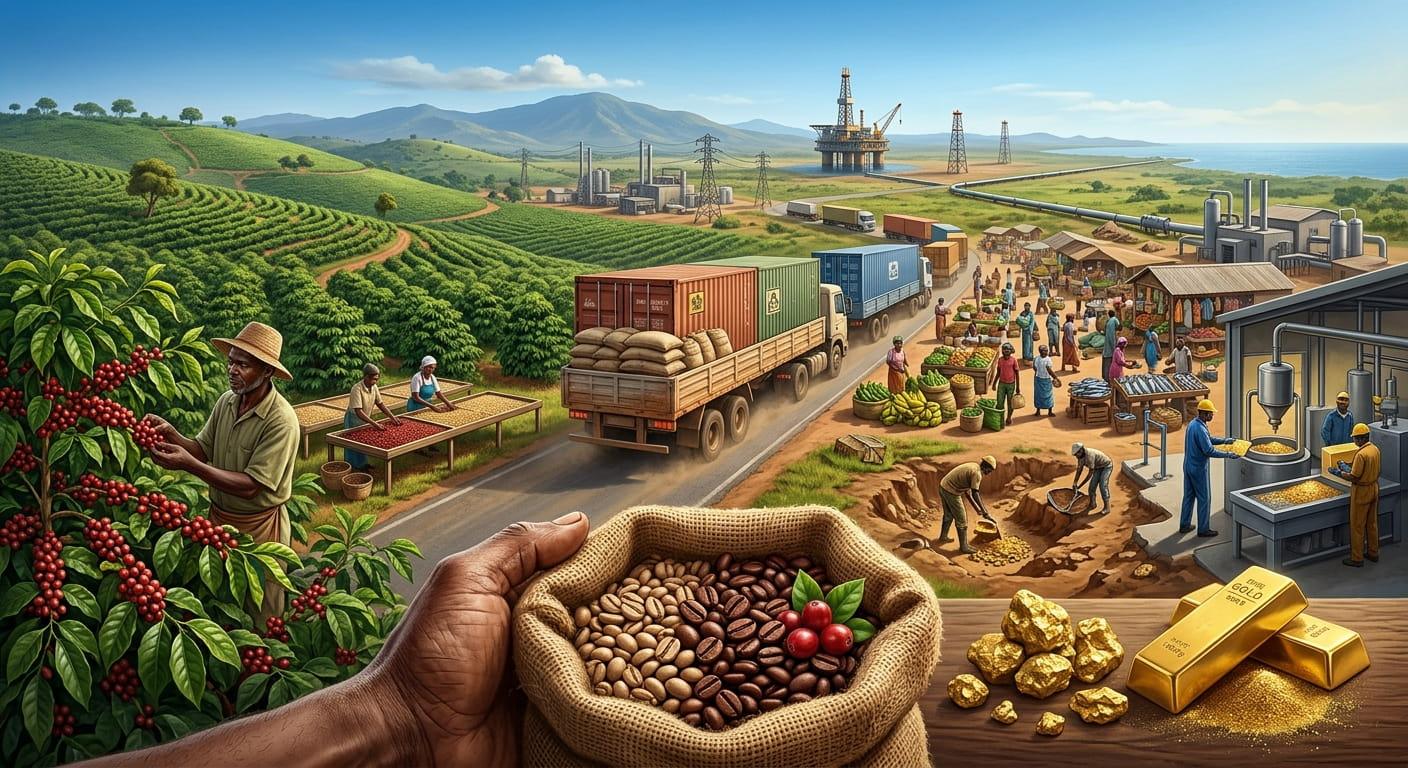
In the 2025/26 financial year, which ended in June 2026, Uganda earned approximately US$8.91 billion from gold exports and US$2.19 billion from coffee, according to Bank of Uganda figures reported by Daily Monitor. Together, the two commodities accounted for about 70% of Uganda's merchandise export earnings.
That is a remarkable concentration for a country whose economy also depends on agriculture, manufacturing, tourism, construction, transport and financial services. It also raises an important question: how much of the money earned from these exports stays in Uganda, and how much depends on products that are processed, traded or sourced across its borders?
Coffee has a long history in Uganda. It supports farmers, processors, exporters, transporters and other businesses across the supply chain. Gold has become a much larger export earner by value, but a significant share of the gold passing through Uganda is believed to originate in neighbouring countries before being refined or traded and exported.
The two commodities therefore tell different stories about the economy. Coffee connects export earnings to a large agricultural workforce, while gold generates substantial foreign exchange through a trade that also raises questions about mineral sourcing, traceability and regional supply chains.
Uganda is also preparing to enter a new phase of its economic development. Commercial oil production, which has been delayed several times, is now targeted for June 2027. If production begins as planned, crude oil exports will add another major source of foreign exchange and government revenue.
However, Uganda's economic prospects cannot be understood through export figures alone. The country imports fuel, machinery, vehicles, medicines and industrial materials. It depends on transport corridors through Kenya and Tanzania because it has no coastline. Its manufacturers and agricultural exporters rely heavily on customers in neighbouring African countries.
Understanding how Uganda makes its money means looking at what it produces, what it buys, how goods move, who its trading partners are and what businesses need to know before entering the market.
This is the fifth profile in Ria's Colony's Africa's Markets, Country by Country series, following Nigeria, Ghana, Kenya and Rwanda.
Uganda at a glance
Measure
Latest figure or position
Population
Approximately 49 million, based on recent national estimates
Nominal GDP
About US$69.35 billion in FY2025/26
Real GDP growth
6.4% in FY2025/26
Main merchandise exports
Gold and coffee
Gold export earnings
Approximately US$8.91 billion in FY2025/26
Coffee export earnings
Approximately US$2.19 billion in FY2025/26
Goods and services exports
Approximately US$18.42 billion in FY2025/26
Tourism receipts
Approximately US$1.62 billion in calendar 2025, according to tourism statistics
Currency
Uganda shilling
Main trade groupings
East African Community, COMESA, IGAD and AfCFTA
Oil production target
By June 2027
Main seaport routes
Mombasa in Kenya and Dar es Salaam in Tanzania
Sources: Uganda Ministry of Finance, Bank of Uganda, Uganda Bureau of Statistics, Ministry of Tourism, Wildlife and Antiquities, and Uganda National Oil Company. Figures cover different reporting periods, as indicated.
How Uganda's economy is built
In this section
Construction has benefited from infrastructure investment and development associated with the oil industry.
Uganda's economy is built on agriculture, industry and services. Services account for the largest share of economic output, followed by industry and agriculture. However, the importance of each sector changes depending on whether the question concerns GDP, employment, exports or household income.
Services include wholesale and retail trade, transport, telecommunications, banking, education, healthcare, tourism and public administration. These activities support businesses throughout the country, from informal market traders to larger companies operating across several industries.
Industry includes manufacturing, construction, electricity, mining and related activities. Construction has benefited from infrastructure investment and development associated with the oil industry. Manufacturing includes cement, steel, plastics, beverages, processed food, pharmaceuticals and other products sold in Uganda and neighbouring countries.
Agriculture remains central to livelihoods, particularly outside the major urban centres. Uganda produces coffee, bananas, maize, cassava, beans, tea, sugar, dairy products, fish and several other crops and food products. Many households depend on farming for some of their income, even when their principal economic activity falls outside agriculture.
According to the FY2026/27 budget speech, services account for approximately 50.5% of employment, agriculture 37.1% and industry 12.4%. These figures show why the agricultural sector remains important even though it contributes a smaller share of GDP than services.
The economy grew by 6.4% in FY2025/26, according to the Uganda Bureau of Statistics. The Ministry of Finance put nominal GDP at approximately US$69.35 billion. These figures indicate an expanding economy, although growth does not tell us how evenly income is distributed or how quickly new jobs are being created.
Uganda has a particularly young population. Around three quarters of its people are under 30, creating a large potential workforce and a continuing demand for education, housing, transport, healthcare and consumer goods. The challenge is to create enough productive jobs for people entering the labour market each year.
This helps explain the government's interest in industrial development, agricultural processing, infrastructure and oil. Each sector has the potential to create work beyond its immediate operations, but the extent of that benefit depends on how much local employment, purchasing and value addition takes place.
What Uganda sells to the world
In this section
Selling a finished product also involves different costs and commercial requirements from exporting raw beans.
Uganda's merchandise exports include gold, coffee, fish, cocoa, tea, dairy products, sugar, tobacco, cement, steel and other manufactured goods. Its services exports include tourism and other activities that earn money from customers outside the country.
For FY2025/26, the Ministry of Finance reported approximately US$18.42 billion in exports of goods and services. Merchandise exports were approximately US$15.76 billion, according to the figures reported by Daily Monitor.
The difference between the two totals is important. Merchandise exports count physical goods crossing borders, while exports of services include activities such as tourism and other services supplied to foreign customers. Gold and coffee's combined share of about 70% applies to merchandise exports, not to all export earnings.
Gold has become Uganda's largest export by value
Gold exports have grown substantially in recent years, supported by high international prices and Uganda's role as a regional trading and refining centre.
Uganda has domestic gold deposits and mining operations, including artisanal and small-scale mining. It also has gold-processing and refining facilities. However, the volume of gold exported is much larger than domestic mine production alone would suggest.
Gold from neighbouring countries, particularly the Democratic Republic of the Congo, has been documented in regional supply chains passing through Uganda. Researchers and international investigations have raised concerns about the traceability of some of this gold, including its potential links to conflict-affected areas and informal trading networks.
The distinction between mining gold and exporting it is important. A country can earn foreign exchange by importing gold, refining it, trading it and exporting it again. Those activities can generate revenue for traders, refiners, transport companies and other businesses, but they do not mean the country mined all the gold it sells.
For Uganda, the trade has brought substantial export earnings. It also creates exposure to international gold prices, the availability of regional supply and the rules that importing markets apply to the origin of minerals.
The United Arab Emirates, particularly Dubai, is a major destination for Uganda's gold exports. The concentration of trade in a small number of destinations makes sourcing standards and buyer requirements important considerations for exporters.
Coffee supports farmers and exporters across Uganda
Coffee is one of Uganda's most established export industries. The country produces both Robusta and Arabica varieties.
Robusta is grown widely in the central and eastern regions, including areas around Lake Victoria. Arabica is cultivated in higher-altitude areas, including the slopes of Mount Elgon in the east and the Rwenzori Mountains in the west.
Coffee is grown by smallholder farmers as well as larger producers. For many rural households, it is an important source of cash income. Its supply chain supports farm labourers, buyers, washing and processing stations, exporters, warehouse operators, transport companies and other service providers.
Uganda's coffee exports reached approximately 8.3 million 60-kilogram bags in FY2025/26, according to the figures cited in contemporary coffee market reporting. Export earnings were approximately US$2.19 billion.
The volume and value figures should be read separately. The amount earned from coffee depends on how much is sold, the prices received, the varieties exported, exchange rates and the proportion of the final selling price retained by farmers and businesses in Uganda.
Italy is an important market for Ugandan coffee, alongside Germany, Sudan, India and other destinations. Export rankings vary according to the reporting period, so comparisons between countries should use the same period and the same measure.
Most Ugandan coffee is exported as green beans rather than as roasted, packaged coffee sold directly to consumers. More domestic roasting, packaging, branding and product development could allow Ugandan companies to capture a larger share of the value generated after harvest.
That opportunity requires investment in processing, quality control, marketing, distribution and access to buyers. Selling a finished product also involves different costs and commercial requirements from exporting raw beans.
In November 2024, Uganda's parliament approved legislation integrating the Uganda Coffee Development Authority's functions into the Ministry of Agriculture, Animal Industry and Fisheries. The change formed part of the government's programme to rationalise public agencies. The transfer of functions did not remove coffee's importance to the economy, but it changed the institutional arrangements supporting the sector.
Agriculture supplies regional food markets
Uganda exports a range of agricultural products beyond coffee. These include fish, cocoa, tea, dairy products, sugar, maize, beans, tobacco, flowers, vanilla, sesame and hides.
Fish from Lake Victoria, including Nile perch and tilapia, supports processing businesses and trade with regional and international markets. Exporters need suitable handling, cold storage, transport and compliance with destination-market requirements because fish is perishable.
Cocoa has also attracted attention as international prices have risen. Its longer-term contribution will depend on production volumes, quality, processing capacity and the prices Ugandan exporters can secure.
Dairy is another important agricultural industry. Ugandan processors produce products such as milk powder and UHT milk for domestic and export markets. Regional demand creates opportunities for producers, processors, packaging businesses and distributors.
Uganda also supplies food to neighbouring countries. Maize, beans, sugar, milk and other products move through regional trade networks, sometimes through formal contracts and sometimes through smaller traders. These exports provide markets for farmers and processors, although supply shortages and price differences can create tensions between exporting and importing countries.
The opportunities extend beyond growing more crops. Storage, processing, packaging, transport, quality certification and distribution can all help agricultural businesses earn more from the products they already produce.
Manufacturing serves Uganda and its neighbours
Uganda's manufacturing sector produces cement, steel products, plastics, beverages, soap, edible oils, pharmaceuticals and processed food. Industrial activity is concentrated around Kampala and surrounding areas, including Mukono, Jinja and Namanve.
Some manufacturers supply the domestic market, while others export to South Sudan, the Democratic Republic of the Congo, Rwanda, Kenya and Burundi.
The location of these markets is an advantage. Businesses operating in Uganda can reach customers across several neighbouring countries by road, provided that they can manage transport costs, border procedures, distribution and payment risks.
Manufacturing also creates demand for packaging, warehousing, maintenance, business services and skilled labour. However, access to electricity, finance, imported inputs and reliable transport affects the cost of producing goods competitively.
Uganda's industrial development will depend partly on whether businesses can increase production and improve productivity while remaining competitive against imports from larger manufacturing economies.
Tourism and other services earn foreign exchange
Tourism brings money into Uganda through accommodation, transport, food, guiding, park fees and other visitor spending.
The country's attractions include mountain gorillas in Bwindi Impenetrable and Mgahinga Gorilla national parks, chimpanzees, savannah wildlife parks, the Rwenzori Mountains and adventure activities around the source of the Nile at Jinja.
Official tourism statistics put receipts at approximately US$1.62 billion for calendar 2025. Tourism receipts are different from the total contribution of tourism to GDP, which can also include indirect economic activity and domestic visitor spending. The period and definition should therefore accompany any tourism figure used in comparisons.
Tourism supports businesses beyond hotels and tour operators. Local transport providers, restaurants, food suppliers, craftspeople, guides and communities near visitor destinations can benefit from spending by international visitors.
The distribution of those benefits depends on employment, local procurement, ownership and the links between tourism businesses and surrounding communities.
Ugandans living abroad also send money home. These remittances help households pay for food, housing, education, healthcare and other expenses. They can support local economic activity, although remittances are private transfers rather than export earnings or government revenue.
What Uganda buys and who it trades with
In this section
A trade deficit means that the value of imported goods exceeded the value of exported goods during the period.
Uganda imports more merchandise than it exports. Its major imports include fuel, machinery, vehicles, iron and steel, medicines, plastics, electronics, wheat, cooking oil and other food products.
The country's oil projects have also required imported equipment, pipes, drilling materials and construction supplies. These purchases support international suppliers while creating demand for local transport, construction, installation and other services.
The Bank of Uganda reported a merchandise trade deficit of approximately US$2.8 billion over the 12 months to August 2026. A trade deficit means that the value of imported goods exceeded the value of exported goods during the period. It does not, by itself, mean that the economy is shrinking or that every imported product is economically harmful.
Imports include goods that households consume, equipment businesses use to produce other goods, and materials required for infrastructure projects. Their economic effect depends on what they are used for, how they are financed and whether the investments generate sufficient returns.
Kenya is an important supplier and customer
Kenya is a major trading partner for Uganda and an important source of imported goods, including fuel, manufactured products and industrial materials.
Ugandan businesses also sell food and manufactured products to the Kenyan market. Dairy, sugar, maize, beans and other agricultural products move between the two countries, alongside cement, steel and consumer goods.
The relationship is not always free of disagreement. Differences in regulations, product standards, domestic supply conditions and political decisions have periodically disrupted trade within the East African Community.
Kenya is also important because the Port of Mombasa serves as a principal maritime gateway for Uganda. Goods imported from outside Africa often travel through Kenya before reaching Ugandan businesses and consumers.
The importance of this route means that congestion, transport charges, border delays and changes in regional policy can affect the cost of doing business in Uganda.
South Sudan and the Democratic Republic of the Congo are major markets
Uganda supplies neighbouring markets with food, cement, steel, consumer goods and other products.
South Sudan is an important destination for Ugandan traders. Goods move by road through the Elegu and Nimule border area towards Juba and other markets. The trade supports transporters, wholesalers, retailers and businesses supplying food and everyday necessities.
The Democratic Republic of the Congo is another important market, particularly for businesses serving eastern DRC. Trade moves through border crossings including Mpondwe and other routes connecting western Uganda to Congolese towns.
Demand in these markets creates opportunities for Ugandan manufacturers, agricultural traders and distributors. However, businesses must account for security conditions, changing border procedures, payment arrangements and currency risks. Conflict in eastern DRC and instability in South Sudan can interrupt transport and affect customers' ability to trade.
Uganda's location can make it a useful base for businesses serving these markets, but proximity alone does not guarantee that distribution will be profitable. Companies still need reliable local partners, clear payment terms and a working understanding of the regulations in each destination.
Other international suppliers and buyers
China and India are important sources of imported machinery, manufactured goods and other products for Uganda. The United Arab Emirates is a major destination for gold and also an important trading partner for various imported goods.
European markets buy Ugandan coffee and other agricultural products. Exporters serving Europe must meet the relevant quality, food safety, documentation and traceability requirements.
The exact ranking of Uganda's trading partners changes depending on whether the figures cover imports, exports, merchandise alone or goods and services together. For this reason, claims about the country's largest trading partner should always identify the measure and reporting period.
Trade agreements that shape Uganda's market access
In this section
The US government cited human rights concerns following the enactment of Uganda's Anti-Homosexuality Act in 2023.
Uganda belongs to several regional and continental organisations that influence trade, movement of goods and business access.
East African Community
The East African Community brings Uganda together with Kenya, Tanzania, Rwanda, Burundi, South Sudan, the Democratic Republic of the Congo and Somalia.
The EAC's customs union and common market arrangements are intended to reduce barriers to trade and movement within the region. The customs union provides a common external tariff framework, while the common market addresses areas such as the movement of goods, services, capital and people.
Uganda also uses the EAC's Single Customs Territory arrangements, which allow qualifying cargo to undergo customs processing at designated points along the transport corridor rather than waiting until it reaches its final destination.
These arrangements are important to Ugandan manufacturers and traders because much of their regional business depends on neighbouring markets.
However, membership does not mean that every product moves without restrictions. Product standards, taxes, documentation, sensitive goods and national enforcement practices can still affect trade.
COMESA and the Tripartite Free Trade Area
Uganda is a member of the Common Market for Eastern and Southern Africa, or COMESA. The organisation provides a framework for preferential trade among participating members.
Uganda is also part of the COMESA-EAC-SADC Tripartite Free Trade Area, which entered into force in July 2024 after the required ratifications.
The tripartite arrangement is intended to bring together countries from three regional trade groupings and reduce overlapping trade barriers. Its practical benefits depend on implementation, tariff schedules, rules of origin and the treatment of individual products.
Businesses should confirm the applicable tariff and documentation requirements before assuming that membership automatically makes a shipment duty-free.
African Continental Free Trade Area
Uganda ratified the African Continental Free Trade Area agreement in 2018.
AfCFTA aims to create a larger continental market by reducing tariffs and addressing other barriers to trade between participating African countries. For Ugandan companies, the agreement could support expansion beyond the East African region, including sales of processed agricultural products and manufactured goods.
The benefits depend on the tariff concessions available for a particular product, compliance with rules of origin, customs procedures and the commercial requirements of the destination market.
A Ugandan company planning to export coffee, packaged food, dairy products or manufactured goods should check the applicable trade arrangements and standards for the country it wants to enter. AfCFTA membership is not a substitute for market research or export documentation.
Access to European and US markets
Uganda qualifies for the European Union's Everything But Arms arrangement as a least developed country. The scheme provides duty-free and quota-free access for eligible products, subject to the applicable rules and exclusions.
Uganda was removed from the United States' African Growth and Opportunity Act eligibility list effective 1 January 2024. The US government cited human rights concerns following the enactment of Uganda's Anti-Homosexuality Act in 2023.
The status of AGOA and any subsequent extension should be checked against current US government announcements and legislation before an exporter relies on the programme. An extension of the overall programme does not automatically restore a country's eligibility.
For exporters, preferential access can affect pricing and competitiveness. However, the commercial value of a preference also depends on freight costs, product quality, compliance requirements and demand in the destination market.
How goods move through Uganda
In this section
Uganda's road network also connects it to South Sudan, eastern DRC, Rwanda and other neighbouring markets.
Uganda is landlocked. Most of its overseas merchandise trade relies on transport corridors connecting the country to ports in Kenya and Tanzania.
The cost and reliability of these corridors influence the price of imported goods and the competitiveness of Ugandan exports.
The Northern Corridor through Kenya
The Northern Corridor connects the Port of Mombasa to Uganda through Kenya. Cargo moves through Nairobi and towards the Malaba and Busia border crossings before continuing to Kampala and other destinations.
Road transport carries much of the freight moving along the corridor. Kenya's Standard Gauge Railway carries cargo from Mombasa to Naivasha, with onward movement to Uganda relying on other transport arrangements.
Uganda has pursued a standard-gauge railway linking Malaba to Kampala and extending towards other parts of the country. The project was formally launched in November 2024, with contractor mobilisation and preliminary works continuing into 2025. Its full delivery will take time.
The Northern Corridor is important for fuel, machinery, vehicles, consumer goods and other imports. It also carries Ugandan exports moving towards overseas markets.
Delays at ports, along roads or at border crossings can raise costs for importers and exporters. Businesses that depend on imported inputs need to account for transport time, inventory requirements and possible disruption when planning production and deliveries.
The Central Corridor through Tanzania
The Central Corridor connects Uganda to the Port of Dar es Salaam through Tanzania. Goods can travel by road and through rail and lake transport arrangements, depending on the route, cargo and available services.
Some Ugandan importers use the Central Corridor as an alternative to Mombasa. The choice of route depends on freight charges, port performance, border procedures, destination and the reliability of transport services.
The East African Crude Oil Pipeline will add a different connection between Uganda and the coast. Rather than transporting general merchandise, it is designed to carry crude oil from Uganda's oil-producing region to Tanga in Tanzania.
This pipeline could diversify Uganda's export routes for crude oil, although it will not eliminate the country's dependence on regional corridors for most imported goods.
Roads connecting Uganda to northern and western markets
Uganda's road network also connects it to South Sudan, eastern DRC, Rwanda and other neighbouring markets.
The Elegu and Nimule crossing serves trade with South Sudan. Routes through western Uganda connect traders to eastern DRC, including through the Mpondwe border area.
These roads support regional commerce and allow Ugandan manufacturers and agricultural traders to serve customers outside the domestic market.
Security conditions, road quality, border operating arrangements and payment risks affect how reliably these routes function. Companies exporting into conflict-affected areas need contingency plans and must understand the conditions facing transporters and customers.
Air transport
Entebbe International Airport handles passenger traffic and cargo, including selected high-value and time-sensitive products such as flowers, fish and fresh produce.
Air freight can be useful for products that would lose value during a long journey by road or sea. It is generally more expensive, so exporters need to compare the cost with the price buyers are willing to pay.
Uganda Airlines, relaunched in 2019, provides international and regional passenger services. Kabaale International Airport is being developed in the oil region to support the petroleum industry and related activities.
Sectors with room for growth
In this section
By October 2026, the Uganda National Oil Company had reported that the pipeline was approximately 92% complete.
Uganda's existing industries provide several possible areas for business investment. Their prospects differ, and the existence of demand does not guarantee that a new business will be profitable.
Oil and gas
Uganda's oil resources are located in the Albertine Graben near Lake Albert, along the border with the Democratic Republic of the Congo.
Two major developments are under way. TotalEnergies is developing the Tilenga project, while China's CNOOC is developing the Kingfisher project. The planned production capacity of the two projects is approximately 230,000 barrels of oil per day at peak.
The East African Crude Oil Pipeline, or EACOP, is designed to transport crude oil over approximately 1,443 kilometres to Tanga on Tanzania's coast.
By October 2026, the Uganda National Oil Company had reported that the pipeline was approximately 92% complete. First commercial oil production is targeted for June 2027, following earlier delays.
The industry requires specialised equipment and technical expertise, but its local supply chain also needs transport, catering, accommodation, construction, security, maintenance and other services.
Uganda's local content rules are intended to encourage participation by Ugandan companies and workers in qualifying activities. Businesses interested in supplying the industry should establish the relevant registration, technical qualifications, procurement requirements and local content obligations before investing.
Oil production could increase export earnings and government revenue. The amount retained in Uganda will depend on production costs, ownership arrangements, taxes, royalties, international prices and how much equipment and expertise must be imported.
Oil will not remove the need to develop other industries. Its longer-term economic contribution will depend on how revenue is managed and whether local businesses can build capabilities that remain useful beyond the construction phase.
Coffee, cocoa and agricultural processing
Uganda has opportunities to earn more from agricultural products through processing and product development.
Coffee roasting, packaging and branding can allow businesses to sell finished products rather than only green beans. Cocoa processing, dairy production, fruit processing, edible oils, maize flour and animal feed are other possible areas for investment.
These activities require reliable supplies of raw materials, suitable equipment, quality control, packaging, distribution and access to customers. Exporters also need to understand food safety requirements and any certification needed in their target markets.
Regional trade offers a potential customer base for processors that can produce consistently and price their goods competitively.
Minerals beyond gold
Uganda has deposits of minerals including copper, cobalt, iron ore, tin, tungsten and phosphates, as well as other mineral resources.
The government has expressed interest in expanding domestic mineral processing rather than exporting raw materials alone. Processing could create additional industrial activity and demand for energy, transport, engineering and technical services.
However, the commercial prospects of individual projects depend on confirmed reserves, extraction costs, infrastructure, financing, environmental requirements and market prices. Mineral deposits do not automatically translate into commercially viable mines or processing plants.
Investors should evaluate each project on its own evidence rather than treating the presence of a mineral resource as proof of a profitable opportunity.
Manufacturing for regional markets
Uganda's manufacturers can serve domestic consumers and neighbouring markets with products such as cement, steel, plastics, beverages, pharmaceuticals and processed food.
The country's position gives businesses access to South Sudan, eastern DRC, Rwanda and Burundi. For some products, producing closer to these customers may reduce delivery times or offer an advantage over suppliers located farther away.
Manufacturers still need to account for the cost of imported inputs, electricity, finance, distribution and compliance with standards in destination markets.
Industrial parks and infrastructure investment may support production, but long-term competitiveness depends on productivity, product quality, skills and the ability to deliver reliably.
Tourism
Uganda's wildlife, forests, mountain landscapes and adventure activities support a tourism industry with potential for further development.
Investment opportunities extend beyond accommodation. Transport, guiding, food supply, local experiences, equipment hire, visitor services and the supply of goods to tourism businesses can also support the industry.
Businesses must consider seasonality, conservation requirements, access to destinations, staff training and the expectations of international visitors. Tourism growth also needs to benefit local communities and protect the natural resources that attract visitors.
Digital services and financial technology
Mobile money is widely used in Uganda, while Kampala has technology businesses working in payments, agriculture, logistics, health and other services.
Digital services can help businesses reach customers, manage payments, coordinate deliveries and collect information. Technology companies may also be able to serve customers in neighbouring countries, provided they understand local regulations and the needs of each market.
The size of the opportunity depends on customers' willingness to pay, reliable connectivity, access to finance, available skills and the ability to build services that work under local conditions.
Doing business in Uganda
In this section
Entrepreneurs should confirm the current requirements with the relevant authorities before beginning operations.
Uganda is open to many forms of private business activity, including foreign investment. However, company registration alone does not satisfy every legal, tax, immigration or sector-specific requirement.
Registering a company
Businesses generally register with the Uganda Registration Services Bureau. They must also address tax registration with the Uganda Revenue Authority and obtain the licences required for their activities and location.
Employers must meet relevant employment and social security obligations, including registration with the National Social Security Fund where applicable.
The requirements vary by business type. A company trading imported goods, a manufacturer, a professional services firm and an oilfield supplier may face different licensing, safety, standards and procurement requirements.
Entrepreneurs should confirm the current requirements with the relevant authorities before beginning operations.
Foreign investment
The Uganda Investment Authority provides information and support for investors considering projects in the country.
Foreign investors seeking a UIA investment licence have traditionally been subject to a minimum planned investment threshold of US$250,000 for most projects. This should not be confused with a universal minimum share capital requirement for every foreign-owned company.
Certain activities may also be subject to restrictions or additional conditions. Investors should confirm the current investment threshold, eligibility rules and applicable sector requirements directly with the Uganda Investment Authority.
A prospective investor should also consider the commercial requirements of the business, including working capital, local partners, staffing, supply contracts and access to customers.
Land and property
Uganda has several land tenure systems, including freehold, mailo, leasehold and customary tenure. The rights attached to a property depend on its tenure, ownership and legal status.
Foreigners generally cannot own freehold or mailo land in the same way as Ugandan citizens, but may acquire leasehold interests subject to applicable law. The permitted duration and terms depend on the arrangement.
Land transactions require careful due diligence. Investors should check title records, boundaries, existing interests, planning restrictions and the legal authority of the person offering the property. Local legal advice is particularly important where land tenure is complex or disputed.
Work permits
Foreign nationals who intend to work in Uganda generally need the appropriate immigration permission. Applications are handled through the Directorate of Citizenship and Immigration Control.
The required category depends on the person's role, nationality, employer and circumstances. Citizens of EAC member states may benefit from regional arrangements, but should still confirm the rules applicable to their intended activity.
Businesses hiring international staff should check work authorisation requirements before the employee begins work.
Currency, taxation and financing
Uganda's currency is the Uganda shilling, which operates under a floating exchange-rate system.
Exchange-rate movements affect the cost of imported goods, foreign-currency loans, international contracts and the value of export receipts when converted into shillings. Businesses that earn and spend money in different currencies should assess how changes in the exchange rate could affect their margins.
Uganda's standard corporate income tax rate is 30%, while the standard VAT rate is 18%. Exemptions, incentives and special rules may apply to particular transactions, sectors or qualifying businesses. Companies should confirm their tax obligations with the Uganda Revenue Authority and qualified advisers.
Financing costs are another consideration. The Bank of Uganda raised its Central Bank Rate to 12% on 14 October 2026 in response to inflation and exchange-rate pressures. Commercial lending rates are different from the policy rate and vary by lender, borrower and loan terms.
Businesses should assess financing costs alongside the expected return from a project rather than assuming that a growing market will necessarily provide attractive returns.
Risks and trade-offs
In this section
Concerns about the origin of some gold moving through Uganda could also affect buyers, refiners and exporters.
Uganda has economic opportunities, but businesses must account for several risks that affect investment, trade and household incomes.
Oil delays and dependence on commodity earnings
Uganda has spent years preparing to produce and export oil. The latest target is June 2027, but the production date remains a target rather than a completed event.
Oil prices can change sharply, and production requires significant capital and technical capacity. Revenue may also be affected by operating costs, financing obligations and the terms governing how earnings are shared between the state and project participants.
Oil-producing countries can face problems when public spending becomes too dependent on volatile commodity revenue. Uganda has legal arrangements for managing petroleum revenue, but their effectiveness will depend on implementation, transparency and the decisions made once production begins.
EACOP has also faced criticism from environmental and human rights organisations over its potential effects on communities, ecosystems and the climate. These concerns have influenced debate over project financing and the responsibilities of companies involved.
Dependence on gold
Gold's contribution to merchandise export earnings makes Uganda sensitive to international prices and the reliability of its regional supply chains.
Concerns about the origin of some gold moving through Uganda could also affect buyers, refiners and exporters. Businesses in this trade need to understand traceability requirements and the rules governing minerals sourced from conflict-affected areas.
The country benefits from gold export earnings, but the long-term resilience of its export base depends partly on the performance of other industries.
Inflation, exchange rates and borrowing costs
In October 2026, the Bank of Uganda raised its policy rate from 9.75% to 12% amid exchange-rate pressure and concerns about rising fuel costs.
Higher borrowing costs can affect business expansion, household spending and investment decisions. A weaker shilling can make imported machinery, fuel and raw materials more expensive, even when exporters receive more shillings for foreign-currency earnings.
Businesses that depend on imported inputs should consider exchange-rate changes when preparing budgets and pricing contracts. Those selling into regional markets also need to assess the currencies in which customers pay.
Public debt and government revenue
Uganda's public debt was reported at approximately US$34.9 billion at the end of 2025, equivalent to around 53% of GDP, according to the Ministry of Finance.
Debt levels need to be assessed alongside the government's revenue, borrowing costs, spending commitments and ability to service its obligations. The ratio alone does not determine whether a country can comfortably meet its future payments.
Uganda's domestic revenue collection remains a concern for public finances. Interest payments and other commitments limit the amount available for infrastructure, public services and development programmes.
Oil revenue could provide additional resources, but the extent of the benefit will depend on production, prices, revenue collection and public spending decisions.
Governance and political conditions
Uganda's governance record has attracted criticism over corruption, restrictions on political opposition and human rights.
The Anti-Homosexuality Act enacted in 2023 contributed to international scrutiny and the country's removal from AGOA eligibility in 2024. These developments can affect trade preferences, perceptions of risk and decisions by some investors and financial institutions.
Uganda held general elections in January 2026, and Yoweri Museveni remained in office after being declared the winner. The political environment is relevant to businesses assessing regulation, public procurement, policy continuity and the broader operating climate.
Companies considering investment should assess their own legal and commercial exposure rather than assuming that political continuity guarantees low risk.
Regional instability
South Sudan and eastern DRC are important markets for Ugandan businesses, but both have experienced conflict and insecurity.
Disruption can affect roads, border crossings, demand, payments and the ability of companies to fulfil contracts. Businesses trading across these borders need to evaluate conditions in specific locations and build flexibility into delivery schedules and payment arrangements.
Uganda's regional position creates access to neighbouring markets, but it also means that events beyond its borders can influence trade at home.
What Uganda means for an African business
In this section
Machinery, industrial materials, vehicles, medicines, food products and business services all have potential customers.
Uganda offers a market of approximately 49 million people, a growing economy and access to several neighbouring countries. Its opportunities vary by industry, and the right entry strategy depends on the product or service a business intends to sell.
For companies elsewhere in Africa, three areas deserve particular attention.
The first is supplying Uganda's import market and the businesses preparing for oil production. Machinery, industrial materials, vehicles, medicines, food products and business services all have potential customers. Companies considering the oil supply chain should confirm procurement requirements, technical qualifications and local content obligations before committing resources.
The second is manufacturing or distributing goods for regional customers. Uganda can serve as a base for reaching South Sudan, eastern DRC, Rwanda and Burundi. This may suit manufacturers, wholesalers and logistics businesses that can establish reliable distribution and manage cross-border risks.
The third is agricultural processing and trade. Coffee, cocoa, dairy, fish, maize, beans and sugar provide opportunities for businesses involved in processing, storage, packaging and distribution. Companies entering these sectors need to evaluate the availability of raw materials, customer demand, standards, transport and competition.
The risks are equally important. Currency movements can raise costs, borrowing can be expensive, and oil and gold earnings are exposed to international markets. Political conditions, regional conflict and infrastructure constraints can also affect operations.
Businesses should research demand, verify regulations, assess payment risks and build relationships with reliable local partners before entering the market. They should also distinguish between an opportunity that exists in theory and one supported by evidence of customers, prices and sustainable margins.
The next stage of Uganda's economy
In this section
The country has room to expand domestic processing, develop manufacturing and create more jobs for its young population.
Uganda earns money through agriculture, manufacturing, services, trade and, increasingly, the processing and export of gold. Coffee remains a major source of export earnings and rural income, while regional food trade supports farmers, processors and distributors.
Its next major economic development is expected to be oil production. The industry could add significant export earnings and public revenue, but its contribution will depend on how production proceeds and how the resulting income is managed.
Uganda's trade with neighbouring countries will remain important. Its landlocked position makes transport corridors through Kenya and Tanzania essential, while markets in South Sudan, eastern DRC and the wider EAC offer opportunities for agricultural and manufactured goods.
The country has room to expand domestic processing, develop manufacturing and create more jobs for its young population. Achieving those goals will require investment, reliable infrastructure, competitive businesses and effective public institutions.
For African companies considering Uganda, the market deserves a careful assessment of both its opportunities and its operating conditions. Its export earnings show where money is being made today. Its transport links, regional customers, industrial capacity and workforce help explain where further business activity may develop.
The next profile in Ria's Colony's Africa's Markets, Country by Country series is Tanzania, Uganda's southern neighbour and the country through which its planned crude oil exports will reach the sea.
Sources and further reading
In this section
Trade rankings and export totals in this article use matching periods and clearly stated definitions.
The following official sources can be used to check the figures in this article. Figures should be checked against the publication date and reporting period stated in each source.
Uganda Ministry of Finance, Planning and Economic Development. FY2026/27 Budget Speech and related economic performance publications. finance.go.ug
Bank of Uganda. October 2026 Monetary Policy Statement, exchange-rate and inflation updates, and merchandise trade statistics. bou.or.ug
Uganda Bureau of Statistics. Preliminary Annual GDP Estimates for FY2025/26 and labour-market statistics. ubos.org
Daily Monitor. Reporting on Uganda's gold and coffee export earnings for FY2025/26. monitor.co.ug
Uganda Ministry of Tourism, Wildlife and Antiquities. Tourism statistical reports for calendar year 2025. tourism.go.ug
Uganda National Oil Company. Updates on the Tilenga and Kingfisher developments, the East African Crude Oil Pipeline and the target for first oil. unoc.co.ug
Uganda Coffee Development Authority and Ministry of Agriculture, Animal Industry and Fisheries. Coffee export statistics and information on the transfer of the authority's functions. ugandacoffee.go.ug and agriculture.go.ug
Uganda Registration Services Bureau and Uganda Revenue Authority. Company registration, tax registration and applicable tax requirements. ursb.go.ug and ura.go.ug
East African Community, COMESA and AfCFTA. Trade agreements, tariff arrangements and rules of origin. eac.int, comesa.int and au-afcfta.org
Office of the United States Trade Representative. Uganda's AGOA eligibility status and official programme announcements. AGOA at ustr.gov
European Commission. Everything But Arms trade preferences and rules applicable to eligible exports from least developed countries. Everything But Arms
Editorial note: Forecasts, oil-production targets and policy positions are time-sensitive, so readers should check them against the latest official releases. Trade rankings and export totals in this article use matching periods and clearly stated definitions.