Discover how Rwanda earns from minerals, coffee, tea, tourism and services, who it trades with, what it imports, and what African businesses need to know.
A small economy growing quickly
In this section
Public investment has supported growth, while borrowing and declining grants have placed pressure on public finances.
Rwanda's economy grew by 9.4% in 2025, according to the National Institute of Statistics of Rwanda (NISR). Growth continued in 2026, with the economy expanding by 10.0% year on year in the first quarter and 9.4% in the second quarter. Mining, construction, trade and information and communication services contributed to the expansion, although performance differed across sectors and quarters.
The International Monetary Fund's October 2026 World Economic Outlook projects Rwanda's economy to grow by 7.2% for the full year. Its October programme update gives a separate projection of 7.8%. These are forecasts, not final growth figures, and should be read according to the source and assumptions behind each estimate.
Rwanda remains a relatively small economy. The IMF's October 2026 outlook puts its projected nominal gross domestic product (GDP) at about US$17.34 billion and GDP per capita at approximately US$1,290. With a population estimated at around 14.5 million, the country has a modest domestic consumer market compared with Kenya, Tanzania or Nigeria.
GDP per capita is the value of economic output divided by the population. It does not tell us what the average household earns, how income is distributed or how much people can afford to spend.
Rwanda has no coastline, and its goods must travel through neighbouring countries to reach seaports. Its economy depends on services, agriculture, mining, construction, tourism and trade. The government has also invested heavily in infrastructure and promoted the country as a destination for foreign investors, international events and visitors.
The country's economic record comes with serious questions. Mineral exports have grown, but the origins of some minerals exported through Rwanda have been disputed by United Nations experts investigating the conflict in eastern Democratic Republic of Congo (DRC). Public investment has supported growth, while borrowing and declining grants have placed pressure on public finances. In 2026, high inflation has added to the difficulties faced by households and businesses.
Understanding Rwanda's economy requires looking at both the sources of its earnings and the costs of maintaining its growth.
This is the fourth profile in our series, Africa's Markets, Country by Country, following Nigeria, Ghana and Kenya. Rwanda's experience offers useful lessons for businesses looking at East Africa, regional supply chains and the opportunities created by trade between African countries.
The GDP figures are annual projections, while the trade figures cover one quarter. They should not be compared as if they describe the same period or measure.
How Rwanda's economy is built
In this section
A sector can account for a relatively modest share of GDP while supporting a large proportion of the population.
Services account for the largest share of Rwanda's economic output. They include wholesale and retail trade, transport, banking, telecommunications, accommodation, restaurants, education, healthcare and public administration.
Industry includes mining, manufacturing, construction and utilities. Agriculture contributes a smaller share of GDP than services but remains important for employment, rural livelihoods, food supply and export earnings.
This difference between output and employment is important. A sector can account for a relatively modest share of GDP while supporting a large proportion of the population. Rwanda's agricultural sector includes smallholder farmers growing bananas, beans, maize, potatoes, cassava and other crops, alongside commercial production of coffee and tea.
The government has played a significant role in the country's development. Public spending has supported roads, electricity, water, schools, healthcare facilities, convention infrastructure and other projects intended to improve economic activity. The government has also promoted Kigali as a centre for conferences, investment and regional services.
The Kigali Convention Centre, RwandAir and the Bugesera International Airport project form part of this wider effort to improve connectivity and attract international business. Rwanda has also used special economic zones, investment incentives and international sponsorship agreements to attract companies and visitors.
These investments can create opportunities for private businesses. Roads can reduce delivery times, reliable electricity can support manufacturing, and conference facilities can generate demand for hotels, transport, catering and event services.
However, infrastructure spending also requires financing. Rwanda has historically received development grants and concessional loans from international partners. It has also borrowed through other channels, including international capital markets.
The African Development Bank's 2026 country report highlights the pressure created by declining grants, rising debt-service costs and the need to mobilise more domestic revenue. The IMF has also called for careful prioritisation of public investment and continued efforts to preserve debt sustainability.
Rwanda's development strategy therefore faces a continuing question: how can the country maintain investment in infrastructure and public services while ensuring that debt and financing costs remain manageable?
Inflation and the cost of doing business
Inflation became a major concern in 2026.
NISR reported annual consumer price inflation of 15.7% in August and 17.2% in September. In September, food and non-alcoholic beverage prices were 20.9% higher than a year earlier, while transport prices rose by 22.4%. Housing-related costs also increased.
These figures matter to businesses because higher prices can affect wages, delivery costs, stock replacement, rent, household spending and the price of imported goods. A restaurant may face higher food costs, while a transport company may pay more for fuel and vehicle maintenance.
The National Bank of Rwanda has tightened monetary policy in response to inflation. The IMF has recommended maintaining an appropriate monetary policy stance while the country works to bring inflation back towards its medium-term target of 5%.
Businesses considering Rwanda should therefore assess current prices and financing conditions rather than relying only on the country's reputation for stability. Strong GDP growth does not mean that operating costs remain unchanged or that every business experiences the same conditions.
Gold is another important export, with the United Arab Emirates among the country's major export destinations.
Rwanda earns foreign exchange from mineral exports, agricultural products, manufactured goods, tourism and other services. It also earns from re-exporting goods that it imports and subsequently sells to other markets.
The composition of exports changes from quarter to quarter. In the second quarter of 2026, Rwanda's domestic goods exports were worth US$548.98 million, up 58.65% from the same quarter in 2025, according to NISR. Re-exports were worth another US$179.59 million.
These are quarterly figures, not annual export totals. They also distinguish goods produced in Rwanda from imported goods that are subsequently sold abroad.
Minerals
Tin, tantalum and tungsten, often grouped together as the 3Ts, are important components of Rwanda's mineral export industry.
Tin is commonly extracted from cassiterite, tantalum from coltan, and tungsten from wolframite. These minerals have industrial uses, including in electronics, metalworking and other manufacturing processes.
Rwanda has developed mining and mineral trading as sources of export earnings. Gold is another important export, with the United Arab Emirates among the country's major export destinations. Investment in processing facilities has also formed part of efforts to capture more value within Rwanda rather than exporting raw materials alone.
Mineral processing can support local employment, technical skills and related services. However, the value retained in the country depends on the economics of each operation, including the cost of electricity, equipment, labour, transport and compliance.
The sector also faces serious scrutiny over mineral origin. United Nations expert reports on eastern DRC have documented allegations involving the movement of minerals from conflict-affected areas into Rwanda and their subsequent export. Rwanda disputes allegations concerning its role in the conflict and points to its own mining production.
These issues should not be treated as proof that every mineral exported from Rwanda originates elsewhere. They do mean that businesses buying tin, tantalum, tungsten or gold through the region need reliable documentation of origin, appropriate due diligence and compliance with applicable supply-chain rules.
For African manufacturers and traders, mineral processing and responsible sourcing offer commercial opportunities, but traceability is essential.
Coffee and tea
Coffee and tea are two of Rwanda's best-known agricultural exports.
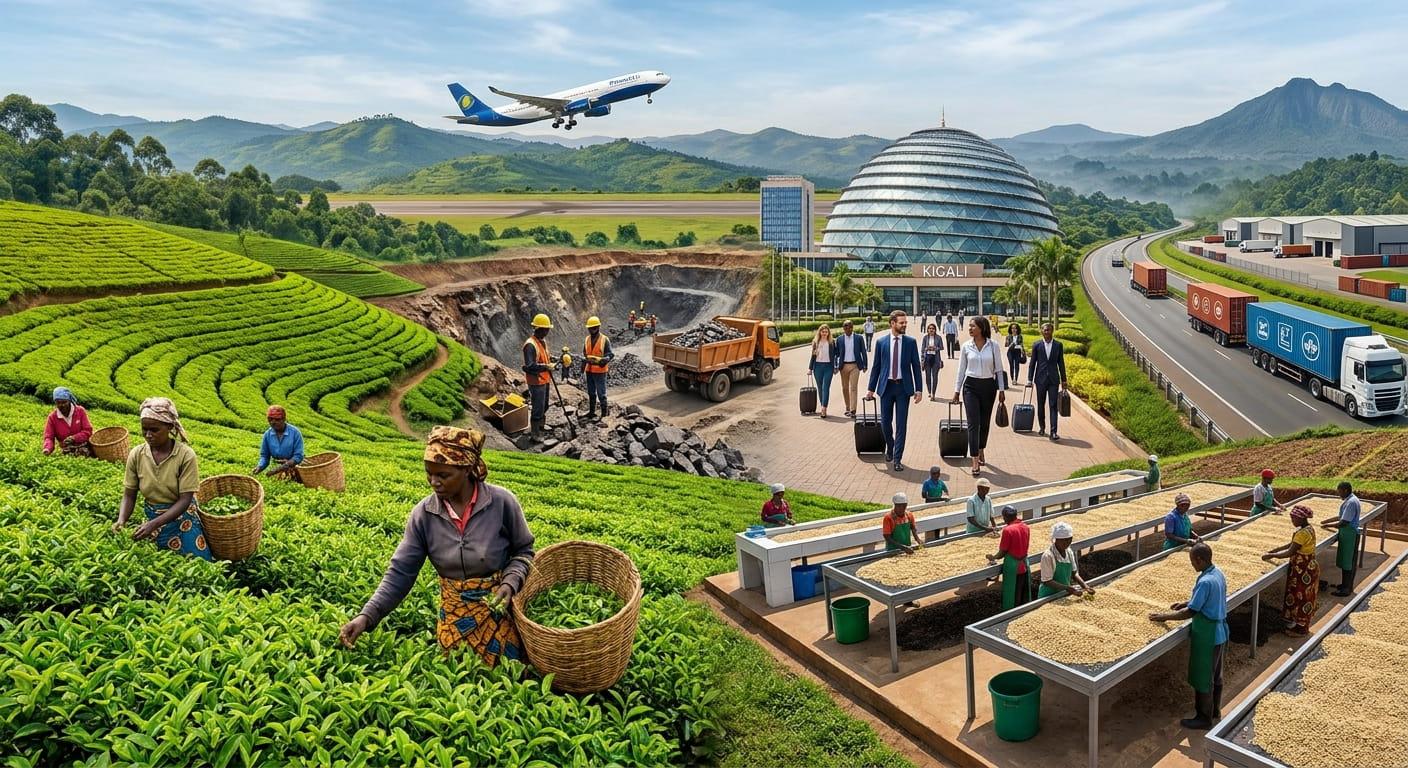
Rwandan coffee is predominantly Arabica, grown in highland areas including the western and southern parts of the country. Coffee is processed through washing stations and sold to international buyers, including specialty roasters in Europe, North America and Asia.
Quality is important in this market. Producers and exporters can earn more when they consistently meet buyers' requirements for flavour, processing, grading, traceability and delivery. Direct relationships between cooperatives, washing stations, exporters and roasters can also affect the share of the final sale price retained by producers.
Tea is grown by smallholders and commercial estates, particularly in the north and west. Rwanda exports tea through established trading channels, including the Mombasa auction, as well as through direct sales to international buyers.
The two commodities provide export income and support employment in farming, processing, packaging, transport and trade. They also expose Rwanda to weather conditions, international prices, changes in buyer demand and the costs of moving products to market.
Production figures must be read by period. Although Rwanda recorded a 60% increase in coffee output in 2025, NISR's Q2 2026 estimates reported a decline in export-crop production, driven mainly by a 33% fall in coffee production during that quarter. Tea production increased by 18% in the same quarter. A strong annual result does not guarantee that production will continue rising in every subsequent period.
Opportunities exist in roasting, packaging, specialty coffee, quality certification, tea processing and direct export relationships. These activities require access to consistent supplies, suitable processing facilities and buyers willing to pay for the product's quality.
Food crops and livestock
Rwanda also trades agricultural products and food with neighbouring countries. Beans, maize, potatoes, milk, livestock and other products move through formal and informal cross-border channels.
The DRC is particularly important to trade in the western border region. Traders serving Goma and Bukavu purchase food, household goods and other supplies through commercial networks that connect eastern Congo with Rwanda.
This trade supports farmers, transport operators, wholesalers, retailers and small traders. It also depends on border access, local purchasing power, security and the cost of moving goods.
Businesses looking at this market need to distinguish between formal exports recorded in national statistics and informal cross-border activity, which may not be captured completely in official trade data.
Re-exports
Rwanda earns additional trade revenue by importing goods and selling them onwards, particularly to markets in the region.
In Q2 2026, re-exports were worth US$179.59 million. The DRC accounted for 88.1% of their recorded destination value, according to NISR.
Re-export activity includes goods such as fuel, building materials and other products supplied to regional markets. The precise composition varies by period. In the second quarter of 2026, food and live animals formed the largest reported re-export commodity group, followed by mineral fuels, lubricants and related materials.
Re-exports allow traders to earn income without manufacturing the goods themselves. They create demand for warehousing, customs services, transport, wholesale distribution and trade finance.
They also depend on reliable supply routes and access to customers across the border. Conflict, border restrictions, currency movements or changes in import rules can affect both the cost of sourcing products and the ability to deliver them.
Tourism and other services
Tourism is a significant source of foreign exchange for Rwanda.
The Rwanda Development Board reported tourism revenue of US$685 million in 2025, up from US$647 million in 2024. The country recorded 1.49 million visitor arrivals, while meetings, incentives, conferences and exhibitions generated US$94.7 million in revenue.
Rwanda's tourism offer includes mountain gorilla trekking in Volcanoes National Park, wildlife viewing in Akagera National Park, Nyungwe Forest, Lake Kivu and cultural attractions. Kigali also hosts conferences, sporting events, exhibitions and concerts.
The sector supports hotels, lodges, restaurants, tour operators, guides, transport providers, event organisers and suppliers of food and other goods. Tourism revenue can therefore circulate through several parts of the domestic economy, although the amount retained locally varies by business and supply chain.
Gorilla trekking is a premium tourism product. The standard permit for foreign visitors is listed at US$1,500, although other visitor categories and promotional arrangements have different rates. Travellers should check the current official Rwanda gorilla permit portal before making plans.
Rwanda has also invested in attracting international events. These bring demand for accommodation, conference venues, catering, security, transport, technical production and professional services. The opportunity extends beyond large hotels and established event companies to local suppliers that can meet quality, capacity and payment requirements.
Tourism remains exposed to international travel conditions, visitor confidence, conservation costs and regional security. High visitor spending can support economic activity, but the distribution of those earnings depends on ownership, employment, sourcing and the way tourism businesses operate.
The second is to establish how goods will be distributed and who will carry the costs and risks at each stage.
Rwanda imports substantially more goods than it exports.
In the second quarter of 2026, goods imports were worth US$1.606 billion, compared with US$548.98 million in domestic exports and US$179.59 million in re-exports. The formal trade deficit for the quarter was US$877.81 million.
Imports rose by 28.78% compared with Q2 2025. Domestic exports grew more quickly over the same period, but the value of imports remained much larger.
Rwanda imports fuel, vehicles, machinery, construction materials, medicines, electronics, manufactured consumer goods and various food products. The mix reflects the country's production needs, infrastructure investment and consumer demand.
As a landlocked country, Rwanda relies on transport corridors through Tanzania and Kenya to access international shipping routes. Goods arriving through these ports must travel long distances by road before reaching Rwanda, adding freight, insurance, handling and border-related costs.
Construction projects also generate demand for cement, steel, equipment, electrical materials and other inputs. Manufacturers need machinery, spare parts, packaging and intermediate goods that may not be available locally in sufficient quantities.
Food imports include products such as rice, sugar, cooking oil and wheat flour. Rwanda also produces a range of food crops domestically, but local production does not remove the need for imports in every product category or season.
The import bill presents opportunities for African suppliers. Manufacturers and distributors in Tanzania, Kenya, Uganda, Egypt, South Africa and other markets may be able to supply products that Rwanda currently buys from outside the continent.
Price alone will not determine competitiveness. Buyers also consider quality, consistency, delivery time, payment terms, product certification, customs requirements and the cost of transporting goods to the customer.
For a company selling into Rwanda, the first task is to identify a product category where it can meet local demand at a competitive delivered price. The second is to establish how goods will be distributed and who will carry the costs and risks at each stage.
Who Rwanda trades with
In this section
A product manufactured in Asia may enter East Africa through one of these countries before continuing to Rwanda.
Rwanda's trade connects it to Asian suppliers, international mineral buyers and neighbouring African markets.
In Q2 2026, China was the largest destination for Rwanda's domestic exports by value, followed by the United Arab Emirates and the DRC. China accounted for US$142.38 million of recorded domestic exports, the UAE for US$107.96 million and the DRC for US$89.51 million.
The destinations differ in the products they buy. Gold is important in Rwanda's exports to the UAE, while minerals contribute to trade with China. The DRC is important for regional commerce, including food, consumer goods and re-exports.
On the import side, China, Tanzania, India, Kenya and Uganda were the five leading countries of origin in Q2 2026, measured on a cost, insurance and freight basis. The value recorded against a country can reflect the way trade is routed and recorded, not only where a product was manufactured.
Tanzania and Kenya are important because their ports provide access to overseas markets. A product manufactured in Asia may enter East Africa through one of these countries before continuing to Rwanda. The country recorded as the import origin can therefore depend on the customs reporting method and the nature of the transaction.
The EAC also plays an important role in Rwanda's trade. In Q2 2026, recorded imports from EAC partners were US$401.81 million, while domestic exports to EAC partners were US$116.47 million. Re-exports to EAC partners were worth US$172.35 million.
These figures show that regional trade is not limited to goods manufactured within East Africa. Goods imported through the region can be redistributed to other markets, creating demand for transport, logistics, storage and wholesale services.
The DRC is particularly important because of its proximity to Rwanda's western border. Goma and Bukavu are major urban centres in eastern Congo, and their commercial networks connect them with Rwandan suppliers and transport routes.
However, trade with eastern DRC is exposed to conflict. The M23 rebel group captured Goma in January 2025 and Bukavu in February 2025. Fighting, border disruptions and political tensions can affect the movement of goods and the security of traders.
Companies operating in this corridor need to monitor border conditions, applicable sanctions, payment risks and the ability of customers to receive goods. A market may offer strong demand while still carrying considerable operational risk.
Trade agreements that matter
In this section
For a Rwandan company, AfCFTA provides a framework for seeking customers in markets beyond East Africa.
East African Community
Rwanda joined the East African Community in 2007. The regional bloc includes Burundi, the Democratic Republic of Congo, Kenya, Rwanda, Somalia, South Sudan, Tanzania and Uganda.
The EAC provides a framework for regional trade, customs cooperation and the movement of people. Its customs union includes a common external tariff for qualifying imports from outside the bloc, while the common market framework addresses the movement of goods, services, capital and people.
The practical treatment of a shipment depends on the product, its origin, the applicable tariff classification and the relevant rules. A business should not assume that every good moving between member states is automatically exempt from all duties or regulatory requirements.
The EAC's single customs territory also facilitates the clearance of eligible goods through the region's ports and inland destinations. This matters to Rwanda because much of its imported cargo arrives through Mombasa in Kenya or Dar es Salaam in Tanzania.
For an African manufacturer, the EAC can provide a wider market than Rwanda alone. A company that establishes distribution in Rwanda may be able to explore customers in neighbouring member states, subject to the relevant product standards, customs procedures and commercial arrangements.
COMESA and ECCAS
Rwanda is also a member of the Common Market for Eastern and Southern Africa (COMESA), which promotes trade and economic cooperation among participating countries across several African regions.
Rwanda rejoined the Economic Community of Central African States (ECCAS) in 2016. ECCAS provides another formal connection to Central African markets, including the DRC and several countries further west.
Membership creates a framework for cooperation, but it does not guarantee that trade between members will be frictionless. Actual market access depends on the agreement in force, the product concerned, rules of origin, customs implementation and other national requirements.
Businesses should verify the relevant trade preference before quoting a customer a price that assumes a reduced tariff.
African Continental Free Trade Area
Rwanda was an early supporter of the African Continental Free Trade Area (AfCFTA). The agreement was signed in Kigali in March 2018 and aims to reduce barriers to trade across participating African countries.
The agreement offers opportunities for Rwanda to expand trade beyond the EAC, including in agricultural products, processed foods, manufactured goods and services.
The benefits depend on implementation. Businesses must establish whether the product is covered by an operational tariff concession, whether it satisfies the applicable rules of origin, and what customs documentation is required. The agreement does not mean that all goods can cross every African border without duties or checks.
For an exporter elsewhere in Africa, Rwanda can be a useful market to investigate. For a Rwandan company, AfCFTA provides a framework for seeking customers in markets beyond East Africa. In both cases, the commercial work still involves finding buyers, meeting standards, calculating delivery costs and arranging payment.
Europe, the United Kingdom and the United States
Rwanda has preferential trade arrangements that can support exports to certain international markets.
Under the European Union's Everything But Arms scheme, eligible products originating in least-developed countries can enter the EU duty-free and quota-free, subject to the scheme's requirements and applicable rules of origin. The United Kingdom operates its own preferential trade arrangements for eligible developing countries.
Rwanda has also been eligible for benefits under the African Growth and Opportunity Act (AGOA), although the treatment of particular products and the programme's current legal status must be checked against the latest US government guidance.
Businesses should not assume that a product qualifies for preferential treatment merely because it is shipped from Rwanda. Origin requirements, processing rules and product-specific conditions determine eligibility.
How goods move
In this section
For businesses, the wider lesson is that logistics includes more than moving cargo from a port to a warehouse.
Rwanda's geography shapes its trading costs. Without a coastline or a railway connection to the sea, the country depends heavily on road transport through neighbouring states.
The Central and Northern Corridors
The Central Corridor connects Rwanda to the port of Dar es Salaam in Tanzania. Goods travel inland through Tanzania and enter Rwanda through border infrastructure that includes the Rusumo crossing.
The Northern Corridor links the port of Mombasa in Kenya with inland markets through Kenya and Uganda. Cargo bound for Rwanda can enter through crossings including Gatuna and Kagitumba.
The choice of corridor depends on the origin and destination of the shipment, shipping schedules, freight prices, border procedures, road conditions and the availability of transport capacity.
Dar es Salaam has become an important route for Rwanda's international trade. The Northern Corridor remains another significant option, and the most economical route can vary by shipment.
The proposed railway connection between Tanzania's rail network and Kigali has been discussed as a way to reduce transport costs and improve freight capacity. Businesses should distinguish between announced infrastructure plans, construction milestones and an operational service when making logistics decisions.
Inland logistics and customs
Goods arriving by road can be handled at inland logistics facilities, bonded warehouses and dry-port infrastructure in the Kigali area. These facilities support storage, customs procedures, consolidation and distribution.
The EAC's customs arrangements can allow eligible cargo to be cleared through the port and transported inland under the relevant procedures. The exact process depends on the shipment and the customs regime that applies.
Importers should account for freight, insurance, customs charges, storage, handling, taxes and the cost of moving goods from the port to the final customer. A low factory price can lose its advantage once these expenses are included.
Trade with the DRC and Burundi
The crossings at Rubavu, opposite Goma, and Rusizi, serving the Bukavu area, are important to regional commerce. Traders move food, household products, agricultural goods and other supplies through these border areas.
The trade includes small businesses whose operations depend on frequent crossings, working capital and access to local customers. Border closures or conflict can interrupt these activities quickly.
Rwanda's relationship with Burundi has also affected trade. The border was closed from 2015 until 2022, and Burundi announced another closure in January 2024 amid political tensions. The current operating conditions should be checked before planning a route or entering a border-dependent market.
Air freight
Kigali International Airport connects Rwanda with regional and international destinations through RwandAir and other carriers. Air freight is useful for high-value or time-sensitive products, including some fresh produce, flowers and specialty goods.
Air transport is generally more expensive than road or sea freight for bulky goods. It makes commercial sense when the product's value, shelf life or delivery requirements justify the additional cost.
Bugesera International Airport, south of Kigali, is intended to expand the country's aviation capacity. Its current construction and delivery status should be checked against official project updates before businesses make operational plans based on its expected opening.
Drones and logistics technology
Rwanda became an early adopter of drone delivery for medical supplies. Zipline began operating medical delivery services in the country in 2016, helping deliver blood and other supplies to healthcare facilities.
The work demonstrated how unmanned aircraft could support deliveries to places where road transport may be slow or difficult. It also created experience in managing delivery networks, aviation procedures and technology-enabled logistics.
For businesses, the wider lesson is that logistics includes more than moving cargo from a port to a warehouse. Inventory management, delivery planning, tracking, payment systems and coordination between suppliers and customers can affect costs and reliability.
Sectors with room to grow
In this section
The country's international events calendar has included major sporting competitions and business gatherings.
Tourism, conferences and events
Rwanda's tourism industry generates income through accommodation, transport, park visits, food, guiding and other visitor services. Its conferences and events sector also creates demand for venues, production, catering, equipment rental and professional services.
RDB reported US$94.7 million in MICE revenue in 2025. The country's international events calendar has included major sporting competitions and business gatherings.
There are opportunities for African businesses that can meet the requirements of hotels, event organisers and corporate clients. These might include food supply, furniture, uniforms, digital services, transport, printing, event production and specialist consulting.
Companies should assess procurement processes, payment terms, seasonal demand and the quality standards expected by their target customers. Being in a growing sector does not guarantee access to its largest contracts.
Mining and mineral processing
Rwanda's mineral sector offers opportunities in processing, equipment maintenance, laboratory services, transport and other supporting activities.
Local processing can retain more activity within the country, provided that production volumes, energy costs, technology and access to buyers support the investment. Processing is capital-intensive, so a business needs to understand the economics of the specific mineral and operation.
Traceability will remain important. Companies that buy, transport, process or export minerals need systems that document origin and meet the due diligence requirements applicable to their markets.
Coffee, tea and horticulture
Coffee and tea can generate more value when producers improve quality, processing, packaging and access to buyers. Opportunities also exist in agricultural inputs, farm services, cold storage, export logistics and quality testing.
Horticulture offers another area for exploration. Fresh vegetables, fruit and flowers can serve regional customers as well as selected international markets, although air freight and post-harvest handling can be expensive.
A viable export business needs reliable supply, appropriate packaging, quality control, certification where required and a buyer willing to pay enough to cover production and delivery costs.
Financial and technology services
The Kigali International Financial Centre was established to attract financial services, investment structures and related professional firms. Its potential customers include fund managers, holding companies, insurers and financial technology businesses.
Kigali Innovation City is intended to bring together education, research and technology companies. Rwanda has also pursued digital government services, mobile payments and technology pilots.
These initiatives create potential demand for software, cybersecurity, professional services, training, payment solutions and business support. The size of the domestic market remains a consideration, so companies may need to serve customers elsewhere in the EAC or beyond.
Businesses should verify current licensing, tax treatment and regulatory requirements before establishing financial or other regulated operations.
Manufacturing for regional markets
Rwanda's industrial base includes food processing, beverages, construction materials, metal products and other manufactured goods. The Kigali Special Economic Zone provides infrastructure for companies operating in manufacturing and related activities.
Volkswagen established vehicle assembly operations in Rwanda in 2018. The broader question for the sector is whether local production can compete with imports on price, quality, availability and after-sales support.
Manufacturers can serve Rwanda's domestic market and explore regional customers. However, production costs, electricity prices, imported inputs, market size and transport costs all affect competitiveness.
For an African manufacturer considering Rwanda, a distribution agreement or local supplier partnership may be a lower-risk first step than building a factory. The right choice depends on sales volumes, tariffs, product requirements and the cost of serving customers from another country.
Health and education
Health and education services support employment and can attract students, patients, professionals and institutions from other markets.
Rwanda has attracted investment in healthcare and biotechnology, including BioNTech's planned vaccine manufacturing activities in Kigali. The status and production capacity of individual facilities should be checked against current company and government announcements.
There may be opportunities for training providers, medical suppliers, laboratories, software firms and specialist service companies. Regulated activities require the relevant approvals, qualified personnel and compliance with national standards.
Doing business in Rwanda
In this section
Land rights in Rwanda operate under a legal system that includes registered land rights and long-term leases.
Rwanda has invested in online business registration and investor support through the Rwanda Development Board (RDB). The country is known for streamlined registration procedures, although the time required to complete a particular business setup depends on the activities involved and any additional licences needed.
Registering a company
Businesses can use RDB's online services to register a company. After registration, they may need to complete tax registration, register employees with the relevant social security system, obtain sector-specific licences and satisfy other requirements.
Foreign ownership is generally permitted, but the rules applicable to a particular activity should be checked before committing capital. A company operating in financial services, healthcare, telecommunications or another regulated sector may face requirements beyond ordinary company registration.
Rwanda offers investment incentives under its investment framework. Depending on the activity, investment level and eligibility conditions, these may include preferential tax treatment or other benefits.
Incentives are not automatic for every company. Investors should confirm the relevant thresholds, documentation, approval process and ongoing compliance requirements before incorporating expected tax savings into a financial forecast.
A business plan should still make sense under the tax treatment that actually applies to the company, rather than relying on an incentive that has not been approved.
Work permits and hiring
Rwanda has immigration procedures for foreign workers and investors. The applicable permit depends on the person's nationality, role, qualifications and circumstances.
Regional arrangements can make movement easier for some EAC citizens, but businesses should confirm the current rules before an employee relocates or begins work. Employers also need to account for employment contracts, payroll obligations and applicable social security requirements.
Land and property
Land rights in Rwanda operate under a legal system that includes registered land rights and long-term leases. Foreign investors should establish which rights they can hold for the intended use and whether the property is subject to particular restrictions.
Before purchasing or leasing property, businesses should carry out title checks, confirm permitted use and understand the terms of the lease. Land for agriculture, industrial activity, commercial premises and residential development can involve different considerations.
Currency and moving money
Rwanda uses the Rwandan franc, and the National Bank of Rwanda manages monetary policy and the foreign exchange framework.
Businesses that import goods or pay overseas suppliers need to account for exchange-rate movements, bank charges and the timing of foreign currency payments. Exporters also need to consider when they receive payment and in which currency their costs are incurred.
The ability to transfer capital, dividends and profits is governed by applicable laws and banking procedures. Companies should confirm current requirements with their bank and relevant authorities rather than assume that every transfer will be processed without documentation or delay.
Tax and operating costs
The standard corporate income tax rate is 28%, and the standard value-added tax rate is 18%, subject to applicable legislation and exemptions. Preferential treatment may be available to qualifying businesses.
Companies should prepare a full cost estimate covering wages, rent, electricity, internet, transport, insurance, taxes, imported inputs, compliance and financing. Rwanda's small domestic market means that some businesses will need regional customers to reach sufficient sales volumes.
High inflation in 2026 makes it especially important to use current supplier quotations and realistic assumptions when estimating costs. A budget prepared a year earlier may no longer reflect the prices a company will face.
For help, businesses can consult the Rwanda Development Board, Rwanda Revenue Authority, National Bank of Rwanda and the Private Sector Federation.
Risks and trade-offs
In this section
The financing environment has become more difficult as grants have declined and debt-service costs have increased.
Conflict in eastern DRC
The conflict in eastern DRC affects one of Rwanda's important regional trading relationships. Goma and Bukavu are significant markets for goods moving through the region, and disruptions can affect traders, transport operators, farmers and suppliers.
United Nations experts have reported Rwandan support for M23, allegations that Rwanda denies. The conflict has also prompted sanctions and changes in international engagement with Rwanda.
For companies trading with eastern DRC, security conditions and border access can change quickly. Businesses need contingency plans for transport, inventory, payment collection and customer access.
The political situation also affects mineral supply chains and the decisions of buyers concerned about sanctions, origin documentation and reputational risks.
Mineral traceability
Minerals provide export earnings and opportunities for processing, but disputed origins can create commercial and legal risks.
Companies buying or processing 3T minerals and gold should establish where material was mined, how it moved through the supply chain and which certification or due diligence requirements apply. Documentation should be independently assessed where appropriate.
A business that cannot demonstrate the origin of its materials may find it difficult to sell to buyers with strict sourcing requirements. This is particularly important when trading across borders affected by armed conflict.
Debt, aid and public investment
Rwanda has relied on grants, concessional lending and other financing to support public investment. The financing environment has become more difficult as grants have declined and debt-service costs have increased.
The IMF's October 2026 outlook estimates general government gross debt at 63.4% of GDP for 2026, while other institutions have published higher estimates based on different definitions, dates and assumptions. These figures should not be combined without checking their methodology.
The government faces competing demands for infrastructure, healthcare, education, social spending and debt service. Changes in financing conditions could affect the pace of public projects and the availability of government-supported opportunities.
Businesses supplying public institutions or contractors should assess procurement arrangements, payment schedules and exposure to individual projects.
Inflation and household purchasing power
Annual inflation reached 17.2% in September 2026. Food prices rose by 20.9% over the year, while transport prices increased by 22.4%.
These increases can reduce the amount households have available for discretionary purchases. Businesses selling to local consumers should examine price sensitivity, customer incomes and the availability of cheaper alternatives.
For importers, higher transport costs and currency movements can add to price pressures. Companies may need to review stock levels, payment terms and pricing more frequently than they would in a more stable price environment.
A small domestic market and high transport costs
Rwanda's population is around 14.5 million, and its GDP per capita remains relatively low. Businesses that require large sales volumes may find the domestic market insufficient on its own.
The country's landlocked position adds transport costs, while imported machinery, materials and consumer goods can increase operating expenses. Regional expansion can improve the commercial case, but it also introduces additional customs, regulatory, security and currency considerations.
Companies should identify their intended customers before committing to fixed costs. A regional strategy can work, but it needs a clear route to market in each country rather than an assumption that neighbouring markets will be equally accessible.
Political space and the role of the state
Rwanda's government has pursued a coordinated development strategy and is often credited with implementing policies and public projects efficiently. The country also faces criticism from human rights organisations over restrictions on political opposition, freedom of expression and independent media.
The state has a significant role in economic planning and investment. Businesses should understand the relevant regulatory environment, procurement practices and political risks in their sector.
This is particularly important for companies seeking government contracts, operating in sensitive industries or investing over long periods. Political and regulatory assessments should form part of normal commercial due diligence.
What Rwanda means for African businesses
In this section
Companies need to compare their delivered prices and service standards with existing suppliers.
Rwanda is not a large consumer market by African standards. Its commercial appeal often rests on a combination of regional access, tourism, services, trade facilitation and government efforts to attract investment.
For African businesses, three routes deserve attention.
The first is supplying goods that Rwanda imports. Machinery, construction materials, processed foods, medicines, consumer goods and other products create potential markets for manufacturers and distributors elsewhere in Africa. Companies need to compare their delivered prices and service standards with existing suppliers.
The second is partnering with businesses in sectors Rwanda is developing. These include tourism, hospitality, events, agricultural processing, mineral processing, financial services and technology. A local partner can help a foreign company understand customer expectations, procurement practices and regulatory requirements.
The third is using Rwanda as one market within a wider regional plan. Companies can investigate opportunities in the EAC and the DRC while accounting for differences in tariffs, rules of origin, customs procedures, security and customer demand. Rwanda's membership in regional trade arrangements provides a framework for expansion, but each transaction still needs to comply with the relevant rules.
A company does not need to establish a large office immediately to test demand. Depending on the product, it may begin by identifying distributors, speaking with potential buyers, attending trade events, reviewing import data and testing a limited number of shipments.
Before investing, businesses should calculate the full cost of reaching customers, verify applicable licences and tax rules, check payment arrangements and understand the risks of relying on one supplier or border route.
Rwanda offers opportunities, but the case for entering the market must rest on the product, customer, cost structure and operating plan. Strong national growth is useful context. It is not a substitute for evidence that a particular business can find customers and operate profitably.
The next profile in Africa's Markets, Country by Country is Uganda, Rwanda's northern neighbour and an important member of the East African Community.
Sources and further reading
In this section
Economic forecasts and trade data are revised, so readers should consult the latest release available.
The following primary sources should be used when checking figures or planning a business decision. Economic forecasts and trade data are revised, so readers should consult the latest release available.
National Institute of Statistics of Rwanda (NISR). GDP, inflation, labour statistics and formal external trade reports. statistics.gov.rw
International Monetary Fund. Rwanda's October 2026 World Economic Outlook indicators. IMF DataMapper: Rwanda
International Monetary Fund. October 2026 review of Rwanda's Extended Credit Facility programme. IMF programme update
African Development Bank. Rwanda Country Focus Report 2026, covering development financing and fiscal pressures. Read the report
Rwanda Development Board (RDB). Tourism, investment, exports and business registration. rdb.rw
National Bank of Rwanda. Monetary policy, exchange rates and financial-sector information. bnr.rw
United Nations Group of Experts on the Democratic Republic of the Congo. Reports on the conflict and mineral supply chains in eastern DRC. Consult the latest report through the UN Security Council's DRC documentation.
East African Community. Regional integration, customs and common market arrangements. eac.int
African Continental Free Trade Area Secretariat. Agreement documents, implementation and market-access information. au-afcfta.org
Editorial note: Trade figures in this article are identified by period, GDP and inflation figures are distinguished from forecasts, and disputed political or mineral-origin claims are attributed. Readers should verify current immigration rules, investment incentives, infrastructure timelines and preferential trade eligibility before making commercial decisions.