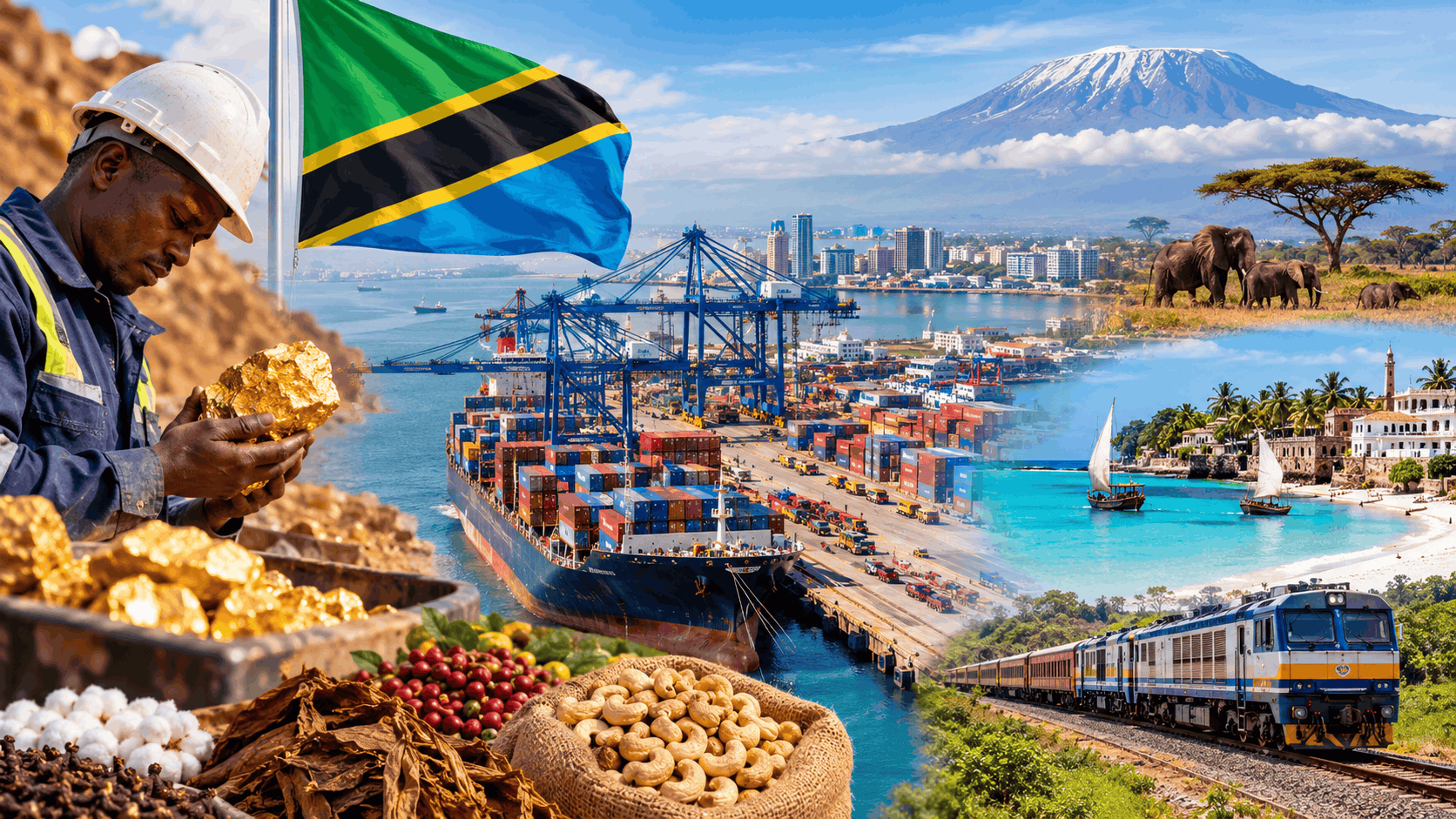
Discover how Tanzania earns from gold, tourism and transport, what it imports, its main trading partners, and the opportunities and risks for African businesses.
A country that earns from moving other countries' goods
In this section
Tanzania is one of East Africa's largest economies, with an estimated population of around 70 million people.
Tanzania earns money by selling gold, welcoming tourists and helping its neighbours move goods across borders. Its ports, roads and railways connect the Indian Ocean to markets in East and Central Africa, including countries that depend on Tanzanian transport routes to reach international markets.
In the year to August 2026, Tanzania recorded approximately US$3.3 billion in transport service receipts, according to figures attributed to the Bank of Tanzania. Tourism receipts were about US$4.4 billion, while gold exports reached approximately US$5.6 billion. These figures show why transport deserves a place alongside mining and tourism when examining how Tanzania earns foreign exchange. They do not mean that all transport receipts come from transit cargo, since the services category covers other transport activities as well.
The Port of Dar es Salaam illustrates the scale of this business. During the 2025/26 financial year, it handled approximately 33.7 million tonnes of cargo, including 14.6 million tonnes of transit cargo destined for other countries. The Democratic Republic of Congo, Zambia and Rwanda were among the main destinations for that transit cargo.
Tanzania also has substantial gold mines, agricultural production, manufacturing industries and internationally recognised tourism attractions. Visitors travel to the Serengeti and Ngorongoro conservation areas, climb Mount Kilimanjaro and visit Zanzibar's beaches and historic Stone Town.
This combination gives Tanzania several sources of export income. Its position on the Indian Ocean also creates opportunities to serve neighbouring economies, although competition from other ports and transport corridors remains a consideration.
This is the sixth country profile in our series, Africa's Markets, Country by Country, following Nigeria, Ghana, Kenya, Rwanda and Uganda. Tanzania is one of East Africa's largest economies, with an estimated population of around 70 million people. The International Monetary Fund projected nominal GDP of approximately US$95 billion for 2026 and real economic growth of about 5.9%.
The economy has continued to grow, but the country also faces questions about political stability, investment rules and the delivery of major infrastructure projects. Understanding these conditions helps businesses assess where opportunities exist and what they should investigate before entering the market.
Tanzania at a glance
Measure
Figure or position
Nominal GDP
Approximately US$95 billion, 2026 IMF projection
GDP per person
Approximately US$1,360, 2026 IMF projection
Real GDP growth
Approximately 5.9%, 2026 IMF projection
Population
Around 70 million
Currency
Tanzanian shilling (TSh)
Gold exports
Approximately US$5.6 billion, year to August 2026
Tourism receipts
Approximately US$4.4 billion in 2025
Transport service receipts
Approximately US$3.3 billion, year to August 2026
Port of Dar es Salaam
Approximately 33.7 million tonnes of cargo in FY2025/26
Main regional trade groupings
East African Community and SADC
Continental trade agreement
African Continental Free Trade Area, which Tanzania has ratified
Sources: IMF World Economic Outlook, Bank of Tanzania, Tanzania Ports Authority reporting and Tanzania's tourism statistics. Figures cover different periods and should not be compared as if they were all recorded in the same year.
How Tanzania's economy is built
In this section
Tourism and cloves are important to its economy, alongside fisheries, seaweed farming and other marine activities.
Agriculture, mining, construction, manufacturing and services all contribute to Tanzania's economy.
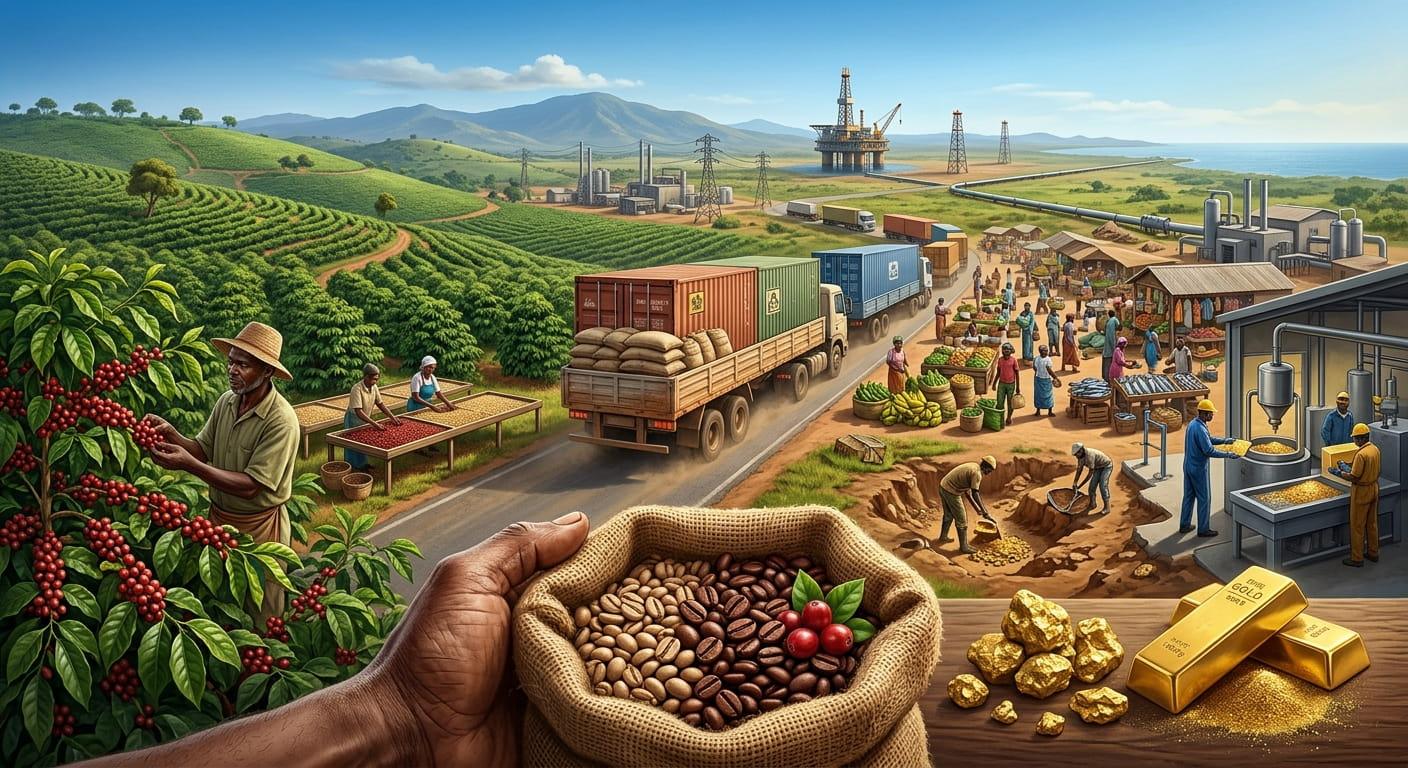
Agriculture supplies food for the domestic market and raw materials for export. Farmers grow maize, rice, cassava, beans and bananas, alongside commercial crops such as cashews, coffee, tobacco, tea, cotton, sisal and cloves. The sector employs a large share of the working population, although its contribution to national output is smaller than its employment share.
Mining provides an important source of foreign exchange. Gold is the leading mineral export, while the country also has deposits of graphite, nickel, rare earth elements, lithium and other minerals. Some of these resources are already being developed, while others remain at earlier stages of exploration or project preparation.
Construction has benefited from investment in transport, energy and other public infrastructure. Projects such as the standard-gauge railway and the Julius Nyerere Hydropower Project are intended to improve transport capacity and electricity supply. Their economic contribution depends partly on completion schedules, operating performance and the extent to which businesses can use the resulting infrastructure.
Services account for a large share of economic activity. These include wholesale and retail trade, transport, tourism, telecommunications, finance and other business services. Tanzania's position between the Indian Ocean and several neighbouring countries gives transport and logistics a particular role within this sector.
Mainland Tanzania and Zanzibar also have different economic characteristics. Zanzibar is a semi-autonomous part of the United Republic of Tanzania with its own government and institutions for many internal matters. Tourism and cloves are important to its economy, alongside fisheries, seaweed farming and other marine activities.
In October 2026, the Bank of Tanzania published rebased national accounts using 2019 as the base year instead of 2015. The revised methodology changed the estimated size of the economy. When comparing Tanzania's GDP across years, readers should therefore check whether figures use the old or new national accounts series.
Growth has been supported by investment, domestic demand, agriculture, mining and services. However, businesses also need to consider inflation, exchange-rate movements and the cost of imported fuel, machinery and other inputs.
The country's political environment is another consideration. The October 2025 election was followed by protests and a violent crackdown. A presidential commission subsequently reported 518 deaths connected to the election violence. The European Parliament also raised concerns about the country's political situation and a proposed EU cooperation programme. The European Commission later approved the €156 million programme in July 2026, with support intended for areas including mineral and agricultural value chains, digital connectivity and cooperation.
The political developments have affected Tanzania's international standing. Businesses assessing the market should follow subsequent policy decisions, legal developments and security conditions rather than relying on economic growth figures alone.
What Tanzania sells
In this section
Exporters must also understand the customs rules and product standards that apply in each destination market.
Tanzania's export earnings come from goods and services. Gold is its largest goods export, while tourism and transport generate substantial service receipts.
The following figures are attributed to Bank of Tanzania data for the year to August 2026. They should be checked against the original monthly economic review before publication, particularly where percentage changes are included.
Export category
Approximate value
Gold
US$5.6 billion
Manufactured goods
US$2.2 billion
Tobacco
US$570 million
Other goods, including agricultural products and other minerals
Approximately US$3.5 billion
Total goods exports
US$12.0 billion
Tourism receipts
US$4.4 billion
Transport service receipts
US$3.3 billion
Total exports of goods and services
US$20.2 billion
Source: Bank of Tanzania, Monthly Economic Review. The goods and services figures must be checked against the same release and statistical definitions before publication. The other-goods estimate is a residual, not a separately reported category.
Gold
Gold is Tanzania's leading goods export. Mining operations in the Lake Victoria region include North Mara and Bulyanhulu, associated with Barrick's operations, and Geita, operated by AngloGold Ashanti. Small-scale mining also contributes to production.
Gold exports bring foreign exchange into the country and connect Tanzania to international bullion markets. India, the United Arab Emirates, Switzerland and South Africa are among the destinations cited for Tanzanian gold, although their exact rankings should be checked against the relevant trade data.
The government has also used gold purchases as part of its efforts to build national reserves. The precise rules governing purchases from small-scale miners and traders should be confirmed against the current Bank of Tanzania and mining regulations before describing any compulsory sales requirement.
Gold gives Tanzania a substantial source of export earnings, but dependence on a single commodity creates exposure to international prices, production costs and changes in demand.
Tourism
Tanzania recorded approximately 2.29 million international tourist arrivals and US$4.41 billion in tourism earnings in 2025. These figures represented a strong year for the sector, with tourism earnings increasing by approximately 13% compared with 2024.
Visitors travel to the northern safari circuit, including the Serengeti, Ngorongoro and Tarangire, as well as the southern parks. Mount Kilimanjaro attracts climbers, while Zanzibar draws visitors interested in beaches, marine activities and historic Stone Town.
Tourism generates foreign exchange and supports hotels, restaurants, tour operators, transport companies, guides, food suppliers and other businesses. Its contribution extends beyond the companies that sell holidays directly.
The sector also depends on reliable air connections, conservation, visitor safety and international perceptions of the country. Businesses operating in tourism should therefore consider both demand for Tanzania's attractions and the conditions that affect travel decisions.
Manufactured goods
Tanzania produces cement, steel products, glass, textiles, plastics, beverages and processed foods. These products serve domestic demand and are sold to neighbouring countries.
Regional markets can be particularly important for manufacturers because proximity may reduce transport costs and make distribution easier. The DRC, Zambia, Malawi, Kenya, Uganda, Rwanda and Burundi are among the countries connected to Tanzania through regional trade.
Manufacturing opportunities depend on the price and availability of electricity, imported inputs, transport, working capital and access to customers. Exporters must also understand the customs rules and product standards that apply in each destination market.
Cashews, coffee, tobacco and other agricultural exports
Tanzania produced a record 617,683 tonnes of cashews in the 2025/26 season. Much of the crop is exported as raw nuts, with India and Vietnam serving as important destinations for processing.
Processing more cashews domestically could allow Tanzanian businesses to retain a greater share of the value generated after harvesting. The opportunity includes grading, shelling, packaging and developing products for retail and industrial buyers.
Coffee is grown in areas including Kilimanjaro and the southern highlands around Mbeya. Tanzania also exports tobacco, tea, cotton, sesame, avocados, cloves from Zanzibar, fish and pulses such as pigeon peas and chickpeas.
These products serve different markets and face different commercial requirements. Buyers may assess quality, consistency, certification, delivery schedules and the ability to supply agreed volumes. Producers seeking to export should establish those requirements before investing in processing or expanding production.
Agriculture also creates opportunities for companies supplying storage, packaging, irrigation equipment, processing machinery, cold-chain services and distribution.
Transport services
Tanzania earns income from the movement and handling of goods through its ports, roads, railways and related logistics facilities.
The Port of Dar es Salaam serves Tanzania and neighbouring markets, particularly countries in the Great Lakes region and southern Africa. Cargo moving through the port may continue by road or rail to its final destination. Transport companies, freight forwarders, warehouse operators, customs agents and other service providers participate in this trade.
Transport receipts should not be confused with the value of the goods passing through the country. A shipment of copper, fuel or machinery may be worth millions of dollars, but Tanzania earns transport and handling fees rather than the full value of the cargo.
This distinction is important when assessing the contribution of transit trade to the national economy.
What Tanzania buys and who it trades with
In this section
Tanzania has restricted some agricultural exports at different times to protect local availability and prices.
Tanzania imports petroleum products, machinery, vehicles, industrial materials, fertiliser, medicines, plastics, cooking oil, wheat and sugar. These purchases support households, businesses, construction, agriculture, mining and transport.
Fuel is a particularly important import because Tanzania relies on imported petroleum products to meet much of its domestic demand. Changes in international oil prices can therefore affect the import bill, transport costs, inflation and demand for foreign currency.
Machinery and equipment are needed for mining, construction, manufacturing and infrastructure projects. Businesses investing in Tanzania should account for the cost of imported equipment, spare parts and other inputs when estimating their operating expenses.
China is an important source of imported goods, alongside India, the United Arab Emirates, Saudi Arabia and other suppliers in Asia and the Gulf. Tanzania also trades with European and American markets, particularly in sectors such as tourism, coffee, fish and horticulture.
Within Africa, its trading partners include the DRC, Zambia, Malawi, Kenya, Uganda, Rwanda and Burundi. Tanzanian manufacturers and agricultural producers supply products to these markets, while companies in neighbouring countries use Tanzanian transport routes to reach overseas destinations.
Afreximbank reported that Tanzania's trade with the rest of Africa increased in 2024. The precise value and percentage change should be checked against the original report before publication.
Trade with neighbouring countries can be affected by domestic food supply policies. Tanzania has restricted some agricultural exports at different times to protect local availability and prices. Such restrictions can affect buyers in neighbouring countries that depend on Tanzanian supplies, particularly for staple foods.
For businesses, the key questions include whether the required products are available in sufficient quantities, whether export restrictions apply and whether delivery schedules can be maintained.
Trade agreements and how goods move
In this section
For a Tanzanian manufacturer, the EAC can provide access to customers across several neighbouring markets.
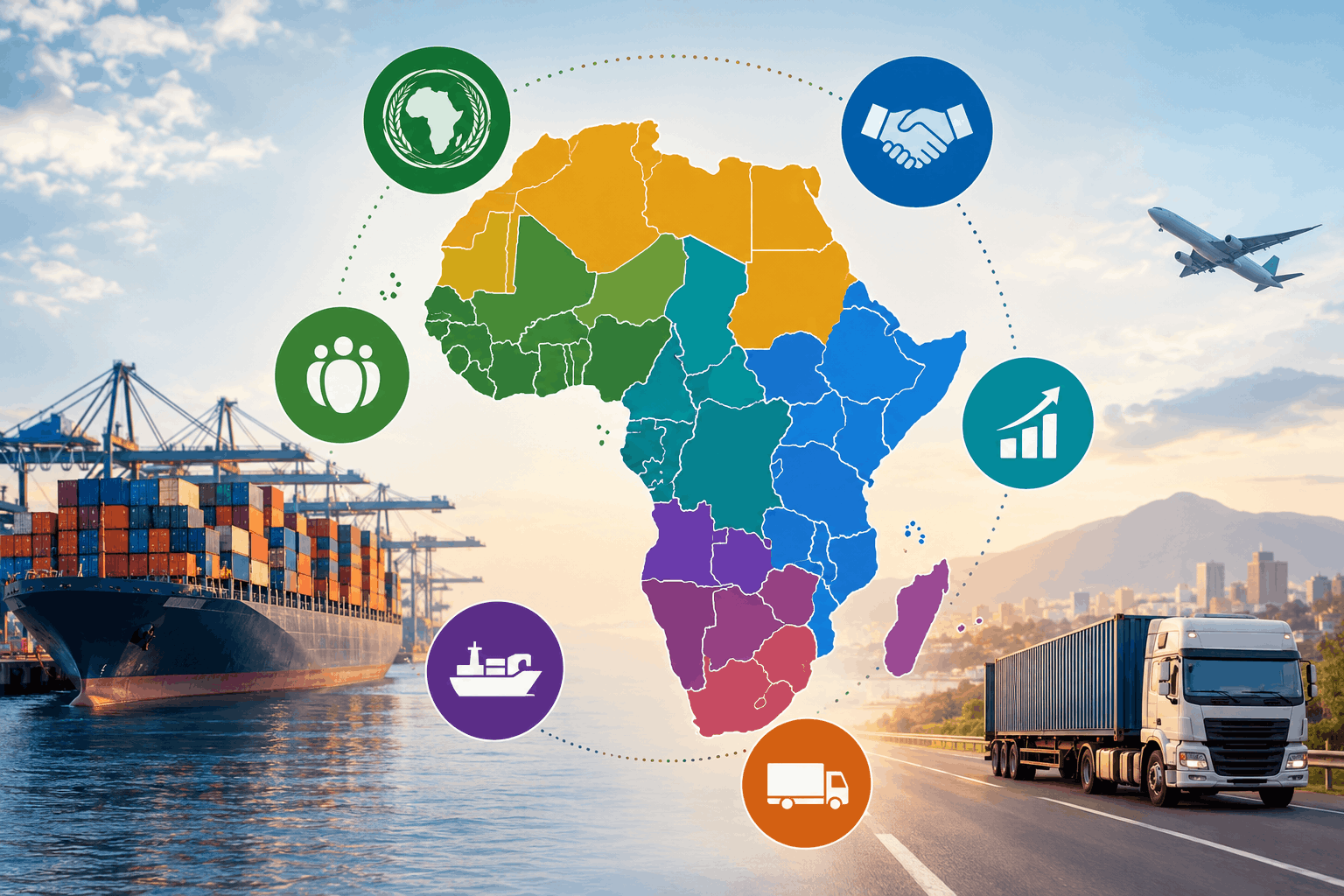
Tanzania belongs to both the East African Community (EAC) and the Southern African Development Community (SADC). It has also ratified the African Continental Free Trade Area (AfCFTA).
These agreements provide frameworks for regional trade, but their benefits depend on the products being traded, rules of origin, customs procedures, applicable tariffs and other requirements.
East African Community
The EAC brings together Tanzania, Kenya, Uganda, Rwanda, Burundi, the DRC, South Sudan and Somalia.
Its customs union provides for a common external tariff and the reduction of internal trade barriers. However, businesses should not assume that every product automatically qualifies for duty-free entry into every partner state. The applicable rules of origin, product classifications and customs requirements must be checked for each shipment.
For a Tanzanian manufacturer, the EAC can provide access to customers across several neighbouring markets. For an exporter based elsewhere in the region, Tanzania can offer a market in its own right and a potential location for distribution.
Southern African Development Community
Tanzania is also a member of SADC, which connects it to markets in southern Africa. The regional trade arrangements provide preferential access for qualifying goods, subject to the applicable rules and product-specific requirements.
Tanzania's membership in both the EAC and SADC gives businesses several regional frameworks to consider. It does not mean that a company can ignore the rules governing the movement of goods between the different trade blocs.
Tanzania withdrew from COMESA in 2000. Businesses planning regional distribution should check the current status of relevant agreements rather than assuming that membership in one regional organisation extends to another.
African Continental Free Trade Area
The AfCFTA aims to reduce trade barriers between participating African countries and expand trade across the continent.
Its commercial value for an individual business depends on whether the relevant countries and products are covered by operational preferences, whether the goods meet rules of origin and whether customs authorities are applying the necessary procedures.
Companies should check the status of the specific trade arrangement they intend to use before building tariff savings into a business plan.
Access to European and American markets
As a least developed country, Tanzania benefits from the European Union's Everything But Arms arrangement, which provides duty-free and quota-free access for eligible products, subject to the scheme's requirements and exceptions.
Tanzania is also eligible for the United States' African Growth and Opportunity Act (AGOA), subject to the programme's conditions. The United States signed legislation extending AGOA in September 2026. Exporters should verify the applicable programme period, Tanzania's current eligibility and product-specific requirements before relying on these preferences.
Preferential access can help exporters compete, but it does not guarantee sales. Buyers still consider price, quality, reliability, certification and the cost of getting goods to market.
Dar es Salaam and Tanzania's transport corridors
In this section
Road transport remains important for goods moving between Tanzania, Zambia, Malawi and the DRC's Katanga region.
The Port of Dar es Salaam
Dar es Salaam is Tanzania's principal port and a major gateway for trade with East and Central Africa.
During FY2025/26, the port handled approximately 33.7 million tonnes of cargo. Transit cargo accounted for about 14.6 million tonnes. The DRC, Zambia and Rwanda were among the main destinations for goods moving through the port to other countries.
These volumes support businesses involved in shipping, trucking, warehousing, freight forwarding, customs clearance and distribution. They also create demand for services such as cargo insurance, equipment maintenance and storage.
Dubai-based DP World began operating part of the port under a concession in April 2024. The arrangement forms part of wider efforts to improve port operations and increase handling capacity. Claims about reductions in ship waiting times and cargo clearance should be tied to dated performance data rather than described as permanent results.
Other ports serve more specialised roles. Tanga is associated with the East African Crude Oil Pipeline project, while Mtwara supports southern Tanzania's trade and offshore gas activities.
The standard-gauge railway
Tanzania is building a standard-gauge railway connecting Dar es Salaam with inland centres and the Lake Victoria region.
Passenger services between Dar es Salaam and Dodoma began in July 2024, and freight operations followed in June 2025. The extension towards Mwanza remains under construction. Tanzania Railways Corporation reported in September 2026 that operations on the Makutupora to Mwanza section were targeted for the end of 2028.
The railway is intended to improve the movement of passengers and goods, reduce dependence on road transport for some journeys and strengthen connections between the coast and inland markets.
Its eventual impact will depend on completion, operating costs, service frequency, connections to ports and border facilities, and whether businesses can use the railway competitively.
Plans for extensions towards neighbouring countries have also been discussed. These should be treated as proposed or developing connections unless construction and operating schedules have been confirmed.
TAZARA and the southern corridors
The Tanzania-Zambia Railway Authority (TAZARA) railway connects Dar es Salaam with Zambia. Built with Chinese assistance in the 1970s, it has historically provided a route for trade between the port and Zambia's copper-producing regions.
China and Tanzania have pursued plans to rehabilitate and modernise the railway. Businesses should distinguish agreements and investment commitments from completed work and operational improvements.
Road transport remains important for goods moving between Tanzania, Zambia, Malawi and the DRC's Katanga region. The Tanzania-Zambia highway and the border crossing at Tunduma are significant parts of this network.
Airports and inland waterways
Julius Nyerere International Airport in Dar es Salaam, Kilimanjaro International Airport near Arusha and Abeid Amani Karume International Airport in Zanzibar serve passenger travel and air cargo.
Lake Victoria and Lake Tanganyika also connect communities and trading centres across national borders. Their commercial importance varies by route, port infrastructure and the availability of reliable services.
Together, these transport systems give Tanzania several ways to connect domestic producers and neighbouring markets to regional and international trade.
Sectors with room to grow
In this section
Regional demand may create opportunities for manufacturers that can meet product standards and deliver consistently.
Logistics and transit services
Transport and logistics offer opportunities for companies that can move goods efficiently between ports, inland markets and neighbouring countries.
Potential activities include warehousing, freight forwarding, trucking, inland container depots, cargo handling and distribution. Demand will depend on trade volumes, infrastructure performance, competition from other corridors and the cost of transporting goods.
Businesses considering this sector should examine specific routes, customer commitments, operating licences and border procedures before investing in equipment or facilities.
Liquefied natural gas
Tanzania has substantial offshore natural gas resources, estimated at around 47 trillion cubic feet. A proposed liquefied natural gas (LNG) project near Lindi has involved Shell, Equinor, ExxonMobil and other participants.
The government has previously placed the project's estimated value at approximately US$42 billion. It would be one of the country's largest proposed investments.
However, negotiations, commercial arrangements and project preparation have taken longer than earlier schedules anticipated. The project should therefore be treated as a potential future investment rather than an operating source of export earnings.
Companies interested in supplying equipment, construction services, logistics or other support should monitor confirmed project milestones and procurement announcements.
Critical minerals
Beyond gold, Tanzania has deposits of graphite, nickel, rare earth elements, lithium and other minerals that may serve battery, manufacturing and clean-energy supply chains.
Projects such as the Kabanga nickel development and graphite projects in southern Tanzania have attracted attention at different stages of development.
The commercial prospects differ by mineral and project. Investors need to examine resource estimates, financing, infrastructure, environmental requirements, licensing and the availability of processing facilities before assessing the value of a particular opportunity.
The government's interest in developing more local processing may create opportunities for businesses that can meet the technical and financial requirements of the sector.
Agricultural processing
Tanzania's cashew production demonstrates the potential for processing agricultural products locally. Much of the harvest is exported as raw nuts, which are then processed elsewhere.
Cashew processing is one possible area for investment, alongside sunflower oil, rice milling, coffee roasting, sugar production, horticulture and fish processing.
These businesses need reliable supplies, suitable equipment, working capital, skilled workers and access to buyers. They must also compete with established processors in other countries.
Processing can create additional domestic economic activity, but it is not automatically profitable. Investors should compare the cost of local production with imported finished products and identify customers before committing capital.
Tourism and the blue economy
Tanzania has opportunities to develop tourism beyond the busiest northern safari circuit and Zanzibar's established visitor destinations. Southern parks, coastal areas, marine activities and cultural attractions offer other possibilities.
Zanzibar has also promoted its blue economy, which includes fisheries, seaweed farming, marine tourism and other activities linked to the ocean.
Businesses considering these sectors should assess environmental requirements, infrastructure, access to customers, seasonality and the availability of trained workers.
Manufacturing
Tanzanian manufacturers produce construction materials, textiles, beverages, plastics and processed foods for domestic and regional markets.
Reliable electricity, transport and access to finance can affect their competitiveness. The Julius Nyerere Hydropower Project is intended to increase electricity generation, but businesses should assess actual supply reliability, tariffs and connection requirements at their proposed locations.
Regional demand may create opportunities for manufacturers that can meet product standards and deliver consistently. Companies should identify their target markets and calculate distribution costs before deciding where to establish production.
Doing business in Tanzania
In this section
Investors should obtain current guidance from the Tanzania Revenue Authority and the relevant sector regulator.
Company registration and investment support
Companies register through the Business Registrations and Licensing Agency (BRELA) and must complete the relevant tax registration and licensing procedures. Requirements vary by business activity, ownership structure and location.
Tanzania's investment framework changed with the Investment and Special Economic Zones Act of 2025, which established the Tanzania Investment and Special Economic Zones Authority (TISEZA). The authority brings together investment promotion and special economic zone functions previously handled by separate institutions.
TISEZA provides information about investment registration, certificates of incentives and relevant licensing procedures. Its published guidance lists minimum project values of US$500,000 for wholly foreign-owned businesses and joint ventures, and US$50,000 for wholly Tanzanian-owned projects seeking a certificate of incentives under the stated category.
These figures should not be treated as universal minimum capital requirements for forming every business. Eligibility depends on the registration route, the activity, the relevant legal provisions and any applicable sector-specific rules. Investors should confirm current requirements and fees directly with TISEZA.
Zanzibar has separate institutions and procedures for many investment and business matters. Investors planning to operate there should establish which Mainland Tanzania and Zanzibar requirements apply to their proposed activities.
Foreign ownership and land
Land in Tanzania is governed by a statutory framework under which land is held by the state in trust for the public. Foreign investors generally do not acquire land through ordinary freehold ownership in the same way that they might in some other countries.
Investment-related access may be available through approved derivative rights, leases and other arrangements permitted by law. The conditions depend on the proposed investment, the land involved and the relevant approvals.
A company should not assume that a local partner or a private lease automatically resolves every land restriction. Before committing funds, investors should obtain legal advice and confirm the status of the land, the permitted use and the rights available to the proposed business.
Work and residence permits
Foreign nationals working in Tanzania generally need the relevant work and residence permits. Requirements vary by role, employer and immigration category.
Businesses hiring foreign workers should establish the applicable application process, documentation, fees and renewal requirements before employment begins. Employers may also need to demonstrate the relevant skills requirements and comply with local training or employment provisions.
Currency and payments
The Tanzanian shilling is the country's currency. Regulations introduced in March 2025 generally require domestic prices and payments to be expressed and settled in shillings, subject to specified exceptions.
This affects businesses that previously priced goods, services or rents in US dollars for domestic transactions. Companies should confirm how the rules apply to their sector, particularly where tourism, international contracts or other permitted transactions are involved.
Businesses should also account for exchange-rate movements when importing goods, servicing foreign-currency obligations or repatriating permitted investment proceeds.
Taxes and operating costs
The standard corporate income tax rate is generally 30%, while the standard VAT rate on Mainland Tanzania is 18%. Specific rules, exemptions and sector provisions may affect the tax treatment of an individual business. Zanzibar's tax arrangements should be checked separately where relevant.
Mining and petroleum projects have additional regulatory requirements, including applicable royalties, licences and local-content provisions.
Investors should obtain current guidance from the Tanzania Revenue Authority and the relevant sector regulator. Tax calculations should include applicable duties, withholding taxes, VAT treatment and compliance costs rather than relying on headline rates alone.
Risks and trade-offs
In this section
A decline in gold prices or production could reduce export earnings and affect the supply of foreign currency.
Political developments
The October 2025 election and the subsequent violence have affected Tanzania's international standing. The presidential commission's reported death toll, concerns raised by international institutions and continuing political developments make it important for businesses to monitor the situation.
The European Parliament objected to the proposed EU cooperation programme in June 2026. The European Commission subsequently approved the €156 million programme in July 2026, with funding directed towards areas including mineral and agricultural value chains and digital connectivity.
These developments should be described accurately. Parliamentary objections, formal funding decisions and the actual disbursement of money are separate events.
Businesses should follow developments affecting security, regulation, investor confidence and international cooperation. Tourism operators should also check current travel advisories and local conditions.
Dependence on gold and transit trade
Gold accounts for a large share of Tanzania's goods exports. A decline in gold prices or production could reduce export earnings and affect the supply of foreign currency.
Transit trade also depends on economic activity in neighbouring countries. Demand for transport services can change with mining output, trade volumes, border delays and competition from other ports and corridors.
Tanzania competes with Mombasa in Kenya and with other routes serving parts of Central and Southern Africa. Transport businesses must assess the total cost, speed and reliability of each route rather than assuming that geographical proximity guarantees cargo.
Fuel prices and the current account
Imported petroleum products expose Tanzania to changes in international oil prices. Higher fuel prices can increase transport and production costs, raise the import bill and place pressure on inflation and the exchange rate.
Businesses that depend on imported fuel, machinery or raw materials should test their financial plans against different exchange rates and input costs.
Delays to major projects
The LNG project and some railway extensions have schedules that depend on construction progress, financing, negotiations and other approvals.
Businesses planning to supply these projects should distinguish confirmed procurement opportunities from anticipated demand. Investment plans should allow for changes in completion dates and should not rely on revenue from a project that has yet to reach the relevant stage.
Policy and compliance
Businesses need to follow changes to foreign-currency rules, agricultural export restrictions, mining regulations, investment procedures and tax requirements. Rules can differ between Mainland Tanzania and Zanzibar. Requirements may also vary by sector and ownership structure.
Before entering the market, companies should identify the licences, approvals, customs procedures and payment rules that apply to their activity. Local professional advice can help them avoid costly assumptions.
What Tanzania means for an African business
In this section
Tanzania's membership in the EAC and SADC can help businesses consider several regional markets from one base.
Tanzania offers a substantial domestic market and connections to several neighbouring economies. Its gold exports, tourism industry, agricultural production, manufacturing base and transport infrastructure provide different entry points for African businesses.
The first opportunity is to use Tanzania as a market and a potential distribution base. Companies can investigate demand for manufactured goods, food products, construction materials, machinery and business services. Those considering regional distribution should compare the costs and requirements of serving each target country.
The second opportunity is to supply goods and services that Tanzania imports. These include petroleum products, machinery, vehicles, industrial materials, fertiliser, cooking oil, sugar and medicines. African suppliers may be competitive in some categories, but they need to compare landed costs, quality requirements, tariffs, payment terms and delivery capacity with established suppliers.
The third opportunity is to work with Tanzanian businesses in agriculture, processing, mining and tourism. Cashew processing, oilseed production, coffee, fisheries, equipment supply and tourism services are areas worth examining. A sound investment case requires evidence of demand, dependable suppliers, suitable partners and a clear route to customers.
Transport and logistics provide another area for investigation. Businesses may find opportunities in warehousing, freight forwarding, distribution and services that support the movement of goods through Dar es Salaam. However, expected growth in cargo volumes should be tested against actual route demand, competing corridors and infrastructure schedules.
Tanzania's membership in the EAC and SADC can help businesses consider several regional markets from one base. The advantages depend on the specific product, applicable trade preferences, rules of origin and the cost of serving customers across borders.
Companies should also account for political developments, currency requirements, land restrictions, tax obligations and possible project delays. These conditions do not make Tanzania unsuitable for investment, but they affect the cost and structure of entering the market.
A business assessing Tanzania should begin with a defined product or service, a target customer group and a clear estimate of the costs involved. It should then verify the applicable regulations, identify credible local partners where needed and test whether the market can support the proposed investment.
Tanzania has several sources of economic activity, and its transport links give it a role beyond its domestic market. The opportunity for an African business depends on identifying where its products or services fit, then checking whether the numbers and operating conditions support the decision.
The next profile in our series, Africa's Markets, Country by Country, examines South Africa, the continent's largest economy by nominal GDP.
Sources and further reading
● Bank of Tanzania: Monthly Economic Reviews
● International Monetary Fund: World Economic Outlook
● Tanzania Investment and Special Economic Zones Authority
● Tanzania Railways Corporation
● European Parliament: 2026 Tanzania cooperation programme procedure
● The Citizen: Tanzania clarifies EU funding decision
● The Chanzo: EU approval of the 2026 Tanzania cooperation programme
● US House Committee on Ways and Means: AGOA Extension Act signed in September 2026
● Tanzania tourism statistics
● Tanzania Revenue Authority
Editorial note: Before publication, confirm the August 2026 export and import figures, the current account balance, the central bank rate, inflation, foreign-exchange reserves and the exchange-rate series against the relevant Bank of Tanzania releases. Confirm the exact source and comparison period for export growth percentages. The source list should be supplemented with the original port and cashew production reports. Where an exact statistic has not been confirmed from its primary source, the article uses rounded figures or omits the unsupported percentage rather than presenting it as established fact.