Discover how Ghana earns and spends its money, from gold, cocoa and oil exports to imports, trading partners, ports, economic recovery and business opportunities.
Gold now earns Ghana more than US$20 billion a year
In this section
The recovery has not erased the difficulties households and businesses experienced during the crisis.
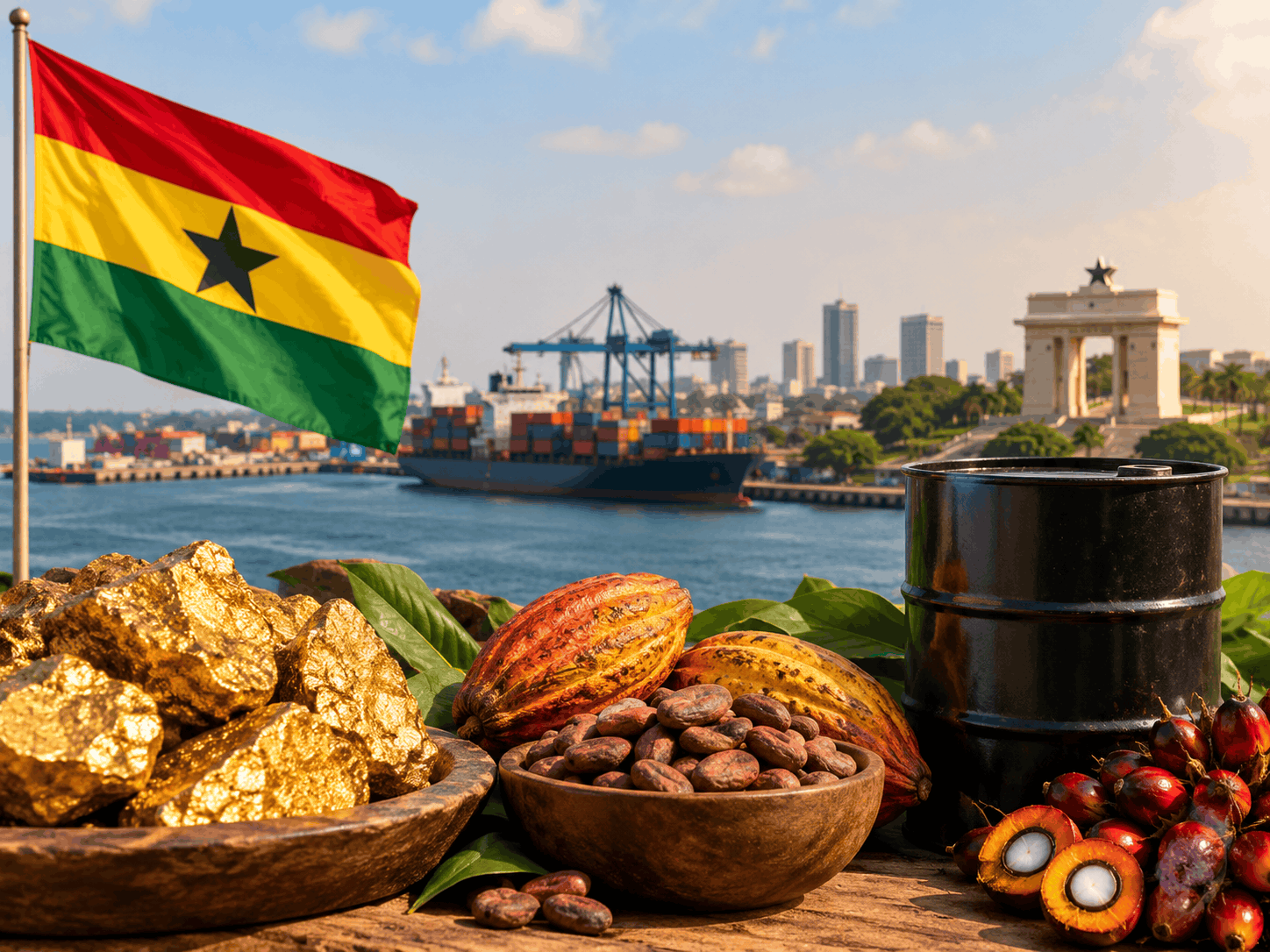
In 2025, Ghana earned almost US$21 billion from gold exports, according to the Bank of Ghana. That was more than double the amount recorded in 2024. Cocoa brought in US$3.9 billion, while crude oil contributed another US$2.6 billion. Together, these three commodities accounted for approximately 88% of Ghana's US$31.1 billion in goods exports.
Gold's rise came at an important time for the country. In December 2022, inflation reached 54.1%, the cedi had lost substantial value and the government suspended payments on most of its external debt. Ghana turned to the International Monetary Fund (IMF) for support, eventually securing a three-year programme worth about US$3 billion.
By the end of 2025, inflation had fallen to 5.4%, export earnings had reached a record level and the country had made substantial progress on restructuring its debt. Higher gold prices helped Ghana bring in foreign exchange during this period, although the recovery also depended on fiscal adjustments, debt restructuring and wider improvements in economic conditions.
The recovery has not erased the difficulties households and businesses experienced during the crisis. Prices remain much higher than they were before the inflation surge, and businesses still have to consider exchange-rate movements, borrowing costs and the risk of another period of economic instability. Ghana has made progress, but the strength of its export earnings now depends heavily on a commodity whose international price the country cannot control.
This is the second profile in our Africa's Markets, Country by Country series, following How Nigeria Makes Its Money. Here, we look at how Ghana's economy works, what it sells and buys, who its trading partners are, how goods move through the country and where African businesses may find opportunities.
Ghana has a smaller economy than Nigeria, but it has a different income profile, a substantial manufacturing and services base, and a strategic role in continental trade. Accra is also home to the secretariat of the African Continental Free Trade Area (AfCFTA), which makes the country an important location for businesses following the development of African trade rules.
Ghana at a glance
Measure
Figure
Period and source
Real GDP growth
6.0%
2025, IMF
Real GDP growth
6.0%
Q2 2026, Ghana Statistical Service
Headline inflation
5.4%
December 2025, Ghana Statistical Service
Headline inflation
5.2%
September 2026, Ghana Statistical Service
Goods exports
US$31.11 billion
2025, Bank of Ghana
Goods imports
US$17.45 billion
2025, Bank of Ghana
Goods trade surplus
US$13.66 billion
2025, Bank of Ghana
Gold exports
US$20.98 billion
2025, Bank of Ghana
Cocoa exports
US$3.86 billion
2025, Bank of Ghana
Crude oil exports
US$2.62 billion
2025, Bank of Ghana
Largest reported export market
United Arab Emirates
2025, Ghana Statistical Service
Largest import supplier
China
2025, Ghana Statistical Service
Currency
Ghanaian cedi (GH¢)
Floating exchange-rate system
Regional trade arrangements
ECOWAS and AfCFTA
Ghana is a member of both
The figures above cover different reporting periods. Annual results, quarterly growth rates and monthly inflation figures should not be treated as if they describe the economy at the same moment.
How Ghana's economy is built
In this section
The programme required Ghana to strengthen its public finances, improve revenue collection and restructure debt.
Services account for the largest share of Ghana's economy. According to the Ghana Statistical Service, services contributed 45.9% of GDP in 2025, while industry accounted for 31.3% and agriculture for 22.8%.
Services include activities such as trade, transport, banking, telecommunications, education, real estate and public administration. Industry covers mining, oil and gas, manufacturing, construction and utilities. Agriculture includes crop production, livestock, forestry and fishing.
These figures help explain why Ghana's economy cannot be understood through gold and cocoa alone. Mining and commodity exports bring in substantial foreign exchange, but millions of people also depend on farming, trading, transport, construction and other services for their livelihoods.
The economy grew by 6.0% in 2025, compared with 5.8% in 2024. Information and communication was the fastest-growing sector, expanding by approximately 20.2%. Crop farming, gold mining, manufacturing, transport and education also contributed to growth. In the second quarter of 2026, the economy again grew by 6.0% year-on-year, with information and communication recording particularly strong expansion.
For businesses, this means Ghana has several sources of demand and economic activity. Its export industries matter, but so do the people buying food, building homes, using mobile financial services, moving goods and purchasing manufactured products.
How the 2022 debt crisis changed Ghana
Ghana's recent economic difficulties developed over several years. The government borrowed heavily during the decade before the crisis, including through international bonds denominated in foreign currencies. When the pandemic put pressure on public finances and global interest rates rose, servicing that debt became more expensive.
Investors became less willing to lend to Ghana, the cedi weakened sharply and imported goods became more expensive. Inflation reached 54.1% in December 2022. That same month, the government suspended payments on most of its external debt and began a restructuring process.
In May 2023, the IMF approved a three-year programme worth approximately US$3 billion. The programme required Ghana to strengthen its public finances, improve revenue collection and restructure debt. The government also exchanged domestic bonds for new instruments with different repayment terms, a process that imposed losses and disruption on some banks, pension funds and other investors.
External debt restructuring followed. International bondholders agreed to revised terms in 2024, while official creditors also negotiated changes to their claims.
The process took time because Ghana had to negotiate with different groups of creditors while trying to restore confidence in its economy. The IMF completed the sixth and final review of the Extended Credit Facility programme in July 2026. Ghana subsequently moved to a Policy Coordination Instrument, a non-financing arrangement under which the IMF continues to assess the country's economic policies without providing a new lending programme.
By then, inflation had fallen considerably from its 2022 peak, export earnings had increased and the government had made progress towards stronger fiscal balances. Gold played an important role in bringing foreign exchange into the country, although it was not the only reason for the recovery.
The effects of the crisis have not disappeared. Lower inflation means prices are rising more slowly; it does not mean prices have returned to their pre-crisis levels. Some investors suffered losses during the domestic debt exchange, while parts of Ghana's financial sector continue to face vulnerabilities.
The recovery has improved the conditions in which businesses operate, but companies still need to account for borrowing costs, currency movements and the possibility that future government spending could put pressure on public finances again.
What Ghana sells to the world
In this section
Cocoa has shaped Ghana's farming communities, export earnings and international reputation for generations.
Ghana's export earnings come primarily from gold, cocoa and crude oil. In 2025, the Bank of Ghana recorded approximately US$31.1 billion in goods exports, of which gold contributed US$21.0 billion.
Export category
2025 value
2024 value
Gold
US$20.98bn
US$10.31bn
Cocoa beans and products
US$3.86bn
US$1.94bn
Crude oil
US$2.62bn
US$3.87bn
Other goods
About US$3.65bn
About US$3.04bn
Total goods exports
US$31.11bn
US$19.16bn
Source: Bank of Ghana. Figures are rounded; the figure for other goods is calculated from the reported totals.
The figures show how much Ghana's export performance changed in a single year. Total goods exports rose by approximately 62%, largely because gold earnings increased sharply. Gold, cocoa and crude oil together accounted for about 88% of the total.
That concentration creates opportunities, but it also exposes Ghana to changes in commodity prices and production.
Gold: Ghana's biggest export earner
Ghana is one of Africa's leading gold producers and has historically ranked among the continent's largest producers of the metal. Gold comes from large industrial mines as well as artisanal and small-scale mining operations.
Industrial mines operated by companies such as Newmont, Gold Fields and AngloGold Ashanti produce gold in several parts of the country. Alongside these operations, small-scale miners work in shallow pits and riverbeds, using a range of methods to extract and process gold.
For years, some gold produced by small-scale miners left Ghana through informal channels. This made it harder for the country to record the production accurately, regulate the trade and capture the full value of the foreign exchange generated.
The government established the Ghana Gold Board, commonly known as GoldBod, in 2025 to regulate and formalise the gold trade, including the buying and export of small-scale gold. GoldBod reported that small-scale gold exports reached approximately 103 tonnes, worth US$10.8 billion, in 2025.
The Bank of Ghana's figures show that the increase in gold earnings came from both higher export volumes and higher prices. Export volumes rose by approximately 35.7%, while the average price received increased by about 49.9%, reaching roughly US$3,400 per fine ounce.
Both developments contributed to the rise in earnings, although higher prices were particularly important. If international gold prices fall, Ghana could earn less from exports even if the volume of gold sold abroad remains high.
GoldBod's role also raises a longer-term question. Ghana earns substantial foreign exchange from exporting gold, but there may be opportunities to retain more value locally through refining, jewellery production and other gold-related services. Achieving that would require investment, reliable regulation, skilled workers and competitive processing facilities.
Cocoa: an important crop facing production difficulties
Cocoa has shaped Ghana's farming communities, export earnings and international reputation for generations. It remains an important source of income for farmers and a major export commodity, although production has faced serious difficulties.
Cocoa is grown largely by smallholder farmers in the country's forest belt. Ghana Cocoa Board, known as COCOBOD, plays a central role in the sector, including setting the producer price paid to farmers and organising the marketing of cocoa.
Ghana has historically been the world's second-largest cocoa producer after Côte d'Ivoire. However, falling output in Ghana and expanding production elsewhere, particularly in Ecuador, have put that position under pressure. Its ranking should be understood in relation to the season and the latest comparable production estimates.
Several problems have contributed to Ghana's production difficulties. Swollen shoot disease has affected cocoa trees, many farms contain ageing trees, and illegal mining has damaged some agricultural land. Smuggling has also been a concern when farmers believe they can receive better prices across neighbouring borders.
International cocoa prices surged during the 2023/24 season and reached exceptional levels in 2024. Prices subsequently fell from those peaks, although the average price over the 2024/25 season remained considerably higher than in the preceding season. Ghana's export earnings do not always respond immediately to changes in the international market because some cocoa is sold through forward contracts.
Ghana is also working to retain more value from cocoa by processing part of its crop into products such as cocoa butter, liquor and powder. Processing can create manufacturing jobs and earn more per tonne than exporting unprocessed beans, although the gains depend on production costs, factory capacity and access to buyers.
In September 2026, COCOBOD announced a producer price of GH¢42,400 per tonne for the 2026/27 season. The new Ghana Cocoa Board Act, 2026, also establishes a minimum share of realised export value for farmers. These changes are intended to improve the distribution of cocoa earnings, but restoring production will take time. Cocoa trees need several years to mature, and rebuilding damaged farms is a longer process than adjusting the price paid to farmers.
Crude oil: still important, but less dominant
Ghana began producing oil commercially in 2010 from the Jubilee field off its western coast. Production later expanded through the TEN and Sankofa fields.
Oil brought a new source of export income and government revenue, but production from mature offshore fields has faced challenges. In 2025, crude oil export earnings fell from approximately US$3.87 billion to US$2.62 billion.
The decline meant oil contributed far less to export earnings than gold. Higher output from particular fields may improve the figures in some quarters, but the outlook depends on production performance, investment and international oil prices.
Ghana's experience shows why the discovery of a valuable resource does not guarantee steadily rising export income. Fields decline, operating costs change and new production requires continued investment.
The exports beyond gold, cocoa and oil
Ghana also exports manganese, bauxite, cashew nuts, shea products, timber and wood products, canned tuna, fresh fruit and manufactured goods. These products do not match gold in export value, but they matter to farmers, processors and manufacturers whose businesses depend on reaching buyers beyond Ghana.
Some Ghanaian manufacturers sell plastics, cement, steel products, cosmetics, beverages and packaged foods to neighbouring West African markets. Processed agricultural products, in particular, offer opportunities to retain more value in the country than exporting raw commodities alone.
AfCFTA may help Ghanaian businesses reach additional African markets where applicable tariff schedules and rules of origin allow preferential treatment. However, lower tariffs alone will not guarantee export growth. Producers still need competitive prices, consistent quality, sufficient production capacity, suitable packaging and reliable transport.
For Ghana to diversify its export earnings, these businesses will need access to finance, equipment, skilled workers and buyers willing to place repeat orders.
What Ghana buys from other countries
In this section
For African producers, Ghana's import bill provides a useful starting point for researching market opportunities.
Ghana imported approximately US$17.45 billion in goods in 2025, leaving it with a goods trade surplus of about US$13.66 billion. The surplus means the recorded value of goods exports exceeded the value of goods imports during the year. It does not mean every business or household had more money available to spend.
Oil and fuel accounted for approximately US$5.1 billion of imports, while non-oil goods made up the remaining US$12.3 billion.
Fuel is one of Ghana's major import needs. The country has the Tema Oil Refinery, but domestic refining has operated intermittently over the years, leaving Ghana reliant on imported refined petroleum products. The availability of regional refining capacity, including Nigeria's Dangote refinery, creates another potential source of supply. The share supplied by any particular refinery, however, depends on actual trade flows and commercial arrangements.
Ghana also imports vehicles and spare parts, machinery for mining and construction, industrial equipment, iron and steel, plastics, chemicals and other manufacturing inputs. Rice, frozen chicken, wheat, sugar and vegetable oil are important food imports.
These purchases reveal some of the costs Ghanaian businesses face. A company that imports machinery needs foreign exchange to pay its supplier. A food distributor buying rice from Asia has to account for international prices, shipping, insurance, port charges and the exchange rate. A manufacturer importing plastics or chemicals may see its production costs rise when the cedi weakens.
The reverse can also happen. When the cedi strengthens, imported goods and inputs may become less expensive in local-currency terms, although the final price still depends on suppliers, taxes, transport and competition.
China is Ghana's largest import supplier, providing a wide range of machinery, vehicles, electronics, plastics, steel and industrial inputs. Other important suppliers include India, the United States, the United Arab Emirates and European trading partners. Nigeria is also relevant to Ghana's regional supply of fuel and other products.
For African producers, Ghana's import bill provides a useful starting point for researching market opportunities. It shows what the country buys from abroad, but it does not establish that local production would automatically be competitive. Any prospective supplier would still need to compare landed costs, product standards, distribution requirements and the strength of existing competition.
Who Ghana trades with
In this section
Ghana also trades with other West African countries, including Nigeria, Côte d'Ivoire, Togo and Burkina Faso.
Ghana's export destinations look different from its import suppliers because gold makes up such a large share of what it sells abroad.
The Ghana Statistical Service reported that the United Arab Emirates was Ghana's largest export market in 2025, accounting for 25.9% of recorded exports. India, Switzerland, South Africa and China were also important destinations.
The presence of the UAE, India and Switzerland reflects the international gold trade. Gold may be shipped to a major trading or refining centre before it reaches its final industrial or jewellery-market destination. A customs record showing one country as the destination therefore does not always tell the full story of where the metal will eventually be used.
Cocoa and other exports follow different routes. Cocoa may be shipped to processing centres in Europe and Asia, while oil is sold to buyers according to commercial contracts and refinery demand.
South Africa is an important African trading partner. Ghana also trades with other West African countries, including Nigeria, Côte d'Ivoire, Togo and Burkina Faso. Ghanaian manufacturers supply products such as plastics, beverages, processed foods, cosmetics and building materials to regional markets.
Trade with African countries is important even though gold-heavy exports make the overall trade figures appear concentrated in a few destinations. Ghanaian firms that sell manufactured goods to neighbouring countries are participating in a different part of the export economy from the firms that export gold.
Ghana also exported goods to numerous African countries in 2025 and recorded a trade surplus with the continent, according to Ghana Statistical Service reporting. That regional figure uses a different currency and trade classification from the Bank of Ghana's dollar figures, so the two should not be combined directly.
On the import side, Ghana relies heavily on Asian manufacturers, especially China. This leaves room for African producers to compete in selected categories, provided they can offer a suitable combination of price, quality, delivery time and after-sales service.
The trade agreements Ghana belongs to
In this section
The agreement does not mean every product can enter every African market without duties or other requirements.
Trade agreements influence the duties businesses pay, the documents they need and the conditions under which goods can enter another market. Ghana participates in regional and continental arrangements as well as trade agreements with partners outside Africa.
ECOWAS
Ghana is a member of the Economic Community of West African States, or ECOWAS. The organisation's trade framework is intended to support the movement of qualifying goods between member countries, while its common external tariff establishes tariff categories for goods imported from outside the bloc.
Under the ECOWAS Trade Liberalisation Scheme, qualifying products that meet the applicable rules of origin can receive preferential treatment. A product does not qualify merely because it was shipped from another ECOWAS country. Its origin, documentation and compliance with the scheme's requirements matter.
Regional trade also involves practical difficulties. Businesses may encounter border delays, inconsistent interpretation of documents, additional transport costs and disputes over the treatment of goods. A tariff preference does not remove every administrative or logistical obstacle.
Burkina Faso, Mali and Niger's withdrawal from ECOWAS became effective on 29 January 2025. ECOWAS subsequently asked member states to continue applying transitional trade arrangements to goods and services from those countries while further arrangements were considered.
This is relevant to Ghana because its northern routes connect coastal markets with landlocked Sahel countries. Businesses using these corridors need to check current transit requirements and border procedures rather than assume that every previous arrangement remains unchanged.
AfCFTA
Ghana ratified the African Continental Free Trade Area agreement in 2018 and hosts the AfCFTA Secretariat in Accra. The agreement aims to reduce barriers to trade among participating African countries and establish a wider framework for trade in goods and services.
For a Ghanaian manufacturer, AfCFTA could make it easier to sell qualifying products in markets beyond West Africa, including parts of East, North and Southern Africa. A company that previously concentrated on Ghana and neighbouring countries may find opportunities to approach buyers elsewhere on the continent.
The agreement does not mean every product can enter every African market without duties or other requirements. Businesses must check the applicable tariff schedule, product-specific rules of origin, standards, permits and customs procedures for their intended market.
For companies looking to expand across Africa, understanding these rules is part of deciding which markets are commercially viable. AfCFTA provides a framework, but businesses still need customers, competitive products and a reliable way to deliver orders.
European Union and United Kingdom
Ghana has an interim Economic Partnership Agreement with the European Union that provides preferential access for Ghanaian goods, subject to the agreement's conditions. Ghana also has a separate trade arrangement with the United Kingdom following Brexit.
These arrangements matter to businesses exporting products such as cocoa products, processed foods, fruit and other eligible goods to European markets. The benefits depend on the product, its origin and the applicable documentation requirements.
Businesses should confirm the rules that apply to their particular goods before quoting prices or promising customers duty-free access. Meeting a tariff rule does not remove requirements relating to food safety, product standards, labelling or other regulations.
United States
Ghana has participated in the African Growth and Opportunity Act (AGOA), a US programme that provides preferential access for eligible products from qualifying African countries.
Exporters should check the current legal status of AGOA and Ghana's eligibility against the latest US government guidance before relying on it. The programme's duration and a country's eligibility are separate questions, and both can affect whether a shipment qualifies for preferential treatment.
For businesses considering the US market, the right approach is to confirm the current programme rules and product eligibility before making investment or pricing decisions.
How goods move through Ghana
In this section
Ghana competes with ports in neighbouring Côte d'Ivoire and Togo to serve landlocked markets farther north.
Ghana's ports and road network connect its domestic market to international suppliers and buyers across West Africa.
Tema and Takoradi ports
Tema, east of Accra, is Ghana's principal container port. It handles a large share of the country's containerised imports, including consumer goods, vehicles, machinery and other products used by households and businesses.
Terminal 3 at Tema opened in 2019 and is operated by Meridian Port Services under a concession involving the Ghana Ports and Harbours Authority. The ownership structure includes GPHA, APM Terminals and Africa Global Logistics, the company that succeeded Bolloré Africa Logistics.
Takoradi, in the Western Region, handles bulk cargo, including mining-related exports, and supports activity connected to the offshore oil industry. Its role is important to businesses moving commodities and industrial materials.
For importers, the choice of port affects more than the distance travelled by sea. Port charges, handling arrangements, customs procedures, storage and the cost of moving goods from the port to the final destination all contribute to the total landed cost.
Ghana as a route to the Sahel
Ghana competes with ports in neighbouring Côte d'Ivoire and Togo to serve landlocked markets farther north. Goods destined for Burkina Faso, Mali and Niger can move through different coastal ports before travelling by road to their destinations.
A shipper's choice depends on the full journey. A port with a shorter sailing time may not be the cheapest option if port charges, border delays or trucking costs are higher. The reliability of transit arrangements also matters when a company needs to deliver goods on a predictable schedule.
Ghana's ports and road connections therefore have a role beyond serving the domestic economy. They can also support trade between international suppliers and businesses in landlocked countries, provided the transport and border arrangements remain competitive.
Roads, rail and air cargo
Road transport carries most domestic freight in Ghana. Major routes connect Tema and Accra with Kumasi, Tamale and northern border crossings, while coastal routes connect the capital with Takoradi and the borders with Côte d'Ivoire and Togo.
Road conditions vary, and long-distance trucking adds to the cost of moving goods between the coast and northern markets. For some products, the cost of transport can influence where a distributor stores inventory or which regional market it can serve competitively.
Ghana has also invested in railway development, including the standard-gauge line connecting Tema with Mpakadan near the Volta Lake. Rail could offer an additional option for moving certain types of freight, but its commercial importance depends on actual operating capacity, connections with ports and roads, and the volume of goods carried.
Kotoka International Airport in Accra is the country's main international air gateway. Air cargo is useful for products that need faster delivery or careful handling, including some fresh produce, pharmaceuticals and high-value goods. It is generally too expensive for many bulky, low-value products.
Ghana also has a free-zones programme administered by the Ghana Free Zones Authority. Qualifying businesses can access specified incentives and customs arrangements when they meet the programme's requirements. Companies considering this option should confirm current eligibility, tax treatment and operating conditions with the Authority.
Sectors with room to grow
In this section
Ghana may also have opportunities to add value to minerals through processing, refining and related services.
Ghana's export concentration leaves room for other industries to expand. Some of the opportunities involve producing goods that are currently imported, while others involve processing local raw materials or selling services to businesses across Africa.
Digital services and telecommunications
Information and communication was Ghana's fastest-growing sector in 2025, expanding by approximately 20.2%. It also recorded strong growth in the second quarter of 2026.
Mobile money, digital payments, telecommunications and online services are part of the country's expanding digital economy. Businesses use these services to collect payments, manage transactions and reach customers without relying entirely on physical branches or cash.
Accra also has technology and fintech companies developing products for Ghanaian customers and, in some cases, regional markets. For a company considering Ghana as a base for serving West Africa, the availability of skilled workers, infrastructure, customers and relevant regulation will all influence the decision.
Agro-processing
Ghana produces cocoa, cashew nuts, shea, fruit and other agricultural commodities that can be processed before export or sale within the region.
Processing cocoa into butter, liquor and powder, for example, creates opportunities for manufacturing and packaging. Cashew processing can support local jobs, while shea processing can supply cosmetic and personal-care manufacturers. Fruit can be dried, packaged or converted into juice and other products.
These activities can retain more value locally than exporting raw materials alone. However, they require reliable supplies, suitable equipment, financing, quality control and buyers willing to purchase at prices that cover production and distribution costs.
Mining and mineral processing
Gold dominates Ghana's mineral export earnings, but the country also produces manganese and bauxite. It has also been developing the Ewoyaa lithium project, which has potential relevance to battery supply chains.
The status of a mining project matters when assessing an investment opportunity. A project that has received approvals or attracted investment is not necessarily producing commercially. Investors should verify its current licensing, construction and production position before treating projected output as available supply.
Ghana may also have opportunities to add value to minerals through processing, refining and related services. Whether those activities are competitive depends on electricity costs, infrastructure, technical skills, financing and access to buyers.
Ghana has attracted vehicle assembly operations and investment from manufacturers including Volkswagen, Toyota, Suzuki and Nissan. The scale and operating status differ by company, so current production should be verified rather than assumed from an announcement or the existence of a local partnership.
Vehicle assembly is part of a wider effort to build manufacturing capacity and supply regional markets. Its long-term prospects depend on demand, component sourcing, financing, logistics and the ability to compete with imported vehicles.
Other manufacturing activities, including plastics, cement, steel products, cosmetics, beverages and packaged foods, already serve Ghanaian consumers and buyers in neighbouring countries. These industries can benefit from access to regional markets, although the applicable trade rules and cost of production will determine how competitive their products are.
Tourism and the diaspora
Ghana's Year of Return campaign in 2019 drew international attention to the country's history, particularly its connections with the transatlantic slave trade and the African diaspora. The December holiday season has also become an important period for visitors attending cultural events, concerts and other activities in Accra.
Tourism supports businesses in accommodation, restaurants, transport, events and the creative industries. It can also create demand for locally made products and services.
The commercial opportunities vary by location and season. Businesses need to understand visitor demand, operating costs and the local market before assuming that increased attention will translate into sustainable revenue.
Regional business services
Ghana's position in West Africa, its English-language business environment and its role as host of the AfCFTA Secretariat make it a potential base for companies serving regional markets.
Trade advisory services, logistics, financial services, professional consulting and regional distribution are among the activities that may benefit from a presence in Ghana.
For a company entering multiple African markets, the decision should still depend on its target customers, costs, regulations and access to talent. Ghana may be suitable for some regional operations, while another country may make more sense for a business with a different customer base or supply chain.
Doing business in Ghana
In this section
Foreign employees may require the relevant work and residence permissions from the Ghana Immigration Service.
Ghana offers access to a substantial domestic market and regional trading routes, but setting up a company requires attention to registration, tax, immigration, investment and sector-specific rules.
Registering a company
Companies are registered through the Office of the Registrar of Companies under the Companies Act, 2019 (Act 992). The applicable requirements depend on the type of company being established.
For a company limited by shares, the requirements include at least two directors, with at least one resident in Ghana, along with the relevant registered-office, company-secretary and filing requirements. Businesses also need to address their tax registration and employment obligations.
The exact process should be checked with the Registrar of Companies and Ghana Revenue Authority because documentation and procedures may differ by company type and the people involved.
Foreign ownership and investment registration
Ghana's investment framework changed in 2026 with the Ghana Investment Promotion Authority Act, 2026 (Act 1173). The new law removed the general minimum-capital requirements that previously applied to many foreign investors, while retaining a US$500,000 cash requirement for foreign-owned trading enterprises.
Under the previous regime, the general thresholds were US$200,000 for a joint venture with a Ghanaian partner, US$500,000 for a wholly foreign-owned enterprise and US$1 million for foreign-owned trading businesses.
The changes are important for businesses considering Ghana, but the general rule does not answer every question an investor may have. Sector-specific licensing, ownership restrictions, reserved activities and other legal requirements may still apply.
Before establishing a company, a foreign investor should confirm the current requirements with the Ghana Investment Promotion Authority and the relevant sector regulator. The investor should also establish which provisions of the new law are in force and what registration or transition procedures apply to the proposed business.
Work and residence permits
Foreign employees may require the relevant work and residence permissions from the Ghana Immigration Service. The requirements can depend on the person's role, employer, nationality and circumstances.
Companies should confirm the current process before making employment commitments or arranging relocation. They should not assume that investment registration automatically removes immigration requirements.
Currency and moving money
Ghana uses the cedi under a floating exchange-rate system. Businesses may also use foreign-currency accounts through authorised banks, subject to applicable rules.
The exchange rate matters to both importers and exporters. A company earning dollars but paying salaries and operating expenses in cedis may benefit when foreign-currency earnings convert into more local currency. If the cedi strengthens, those same dollar earnings may convert into fewer cedis.
Importers face the opposite pressure. A weaker cedi can raise the local-currency cost of machinery, fuel, food and other imported goods, even when the international price has not changed.
Ghana's foreign-exchange conditions improved during the recovery from the 2022 crisis, but businesses should distinguish between the country's overall reserve position and their own ability to obtain foreign currency through a bank. They should plan for exchange-rate movements and confirm the applicable rules for transferring dividends, profits and loan repayments abroad.
Taxes and operating costs
Ghana's standard corporate income tax rate is 25%, although different rates and incentives can apply to qualifying sectors and businesses.
The VAT system changed in January 2026 under the Value Added Tax Act, 2025 (Act 1151). For standard-rated supplies, the structure comprises 15% VAT, a 2.5% National Health Insurance Levy and a 2.5% GETFund Levy, giving a combined effective rate of 20%. The COVID-19 Health Recovery Levy was abolished, and the previous cascading calculation method was removed.
Businesses should check their registration obligations, applicable exemptions and sector-specific rules with the Ghana Revenue Authority rather than assume the same treatment applies to every transaction.
Financing is another consideration. Although the Bank of Ghana reduced its policy rate from the higher levels reached during the crisis, commercial lending costs do not automatically fall to the policy rate. A business should obtain actual lending terms from its bank and test whether projected revenue can cover financing costs.
Electricity reliability and cost can also affect operations. Conditions vary by location and type of business, so companies with substantial energy requirements should assess supply arrangements and backup costs before choosing a site.
Where to get help
Foreign investors can approach the Ghana Investment Promotion Authority for guidance on investment registration and applicable rules. The Ghana Export Promotion Authority supports export development, while the Ghana Free Zones Authority administers the free-zones programme.
Businesses exploring trade under AfCFTA should consult the relevant tariff schedules, rules of origin and customs guidance for the markets they intend to enter. The AfCFTA Secretariat can provide information about the continental framework, but product-level compliance and national implementation still need to be checked.
The risks businesses should understand
In this section
Instability in Burkina Faso and the wider Sahel creates security concerns for Ghana's northern border regions.
Ghana's recovery has improved economic conditions, but several risks remain relevant to investors, importers and exporters.
Dependence on gold
Gold accounted for roughly 67% of Ghana's goods export earnings in 2025. That concentration means changes in the international gold price can have a substantial effect on export receipts and foreign-exchange inflows.
Higher prices helped Ghana earn more from gold during the recovery. If prices fall, the country may receive less foreign exchange even when production remains strong. Lower earnings can also affect government revenue from the sector and put pressure on the cedi.
Gold production and trading reforms can improve the recording and regulation of exports, but they cannot remove the country's exposure to international prices.
Illegal mining and environmental damage
Illegal small-scale gold mining, commonly called galamsey in Ghana, has damaged farmland and polluted rivers, including parts of the Pra, Ankobra and Offin river systems.
The consequences extend beyond mining communities. Pollution can affect farming, water treatment and other economic activities that depend on clean water and usable land.
GoldBod's role in formalising small-scale gold trading is part of the effort to improve oversight, but regulating the sale of gold is different from stopping illegal mining at its source. Enforcement, environmental restoration and alternative livelihoods remain important to addressing the damage.
Cocoa production difficulties
Cocoa remains important to farmers and export earnings, but production has been affected by disease, ageing trees, smuggling and the loss of agricultural land to mining.
Higher producer prices can help farmers, but they cannot quickly restore output from damaged or ageing farms. New cocoa trees take several years to produce meaningful harvests, so rebuilding production requires sustained investment and support.
For businesses that depend on Ghanaian cocoa, supply availability and prices need to be assessed over time rather than inferred from a single season's export value.
Maintaining the gains after the IMF programme
Ghana has made progress in restructuring debt and strengthening its public finances. The transition to a non-financing IMF arrangement means the country remains under policy monitoring even though the previous lending programme has ended.
Maintaining fiscal discipline will be important. If government spending and borrowing rise sharply again, the country could face renewed pressure on its debt, currency and interest rates.
Investors should follow the government's fiscal position, debt reports and financial-sector developments rather than assume that one period of improved figures guarantees lasting stability.
Banks and energy costs
The domestic debt exchange affected banks and other financial institutions that held government bonds. Some financial institutions have continued to face weaknesses, making financial-sector monitoring relevant to businesses seeking credit or relying on local financial services.
The electricity sector also faces financial challenges, including the cost of supplying power and the collection of payments. These pressures can affect the reliability and cost of electricity, which matters to factories, cold-storage businesses and other operations that need a dependable supply.
Security and regional transport
Instability in Burkina Faso and the wider Sahel creates security concerns for Ghana's northern border regions. Even when violence does not occur inside Ghana, insecurity farther north can affect transport routes, cross-border trade and the cost of moving goods.
Companies using northern corridors should monitor current travel and security advice, check transit arrangements and consider the reliability of alternative routes.
What Ghana's economy means for African businesses
In this section
For companies considering Ghana, the next step is to investigate the specific market they want to enter.
Ghana offers African businesses a domestic market, established trading routes and access to regional markets. Its import figures also show where the country depends on foreign suppliers, from fuel and machinery to food, vehicles and industrial materials.
For producers elsewhere in Africa, those imports can provide a starting point for market research. A company that manufactures packaged foods, plastics, cosmetics, building materials or other goods may find potential buyers in Ghana. Whether it can compete depends on its production costs, quality, distribution arrangements and the prices already offered by local and international suppliers.
Ghana can also serve as a base for some businesses looking to reach West African markets. Tema's port, the road network and links to neighbouring countries support distribution, while the country's role in AfCFTA creates access to information about continental trade policy.
However, companies should not assume that setting up in Ghana automatically provides easy access to every African market. ECOWAS and AfCFTA preferences depend on applicable rules, and each target country may have its own licensing, standards and customs requirements.
The country's economic recovery also deserves close attention. Gold exports have strengthened Ghana's foreign-exchange position, but the dependence on gold and the continuing challenges in cocoa show why businesses should look beyond headline growth figures. Currency movements, borrowing costs, energy supply, customer demand and regulation will all influence whether an investment succeeds.
For companies considering Ghana, the next step is to investigate the specific market they want to enter. Identify the buyers, compare imported and locally produced alternatives, calculate the full cost of delivery and confirm the relevant regulations before committing capital.
Ghana's economy offers opportunities across trade, manufacturing, services and agriculture. The businesses most likely to benefit will be those that understand what customers need and can supply it competitively, consistently and within the rules that govern the market.
Our next profile in Africa's Markets, Country by Country turns to Kenya, one of East Africa's largest economies, to examine what it produces, what it buys and how businesses can understand its market.