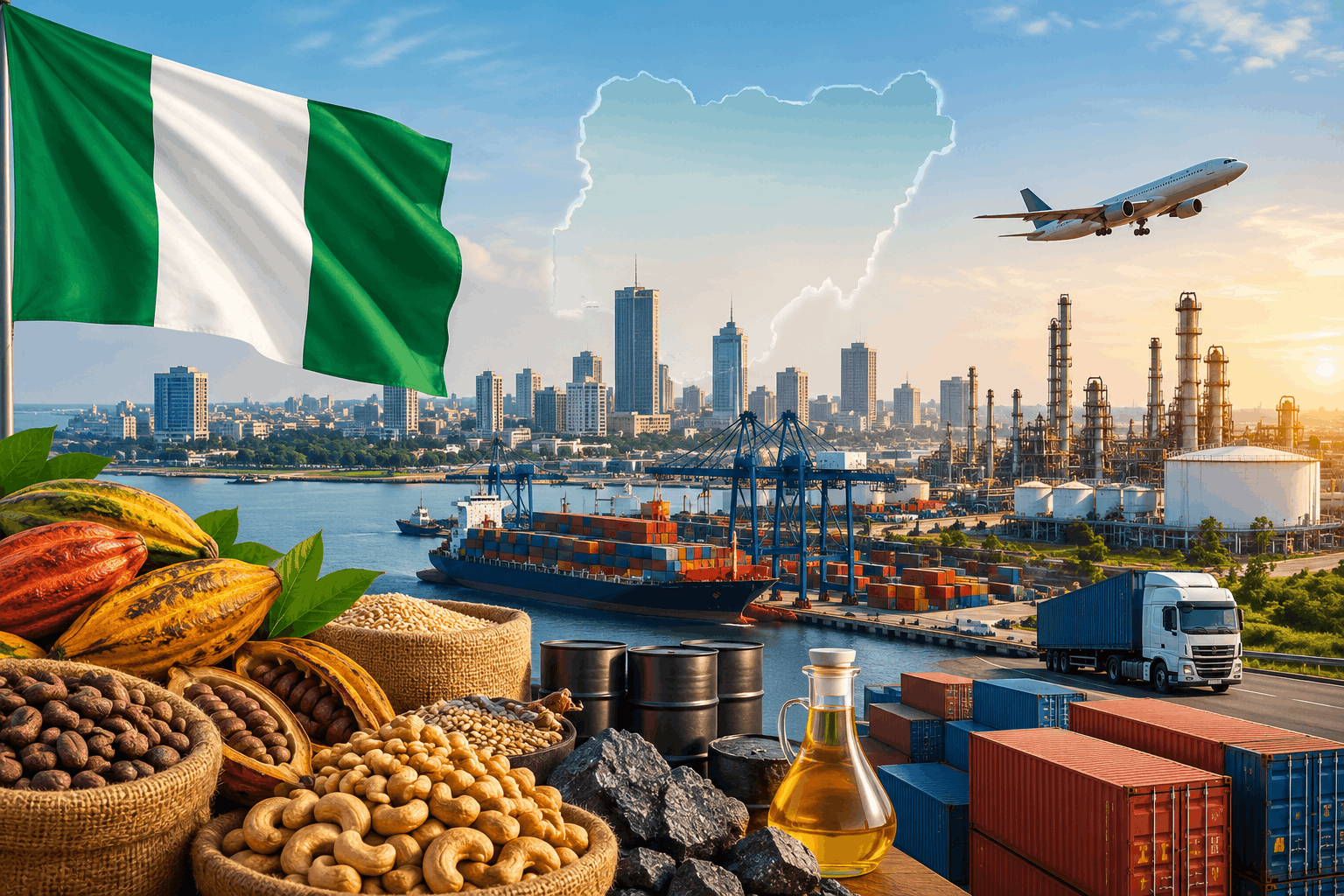
How Nigeria's economy earns and spends: its main exports and imports, trading partners in Africa and beyond, ports and borders, growing sectors and what it takes to do business there.
Togo, Nigeria's fifth-largest customer
In this section
Togo is one of the markets supplied by the Dangote refinery outside Lagos, which reached its full 650,000-barrel-a-day capacity in February 2026.
In the second quarter of 2026, Togo bought more goods from Nigeria than Germany, China or Ghana did.
According to the National Bureau of Statistics, Nigerian exports to Togo were worth ₦1.50 trillion during those three months, making the small coastal country Nigeria's fifth-largest export market in the world, behind India, Spain, the Netherlands and the United States.
The products moving in that direction tell part of the story. Crude oil remains Nigeria's biggest export, but diesel, jet fuel and petrol are now important parts of what Nigeria sells to other African countries. Togo is one of the markets supplied by the Dangote refinery outside Lagos, which reached its full 650,000-barrel-a-day capacity in February 2026.
A few years ago, this would have been a less familiar picture. For decades, Nigeria sold crude oil abroad and imported large quantities of the refined petrol and diesel it consumed at home. The country was exporting the raw material and buying back some of the finished products.
The change in Togo's place on Nigeria's export list is a small sign of a wider story: Nigeria is still heavily dependent on oil for export earnings, but its trade is becoming more varied, with refined petroleum products, fertiliser, manufactured goods and agricultural products moving across African markets.
This is the first country profile in our series, Africa's Markets, Country by Country. It uses the measures explained in How to Read an African Economy to look at what Nigeria produces, what it sells and buys, who it trades with, how its goods move and what a business needs to know before entering the market.
Nigeria is a natural place to start. It has Africa's largest population, is the continent's third-largest economy by nominal GDP, and runs a substantial goods-trade surplus with the rest of Africa.
Nigeria at a glance
In this section
The US$377 billion GDP figure should be read as the IMF's April 2026 World Economic Outlook projection.
The naira figures for trade cover goods only and are reported by the NBS in current naira. They therefore reflect both changes in trade volumes and changes in prices and the exchange rate. Services, such as tourism, transport and money sent home by Nigerians abroad, are not included.
The US$377 billion GDP figure should be read as the IMF's April 2026 World Economic Outlook projection. Different IMF WEO editions have produced different estimates for Nigeria's 2026 nominal GDP as exchange-rate and economic assumptions change.
How the economy is built
In this section
Services are the largest broad sector, while crop production is the largest individual activity.
Nigeria is often described as an oil economy. That description makes sense when looking at exports and foreign-exchange earnings. Inside the country, however, oil represents a much smaller part of the economy.
In the second quarter of 2026, the oil sector accounted for about 4.16% of real GDP, according to the NBS. The rest came from agriculture, trade, telecommunications, property, banking, manufacturing, construction and a long list of other activities.
The July 2025 GDP rebasing, which moved the base year from 2010 to 2019, gave a clearer picture of this structure. On the new 2019 base, services accounted for 53.09%, agriculture 25.83% and industry 21.08% of GDP.
Those percentages describe the economy using the new base year. They should not be read as a breakdown of the ₦372.8 trillion 2024 nominal GDP figure.
The NBS also identified the largest individual economic activities using the 2019 base. Crop production accounted for 17.6% of GDP, wholesale and retail trade 17.4%, real estate 10.8%, telecommunications 6.8%, and crude oil and natural gas 5.9%. The rebasing also increased the measured contribution of informal activity, which the NBS estimated at about 42.5% of GDP.
That distinction between sectors and individual activities matters when looking at Nigeria's economy. Services are the largest broad sector, while crop production is the largest individual activity. Agriculture as a whole is not the country's largest sector by output.
Crop production is spread across millions of farms growing cassava, yams, maize, rice, sorghum and vegetables for local markets, alongside export crops such as cocoa, sesame and cashews. Trade covers everything from large distributors to the markets of Onitsha, Kano and Lagos, which supply goods across Nigeria and into neighbouring countries.
Telecommunications and financial technology have grown rapidly since the 2000s. Payment companies and digital financial services now form an important part of everyday commercial life. Real estate and construction follow the growth of cities, especially Lagos, Abuja and Port Harcourt.
This structure helps explain why Nigeria can be both an oil-dependent exporter and an economy where oil represents only a small share of domestic production.
A fall in oil earnings can put pressure on foreign-exchange availability, government revenue and the naira even while most of the country's shops, farms, factories, banks and service businesses continue operating.
What Nigeria sells
In this section
China, for example, buys products including sesame seeds, malt, tin ores, rubber and goat leather from Nigeria.
Nigeria exported goods worth ₦85.13 trillion in 2025.
The NBS data show a country whose export earnings remain heavily tied to petroleum, even as the range of products leaving its ports expands.
Export group, 2025
Value
Share of exports
Crude oil
₦47.43 trillion
55.7%
Other oil and gas*
₦25.34 trillion
29.8%
Non-oil goods
₦12.36 trillion
14.5%
The "other oil and gas" figure is calculated from the NBS non-crude total and its non-oil products figure rather than being published directly as a separate category.
Crude oil is still Nigeria's single most valuable export. In August 2026, total crude and condensate production was about 1.68 million barrels a day, according to the Nigerian Upstream Petroleum Regulatory Commission.
The OPEC quota needs a little care here. The quota for August was 1.50 million barrels a day of crude excluding condensate. The approximately 1.68 million figure includes condensate, so the two numbers should not be compared as if they measure the same thing. Nigeria's production also remained below the roughly 1.84 million barrels a day assumed in the 2026 budget.
Most Nigerian crude leaves through terminals in and around the Niger Delta, including Bonny, Forcados, Qua Iboe and Escravos, as well as offshore production such as Bonga.
Natural gas is another major source of export income, with liquefied natural gas shipped from the Nigeria LNG plant on Bonny Island.
But crude's dominance in the export basket has been easing.
Crude accounted for 51.17% of exports in the fourth quarter of 2025 and 47.79% in the second quarter of 2026. That does not mean Nigeria stopped depending on oil. It means other exports grew quickly enough to take a larger share.
Other oil-product exports were particularly important. In Q2 2026, the value of crude exports itself was higher than a year earlier, while exports of other oil products rose substantially. Refined petroleum products also became more visible in trade with African markets.
The timing matters. Global oil markets were volatile during Q2, with Brent crude starting the quarter above US$100 a barrel amid the disruption around the Strait of Hormuz. So falling oil prices were not the main reason crude's share declined.
Nigeria's export mix was changing partly because it was selling more products beyond crude.
Non-oil exports
Non-oil exports are smaller but more varied.
Cocoa beans and cocoa products, sesame seeds, cashew nuts, ginger, fertiliser, cement, tin ore, natural rubber and leather all appear in Nigeria's export trade.
China, for example, buys products including sesame seeds, malt, tin ores, rubber and goat leather from Nigeria.
Many Nigerian commodities still leave the country with much of their final value yet to be added. Sesame can be processed into oil, cocoa can become chocolate and other finished products, and leather can become shoes, bags and other manufactured goods.
That is one reason processing remains such an important part of Nigeria's industrial story. The question is not only what Nigeria can produce, but how much of the processing, packaging and manufacturing can happen before the product crosses the border.
What Nigeria buys
In this section
The refinery began production in 2024 and reached its full 650,000-barrel-a-day capacity in February 2026.
Nigeria imported goods worth ₦67.35 trillion in 2025.
Its imports include machinery and equipment for factories, farms, telecommunications networks and power; vehicles and spare parts; food such as wheat and fish; chemicals, plastics and manufacturing inputs; and petroleum products.
China is by far the largest supplier.
In 2025, Nigeria bought ₦19.79 trillion worth of goods from China and sold China about ₦2.78 trillion, leaving a bilateral trade deficit of roughly ₦17 trillion.
Chinese goods entering Nigeria include machinery, telecommunications equipment, motorcycles, plastics, solar equipment and other manufactured products.
The concentration became even clearer in Q2 2026. China supplied 41.02% of Nigeria's imports, ahead of the United States, India, the Netherlands and Germany.
Asia as a whole supplied 59.37% of imports in that quarter.
The refinery changes the fuel equation
For much of the past four decades, Nigeria's domestic refineries operated well below their potential, leaving the country dependent on imported refined petroleum products.
That meant Nigeria could be a major crude-oil producer while importing much of the petrol and diesel used at home.
The removal of the petrol subsidy in May 2023 changed the economics of the domestic fuel market, while the Dangote refinery introduced a new source of large-scale domestic refining.
The refinery began production in 2024 and reached its full 650,000-barrel-a-day capacity in February 2026.
It is also exporting refined products to African markets, including Ghana, Togo and Cameroon.
The change is important beyond the refinery itself. Every barrel refined domestically can alter the country's demand for imported petroleum products, the demand for foreign currency and the flow of refined fuel between Nigeria and its neighbours.
The refinery has also imported crude at times rather than relying entirely on domestic producers, so the domestic refining story does not automatically mean that every part of Nigeria's oil value chain is now supplied locally.
Food imports remain a separate pressure. Wheat, used heavily in bread and noodles, and fish are among the products Nigeria continues to import in significant quantities.
Who Nigeria trades with
In this section
With Europe, India and parts of Africa, Nigeria often runs the opposite pattern, selling more than it buys.
Nigeria's trade with the rest of the world points in several directions at once.
With China, Nigeria buys much more than it sells.
With Europe, India and parts of Africa, Nigeria often runs the opposite pattern, selling more than it buys.
In the fourth quarter of 2025, Europe accounted for 36.24% of Nigeria's exports, with Spain, the Netherlands and other European markets among the major destinations.
India is also a major buyer of Nigerian crude and can rank as Nigeria's largest export destination in individual quarters.
Africa is particularly important from Nigeria's point of view.
In 2025, Nigeria exported ₦13.14 trillion in goods to other African countries and imported ₦2.86 trillion, giving it an African trade surplus of about ₦10.28 trillion.
That means Nigeria sold more than four times as much to the rest of Africa as it bought from the continent.
Nigeria's biggest African markets
In the second quarter of 2026, five African countries accounted for about three quarters of Nigeria's exports to the continent.
African market, Q2 2026
Nigerian exports
Togo
₦1.50 trillion
South Africa
₦1.34 trillion
Côte d'Ivoire
₦1.22 trillion
Ghana
₦461 billion
Egypt
₦456 billion
Togo's position is particularly striking. A country with a population far smaller than Nigeria's became the country's fifth-largest export destination worldwide in that quarter.
The products moving around the region explain some of this trade. Crude remains important, but refined petroleum products are now prominent among Nigeria's sales to African markets.
The Dangote refinery's exports to Ghana, Togo and Cameroon are part of this newer pattern. Togo's port at Lomé also serves as an important gateway to landlocked markets farther north.
Nigeria's African trade is not only about petroleum. Manufactured goods, cement, food products, chemicals and agricultural commodities also cross the region.
The Q2 2026 figures also show how quickly individual markets can change. Trade with ECOWAS partners rose 77.2% from the previous quarter.
These figures cover formal, recorded trade.
A large amount of commerce with Nigeria's neighbours also takes place informally across land borders with Benin, Niger, Chad and Cameroon. Grain, livestock, textiles, used vehicles, rice, fuel and other goods move in both directions, and not all of this activity appears in customs statistics.
Benin has long been an important route for goods entering Nigeria, particularly products affected by Nigerian tariffs, restrictions or import policies.
Trade agreements
In this section
Niger is particularly important to Nigeria because the two countries share roughly 1,600 kilometres of border.
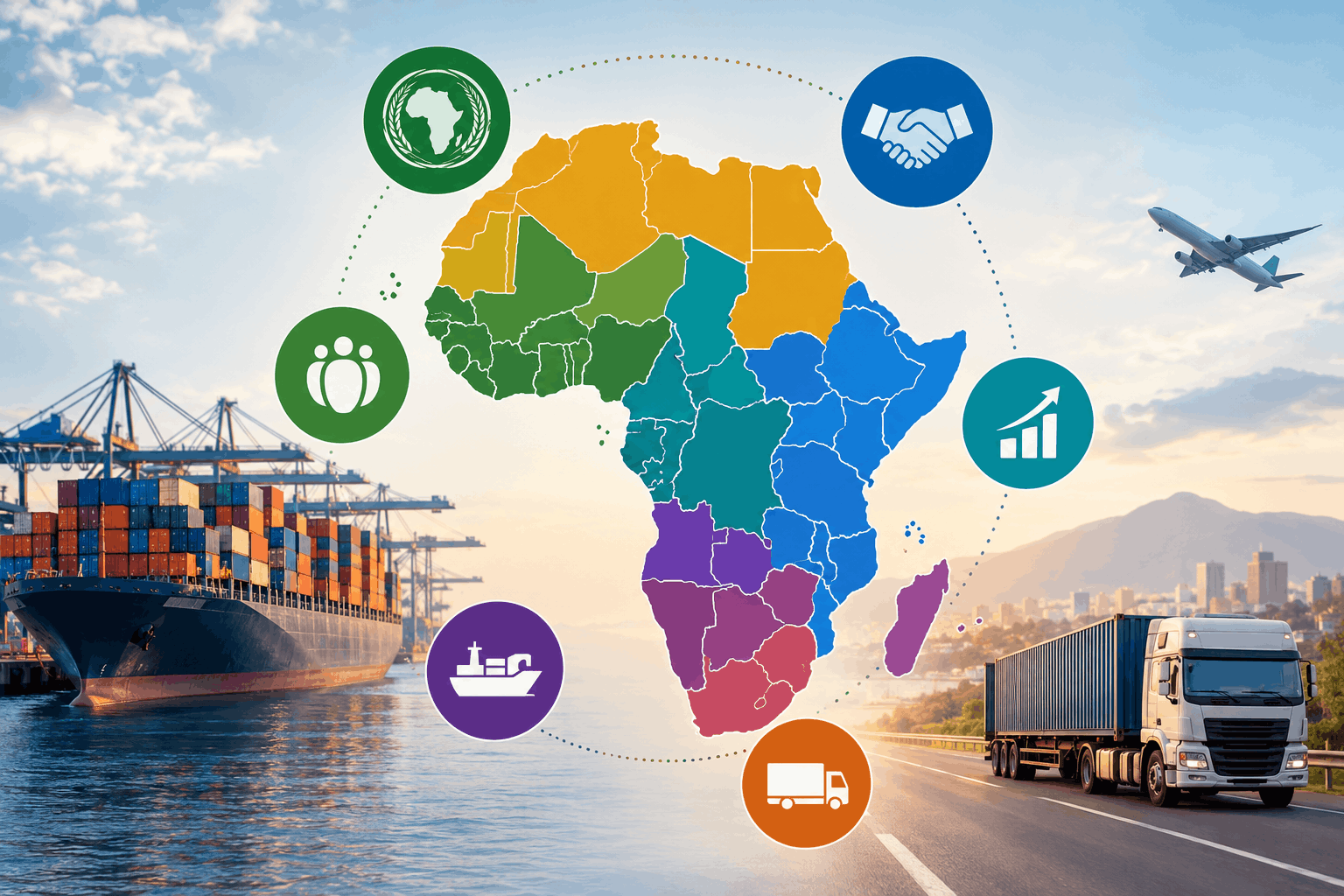
Nigeria is a founding member of ECOWAS, established by the Treaty of Lagos in 1975, and hosts the organisation's headquarters in Abuja.
Under the ECOWAS Trade Liberalization Scheme, goods made in member countries that meet the bloc's rules of origin can move into other member states without import duty. Nigeria also applies the ECOWAS common external tariff to goods from outside the bloc.
For businesses, the rules matter because they can make a product manufactured in one West African country easier to sell in another without treating every border as a completely separate market.
In practice, Nigeria has often balanced regional integration against protecting domestic producers.
The country has used import restrictions and border controls to tackle smuggling. One of the clearest examples was the land-border closure that began in August 2019.
The closure did not end everywhere at the same time.
In December 2020, Nigeria reopened four major crossings: Seme, Illela, Maigatari and Mfun. Other crossings, including Idiroko, Jibia, Kamba and Ikom, remained closed until later, with several not reopening until 2022.
That staggered reopening is important because the episode was not a single closure followed by a single reopening date.
Nigeria, ECOWAS and the Sahel
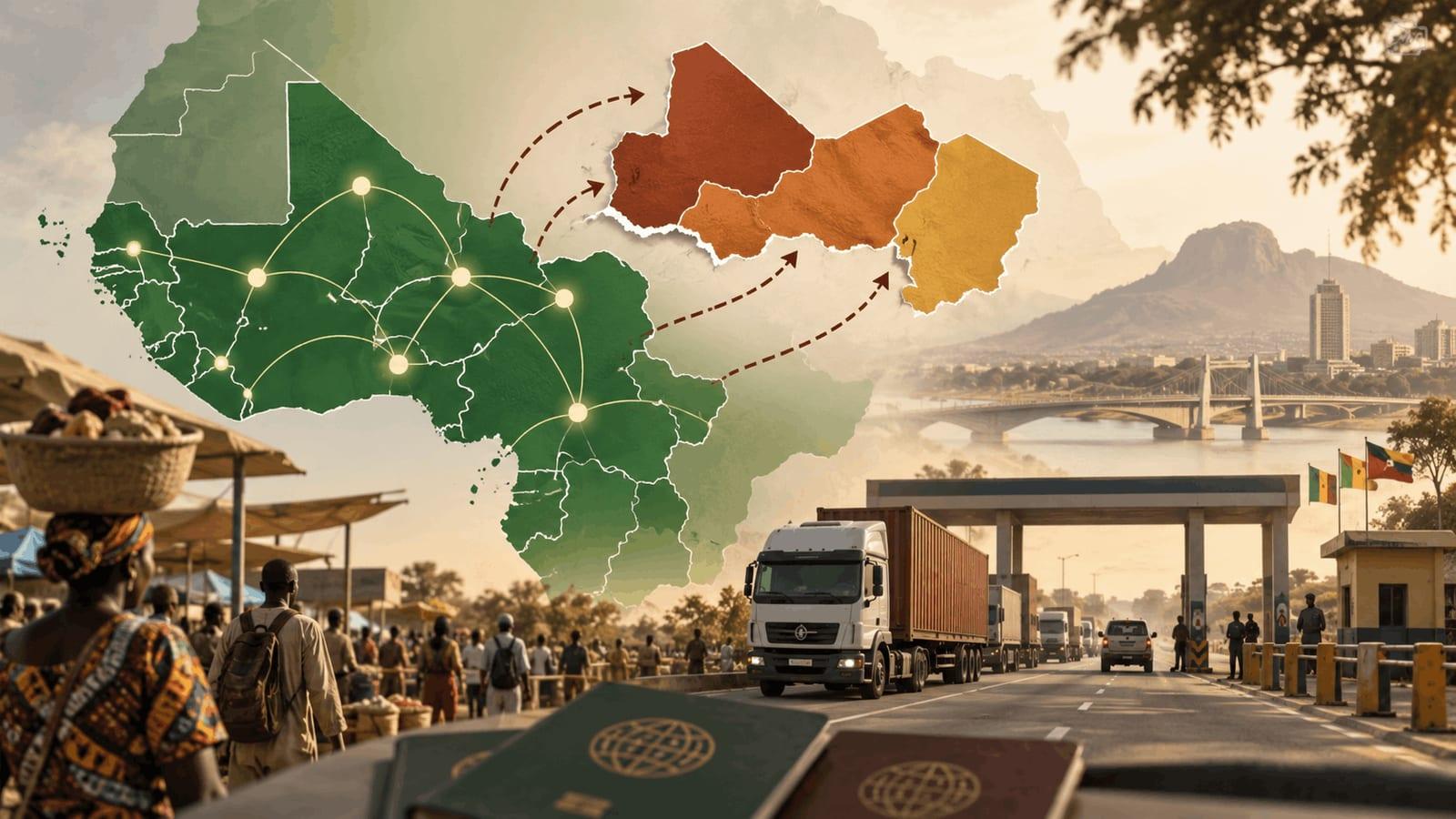
The departure of Burkina Faso, Mali and Niger from ECOWAS in January 2025 changed the trading environment around Nigeria's northern and western borders.
Niger is particularly important to Nigeria because the two countries share roughly 1,600 kilometres of border.
Relations had already been strained after the July 2023 military coup in Niger.
ECOWAS imposed sanctions following the coup, including border restrictions and other measures. Nigeria also cut electricity supplies to Niger as part of the sanctions.
ECOWAS lifted the sanctions on 24 February 2024, and Nigeria reopened its land and air borders with Niger in March.
The border therefore reopened before Burkina Faso, Mali and Niger formally left ECOWAS on 29 January 2025.
After the three countries announced their withdrawal, ECOWAS introduced a transition arrangement under which member states were told to continue allowing goods from the three countries to benefit from existing trade and movement arrangements while the separation was being worked through.
That instruction was a transitional measure rather than a permanent guarantee of the old ECOWAS trading relationship. The longer-term rules governing trade between Nigeria and the three former members therefore need to be assessed separately from the arrangements that applied during the transition.
For businesses, the distinction matters. A border can remain physically open while the tariffs, customs treatment and documentation applied to goods crossing it change.
AfCFTA
Nigeria has also ratified the African Continental Free Trade Area, giving it a framework for trading with African countries outside ECOWAS as well as within the West African market.
Nigeria signed the AfCFTA agreement in 2019 after initially holding back in 2018 while manufacturers, labour groups and other stakeholders raised concerns about competition.
The agreement's practical value for Nigerian companies depends on tariff schedules, rules of origin and implementation. For a manufacturer, having an African free-trade framework is different from having every product automatically qualify for duty-free entry.
Outside Africa, Nigeria does not have broad free-trade agreements with the European Union, China or the United States.
The US relationship also changed in 2026. On 24 July 2026, the United States imposed a 12.5% tariff on Nigerian imports, although crude oil, liquefied natural gas and petroleum products were exempt. The African Growth and Opportunity Act, under which qualifying African exports can receive preferential US access, is scheduled to expire in December 2026 unless extended or replaced.
For Nigerian exporters, access to individual markets therefore needs to be checked product by product rather than assumed from the existence of a broad trading relationship.
How goods move
In this section
Jibia and Illela are important northern crossings towards Niger, while Mfum and Ekok connect Cross River State with Cameroon.
Most of Nigeria's container trade passes through Lagos.
The older port complexes, Apapa and Tin Can Island, sit inside the city and have long struggled with congestion, with trucks often queuing on roads leading to the ports.
The Lekki Deep Sea Port, east of Lagos, began full commercial operations in April 2023 and was built partly to relieve this pressure.
It has a depth of about 16.5 metres and a first-phase capacity of roughly 1.2 million twenty-foot equivalent units (TEUs). A second phase is expected to increase capacity to about 2.5 million TEUs.
The port is part of the wider Lekki economic corridor, close to the Dangote refinery and fertiliser plants and the Lekki Free Zone.
Outside Lagos, Onne port in Rivers State is particularly important to the oil and gas industry and also handles general cargo. Warri, Calabar and Port Harcourt serve regional and specialised cargo needs.
Crude oil leaves Nigeria mainly through offshore and coastal terminals in the Niger Delta.
Once goods enter the country, road transport carries most domestic freight. Nigeria has one of Africa's largest road networks, but poor road conditions, congestion and long distances add substantially to the cost of moving goods.
Rail is returning as an alternative for some routes. Standard-gauge services connect Lagos and Ibadan, Abuja and Kaduna, and Itakpe and Warri. The Lagos-Ibadan line also connects into the wider Lagos port area, although rail still accounts for a relatively small share of Nigeria's freight movement.
For trade with neighbouring countries, Seme is one of the most important crossings. It sits on the Benin border along the Abidjan-Lagos corridor, connecting Nigeria by road to Benin, Togo, Ghana and Côte d'Ivoire.
Jibia and Illela are important northern crossings towards Niger, while Mfum and Ekok connect Cross River State with Cameroon.
Air cargo moves mainly through Murtala Muhammed International Airport in Lagos, with Abuja, Kano and Port Harcourt also serving the market.
For time-sensitive goods such as fresh produce and pharmaceuticals, logistics infrastructure, cold storage and reliable transport remain important constraints.
Sectors with room to grow
In this section
Agriculture is one of Nigeria's largest parts of the economy, while crop production is its largest individual economic activity.
Several parts of Nigeria's economy are attracting investment or have room for further expansion.
Refining, petrochemicals and gas
The Dangote refinery has demonstrated the possibility of large-scale refining in Nigeria, while nearby fertiliser and petrochemical facilities turn oil and gas resources into products that can be consumed locally or exported.
Dangote's longer-term plans include expanding refining capacity beyond the current 650,000 barrels a day.
Nigeria also has Africa's largest proven natural gas reserves. Gas is being promoted for power generation, cooking and transport, while gas-based industries support fertiliser and petrochemical production.
That creates demand for engineering, maintenance, equipment, logistics and other industrial services.
Agro-processing
Agriculture is one of Nigeria's largest parts of the economy, while crop production is its largest individual economic activity.
The sector also has substantial room for processing.
Sesame can be turned into oil, cocoa into butter and powder, cassava into starch and flour, and tomatoes into paste. Processing closer to the point of production can reduce some of the value that currently leaves the country with raw commodities.
Cold storage, packaging, transport and reliable market access remain important gaps.
Nigeria's agricultural economy is also highly fragmented. Large companies have invested in processing, but millions of smaller farms remain central to production.
Digital services and fintech
Lagos is one of Africa's major technology centres.
Nigerian payment and financial technology companies have built services used by businesses and consumers across the country, while telecommunications remain one of the country's most important economic activities.
Demand exists across software, data centres, cloud services, cybersecurity, digital payments and digital skills.
Nigeria's large domestic market also gives technology companies a sizeable customer base before they expand elsewhere in Africa.
Creative industries
Nollywood is one of the world's largest film industries by volume, while Nigerian music has developed a global audience.
Artists such as Burna Boy, Wizkid and Tems have helped push Nigerian music into international markets, alongside the wider growth of fashion, film, content and entertainment.
These industries create demand beyond the creative work itself: studios, equipment, events, streaming, legal services, financial services and intellectual property management all form part of the business around creative production.
Solid minerals
Nigeria has deposits of lithium, gold, tin, limestone, barite and other minerals.
The government is also pushing for more domestic processing rather than exporting minerals in raw form. Lithium processing has attracted particular attention, with several plants established or announced in recent years.
The opportunity is therefore not only in mining. Processing, logistics, equipment, technical services and manufacturing can all become part of a larger minerals value chain.
Manufacturing for regional markets
Nigeria's large domestic market and its position in West Africa make it a natural manufacturing base for products such as cement, food, beverages, pharmaceuticals, plastics, building materials and household goods.
Companies that can produce competitively in Nigeria can potentially serve neighbouring markets as well as domestic customers.
Dangote Cement's operations across several African countries show how Nigerian companies can expand beyond the domestic market.
AfCFTA could widen that opportunity further as implementation develops.
Doing business in Nigeria
In this section
A company with foreign shareholders generally requires issued share capital of at least ₦100 million and must register with the Nigerian Investment Promotion Commission (NIPC).
For a business from elsewhere in Africa or beyond, entering Nigeria involves several layers of registration, immigration, tax and regulatory requirements.
Registering a company
Companies are registered with the Corporate Affairs Commission (CAC), which provides online registration services.
Foreign investors can own 100% of a Nigerian company in most sectors, subject to sector-specific rules.
A company with foreign shareholders generally requires issued share capital of at least ₦100 million and must register with the Nigerian Investment Promotion Commission (NIPC).
Permits for foreign-owned companies and staff
A foreign-owned company operating in Nigeria generally needs a Business Permit from the Federal Ministry of Interior.
Businesses employing foreign workers also need to deal with Expatriate Quota requirements, which specify the positions and number of foreign employees a company is permitted to employ.
Each foreign employee then needs the relevant immigration documentation, including CERPAC, the Combined Expatriate Residence Permit and Aliens Card.
Some sectors are restricted or subject to additional local participation and local-content requirements. A foreign investor therefore needs to check the rules for the specific industry rather than assuming that the general company-registration rules apply everywhere.
Bringing money in and taking profits out
When foreign investors bring capital into Nigeria, their bank issues a Certificate of Capital Importation.
The certificate is important for later repatriation of dividends, profits and eligible loan repayments through the formal foreign-exchange system.
Since the foreign-exchange reforms of 2023, Nigeria has operated a more market-based exchange-rate system than it did under the previous multiple-rate structure.
Currency risk nevertheless remains important. A business earning most of its revenue in naira while paying suppliers or lenders in dollars can see its costs change sharply when the exchange rate moves.
Tax
Nigeria's tax system was overhauled through four tax reform laws signed in 2025, with the new framework taking effect from 1 January 2026.
Under the Nigeria Tax Act, a small company generally means one with turnover of up to ₦100 million and fixed assets of up to ₦250 million. Qualifying small companies are exempt from company income tax, capital gains tax and the development levy.
There is an important qualification: professional services are excluded from the small-company exemption, so a business cannot determine its tax treatment from turnover alone.
For companies outside the small-company category, company income tax remains 30%. A new 4% development levy replaced several previous levies.
The capital gains tax treatment also changed. The company capital gains tax rate rose from the previous 10% rate to 30%.
Very large companies and multinational groups are subject to a 15% minimum effective tax rate, with the relevant thresholds set at ₦50 billion in turnover for companies or €750 million in global revenue for multinational groups, subject to the rules of the new tax framework.
VAT remains an important part of the system, and businesses need to check their specific obligations under the new tax laws and implementing rules.
Cost of money
Borrowing in naira remains expensive.
The Central Bank of Nigeria cut its Monetary Policy Rate from 26.5% to 23% in September 2026.
It was the second rate cut of 2026, following a 50-basis-point cut in February, and the September reduction was the biggest since 2006.
The CBN described the move as a reset, rather than a change in the overall direction of monetary policy.
It is also important not to translate the 350-basis-point MPR reduction directly into a 350-basis-point fall in business borrowing costs. Commercial lending rates depend on banks' funding costs, risk assessments and other market conditions, and the interbank rate had already been around 22%.
Other practical points
Electricity from the national grid remains unreliable in many parts of the country, so businesses often budget for generators, solar systems or other backup power.
Lagos, Abuja and Port Harcourt have deep pools of skilled workers and professional services, but operating costs are also higher in these cities.
Free zones, including the Lekki Free Zone and other zones overseen by the Nigeria Export Processing Zones Authority, can offer tax and customs incentives to qualifying businesses, particularly those producing for export.
Risks and trade-offs
In this section
Unreliable power, congested roads, port delays and long transport distances add to the cost of doing business.
Nigeria's size and economic reforms come with risks that businesses need to understand alongside the opportunities.
Oil still drives the currency
Even when crude falls below half of total exports in an individual quarter, oil and gas remain central to Nigeria's foreign-exchange earnings and government revenue.
A sustained fall in oil prices, a decline in production or disruption in the Niger Delta can reduce the dollars entering the economy and put pressure on the naira.
The stronger reserves recorded in 2026 provide more of a cushion than Nigeria had during earlier periods of pressure, but the country's exposure to oil earnings has not disappeared.
Prices and purchasing power
Inflation has eased substantially from its recent highs.
By August 2026, headline inflation was 15.39%, while food inflation stood at 19.57%.
For businesses selling directly to consumers, the difference between headline inflation and the cost of food and other essentials matters. Households still have to make difficult choices about what they buy, how often they buy it and which products offer the best value.
That affects everything from package sizes and product formats to credit terms and distribution strategies.
Security
Security conditions vary widely across Nigeria.
Insecurity affects parts of the north-east, north-west and north-central regions, while oil theft and other security problems affect parts of the Niger Delta.
For businesses, the consequences can include disruptions to farming and transport, higher insurance and security costs, and restrictions on where staff and goods can move.
A company entering Nigeria therefore needs a location-specific assessment rather than treating the country as a single security environment.
Infrastructure costs
Unreliable power, congested roads, port delays and long transport distances add to the cost of doing business.
A product may be inexpensive to manufacture and still become expensive by the time it reaches a customer hundreds of kilometres away.
This is one reason distribution networks, warehousing and local partnerships can be as important as the product itself.
Policy changes
Nigeria has a history of changes to import restrictions, tariffs, foreign-exchange rules and taxes.
The reforms since 2023 have moved several parts of the economy towards more market-based systems, but businesses still need to monitor announcements from the central bank, customs authorities and tax authorities.
For foreign companies, local legal and regulatory advice is often worth the cost.
Concentration of trade
Nigeria buys heavily from China while its non-oil export base remains comparatively small.
That creates exposure to changes in Chinese supply chains, manufacturing prices and shipping conditions.
At the same time, expanding non-oil exports gives Nigeria a route to reduce the concentration of its export earnings over time.
What this means for an African business
In this section
In 2025, Nigeria exported more than four times as much to the rest of Africa as it imported from the continent.
For a company elsewhere in Africa, Nigeria can be a customer, supplier, competitor or operating base.
Each role comes with a different calculation.
As a market
Nigeria offers a scale few African markets can match.
Its population is the largest on the continent, and demand exists across food, housing, transport, telecommunications, financial services, education and entertainment.
The challenge is purchasing power and distribution.
Income per person is modest, customers are price-conscious and moving products across a country of Nigeria's size can be expensive.
Businesses entering the market therefore need to think carefully about pricing, distribution, local partnerships and currency exposure.
As a supplier
Nigeria is becoming a more important supplier to neighbouring countries.
Refined fuel, fertiliser, cement, processed food and manufactured products now move from Nigerian plants into markets across West Africa.
In 2025, Nigeria exported more than four times as much to the rest of Africa as it imported from the continent.
For businesses in Ghana, Togo, Côte d'Ivoire, Cameroon and other nearby markets, Nigerian suppliers can offer shorter transport routes than suppliers in Asia or Europe.
Where products qualify under ECOWAS rules, regional trade preferences can also reduce import costs.
As a customer
The trade imbalance works in the other direction too.
Nigeria buys relatively little from many African markets compared with the amount it sells to them.
That creates opportunities for African exporters of food, consumer products, machinery, professional services and other goods.
A company does not need to compete with China across the whole Nigerian market to find an opportunity. It may be able to serve a specific customer group, industry or region where an African supplier has a logistical or commercial advantage.
AfCFTA could widen these opportunities as implementation develops.
As a base
Lagos has the companies, investors, lawyers, banks, creative talent and technology businesses needed to support regional operations.
The Lekki port and surrounding free-zone developments also give manufacturers access to deep-water shipping and an increasingly important industrial corridor.
For a business considering Nigeria, the question is therefore less about whether the country matters and more about where the business fits into the market, how it will move goods or services, and how it will manage currency, infrastructure and regulatory costs.
Nigeria is too large to treat as a footnote in an African expansion strategy.
It is also too varied to treat as one market with one set of conditions.
The next profile in the series looks at Ghana, Nigeria's neighbour along the Abidjan-Lagos corridor, whose economy draws heavily on gold, cocoa, oil and services.