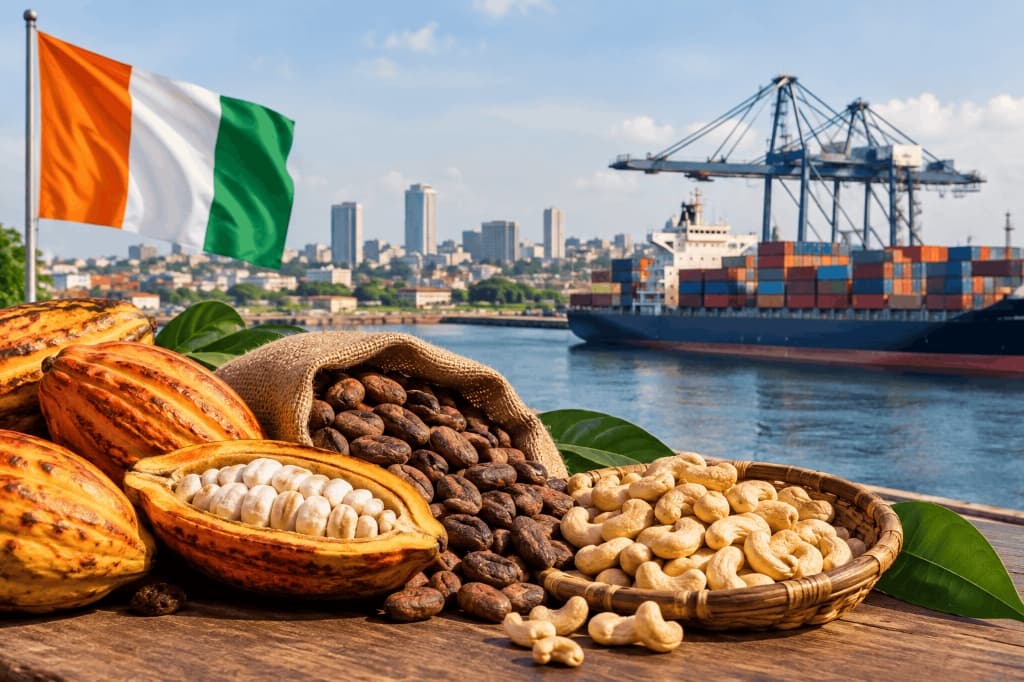
How Côte d'Ivoire earns, spends and trades through cocoa, cashews, rubber, gold and offshore oil, its trading partners, Abidjan port and business opportunities.
From 2,800 francs to 1,200
In this section
The city is also an important centre for banking and business services across French-speaking West Africa.
In October 2025, Côte d'Ivoire set the guaranteed price paid to cocoa farmers for the main harvest at 2,800 CFA francs per kilogram. It was a record price. In March 2026, the government announced a lower price of 1,200 CFA francs per kilogram for the mid-crop harvest. In September, it kept the price at 1,200 CFA francs for the 2026/27 main crop. The government's announcements confirm the three prices.
For a farmer selling one tonne of cocoa, the difference between the two main-crop prices is 1.6 million CFA francs. That is a 57.1% reduction in the guaranteed price per kilogram. It does not mean every farmer's annual income fell by that amount, since earnings also depend on how much cocoa they sell and when they sell it. Still, the price change shows how closely the fortunes of cocoa farmers are tied to international markets.
Côte d'Ivoire is the world's largest cocoa producer. Cocoa beans and processed cocoa products account for a major share of its export earnings, while cocoa farming supports livelihoods across the country's southern and western regions. When international cocoa prices rise or fall, the effects reach farming communities, exporters, processors and the wider economy.
But cocoa is only one part of the country's economy.
Côte d'Ivoire also produces cashews, natural rubber, palm oil, coffee and fruit. It mines gold, refines petroleum products and has begun producing oil and gas from offshore fields. Its industrial and services sectors include food processing, construction, banking, telecommunications, transport and trade.
Abidjan connects many of these activities to international markets. Its port handles goods entering and leaving the country, as well as cargo moving through Côte d'Ivoire to landlocked neighbours. The city is also an important centre for banking and business services across French-speaking West Africa.
This is the eighth country profile in our Africa's Markets, Country by Country series, following our profiles of Nigeria and Ghana. We look at how Côte d'Ivoire earns foreign exchange, what it imports, where its trade goes and what businesses from other African countries should understand before entering the market.
Côte d'Ivoire at a glance
Measure
Figure
Nominal GDP
Approximately US$112.1 billion, 2026 projection
GDP per person
Approximately US$3,310, 2026 projection
Real GDP growth
6.5% in 2025; 6.1% projected for 2026
Inflation
Approximately 0% in 2025; 3.3% projected for 2026
Public debt
57.1% of GDP in 2025
Fiscal deficit
3.0% of GDP in 2025
Goods exports
Approximately US$29.4 billion in 2025, according to UN Comtrade data reported by Trading Economics
Main export markets
Netherlands, Switzerland, Mali, Vietnam and the United States, depending on the trade dataset and reporting period
Currency
West African CFA franc, pegged to the euro at CFAF 655.957 per euro
Regional groupings
WAEMU, ECOWAS and AfCFTA
The IMF's April 2026 World Economic Outlook provides the GDP projections, while its June 2026 review covers growth, inflation, public debt and the fiscal position. These figures describe estimates and projections, not final results for the full 2026 calendar year.
How the economy is built
In this section
Côte d'Ivoire has petroleum refining, gold mining, food and beverage production, cement manufacturing and construction.
Agriculture remains central to Côte d'Ivoire's economy. The country grows cocoa, cashews, natural rubber, palm oil, coffee, cotton, bananas, pineapples and other crops. These products support farming livelihoods, domestic processing industries and export earnings.
Agriculture also supplies raw materials to factories. Cocoa beans can be turned into cocoa butter, powder and chocolate ingredients. Cashews can be processed into kernels for food markets. Rubber supplies manufacturers of tyres and other rubber products. Processing more of these products locally allows businesses to sell goods at different stages of production rather than relying entirely on raw commodity exports.
Industry extends beyond agriculture. Côte d'Ivoire has petroleum refining, gold mining, food and beverage production, cement manufacturing and construction. Investment in roads, bridges, housing, energy and ports supports demand for building materials, equipment, engineering and transport services.
Services account for a substantial part of economic activity. Abidjan has banks, insurance companies, telecommunications providers, logistics businesses and professional services firms serving local customers and regional markets. The city also hosts the African Development Bank and the headquarters of the West African Economic and Monetary Union's regional stock exchange, the BRVM.
Côte d'Ivoire's economy has changed considerably since independence. Cocoa and coffee helped drive strong economic performance in the 1960s and 1970s. Economic difficulties and political instability followed, including a period of conflict that continued into the early 2010s. Since 2012, growth has been supported by infrastructure investment, expanding private-sector activity, agriculture, mining and services.
The country has continued to grow despite pressures that include commodity-price fluctuations, infrastructure needs and security risks in some northern border areas. The IMF estimated growth at 6.5% in 2025 and projected 6.1% for 2026. It also reported a fiscal deficit of 3% of GDP and public debt of 57.1% of GDP in 2025.
These figures suggest a growing economy, but growth does not tell the whole story. Businesses still need to consider the cost of finance, transport, imported inputs, regulatory procedures and the purchasing power of their target customers.
The CFA franc and the euro peg
Côte d'Ivoire uses the West African CFA franc, known as the XOF. The currency is shared by eight countries in the West African Economic and Monetary Union, or WAEMU. Its exchange rate is fixed at 655.957 CFA francs to one euro.
The peg limits exchange-rate movements against the euro, which can make pricing and payments more predictable for businesses trading with European partners. It does not remove every financial risk. A company can still face changes in the value of the CFA franc against the US dollar, shifts in the cost of imported goods, banking fees and delays in cross-border transfers.
Côte d'Ivoire also does not set monetary policy independently of the other WAEMU members. The regional central bank, BCEAO, sets policy for the monetary union.
For a business considering Côte d'Ivoire, the shared currency can be useful, particularly when operating across several WAEMU countries. The company still needs to understand local banking procedures, taxes and the rules governing payments outside the monetary union.
Politics and economic continuity
Alassane Ouattara won the October 2025 presidential election with 89.77% of votes cast, according to the Constitutional Council. Turnout was approximately 50.1%. The main opposition figures Laurent Gbagbo and Tidjane Thiam were excluded from the ballot, making the political environment and the question of succession ahead of 2030 important considerations.
The election did not produce the large-scale violence associated with the 2010–2011 crisis. However, the exclusion of prominent opposition figures and questions about the next transfer of power remain relevant to assessments of political inclusion and longer-term stability.
For businesses, political continuity can support the planning of infrastructure projects and investment. It does not remove the need to monitor regulatory changes, public spending, security conditions and the wider political environment.
What Côte d'Ivoire sells
In this section
The country has also reported the Calao South gas and condensate discovery, announced by Eni in February 2026.
Côte d'Ivoire's exports include agricultural commodities, processed food ingredients, petroleum products, gold and manufactured goods. Cocoa remains the most prominent export, but the other sectors are important to understanding how the country earns money and where businesses can find customers.
Cocoa and cocoa processing
Côte d'Ivoire is the world's leading cocoa producer. Cocoa beans are exported to international buyers, while local factories process part of the harvest into cocoa butter, cocoa paste and powder. These ingredients supply chocolate makers and food manufacturers.
Companies operating in the country's cocoa-processing industry include international groups such as Cargill, Barry Callebaut and Olam, alongside Ivorian businesses. Local processing gives Côte d'Ivoire a share of the value created after the beans leave the farm, although the benefits depend on processing costs, investment, access to markets and the prices manufacturers can obtain.
The government wants more cocoa to be processed domestically. Its September 2026 announcement set a target of processing 43% to 50% of cocoa locally by 2030. Côte d'Ivoire's government has identified local processing as part of its plans for the sector.
The industry faces several pressures. Cocoa trees age, swollen shoot disease damages plantations, and weather conditions affect harvests. Producers must also respond to changing international prices and stricter requirements from some overseas buyers.
The European Union's deforestation regulation adds another compliance requirement. Businesses covered by the rules must be able to demonstrate that relevant products, including cocoa, meet the applicable requirements concerning deforestation and forest degradation. Large and medium-sized operators are scheduled to fall under the rules from 30 December 2026, with a later application date for most micro and small operators. Exporters supplying European customers need to establish which rules apply to their products and buyers.
Cashews
Cashews have become another major agricultural export. Côte d'Ivoire is one of the world's leading producers of raw cashew nuts, which are grown mainly in the centre and north of the country.
For years, much of the harvest was exported in its raw form for processing elsewhere, particularly in Vietnam and India. The government has encouraged local processing, and domestic factories now turn more of the harvest into kernels for food manufacturers and retailers.
Processing creates demand for equipment, packaging, storage, transport, finance and quality-control services. It also requires reliable supplies of raw nuts, trained workers and access to buyers. Businesses considering the sector need to examine the economics of processing locally rather than assume that keeping more production in the country automatically makes a factory profitable.
Rubber, palm oil, coffee and fruit
Natural rubber is another important export. Côte d'Ivoire has expanded production significantly over the past decade, supplying international markets and supporting local businesses involved in collection, processing and transport.
The country also produces palm oil, coffee, cotton, bananas, pineapples and mangoes. These sectors connect farming to food processing, packaging, cold storage, shipping and distribution. Their commercial prospects vary by product, season and destination market.
For companies outside agriculture, the supply chains around these crops can be just as relevant as the crops themselves. Farmers and processors need access to finance, equipment, transport, storage and reliable buyers. Each of those needs creates a possible market for businesses that can provide the service at a competitive price.
Oil and refined petroleum products
Côte d'Ivoire's oil and gas industry has gained attention through the offshore Baleine field, discovered by Eni in 2021. Production began in 2023, and subsequent development phases have increased the field's capacity.
In May 2026, Eni confirmed a final investment decision for Baleine Phase 3. The expansion is designed to raise the field's output to approximately 150,000 barrels of oil per day and 200 million cubic feet of gas per day. Those figures describe the planned capacity after expansion, not the field's current production.
The country has also reported the Calao South gas and condensate discovery, announced by Eni in February 2026. New discoveries could support future production, but their economic contribution will depend on development costs, commercial viability, infrastructure and the timing of production.
Côte d'Ivoire also has a petroleum refinery in Abidjan. Refined fuels supply domestic demand and regional markets, including landlocked countries that rely on coastal ports and road networks to receive imported fuel.
Oil production can increase export earnings and supply gas for electricity generation. However, new projects require substantial investment, and their contribution to public revenue depends on production, prices, costs and the fiscal arrangements governing each project.
Gold mining has expanded over the past decade, with mines operating in several parts of the country. Gold contributes to exports, investment and government revenue. The sector also creates demand for machinery, engineering, power, transport and specialist services.
Côte d'Ivoire has deposits of manganese and other minerals, including nickel and lithium resources that may support further development. Deposits alone do not guarantee commercially viable mines. Companies must assess the quality and size of the resource, infrastructure, financing, environmental requirements and the time needed to bring a project into production.
The government introduced a flat 8% gold royalty in 2025, replacing the previous system of rates ranging from 3% to 6% under different arrangements. Changes in royalties and other fiscal rules affect the costs of mining projects and should be included in investment calculations.
Exports to neighbouring countries
Côte d'Ivoire also sells goods within West Africa. Refined fuel, electricity, cement, processed foods, beverages, plastics and other manufactured products move to neighbouring markets.
Mali and Burkina Faso are particularly important because both are landlocked and use regional transport corridors to reach seaports. Businesses in these countries buy goods from Ivorian suppliers, while their imports and exports also create demand for port handling, trucking, warehousing and customs services.
Regional trade gives Ivorian manufacturers a market beyond the domestic population. However, the opportunity depends on the product, the cost of transport, border procedures, payment arrangements and the competition from suppliers in other countries.
What Côte d'Ivoire buys and who it trades with
In this section
Food imports help meet domestic demand, although the country also produces a range of agricultural goods.
Côte d'Ivoire imports machinery, vehicles, industrial equipment, chemicals, fertiliser, pharmaceuticals, steel and consumer goods. It also buys food products, including rice, wheat and fish, from international suppliers.
Imports serve different purposes. Machinery and equipment support investment in construction, energy, mining and manufacturing. Fuel and other industrial inputs supply businesses that cannot meet all their needs locally. Food imports help meet domestic demand, although the country also produces a range of agricultural goods.
The country's 2025 goods exports were estimated at approximately US$29.4 billion in UN Comtrade data reported by Trading Economics. The reported leading export destinations included Switzerland, the Netherlands, Mali, Vietnam and the United States. These rankings depend on the reporting dataset, and the country recorded as the destination is not necessarily the final consumer of every product.
Switzerland and the Netherlands are important destinations for Ivorian exports, including commodities and cocoa products. Mali is a significant regional market, while Vietnam is an important destination for raw cashews. To establish the exact value of each commodity moving to each market, the trade figures need to be examined by product code as well as destination.
On the import side, China, Nigeria, France and India are among the country's major suppliers. The mix reflects demand for machinery, industrial inputs, fuel, food and consumer products.
Nigeria's role is particularly relevant to regional trade in petroleum and other goods. France remains an important European trading partner, while China supplies a wide range of manufactured products and equipment.
For businesses, the trade figures are a starting point for market research. A large export market does not automatically represent an easy opportunity for a new supplier. Companies still need to determine who buys the product, what specifications buyers require, how goods reach them and whether the selling price covers production, shipping, duties and other costs.
Trade agreements and how goods move
In this section
Côte d'Ivoire also has an interim Economic Partnership Agreement with the European Union, applied since 2016.
Côte d'Ivoire belongs to several regional and international trade arrangements. These agreements can reduce barriers and create opportunities for businesses, but the conditions differ by market and product.
WAEMU and ECOWAS
The West African Economic and Monetary Union, or WAEMU, brings together eight countries that share the CFA franc and a regional economic framework. Its members are Benin, Burkina Faso, Côte d'Ivoire, Guinea-Bissau, Mali, Niger, Senegal and Togo.
WAEMU's customs arrangements provide preferential treatment for eligible goods traded within the union. Companies still need to satisfy the relevant origin, product and customs requirements.
Côte d'Ivoire is also a member of the Economic Community of West African States, or ECOWAS. Mali and Burkina Faso formally left ECOWAS in January 2025, alongside Niger. All three remain members of WAEMU, although the future terms of their relations with ECOWAS and the application of regional trade arrangements require attention.
Businesses should not assume that a product qualifies for duty-free treatment simply because it is moving between West African countries. The applicable agreement, rules of origin, customs classification and any transitional measures need to be checked for the particular transaction.
AfCFTA, the European Union and the United States
Côte d'Ivoire has ratified the African Continental Free Trade Area agreement, known as AfCFTA. The agreement aims to expand trade between African countries by reducing tariffs on qualifying goods and addressing other barriers to trade. Implementation takes place through agreed schedules, rules of origin and national customs procedures.
For businesses, AfCFTA creates a framework for expanding into other African markets. It does not mean that every product can already cross every African border without duties or administrative requirements. Companies need to confirm whether their product is covered by the relevant tariff concessions and whether they meet the origin requirements.
Côte d'Ivoire also has an interim Economic Partnership Agreement with the European Union, applied since 2016. It provides preferential access for qualifying Ivorian goods under the agreement's terms. Exporters must still meet product-specific requirements, including rules on origin, safety, quality and traceability where applicable.
In the United States, Côte d'Ivoire has been eligible for benefits under the African Growth and Opportunity Act, or AGOA, subject to the programme's eligibility rules. The programme was extended in September 2026 through 2028. Exporters should confirm that their products qualify and that the applicable country and product requirements are met.
These arrangements can improve market access, but they do not replace commercial preparation. A business needs to check the relevant tariff, rules of origin, certificates, customs process and buyer requirements before quoting a price or promising a delivery date.
Abidjan port
In this section
Abidjan competes with other West African ports, including Tema, Lomé and Dakar, for cargo moving to inland markets.
The Autonomous Port of Abidjan is a major gateway for Côte d'Ivoire's international trade. It handles imports for domestic businesses, exports from local producers and cargo moving through the country to landlocked neighbours.
The port handled 40.1 million tonnes in 2024 and 46.6 million tonnes in 2025, according to published port statistics. The 2025 total represented an increase of approximately 16.1% over the previous year. The port authority published the 2025 results in February 2026.
The port's facilities include container terminals and specialised areas for different types of cargo. The second container terminal, which opened in 2022, expanded the port's capacity to handle containers.
Abidjan competes with other West African ports, including Tema, Lomé and Dakar, for cargo moving to inland markets. The choice of port depends on the destination, shipping route, freight rates, customs procedures and the cost and reliability of inland transport.
The port's growth does not mean that all neighbouring countries depend on it to the same extent. In 2025, transit cargo moving through Abidjan to Burkina Faso and Mali amounted to approximately 3.92 million tonnes combined, according to the Côte d'Ivoire Trade Information and Promotion portal. The figures illustrate the importance of the inland corridors without suggesting that most of either country's trade passes through Abidjan.
For importers and exporters, port capacity is only one part of the calculation. Trucking availability, road conditions, border delays, warehousing and the cost of moving goods from the port to their final destination can all affect the final price.
San-Pédro port
San-Pédro, in south-western Côte d'Ivoire, is another important port, particularly for cocoa and other agricultural exports. It also handles imports and is developing its role in the movement of other commodities.
The two ports serve different needs. Abidjan handles most of the country's container traffic, while San-Pédro has historically been closely associated with cocoa exports. Businesses should compare their location, cargo type, shipping routes and inland transport costs before deciding which port to use.
Rail and roads
Road transport carries much of the freight moving between Côte d'Ivoire and its landlocked neighbours. The Abidjan–Ouagadougou railway also connects Côte d'Ivoire with Burkina Faso and provides a route for freight between the two countries.
Infrastructure improvements can reduce transport costs and improve the movement of goods, but planned upgrades should not be treated as completed projects. Businesses should check current routes, service availability, border procedures and delivery times before building a supply chain around a particular corridor.
Côte d'Ivoire is also connected to the coastal Abidjan–Lagos corridor, which links markets along the Gulf of Guinea. These connections can support regional distribution, although congestion, road conditions and border processes affect how efficiently goods move.
Sectors with room to grow
In this section
Further processing within Côte d'Ivoire could also create demand for industrial inputs and technical expertise.
Côte d'Ivoire's existing industries point to several areas businesses can investigate. The opportunities differ by company size, expertise and access to finance, so the following sectors should be treated as areas for market research rather than guarantees of profit.
Cocoa and cashew processing
The government wants a larger share of cocoa and cashews to be processed locally. That creates possible demand for machinery, packaging, quality testing, storage, transport, maintenance and business finance.
A company does not necessarily need to own a processing plant to participate in these supply chains. It could supply equipment, help processors meet buyer specifications, provide logistics or connect producers with customers. The viability of each opportunity depends on the scale of demand and the costs of serving it.
Oil and gas services
The expansion of Baleine and further exploration activity could create demand for engineering, equipment, maintenance, logistics and specialist services. Gas production can also support electricity generation and industrial activity.
However, oil and gas projects have long development timelines and demanding technical and regulatory requirements. Companies interested in supplying the sector need to establish the qualifications, safety standards, local-participation rules and procurement procedures required by operators and contractors.
Mining and mineral processing
Gold and other mineral projects may create opportunities in equipment supply, engineering, transport, energy and supporting services. Further processing within Côte d'Ivoire could also create demand for industrial inputs and technical expertise.
Before entering this market, businesses should assess the specific project, the operator's procurement process, applicable licences, environmental requirements and the financial strength of potential customers.
Power and infrastructure
Côte d'Ivoire has invested in electricity generation and transmission and exports electricity to several neighbouring countries. Further investment in gas, hydroelectricity and solar power could support businesses that need reliable energy and create demand for equipment, construction and maintenance services.
The government's 2026–2030 national development plan is valued at approximately CFAF 114.8 trillion, equivalent to roughly US$209 billion using the relevant conversion rate. The plan anticipates that around 70% of financing will come from the private sector. These figures describe the planned scale and financing mix of the programme, not money already raised or contracts already awarded.
Companies interested in infrastructure should identify specific funded projects, procurement notices and qualified local partners. A national spending plan can indicate the government's priorities, but it does not establish that a particular contract is available.
Logistics and regional business services
Abidjan's port, road connections and concentration of financial and professional services make logistics and regional business support worth investigating.
Demand may exist for freight forwarding, warehousing, inventory management, customs support, insurance, accounting, technology and distribution services. Companies can also assess whether Abidjan is a suitable base for serving customers in other French-speaking West African markets.
The decision depends on the intended customer base, the cost of operating in Abidjan, the availability of staff and the requirements for doing business in each target country.
Doing business in Côte d'Ivoire
In this section
The time required depends on the business structure, the documents involved and any sector-specific approvals.
Côte d'Ivoire offers access to a substantial domestic market and regional trading connections. However, businesses entering the country need to understand its registration procedures, legal framework, tax obligations, land rules and requirements for moving money.
Registering a company
CEPICI, Côte d'Ivoire's investment promotion agency, provides a one-stop service for investors and supports company-creation procedures. The process can involve commercial registration, tax registration and social security formalities.
The time required depends on the business structure, the documents involved and any sector-specific approvals. Before committing to a launch date, confirm the current procedure and documentation directly with CEPICI.
Côte d'Ivoire is also a member of OHADA, the Organisation for the Harmonisation of Business Law in Africa. OHADA provides common business-law frameworks across its member states, covering areas such as commercial companies, accounting, security interests and debt recovery. This can help businesses operating in more than one member country, although local regulatory requirements still apply.
Foreign ownership and investment incentives
Foreign investors can participate in many sectors of the Ivorian economy. The conditions depend on the activity, the company's structure and any applicable sector-specific restrictions or approvals.
The Investment Code provides incentives for qualifying investments in areas such as agriculture, industry, tourism, health, education and housing. Eligibility depends on the project and the applicable rules. Businesses should obtain current guidance from CEPICI and the relevant authorities before including tax exemptions or credits in their financial forecasts.
Do not assume that an incentive will be granted automatically or that every sector has the same requirements. Confirm the application process, approval conditions and duration of any benefit in writing.
Land and property
Land is an area where investors need specific legal advice. Côte d'Ivoire has different rules governing rural land, urban property, leases, concessions and land titles. The rights available to a foreign investor depend on the type of land and the legal arrangement involved.
Before paying for land or committing to a construction project, verify ownership, the status of the title, permitted use, registration requirements and any restrictions that apply to the proposed transaction. A local lawyer familiar with Ivorian land law can help establish whether the proposed arrangement provides the rights the business needs.
Currency and moving money
The CFA franc's peg to the euro can make transactions with euro-area partners more predictable. Transfers outside the WAEMU zone are subject to applicable foreign-exchange rules and banking procedures.
Businesses should discuss payment documentation, transfer timelines, currency conversion, bank charges and profit-repatriation procedures with an authorised bank before investing. The euro peg does not remove currency risk against other currencies, and cross-border payments can still require supporting documents and regulatory checks.
Taxes and compliance
Companies need to establish which corporate income tax, value-added tax, payroll, customs and sector-specific obligations apply to their activities. Rates, exemptions and filing requirements can differ according to the transaction and the business.
Rather than relying on a single headline tax rate, obtain current guidance from the Ivorian tax authority or a qualified local tax adviser. This is particularly important for businesses importing equipment, exporting goods, operating across borders or applying for investment incentives.
Côte d'Ivoire was on the Financial Action Task Force's increased-monitoring list in 2026. This designation can lead to closer scrutiny of some financial transactions, but it does not mean that every payment will be delayed. Businesses should maintain accurate company, ownership, invoice and payment records and ask their banks about any additional documentation required.
Risks and trade-offs
In this section
Company registration, permits, tax matters, customs clearance and land transactions can involve multiple authorities.
Côte d'Ivoire's growth and regional connections come with risks that businesses need to assess before entering the market.
Commodity prices can change quickly. Cocoa illustrates the problem. A fall in international prices can affect farmer incomes, export receipts and spending in cocoa-producing communities. Other commodity sectors face their own price cycles, so a business dependent on one product or one buyer should test its finances against lower prices and weaker demand.
Export rules can increase costs. European buyers may require traceability, documentation and proof that products meet environmental and quality standards. For cocoa, rubber and other covered commodities, businesses must establish which deforestation-regulation requirements apply and when they take effect. Compliance may require better farm records, supplier checks and changes to purchasing systems.
Large projects take time. Oil, gas, mining and infrastructure projects can create opportunities for suppliers, but investment decisions, approvals and construction schedules can change. Companies should distinguish announced projects from financed projects and awarded contracts.
Administrative procedures require preparation. Company registration, permits, tax matters, customs clearance and land transactions can involve multiple authorities. Incomplete documents or uncertainty about requirements can add time and cost.
Political and security conditions matter. The 2030 succession question remains relevant, while parts of the northern border region face security risks associated with armed groups operating in the Sahel. Businesses should assess security conditions for their actual locations and transport routes rather than treating the country as uniformly risky or uniformly safe.
Regional access has conditions. Membership in WAEMU, ECOWAS and AfCFTA can support trade, but tariff preferences and customs treatment depend on the applicable rules. Companies should confirm the position for their specific products and routes before relying on preferential access in a pricing decision.
What this means for an African business
In this section
Côte d'Ivoire is worth examining as a market in its own right, not just as a route into other countries.
Côte d'Ivoire has a growing economy, a population of roughly 34 million and a commercial centre in Abidjan that connects domestic businesses with regional and international markets. For companies elsewhere in Africa, three areas are worth investigating.
The first is regional distribution. Abidjan's port and business services can make it a useful base for reaching customers in Côte d'Ivoire and, where the commercial case supports it, other West African markets. A company should compare transport costs, customer locations, customs procedures and local operating expenses before deciding to establish a regional base there.
The second is agricultural value chains. Cocoa, cashews, rubber, palm oil and fruit support demand for processing, packaging, storage, transport, equipment and finance. Businesses can assess opportunities at different points in these supply chains, from working with producers to supplying factories and connecting them with buyers.
The third is the supply of goods and services to investment projects. Construction, energy, mining, manufacturing and logistics may need equipment, engineering, maintenance and specialist services. The strongest opportunities will be those where a company can demonstrate relevant experience, meet local requirements and compete on price, quality and reliability.
Before entering the market, a business should identify its target customers, check the regulations that apply to its sector, calculate the cost of delivering its product and verify the route to market. It should also establish how customers pay, who the competitors are and whether a local partner is needed.
French is the main language of government and business, so companies that do not operate in French may need French-speaking employees, advisers or commercial partners. That preparation can help reduce misunderstandings during negotiations and when dealing with public authorities.
Côte d'Ivoire is worth examining as a market in its own right, not just as a route into other countries. Its domestic demand, agricultural industries, manufacturing activity and services sector each offer different possibilities. The right opportunity depends on what a company sells, whom it serves and whether it can operate competitively under local conditions.
The next profile in our Africa's Markets, Country by Country series is Senegal, another WAEMU member whose economy is developing through agriculture, services and new oil and gas production.
Sources
IMF: Côte d'Ivoire's 2026 economic review, for GDP growth, inflation, public debt and fiscal performance.
Côte d'Ivoire government: 2026/27 cocoa farmgate price, for the official cocoa price and local-processing target.
International Cocoa Organization: Annual Report 2024/2025, for cocoa production estimates and global market conditions.
Abidjan Port Authority: 2025 traffic results, for port traffic figures.
Côte d'Ivoire Trade Information and Promotion portal, for trade and logistics data.
European Commission: EU deforestation regulation, for compliance requirements and implementation dates.
Eni, for the Baleine Phase 3 investment decision and planned production capacity.