Discover how Sierra Leone earns and trades through iron ore, diamonds, rutile, agriculture and fisheries, and what businesses need to know about its economy.
Iron ore, not diamonds
In this section
The country also produces rutile, a mineral used to make titanium dioxide, which is used in paints, plastics and paper.
When people think about Sierra Leone's exports, diamonds are often the first thing that comes to mind. The country became internationally known for its diamonds, particularly during the civil war, when the illegal diamond trade helped finance the conflict.
Today, however, iron ore brings in much more export income than diamonds.
Sierra Leone exported US$1.3 billion worth of minerals in 2025, according to its Ministry of Mines and Mineral Resources. The ministry also reported mineral production of about 12 million tonnes. Iron ore was the main contributor, although the ministry's published summary does not provide a full breakdown of the year's mineral exports by commodity.
The country also produces rutile, a mineral used to make titanium dioxide, which is used in paints, plastics and paper. Diamonds, gold and bauxite are other important minerals. Sierra Leone was the world's third-largest rutile producer in 2024, according to the United States Geological Survey (USGS).
Mining brings in much of the country's export income, but it does not employ most Sierra Leoneans. Agriculture supports the livelihoods of a large part of the population, while fishing, trade, construction, transport and other services also contribute to economic activity.
The country has considerable natural resources, but many people still live with low incomes. Sierra Leone's economy is projected to reach about US$8.52 billion in 2026, with GDP per person estimated at approximately US$946, according to the IMF's October 2026 World Economic Outlook.
This is the sixteenth profile in our series, Africa's Markets, Country by Country, following Togo. Sierra Leone has a population of approximately 8.8 million, a major natural harbour at Freetown, fertile agricultural land and fishing grounds along its Atlantic coast.
Its economy grew by an estimated 5% in 2025, according to the IMF's June 2026 assessment. Growth is projected to slow to 4% in 2026. The country is also a member of ECOWAS and the Mano River Union, giving businesses access to regional trade relationships.
Sierra Leone at a glance
Measure
Figure
Nominal GDP
US$7.46 billion in 2025, World Bank
Nominal GDP
US$8.52 billion projected for 2026, IMF
GDP per person
US$946 projected for 2026, IMF
Real GDP growth
5% in 2025, preliminary IMF estimate
2026 growth forecast
4%, IMF June 2026 assessment
Inflation
15.66% in August 2026
Monetary policy rate
17.25%, Bank of Sierra Leone's published rate
Mineral exports
US$1.3 billion in 2025
Minerals' share of merchandise exports
76.8% in 2024
Population
Approximately 8.82 million in 2025
Currency
Sierra Leonean leone (SLE), redenominated in 2022
Trade groups
ECOWAS, Mano River Union and AfCFTA
Figures refer to different reporting periods and should not be treated as measurements from the same year. The GDP figures are nominal values, not measures of how much money the average person earns.
How the economy is built
In this section
Services include trade, transport, telecommunications, construction, banking, tourism and government activities.
Sierra Leone's economy has three major parts: agriculture, mining and services.
Agriculture supports a large share of the population. Farmers grow rice, cassava, cocoa, coffee, palm oil and other crops. Fishing is also important because the country has a long Atlantic coastline and productive marine waters.
Mining plays a different role. It generates a large share of export earnings and contributes to government revenue through taxes, royalties and other payments. Iron ore, diamonds, rutile, gold and bauxite are among the minerals produced in the country.
Services include trade, transport, telecommunications, construction, banking, tourism and government activities. Much of this activity is concentrated in and around Freetown, the capital and largest commercial centre.
The economy grew by 4.4% in 2024 and an estimated 5% in 2025, according to the IMF. However, growth is not the same as an improvement in living standards for everyone. The country continues to face poverty, limited infrastructure and pressure on household incomes.
Inflation is another challenge. Prices increased sharply during the cost-of-living crisis of 2022 and 2023, when the leone weakened and international food and fuel prices rose. Inflation later declined, but the Bank of Sierra Leone reported an inflation rate of 15.66% in August 2026.
The central bank has used higher interest rates to control inflation and support the currency. Its published monetary policy rate is 17.25%. These rates also make borrowing more expensive for businesses and individuals.
Sierra Leone redenominated its currency in 2022, removing three zeros from the old leone. The new currency is known as the leone, with the international currency code SLE.
Government finances also face pressure from debt interest payments. Coface reported that interest payments took about 42% of government revenue in 2025, leaving less money available for other public spending.
The country is still dealing with the effects of its 1991 to 2002 civil war and the 2014 to 2016 Ebola epidemic. Both affected economic activity, public services and investment. The cost-of-living crisis in 2022 and 2023 added further pressure on households and businesses.
What Sierra Leone sells, buys and who it trades with
In this section
Mining companies also need equipment, spare parts, fuel and other supplies to keep their operations running.
Iron ore
Iron ore is Sierra Leone's most important mineral export. The country has major deposits at Tonkolili and Marampa, which supply iron ore to international markets.
In 2024, iron ore exports were valued at approximately US$830 million, according to the Ministry of Finance's Annual Economic Bulletin. This was more than half of the country's total merchandise export value for that year.
Tonkolili is one of the country's major iron ore mining areas. Its operations are associated with Leone Rock Metal Group, which has links to Chinese investors. The company transports ore through the Pepel export route.
Marampa Mines operates the Marampa iron ore project in the north-west of the country. The company is part of the Gerald Group.
China is an important destination for Sierra Leonean iron ore. Demand from the Chinese steel industry therefore has a direct effect on the country's export earnings.
Sierra Leone is also working to process more of its minerals locally. This could allow the country to earn more from the resources it already produces instead of exporting them with limited processing.
Rutile
Rutile is a titanium mineral used mainly to produce titanium dioxide, a white pigment found in paints, plastics, paper and other products. It is also used in the production of titanium metal.
Sierra Leone is one of the world's leading rutile producers. The USGS ranked it third globally in 2024, accounting for about 17% of world production.
The country's main rutile mining operations are in the south, including the Lanti and Gangama mines.
In 2024, rutile export receipts were approximately US$84.1 million, according to the Ministry of Finance. This was lower than diamond export receipts for the same year.
The sector is important to Sierra Leone because titanium minerals have industrial uses in several international markets.
Diamonds and gold
Diamonds helped make Sierra Leone internationally famous, but they no longer generate as much export income as iron ore.
The country produces both gem-quality and industrial diamonds. Mining takes place in areas such as Kono, where the Koidu mining complex is located. Artisanal and small-scale mining also takes place in different parts of the country.
In 2024, diamond exports were valued at approximately US$102.3 million. This was higher than rutile exports for the same year.
The history of diamond mining in Sierra Leone is closely connected to the civil war, which lasted from 1991 to 2002. Diamonds traded illegally during the conflict became known internationally as blood diamonds. The trade helped finance armed groups and drew attention to the need for better controls over mineral production and sales.
Gold is another mineral produced in Sierra Leone. The country has both artisanal gold mining and larger projects under development. The Baomahun gold project is one of the developments expected to contribute to the sector.
Diamond export destinations include India, Belgium, the United Kingdom, the United States and Thailand, according to the USGS. These markets should not be confused with the destinations for iron ore, which has a different buyer base.
Cocoa, coffee, palm oil and fish
Agriculture and fishing also bring export income into Sierra Leone.
The Ministry of Finance recorded agricultural export receipts of approximately US$291.1 million in 2024, compared with US$94.2 million in 2023. This was a substantial increase.
Cocoa contributed about US$144.9 million, while palm oil contributed approximately US$95 million. Fish and shrimp exports were valued at about US$32.8 million, and coffee contributed around US$12.1 million.
Cocoa and coffee are grown in parts of eastern Sierra Leone, including Kailahun and Kenema. Palm oil production is also important, with opportunities for processing and wider distribution.
Fish is an important source of food and income for coastal communities. The sector includes fishing, processing, storage and distribution. Better cold storage and processing facilities could help businesses preserve more of their catch and reach additional markets.
The figures show that agriculture and fisheries are already contributing to export earnings. Their importance is not limited to what they might produce in the future.
What Sierra Leone buys
Sierra Leone imports a range of goods for households, businesses and industries.
Rice is particularly important because it is the country's staple food. Despite its agricultural land, Sierra Leone imports significant quantities to meet domestic demand.
Other imports include fuel, wheat, sugar, vegetable oil, machinery, vehicles, medicines, construction materials and consumer goods.
Mining companies also need equipment, spare parts, fuel and other supplies to keep their operations running.
China and India are among Sierra Leone's important trading partners for imported goods. However, the exact ranking of suppliers varies by year and product, so they should not be treated as the leading suppliers of every category.
Trade agreements and how goods move
In this section
Sierra Leone uses its own currency, the leone, rather than the CFA franc used by several West African countries.
ECOWAS and the Mano River Union
Sierra Leone belongs to the Economic Community of West African States (ECOWAS), which brings together countries in West Africa to support regional trade, movement and economic cooperation.
Membership gives Sierra Leone access to regional trade arrangements, including ECOWAS trade rules and the community's common external tariff.
The country is also a member of the Mano River Union, alongside Liberia, Guinea and Côte d'Ivoire. The union provides a framework for cooperation among these neighbouring countries, particularly in trade, transport, infrastructure and regional development.
Sierra Leone uses its own currency, the leone, rather than the CFA franc used by several West African countries.
AfCFTA and international market access
Sierra Leone has ratified the African Continental Free Trade Area (AfCFTA) Agreement.
The agreement aims to make trade between African countries easier by reducing tariffs on eligible goods, addressing non-tariff barriers and improving access to markets across the continent.
For Sierra Leonean businesses, this creates opportunities to sell products to other African countries under the agreement's applicable rules of origin and trade arrangements.
The country also benefits from the European Union's Everything But Arms arrangement. As a least developed country, Sierra Leone receives duty-free and quota-free access to the EU market for eligible products, except arms and ammunition.
Sierra Leone is also among the countries eligible for the United States' African Growth and Opportunity Act (AGOA) preferences in 2026. AGOA provides eligible African countries with preferential access to the US market for many products. However, the programme was reauthorised only through December 2026, so businesses should check its status and country eligibility before relying on it for longer-term plans.
Freetown and the port
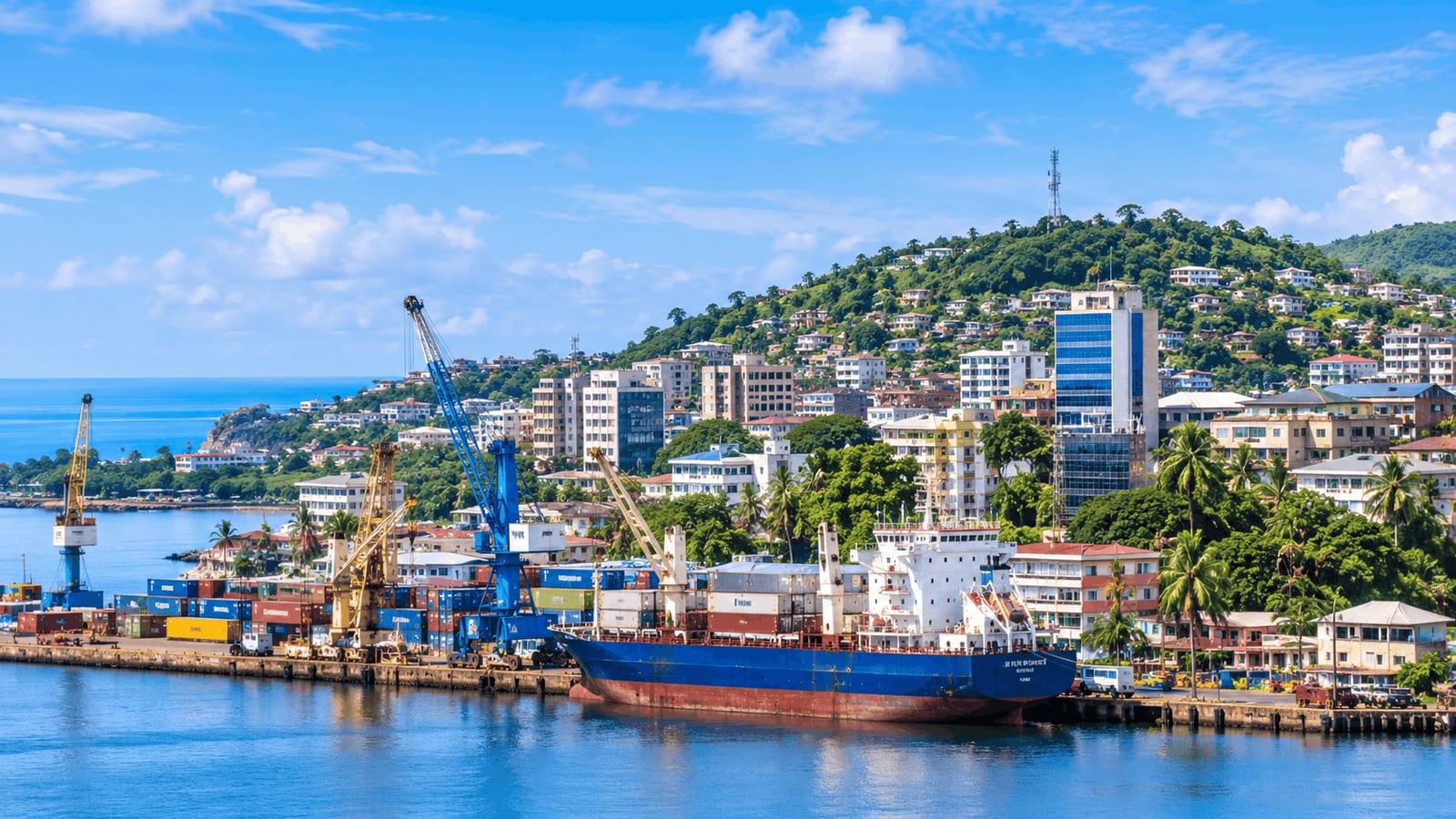
Freetown has one of the world's largest natural harbours. Its location makes it an important point for the movement of goods into and out of Sierra Leone.
Queen Elizabeth II Quay is the country's main commercial port. It handles much of the country's general cargo and container traffic. Freetown Terminal Limited operates the container terminal.
Mining companies also use dedicated export facilities. Iron ore from Tonkolili moves through the Pepel export route, while other mineral operations use facilities suited to their locations and products.
The ports are important to businesses importing machinery, food, fuel and consumer goods, as well as companies exporting minerals and agricultural products.
Roads and borders
Sierra Leone shares borders with Guinea and Liberia. These connections are important for regional trade and the movement of people and goods.
Roads link Freetown with other parts of the country and neighbouring markets. However, transport remains difficult in some rural areas, where poor road conditions can increase the cost of moving agricultural produce.
During the rainy season, some roads become harder to use. This can delay deliveries and make it more expensive for farmers and traders to get goods to markets.
Air transport
Freetown's main international airport is located at Lungi, across the estuary from the capital.
A new airport terminal began operations in 2023. Travellers moving between the airport and Freetown can use ferries, water taxis and road connections.
The government signed a memorandum of understanding with US-based Acrow Corporation in June 2025 for the proposed Lungi Bridge project. The agreement covers the design, construction, operation and eventual transfer of the bridge. The project is intended to improve connections between the airport and the capital, although the bridge is not yet an operating transport route.
Sectors with room to grow and doing business
In this section
Better facilities could help reduce losses and allow more seafood to reach domestic and international markets.
Mineral processing
Sierra Leone already earns substantial export income from minerals, but more processing within the country could create additional economic activity.
Iron ore processing, for example, could increase the value of the material before it is exported. The same applies to other minerals where local processing is commercially and technically viable.
The government has identified mineral processing as an area for development. However, projects require investment in electricity, transport, equipment, skills and reliable access to international markets.
Agriculture
Sierra Leone has fertile land and favourable conditions for growing several crops, yet it continues to import large quantities of rice.
The government's Feed Salone programme aims to increase food production, improve agricultural productivity and reduce dependence on food imports.
There are opportunities in rice production, cocoa, coffee, palm oil and other crops. Businesses can also participate in storage, processing, packaging, distribution and agricultural equipment supply.
For companies entering this sector, access to land, reliable transport, financing and suitable processing facilities will be important considerations.
Fisheries
Fishing supports livelihoods and provides food for communities across Sierra Leone.
The country has opportunities to develop fish processing, cold storage, packaging and distribution. Better facilities could help reduce losses and allow more seafood to reach domestic and international markets.
Illegal, unreported and unregulated fishing is also a concern for the country's marine resources. Stronger monitoring and enforcement are important for protecting fish stocks and supporting businesses that depend on sustainable fishing.
Tourism
Sierra Leone has beaches around the Freetown Peninsula, islands such as Banana and Turtle Islands, and natural attractions such as Tiwai Island.
These places offer opportunities for accommodation, hospitality, transport, food services and local tourism businesses.
However, tourism development depends on more than natural attractions. Reliable electricity, roads, transport connections, accommodation and other visitor services are necessary to support the sector.
Energy
Access to reliable electricity remains a major challenge for households and businesses.
The World Bank's development data shows that electricity access reached approximately 39% of the population in 2024.
This affects manufacturing, food processing, mining, cold storage and other activities that depend on a consistent power supply.
Investment in hydroelectricity, solar power and electricity distribution could support businesses and improve access for communities outside the main urban centres.
Doing business in Sierra Leone
Businesses operating in Sierra Leone need to understand the country's registration, tax, licensing and investment rules.
Companies register through the Corporate Affairs Commission, while the Sierra Leone Investment and Export Promotion Agency (SLIEPA) provides information and support for investors.
The general corporate income tax rate for resident companies is 30% under the Finance Act 2026. The Goods and Services Tax is generally 15%, subject to applicable exemptions and special rules.
Mining companies face additional requirements under Sierra Leone's mining and extractive industries legislation. The general royalty rate for bulk minerals such as iron ore, bauxite and rutile is 3% of sale value. Precious metals such as gold attract a 5% royalty, while precious stones have a general rate of 6.5%. Special stones attract 8%.
Some mining companies operate under specific agreements or concessions, so their actual tax and royalty arrangements may differ from the general statutory rates.
English is the official language, and the country's legal system is based on common law.
Businesses should also account for the practical challenges of operating in the country. These include expensive borrowing, foreign exchange constraints, electricity supply, transport costs and changes in prices.
Risks and trade-offs
In this section
Heavy rainfall can also cause flooding and landslides, affecting roads, homes, farms and commercial activities.
Inflation and the leone
Inflation remains a concern for households and businesses. The Bank of Sierra Leone reported inflation of 15.66% in August 2026.
Higher prices affect the cost of food, fuel, transport, equipment and other business expenses. Changes in the leone's value can also affect companies that import goods or make payments in foreign currencies.
Businesses should account for possible price changes when preparing budgets and setting prices.
Government debt and interest payments
Debt interest payments place pressure on government finances.
Coface estimates that interest payments took about 42% of government revenue in 2025. This reduces the amount available for public investment and other government spending.
For businesses, delayed public payments and changes in government spending can affect suppliers, contractors and companies that depend on public projects.
Dependence on mineral exports
Mining provides much of Sierra Leone's export income, particularly through iron ore.
This creates exposure to changes in international commodity prices and demand. If iron ore prices fall or major mining operations experience disruptions, the country's export earnings and foreign exchange inflows can be affected.
China's demand for iron ore is particularly important because it is a major buyer.
Political and institutional risks
Sierra Leone has maintained electoral competition since the end of the civil war, but its political environment has not been without tensions.
President Julius Maada Bio was re-elected in June 2023. The main opposition party, the All People's Congress, disputed the results, while international election observers raised concerns about the transparency of the counting and tabulation process.
Political dialogue followed, but businesses should continue to pay attention to election developments, government policies and regulatory changes.
Infrastructure and climate
Poor roads, unreliable electricity and limited transport facilities increase the cost of doing business.
Heavy rainfall can also cause flooding and landslides, affecting roads, homes, farms and commercial activities.
Companies involved in agriculture, logistics, construction and distribution should consider seasonal transport conditions when planning operations.
What this means for an African business
In this section
Companies in agriculture can explore opportunities in food production, rice supply, processing, packaging and distribution.
Sierra Leone is a market of approximately 8.8 million people with opportunities in mining services, agriculture, fisheries, transport, energy and trade.
For businesses elsewhere in Africa, its mining industry creates demand for equipment, maintenance, engineering, transport and other services. Companies in agriculture can explore opportunities in food production, rice supply, processing, packaging and distribution.
There are also opportunities in fisheries, cold storage, renewable energy and electricity infrastructure. These are areas where businesses can provide products and services that support existing economic activity.
Its membership of ECOWAS, the Mano River Union and AfCFTA also gives Sierra Leone a place within wider African trade arrangements. Companies looking at the country should understand the applicable rules and consider how it fits into their regional operations.
However, entering the market requires careful planning. High borrowing costs, inflation, exchange rate movements, electricity supply and transport conditions can affect operating expenses.
Businesses interested in the mining sector must also understand the licensing requirements, local-content rules and tax arrangements that apply to their activities.
Sierra Leone has natural resources and an economy with several areas of commercial activity. The opportunities are there, but companies need to understand the market, its regulations and the cost of operating before making investment decisions.
The next profile in our series is Liberia, Sierra Leone's south-eastern neighbour.
Sources
International Monetary Fund, Sierra Leone: June 2026 Economic Assessment
IMF World Economic Outlook, October 2026: Sierra Leone
World Bank, Sierra Leone Country Data
Sierra Leone Ministry of Finance, Annual Economic Bulletin 2024
Sierra Leone Ministry of Mines and Mineral Resources, 2025 Mining Sector Performance
United States Geological Survey, Sierra Leone Mineral Industry
Bank of Sierra Leone
World Bank, Sierra Leone Country Economic Memorandum
National Revenue Authority, Income Tax
Sierra Leone Finance Act 2026
Coface, Sierra Leone Country Risk Assessment
US Congressional Research Service, African Growth and Opportunity Act, August 2026
ECOWAS, Decisions of the 69th Summit, July 2026
Sierra Leone National Investment Board, Lungi Bridge Agreement