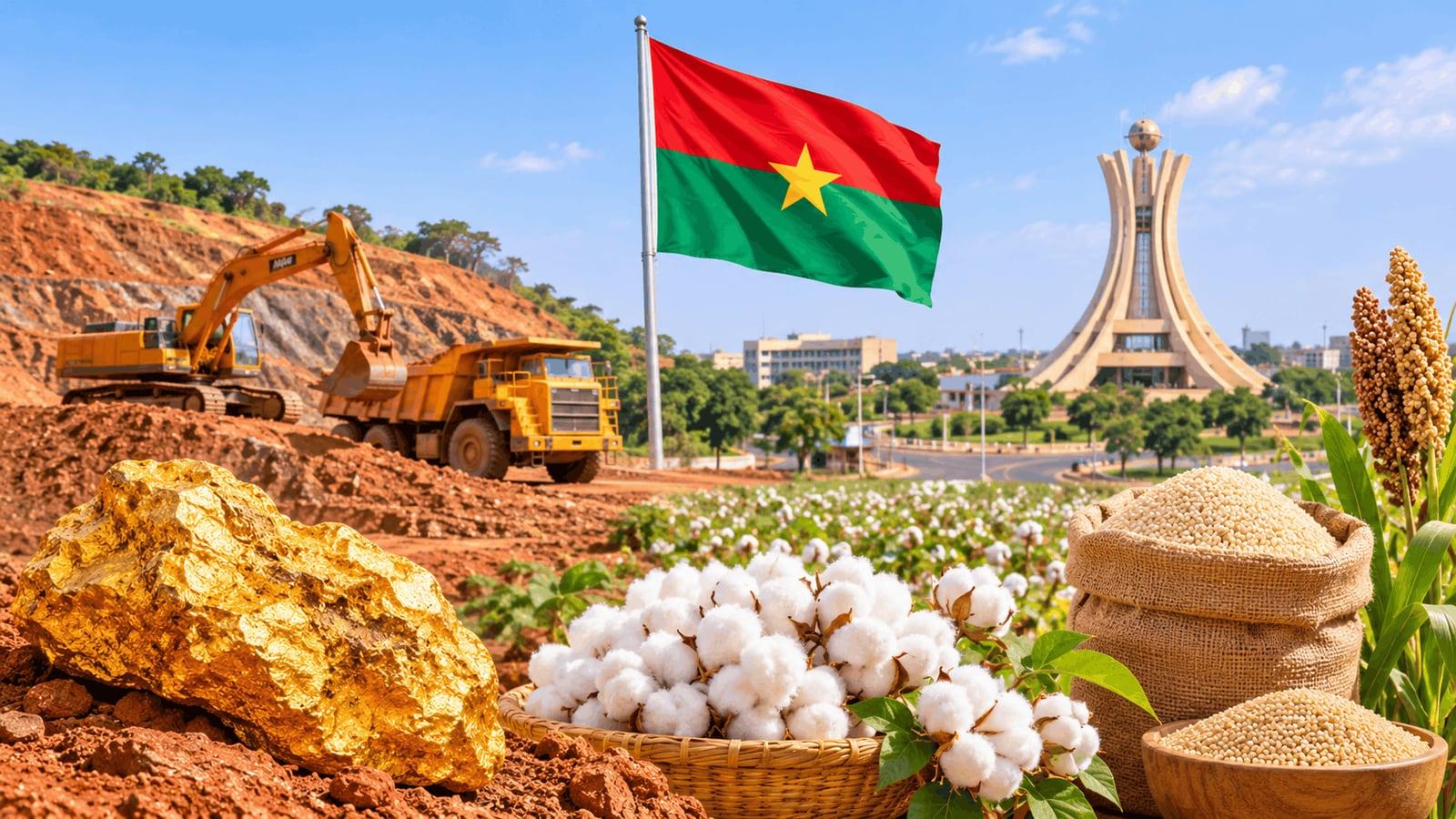
Discover how Burkina Faso makes its money through gold, cotton, agriculture and regional trade. Understand its mining reforms, export markets, transport routes and business opportunities.
From 457 kilograms to 40 tonnes
In this section
Burkina Faso is a landlocked country in West Africa, with a population of approximately 24 million people.
In 2022, Burkina Faso's national precious materials company collected 457 kilograms of gold from the country's artisanal mining sector. By 2025, that figure had risen to about 40 tonnes, according to figures presented by the government in October 2026. That is almost 87 times the amount collected three years earlier.
The country's total gold production also reached a record 94 tonnes in 2025, up from 61 tonnes in 2024, according to the World Bank.
At the average international gold price of US$3,218 per troy ounce in 2025, 94 tonnes of gold would have a gross market value of approximately US$9.7 billion. This is a calculation based on the market price, not the amount Burkina Faso received from exports or the money that went into government accounts.
Gold has become even more important to the government under Captain Ibrahim Traoré. Since taking power in September 2022, his administration has introduced measures to increase state ownership of mining assets, bring more artisanal gold into official trading channels and process more of the country's gold locally.
The government reported that the mining sector generated about CFAF 2.5 trillion in direct revenue between 2022 and 2025. It has also transferred several mining assets previously held by foreign companies to a state-owned mining company, SOPAMIB.
In September 2026, Burkina Faso inaugurated its first national gold refinery in Ouagadougou. The facility has an initial refining capacity of 164 tonnes a year, although its actual processing volumes will depend on its operations.
These developments show how important gold has become to Burkina Faso's economy and the government's plans to have a larger share of the income from its natural resources.
This is the eleventh country profile in our series, Africa's Markets, Country by Country, following Mali.
Burkina Faso is a landlocked country in West Africa, with a population of approximately 24 million people. Its capital is Ouagadougou, and its economy depends heavily on gold, agriculture, livestock and trade with neighbouring countries.
The country has continued to record economic growth despite a long-running security crisis. According to the IMF, the economy grew by 5.3% in 2025, supported partly by increased mining activity and higher gold prices.
However, growth figures do not tell the whole story. Much of the country faces insecurity, businesses have to deal with difficult transport routes, and the government is making significant changes to how strategic industries are managed.
Burkina Faso at a glance
Measure
Figure
Period and source
Nominal GDP
Approx. US$28.7 billion
2026 projection, IMF
GDP per person
US$1,149
2026 projection, IMF
Real GDP growth
5.3%
2025, IMF
Inflation
-0.5%
2025, IMF
Expected inflation
1.4%
2026 projection, IMF
Budget deficit
1.8% of GDP
2025, IMF
Gold production
94 tonnes
2025, World Bank
Gold collected by the state company
Approx. 40 tonnes
2025, government-reported
Mining revenue
CFAF 2.5 trillion
2022 to 2025, government-reported
Installed electricity capacity
Over 812 MW
October 2026, government-reported
Currency
West African CFA franc (XOF)
CFAF 655.957 per euro
Trade groups
WAEMU, AES and AfCFTA
Current
ECOWAS membership
Withdrawal effective 29 January 2025
ECOWAS
Note
The IMF's June 2026 assessment gives a 2025 budget deficit of 1.8% of GDP. The World Bank publishes a different estimate of 3.7%. The table uses the more recent IMF assessment. The nominal GDP figure is calculated from the IMF's projected CFA franc GDP and average exchange rate.
How the economy is built
In this section
The service sector includes transport, telecommunications, retail, banking, education and government services.
Burkina Faso's economy rests on two major activities: farming and mining.
Agriculture supports a large part of the population. Farmers grow sorghum, millet, maize and rice for local consumption, while cotton, sesame, cashews and other crops provide income from sales. Livestock farming is also important, with cattle, sheep and goats raised for local consumption and regional trade.
Gold mining provides most of the country's export earnings. Both large industrial mines and smaller artisanal mining operations contribute to production.
The service sector includes transport, telecommunications, retail, banking, education and government services. Much of this activity is concentrated in Ouagadougou and Bobo-Dioulasso, the country's second-largest city.
The economy grew by 5.3% in 2025, according to the IMF. Mining activity and higher international gold prices supported this growth. Inflation averaged -0.5%, meaning that consumer prices were slightly lower on average than in 2024.
The government also reduced its budget deficit from 5.8% of GDP in 2024 to 1.8% in 2025, according to the IMF. However, security spending, humanitarian needs and the cost of maintaining public services continue to put pressure on government finances.
Burkina Faso has an ongoing financial programme with the IMF. In June 2026, the Fund completed the fifth review of its Extended Credit Facility programme, which was originally approved in September 2023. It also completed the first review of a Resilience and Sustainability Facility arrangement approved in February 2026.
The political and security situation
Burkina Faso has been under military rule since January 2022, when the military removed President Roch Marc Christian Kaboré from office. A second coup took place in September 2022, bringing Captain Ibrahim Traoré to power.
In May 2024, the authorities adopted a new transition charter that extended the transition period by five years from July 2024. It also allowed Traoré to contest future elections.
In January 2026, the government dissolved all political parties and political formations. The authorities said the decision was part of a wider plan to reorganise the country's political system.
Relations with France have also deteriorated. Burkina Faso ended its military cooperation with France, and in June 2026 the government announced that it was breaking diplomatic relations with the country. Russia has become a more prominent security and diplomatic partner.
Burkina Faso has also strengthened its ties with Mali and Niger through the Alliance of Sahel States (AES). The three countries formed the confederation after their political and security disagreements with ECOWAS.
Security remains one of the country's biggest economic problems. Armed groups linked to al-Qaeda and the Islamic State operate in several parts of Burkina Faso, particularly in the north and east.
The Global Terrorism Index 2026 ranked Burkina Faso second among the countries most affected by terrorism. It recorded 846 terrorism-related deaths in 2025, down from 1,532 in 2024. Although the number of deaths fell, the threat remains serious.
The report also notes that external assessments suggest government forces control 30% or less of the country's territory. This differs sharply from the government's own claims about the areas it has recovered.
The humanitarian situation is also difficult. UNICEF estimates that 4.5 million people, including 2.9 million children, will need humanitarian assistance in 2026.
Insecurity affects farming, transport, education, healthcare and mining. Some communities have been displaced, while businesses in affected areas face difficulties moving workers, supplies and goods.
What Burkina Faso sells, buys and who it trades with
In this section
The crop is grown mainly by smallholder farmers, particularly in the western and southern parts of the country.
Burkina Faso's exports are dominated by gold, followed by cotton and agricultural products.
According to the World Trade Organization's trade data, gold accounted for 82.3% of the country's total export value in 2024. Cotton accounted for 5.9%, while cashew nuts and sesame seeds also contributed to export earnings.
Gold
Gold is Burkina Faso's most important export.
The country produces gold through industrial mines operated by companies as well as artisanal and small-scale mining activities.
Industrial mining companies have included Endeavour Mining, IAMGOLD, Orezone and West African Resources. Their operations and ownership arrangements have changed over time, particularly following the government's mining reforms.
The 2024 mining code increased the state's free-carried interest in new mining projects from 10% to 15%. It also provides for additional participation by the state and national private investors.
The government has also strengthened its ownership of existing mining assets.
In June 2025, five mining assets previously held by subsidiaries associated with Endeavour Mining and Lilium Mining were transferred to SOPAMIB, the state-owned mining holding company. These included two operating gold mines and three exploration assets.
The government says these measures will allow Burkina Faso to retain a larger share of the income generated from its mineral resources.
Another major development is the national gold refinery, RAFFINOR-BF, inaugurated in Ouagadougou on 28 September 2026. Its first phase has a stated refining capacity of 164 tonnes a year, with plans to expand capacity in the future.
Before the refinery, much of Burkina Faso's gold was exported for processing abroad.
WTO data for 2024 identifies Switzerland and the United Arab Emirates as the two largest destinations for the country's recorded exports. Together, they accounted for more than 82% of total export value.
These figures describe declared export destinations. They do not establish that all the gold was refined in those countries.
The new refinery is intended to allow more processing to take place within Burkina Faso. However, its actual contribution will depend on how much gold it receives and processes.
Cotton
Cotton is another important export and a major source of income for farming communities.
Burkina Faso has been one of West Africa's leading cotton producers. The crop is grown mainly by smallholder farmers, particularly in the western and southern parts of the country.
The harvested cotton is sent to ginning companies, which separate the cotton fibre from the seeds.
The main companies in the sector include SOFITEX, SOCOMA and Faso Coton. SOFITEX is the largest of the three.
According to SOFITEX, its cotton fibre is exported mainly to Asian and European markets. The company also reports that only a small proportion of the fibre is processed locally into yarn.
This leaves room for more textile production within the country. Spinning, fabric production and garment manufacturing could create additional jobs and allow Burkina Faso to earn more from cotton before it leaves the country.
Cotton production changes from one season to another because of rainfall, pests, farming costs and insecurity in some growing areas.
Shea, sesame, cashews and livestock
Burkina Faso also produces shea nuts, sesame, cashews and mangoes.
Shea is particularly important to women involved in collecting, processing and selling the nuts and butter. The product is used in cosmetics, skincare and food manufacturing.
Sesame is sold to international markets, while cashews are exported in their raw form and processed products. Mangoes also contribute to agricultural exports.
The country has a large livestock sector. Cattle, sheep and goats are raised for meat, milk and other products, with regional markets providing important outlets for livestock traders.
Côte d'Ivoire, Ghana, Togo, Benin and Nigeria are among the neighbouring countries connected to Burkina Faso through regional livestock and agricultural trade.
These activities are important to livelihoods and rural incomes, even though their combined export value is much smaller than gold.
What Burkina Faso buys
Burkina Faso imports a wide range of goods, including fuel, machinery, vehicles, medicines, food products, fertiliser, electricity and industrial supplies.
Rice, wheat, sugar and vegetable oils are among the food products brought into the country. Mining companies also require machinery, spare parts, fuel and other equipment to keep their operations running.
According to WTO data for 2024, the European Union was Burkina Faso's largest import partner, accounting for 17.2% of total imports. China accounted for 15.8%, followed by Côte d'Ivoire at 15.3%.
Russia accounted for 11.7%, while Ghana contributed 8.9%.
These figures show the importance of both international suppliers and neighbouring African markets to Burkina Faso's economy.
Fuel supply is a particularly important issue.
Burkina Faso depends on imported petroleum products and relies on coastal countries for access to international supplies.
In September 2026, Reuters reported that Ghana's state-owned fuel distributor, BOST Energies, had reduced fuel shipments to Burkina Faso and Mali because of pressure on its domestic supply.
Burkina Faso had requested 80,000 tonnes of fuel for July and August, but Ghana supplied 40,000 tonnes.
The development showed how changes in supply decisions in neighbouring countries can affect businesses and consumers in Burkina Faso.
Trade agreements and how goods move
In this section
The union has eight members: Benin, Burkina Faso, Côte d'Ivoire, Guinea-Bissau, Mali, Niger, Senegal and Togo.
Burkina Faso's location creates a particular challenge for international trade. It has no coastline, so imported and exported goods must pass through neighbouring countries to reach international markets.
Its regional trade arrangements and transport corridors are therefore important to the economy.
WAEMU and the Alliance of Sahel States
Burkina Faso remains a member of the West African Economic and Monetary Union (WAEMU), also known by its French abbreviation, UEMOA.
The union has eight members: Benin, Burkina Faso, Côte d'Ivoire, Guinea-Bissau, Mali, Niger, Senegal and Togo.
WAEMU provides a shared currency, the West African CFA franc, and a customs union that supports trade among its members.
The CFA franc is pegged to the euro at CFAF 655.957 per euro.
Burkina Faso withdrew from ECOWAS alongside Mali and Niger. Their withdrawal became effective on 29 January 2025.
However, ECOWAS announced transitional arrangements allowing goods and services from the three countries to continue receiving treatment under its Trade Liberalisation Scheme until further notice. Visa-free movement arrangements were also maintained during the transition.
The three countries have continued developing the Alliance of Sahel States.
In December 2025, the AES inaugurated the Confederal Bank for Investment and Development, known as BCID-AES. The bank was announced with initial capital of CFAF 500 billion and is intended to finance projects in infrastructure, agriculture, energy and private business.
The AES also introduced a common biometric passport in January 2025.
These developments are intended to support closer economic cooperation among Burkina Faso, Mali and Niger. Their long-term impact will depend on how effectively the institutions operate and how much trade and investment they can support.
AfCFTA, Europe and the United States
Burkina Faso has ratified the African Continental Free Trade Area (AfCFTA).
The agreement aims to reduce trade barriers between African countries and create a larger market for goods and services produced across the continent.
For Burkina Faso, this could support exports of agricultural products, processed goods and manufactured products to other African markets.
The country also benefits from the European Union's Everything But Arms arrangement because it is classified as a least-developed country. The arrangement provides duty-free and quota-free access to the EU market for eligible products, apart from arms and ammunition.
Its access to the United States under the African Growth and Opportunity Act (AGOA) was terminated effective 1 January 2023, following the US decision to end its beneficiary status in 2022.
Corridors to the sea
Burkina Faso uses several coastal ports to move goods into and out of the country.
The main routes include:
Abidjan, Côte d'Ivoire: The Abidjan-Ouagadougou corridor is an important route for imports and exports. Goods move by road and rail between the port and the Burkinabè capital.
Tema and Takoradi, Ghana: These ports provide alternative access to international shipping and are important for fuel and general cargo.
Lomé, Togo: The Port of Lomé is another major gateway, connected to Ouagadougou by road.
Cotonou, Benin: This is an additional route for goods entering and leaving Burkina Faso.
The Abidjan-Ouagadougou railway is operated by Sitarail and carries freight through Bobo-Dioulasso. It is important for moving goods over long distances, particularly cargo that would be more expensive to transport entirely by road.
These corridors also create business opportunities for transport companies, freight forwarders, customs agents, warehouses and logistics providers in the coastal countries.
However, insecurity in parts of Burkina Faso has made some routes more difficult to use. Road closures, attacks on transport convoys and delays can increase the cost of moving goods.
Electricity
Burkina Faso imports electricity, mainly from Côte d'Ivoire and Ghana, through regional power connections.
At the same time, the country has expanded its domestic electricity generation, particularly through solar projects.
The government reported that installed electricity capacity increased from 501 MW in 2022 to more than 812 MW by October 2026. It also reported an increase in rural electricity access from approximately 6% to 12%.
These are government-reported figures. Installed capacity does not mean that all the electricity can be generated and delivered at every moment, but the expansion shows the government's efforts to increase domestic supply.
Solar power, electricity distribution and mini-grid projects remain relevant areas for investment, particularly in communities that are not connected to the main grid.
Sectors with room to grow and doing business
In this section
The expansion of electricity capacity also creates demand for equipment, maintenance and technical services.
Burkina Faso has opportunities in several sectors, although insecurity, transport costs and changes in government policy need to be considered before entering the market.
Gold processing
The opening of RAFFINOR-BF creates an opportunity to develop more activity around gold refining, testing, storage and jewellery production.
The government wants more of the country's gold to be processed locally rather than exported in less processed forms.
This could create demand for technical skills, equipment, laboratories and related services. However, the refinery's actual commercial performance and ability to attract sufficient supplies will need to be assessed over time.
Burkina Faso produces cotton in large quantities, but much of the fibre is exported without being turned into finished textile products.
Local spinning, weaving, fabric production and garment manufacturing could create more employment and retain more value within the country.
Shea processing also offers opportunities, particularly for businesses working with women's cooperatives and small producers.
Producing finished shea butter, skincare products and other goods for regional and international markets could help businesses earn more from the country's agricultural resources.
Solar energy
Solar energy is another area with potential.
Burkina Faso receives strong sunlight, but access to reliable electricity remains a challenge, particularly outside major towns.
Solar installations, mini-grids, battery storage and electricity distribution services could support households, farms and businesses.
The expansion of electricity capacity also creates demand for equipment, maintenance and technical services.
Agro-processing and livestock
Burkina Faso produces sesame, cashews, mangoes, rice and other agricultural products.
Processing these products locally could reduce losses, create jobs and supply markets in neighbouring countries.
Livestock processing is another area worth watching. Meat processing, cold storage, animal feed and related services could support regional trade.
These opportunities depend on access to reliable electricity, transport, financing, security and suitable processing facilities.
Doing business in Burkina Faso
Companies registering a business in Burkina Faso can use the Maison de l'Entreprise du Burkina Faso (MEBF), which operates the Centre de Formalités des Entreprises (CEFORE).
The registration system provides a central point for handling several business registration procedures under the OHADA legal framework used by many West and Central African countries.
The standard corporate income tax rate is 27.5%, while the standard VAT rate is 18%, according to the country's General Tax Code.
Foreign investors also need to consider the rules governing their particular sector. Mining, for example, is subject to the revised 2024 mining code and its requirements on state participation and local involvement.
Businesses transferring profits or other funds across borders must follow applicable WAEMU foreign exchange regulations, including relevant banking and documentation procedures.
For companies considering the market, important questions include:
Can goods reach the business reliably through the available coastal corridors?
Are there established local suppliers and distribution partners?
What security arrangements are needed for staff, transport and assets?
Does the business require a sector-specific licence or government approval?
Can the business manage changes in regulations and government policy?
These questions are particularly important for companies entering mining, transport, energy and other strategic sectors.
Risks and trade-offs
In this section
Limited infrastructure and electricity supply: Although electricity capacity has expanded, reliable supply remains an issue.
Burkina Faso has recorded strong economic growth, but the risks of operating in the country remain high.
Insecurity: The armed conflict affects communities, transport routes, farming and business activity. The Global Terrorism Index ranked Burkina Faso second in 2026, with 846 terrorism-related deaths recorded in 2025.
Government control of strategic industries: The transfer of five mining assets to SOPAMIB and changes under the 2024 mining code show that the government wants a larger role in the mining sector. Investors need to understand the rules governing ownership, licences and state participation before committing capital.
Dependence on gold: Gold accounts for a large share of export earnings. A fall in international prices, lower production or interruptions at major mines could affect export income and government revenue.
Political conditions: The dissolution of political parties and restrictions on independent media and civil society have raised concerns among human rights organisations. These developments also affect the country's relations with some international partners.
Dependence on imported fuel and transport corridors: Burkina Faso relies on neighbouring coastal countries for fuel and access to international shipping. The reduction in Ghana's fuel supplies in 2026 showed how changes in one country's supply decisions can affect another country's economy.
Limited infrastructure and electricity supply: Although electricity capacity has expanded, reliable supply remains an issue. Businesses that depend on continuous power may need to plan for additional energy costs and backup systems.
What this means for an African business
In this section
Burkina Faso's economic performance shows that its economy can continue growing despite serious challenges.
Burkina Faso is an important market in West Africa. It has a population of more than 23 million, a major gold industry, an established agricultural sector and trade connections with several coastal economies.
For companies in Côte d'Ivoire, Ghana, Togo and Benin, the country provides a market for fuel, food, machinery, construction materials and consumer goods. Its need for imported products also creates opportunities for suppliers and distributors.
Businesses in mining equipment, solar energy, agricultural processing, transport and logistics may also find areas worth exploring.
However, entering the market requires careful planning. Security conditions vary across the country, government involvement in strategic industries has increased, and transport routes can be affected by political and security developments.
Companies should carry out proper market research, understand local regulations, work with established partners and assess more than one supply route where possible. Political risk insurance and appropriate security arrangements may also be necessary, depending on the nature and location of the business.
Burkina Faso's economic performance shows that its economy can continue growing despite serious challenges. But the opportunities need to be assessed alongside the conditions that businesses and communities face on the ground.
The next profile in our series is Guinea, a coastal country with some of the world's largest bauxite reserves and a growing role in the global aluminium supply chain.
Sources
In this section
The following sources were used to check the economic figures, trade data, mining developments, political situation and business information in this article.
The following sources were used to check the economic figures, trade data, mining developments, political situation and business information in this article.
Economic data and mining
International Monetary Fund: Burkina Faso 2026 Article IV Consultation, June 2026
FAOLEX: Burkina Faso Mining Code, Law No. 016-2024/ALT
UNCTAD: Transfer of Mining Assets to SOPAMIB, June 2025
Burkina Faso Government: Inauguration of the National Gold Refinery, 28 September 2026
African Perceptions: Burkina Faso's Mining Revenue and Gold Collection Figures, October 2026
Trade and agriculture
World Trade Organization: Burkina Faso Trade Profile
World Bank: World Integrated Trade Solution
SOFITEX: Cotton Production and Processing in Burkina Faso
Regional trade and transport
ECOWAS: Statement on the Withdrawal of Burkina Faso, Mali and Niger, January 2025
Burkina Faso Government: Introduction of the AES Biometric Passport
Burkina Faso Government: Operationalisation of the AES Confederal Investment and Development Bank, December 2025
UNCTAD: Cotonou-Niamey and Lomé-Ouagadougou Transport Corridors
Security and political developments
Global Terrorism Index 2026
UNICEF: Burkina Faso Humanitarian Appeal 2026
Burkina Faso Presidency: Dissolution of Political Parties, January 2026
France Diplomatie: Burkina Faso's Decision to Break Diplomatic Relations, June 2026
Reuters: Ghana Reduces Fuel Supplies to Burkina Faso and Mali, September 2026
Business and taxation
Burkina Faso Directorate General of Taxes: General Tax Code
Burkina Faso Public Service Portal: Company Registration
Note
Some production, gold collection, mining revenue and electricity figures are government-reported. They are identified as such in the article rather than presented as independently audited figures. The estimated US$9.7 billion gross value of 2025 gold production is an independent calculation based on production volume and the IMF's average gold price for that year. It is not an official export or government revenue figure.