Learn how Mali earns, spends and trades through gold, cotton, lithium, livestock and regional trade, and what businesses need to know about its economy.
A gold economy that depends on its neighbours
In this section
Mali is landlocked, so it depends on neighbouring countries for access to seaports and many imported goods.
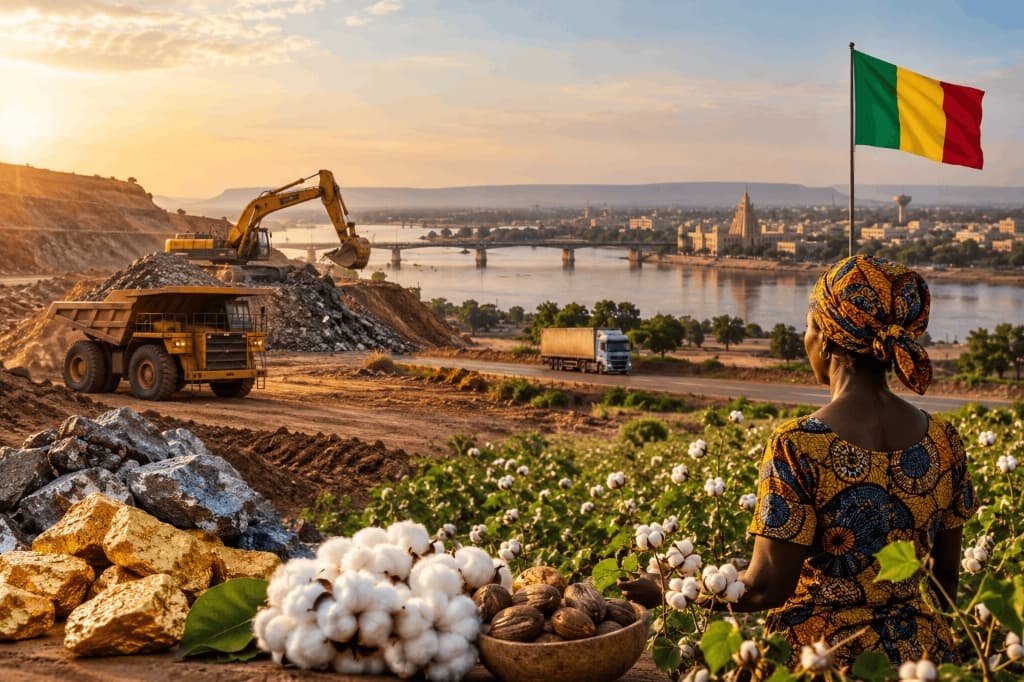
Gold is Mali's most important export. It brings in foreign currency, supports government revenue and attracts major mining companies. But the country's economy depends on much more than what comes out of its mines. Mali also grows cotton, raises livestock, produces food and is beginning to export lithium.
Getting these goods to international markets is another matter. Mali is landlocked, so it depends on neighbouring countries for access to seaports and many imported goods. Fuel supplies, in particular, rely heavily on road transport through Senegal and Côte d'Ivoire.
In September 2025, attacks on fuel tankers by Jama'at Nusrat al-Islam wal-Muslimin (JNIM), an armed group linked to al-Qaeda, disrupted supplies and caused shortages in Bamako. The crisis led to school closures and affected transport and electricity supply. Reports from early 2026 continued to document the effects of insecurity on fuel distribution. FEWS NET's Mali reports provide further information on these disruptions.
This is the tenth country profile in our series, Africa's Markets, Country by Country. Following our profiles on Côte d'Ivoire and Senegal, we turn to Mali, a country whose mineral wealth and regional trade links create opportunities, but whose security situation and transport challenges can make business difficult.
Mali had an estimated population of 26 million in 2026. The International Monetary Fund (IMF) projects its economy will be worth about US$33.85 billion that year, with GDP per person of approximately US$1,340. The country is governed by military authorities following coups in 2020 and 2021, and it withdrew from the Economic Community of West African States (ECOWAS) in January 2025.
So, where does Mali's money come from, what does it buy from other countries, and what should businesses know before entering its market?
Mali at a glance
Measure
Figure
Period and source
Nominal GDP
US$33.85 billion
2026 projection, IMF
GDP per person
About US$1,340
2026 projection, IMF
Real GDP growth
5.5% projected
2026, IMF
Real GDP growth
9.3% year on year
Q1 2026, INSTAT
Industrial gold production
42.2 tonnes
2025, Ministry of Mines data reported by Reuters
Industrial gold production
23.5 tonnes
First half of 2026, Ministry of Mines data reported by Reuters
Total gold production
48.2 tonnes
2025, including artisanal production
Currency
West African CFA franc (XOF)
Fixed exchange rate of CFAF 655.957 per euro
Regional economic union
WAEMU
Member
Regional political and economic grouping
Alliance of Sahel States (AES)
Member
Continental trade agreement
AfCFTA
Ratified
ECOWAS membership
Withdrawn
January 2025
Sources: IMF World Economic Outlook, April 2026, Mali's National Institute of Statistics and Reuters' gold production report.
How Mali's economy works
Mali's economy rests on agriculture, livestock, mining and services.
Agriculture employs a large share of the population. Farmers in the south and along the Niger River grow cotton, rice, millet, sorghum and maize. Livestock farming is also important, particularly in the central and northern parts of the country, where cattle, sheep, goats and camels are raised.
Gold mining generates a large share of Mali's export earnings and government revenue. Industrial mines operate mainly in the south and west, while artisanal miners also extract gold across the country. Services, including transport, trade, telecommunications and government activities, account for much of the remaining economic activity, with many businesses concentrated in Bamako.
These sectors do not contribute to the economy in the same way. Agriculture supports livelihoods and supplies food and raw materials. Livestock connects rural producers to regional markets. Mining earns foreign currency and generates public revenue. Services help move goods, connect buyers and sellers, and support everyday economic activity.
The challenge is that Mali relies heavily on a few important sources of export income, particularly gold. When mining production falls or gold prices change, the effects can reach government finances and other parts of the economy.
Why gold matters so much
In this section
The 2023 mining code provides for a 10% government stake in new projects, with an option for an additional 20%.
Mali is one of Africa's leading gold producers. In 2025, industrial gold production fell by 22.9%, from 54.8 tonnes in 2024 to 42.2 tonnes. Artisanal production added about six tonnes, bringing total national production to approximately 48.2 tonnes.
The decline was closely linked to the dispute between the government and Barrick Mining, which operates the Loulo-Gounkoto complex, one of Mali's major gold-producing operations.
In 2023, Mali introduced a new mining code intended to increase the share of mining revenue retained in the country. The reforms changed the rules on state participation, royalties and local involvement in mining projects. Disagreements over the new requirements contributed to a prolonged dispute with Barrick.
The government placed Loulo-Gounkoto under provisional administration in June 2025. Barrick and the government reached a settlement in November 2025, and the company regained operational control in December. Production was expected to resume gradually.
The dispute illustrates the tension between a government's desire to earn more from its mineral resources and mining companies' need for clear, predictable rules.
The 2023 mining code provides for a 10% government stake in new projects, with an option for an additional 20%. A further 5% can be allocated to Malian private investors. This means the potential combined government and local private ownership can reach 35%, rather than the government alone automatically owning 35%.
Production began to recover in 2026. According to figures reported by Reuters, industrial mines produced 23.5 tonnes in the first half of the year, compared with about 18 tonnes during the same period in 2025.
However, higher production does not remove the risks associated with depending so heavily on gold. A fall in international prices, lower output or a dispute between the government and major mining companies can affect exports and public finances.
Sources: Reuters on Mali's gold production and UNCTAD's summary of Mali's mining-code reforms.
What Mali sells to other countries
In this section
Gold exports bring foreign currency into Mali and generate taxes, royalties and other payments to the state.
1. Gold
Gold is Mali's leading export. Large industrial mines produce most of the country's officially recorded industrial output, while artisanal mining provides an additional source of production.
Major industrial operators include B2Gold, which operates the Fekola mine; Barrick, associated with Loulo-Gounkoto; Resolute Mining, which operates Syama; and Allied Gold, which operates the Sadiola mine and the newer Korali-Sud operation.
Gold exports bring foreign currency into Mali and generate taxes, royalties and other payments to the state. They also create demand for mining equipment, engineering, transport, security and other services.
However, much of the value from gold leaves the country in the form of exports of the metal rather than through the manufacture of finished products in Mali.
For businesses, this creates opportunities in supplying mines and supporting their operations. It also means that changes in mining policy, production and international gold prices deserve close attention.
2. Cotton
Cotton is another important export. Mali is a major cotton producer in West Africa, alongside countries such as Benin and Burkina Faso.
Hundreds of thousands of smallholder farmers grow cotton, mainly in the south. The state-controlled Compagnie Malienne pour le Développement des Textiles (CMDT) plays a central role in purchasing and processing the crop.
Much of Mali's cotton leaves the country as raw fibre. This means that activities such as spinning, weaving and garment production could retain more value locally if the right investment, infrastructure, skills and market access were available.
Cotton production varies from year to year because of rainfall, pests, farm costs and international prices. Businesses considering the sector need to examine production and export figures for the relevant marketing year rather than rely on a single annual ranking.
The opportunities extend beyond growing and exporting cotton. They include textile manufacturing, cottonseed processing, agricultural inputs, storage, transport and other services that support farmers and processors.
Sources: USDA Foreign Agricultural Service and Mali's National Institute of Statistics.
3. Lithium
Lithium is a newer addition to Mali's mineral exports. The country has two major projects, Goulamina and Bougouni, which have moved into production.
Goulamina, operated by a subsidiary of China's Ganfeng Lithium, formally began production in December 2024. The project includes state participation through the mining company.
At Bougouni, developed by Kodal Minerals with Chinese partners, production of spodumene concentrate began in February 2025. Its first shipment left the port of San Pedro in Côte d'Ivoire on 30 November 2025, bound for China.
These dates are important because starting production and making a commercial shipment are different milestones. A mine may produce material before it has accumulated enough stock, arranged transport and completed the steps required for export.
Lithium gives Mali another mineral export alongside gold. It also creates demand for mining services, processing equipment, transport and port logistics.
However, the presence of lithium deposits does not automatically mean Mali will capture most of the value from the battery industry. The concentrate must be processed further before it becomes material used in batteries. The scale of local processing will depend on investment, energy supply, infrastructure, technical capacity and commercial conditions.
Sources: Ganfeng Lithium's announcement on Goulamina and Kodal Minerals' first shipment announcement.
4. Livestock and agricultural products
Mali also trades livestock with neighbouring countries. Cattle, sheep and goats move through regional markets, supplying consumers and traders in countries including Senegal, Côte d'Ivoire and Guinea.
Demand can rise around major religious festivals, including Tabaski, when many households purchase animals. Livestock trade supports farmers, market traders, transporters and other businesses along the supply chain.
Other agricultural exports include products such as shea nuts, mangoes, sesame and cashews. Their commercial potential depends on production volumes, quality, storage, processing and access to buyers.
For businesses, processing and distribution can offer opportunities beyond selling raw products. Examples include food processing, animal feed, meat processing, cold storage and packaging.
These opportunities should be assessed against the availability of reliable supplies, transport costs, sanitary requirements and the ability to reach buyers consistently.
What Mali buys and where its imports come from
In this section
The fuel crisis that began in 2025 showed how exposed the country can be when major supply routes become unsafe.
Mali imports fuel, food, vehicles, machinery, medicines, fertiliser, cement and a wide range of consumer goods.
Its landlocked position means that many imported products arrive through ports in neighbouring countries before travelling overland to Mali. Dakar in Senegal and Abidjan in Côte d'Ivoire are particularly important routes.
Trade data for 2024 puts Mali's goods imports from Côte d'Ivoire at approximately US$1.67 billion and imports from Senegal at about US$1.3 billion. These figures show the importance of the two neighbours as sources of goods and as gateways to international markets.
Not everything imported through these countries is produced there. Some products are re-exported after arriving from elsewhere.
China and France are also important suppliers. Other European and Asian countries contribute to Mali's imports, depending on the product.
Fuel is particularly important because it supports transport, electricity generation, mining and many other activities. Disruptions to fuel deliveries can therefore affect businesses well beyond the energy sector.
The fuel crisis that began in 2025 showed how exposed the country can be when major supply routes become unsafe. Attacks on tankers disrupted deliveries, contributed to shortages in Bamako and forced the government to take measures to maintain supplies.
For importers, the lesson is not that trade with Mali is impossible. It is that delivery times and costs can be affected by events far beyond the point of purchase. Businesses need to account for transport security, route availability, inventory requirements and the possibility of delays.
Sources: World Trade Organization, Mali trade profile and FEWS NET.
How Mali trades with the rest of Africa
In this section
Road transport is central to this system, particularly for fuel, food, industrial inputs and consumer goods.
WAEMU and the CFA franc
Mali remains a member of the West African Economic and Monetary Union (WAEMU), alongside Benin, Burkina Faso, Côte d'Ivoire, Guinea-Bissau, Niger, Senegal and Togo.
The union has a common currency, the West African CFA franc, and a customs union. The currency is pegged to the euro at CFAF 655.957 to €1.
For businesses trading between WAEMU countries, the shared currency removes exchange-rate movements between member currencies. This can make pricing and payments easier to manage.
It does not, however, remove every barrier to trade. Transport costs, customs procedures, product standards, payment delays and security conditions can still affect the cost of moving goods across borders.
What changed after Mali left ECOWAS?
Mali, Burkina Faso and Niger officially withdrew from ECOWAS on 29 January 2025. The three countries had formed the Alliance of Sahel States, known by its French acronym, AES.
ECOWAS announced transitional arrangements after the withdrawal, including continued recognition of certain travel documents and the treatment of goods and services while further arrangements were considered.
This means businesses should not assume that all practical trade arrangements ended on the day of withdrawal. At the same time, they should not assume that the long-term rules will remain unchanged.
Mali continues to trade with countries such as Ghana, Guinea and Nigeria. However, businesses dealing with markets outside WAEMU should check the applicable customs procedures and trade rules before shipping goods.
The AES has also announced plans for closer economic cooperation, including common institutions and a joint investment bank. Announcements and proposals should be distinguished from institutions that are already operational.
The African Continental Free Trade Area
Mali has ratified the African Continental Free Trade Area (AfCFTA), which aims to increase trade among African countries by reducing tariffs and other barriers.
For Malian businesses, the agreement provides a framework for accessing participating African markets under preferential trade arrangements.
However, AfCFTA does not make every product automatically duty-free across the continent. The applicable tariff commitments, product coverage, rules of origin and implementation arrangements determine whether a shipment qualifies for preferential treatment.
A company planning to export from Mali should check the relevant product classification and destination-market requirements before pricing a shipment on the assumption that a tariff reduction applies.
How goods reach Mali
Mali's main import corridors run through neighbouring countries to the sea. Dakar and Abidjan are major gateways, while Conakry in Guinea also provides an important route.
Goods then travel overland to Bamako and other destinations. Road transport is central to this system, particularly for fuel, food, industrial inputs and consumer goods.
The condition of the roads, the security situation and delays at borders can all affect delivery times and costs. The fuel attacks reported from September 2025 demonstrated how quickly a disruption along a major corridor can affect the wider economy.
Air transport serves a different purpose. Bamako's Modibo Keïta International Airport handles passenger traffic and air cargo, which can be useful for time-sensitive or high-value goods.
Sources: ECOWAS, AfCFTA and WAEMU.
Where businesses may find opportunities
In this section
Spinning, weaving and garment manufacturing could create more value locally than exporting raw cotton alone.
Mali's economy has several sectors worth examining. The opportunities are real, but each requires a clear understanding of demand, operating costs, regulation and security.
Lithium and mining services
The expansion of lithium production creates demand for equipment, engineering, maintenance, logistics and other services that support mining operations.
Gold mines also need a wide range of goods and services. Companies considering this market should identify the operators, understand their procurement processes and assess whether they can meet the relevant technical, legal and safety requirements.
Mining is not a sector where a general interest in Mali is enough. Businesses need to understand the 2023 mining code, the role of the state, local-content requirements and the risks associated with regulatory disputes.
Cotton and agro-processing
Mali's cotton industry provides a starting point for businesses interested in textiles and agricultural processing.
Spinning, weaving and garment manufacturing could create more value locally than exporting raw cotton alone. Other possible areas include processing shea, mangoes, sesame, cashews and rice.
The commercial case depends on whether businesses can secure consistent supplies, access reliable power, meet product standards and reach buyers at prices that cover their costs.
Energy
Electricity supply is an important consideration for industrial and commercial operations in Mali. Businesses that rely on continuous power need to assess the reliability and cost of supply before investing.
Solar power is one area worth examining, particularly for businesses seeking alternatives or additional capacity. However, individual projects should be assessed on their financing, technology, grid connections, operating arrangements and actual delivery status.
Livestock and food processing
Livestock trade supports a wide network of producers, traders and transporters. There may be opportunities in meat processing, abattoirs, cold storage, animal feed and distribution.
Food processing could also help businesses serve domestic demand and regional markets. But companies need to consider supply consistency, storage, transport, food safety rules and the costs of reaching customers.
Supplying the domestic market
Mali imports many everyday goods, including food, medicines, vehicles, building materials and consumer products.
For businesses in neighbouring countries, this creates potential demand for products they already manufacture or distribute. The first step is to identify which products Mali actually imports, who supplies them now, how much buyers pay and what it costs to deliver them.
A large import market does not guarantee that a new supplier will succeed. Price, quality, payment terms, distribution and reliable delivery all affect the opportunity.
What businesses should know before entering Mali
In this section
Companies operating in other sectors should also check whether they need additional permits or approvals.
Companies register and operate under Mali's legal and regulatory framework, including the OHADA system of business law. The investment promotion agency, API-Mali, is a starting point for understanding investment procedures.
Before establishing a business, investors should confirm the current registration process, licensing requirements and any rules that apply to their sector.
Mining has specific requirements under the 2023 mining code, including changes to state participation and local involvement. Companies operating in other sectors should also check whether they need additional permits or approvals.
Tax and foreign-exchange rules require the same care. Businesses should confirm the current corporate tax rate, VAT obligations, applicable exemptions and the procedures for transferring profits abroad with qualified local advisers or the relevant authorities. These rules should not be treated as fixed without checking the latest official guidance.
Security is another major consideration. Attacks on roads can affect employees, goods and access to suppliers. Businesses may need to budget for additional transport arrangements, insurance, contingency stocks and alternative delivery plans.
Power supply, access to finance and the possibility of disputes over contracts or regulation also need to be considered.
For a company entering the market, local knowledge is essential. A distributor, legal adviser, logistics provider or commercial partner who understands the relevant sector can help identify the requirements that apply to a particular product or business model.
Risks and trade-offs
In this section
Mali's revised mining rules reflect the government's intention to capture more value from its mineral resources.
Insecurity and transport disruption
Armed groups operate in parts of Mali, and attacks have affected roads and supply routes. The fuel crisis of 2025 showed how disruptions can spread from transport into education, electricity and ordinary commercial activity.
Companies need current security information before sending staff or goods into the country. They should also assess the routes they intend to use rather than treating all regions as having the same level of risk.
Dependence on gold
Gold provides a large share of Mali's export earnings. This brings substantial income when production and prices are favourable, but it also exposes the economy to changes in international prices and mining output.
A dispute involving a major producer can have effects beyond the company concerned, including lower production and reduced export earnings.
Regulatory uncertainty
Mali's revised mining rules reflect the government's intention to capture more value from its mineral resources. The Barrick dispute also showed how disagreements over the interpretation and application of these rules can disrupt operations.
Investors should understand the law, the terms of their contracts and the procedures for resolving disputes before committing capital.
Regional trade changes
Mali's withdrawal from ECOWAS has changed its regional political position, although trade with neighbouring countries continues. Businesses should follow developments involving ECOWAS, WAEMU and the AES because changes to customs procedures or trade arrangements could affect cross-border operations.
Climate and food security
Droughts, floods and changing environmental conditions affect farming and livestock production. These risks can influence harvests, food prices and the supply of agricultural raw materials.
Businesses that depend on local agricultural products should consider seasonal variation, storage and alternative suppliers when planning their operations.
What this means for an African business
In this section
The next profile in our series is Burkina Faso, Mali's neighbour and fellow member of the Alliance of Sahel States.
Mali offers a market of about 26 million people, established trade links with neighbouring countries and significant mineral and agricultural resources. It imports a wide range of products and has developing industries that require equipment, services and investment.
For businesses in Senegal, Côte d'Ivoire, Guinea, Ghana, Nigeria and other African markets, Mali can be a destination for goods and services. Its demand for fuel, food, building materials, vehicles and consumer products creates opportunities for suppliers that can compete on price and deliver reliably.
Mining companies and their suppliers may find opportunities in gold and lithium operations. Agricultural businesses can examine cotton, livestock and food processing. Manufacturers and distributors can investigate products that Mali already imports.
But the market requires careful preparation. Security risks, transport disruptions, power supply, regulatory requirements and changing regional arrangements can all affect costs.
A company considering Mali should start with specific questions: What does the market import? Who supplies it? What do buyers need? What rules apply to the product? How will it reach the customer, and what happens if the main route becomes unavailable?
The answers will vary by sector and business model. Researching them before committing money is a better starting point than assuming that the country's mineral wealth alone guarantees an opportunity.
Mali's economy depends on gold, but its trade reaches far beyond mining. Agriculture, livestock, lithium, services and imports all connect it to the wider West African market. Understanding those connections is essential for any business considering a move into the country.
The next profile in our series is Burkina Faso, Mali's neighbour and fellow member of the Alliance of Sahel States.
Sources
International Monetary Fund, Mali country data and April 2026 World Economic Outlook
Mali National Institute of Statistics, INSTAT
Reuters, Mali's industrial gold production in 2025
Reuters, first-half 2026 gold production
Reuters, Barrick settlement and return to operational control
UNCTAD, Mali's 2023 mining code
Ganfeng Lithium, Goulamina first-phase production announcement
Kodal Minerals, first shipment from Bougouni
USDA Foreign Agricultural Service
World Trade Organization, Mali trade profile
ECOWAS
African Continental Free Trade Area
West African Economic and Monetary Union
FEWS NET, food security and supply disruption reporting