How Guinea-Bissau earns and trades through cashews, fisheries and agriculture. Explore its economy, trade partners, business opportunities and political risks.
One crop accounts for more than nine in every ten export dollars
In this section
Most of the nuts are exported raw and processed abroad, where they are shelled, roasted and packaged for consumers.
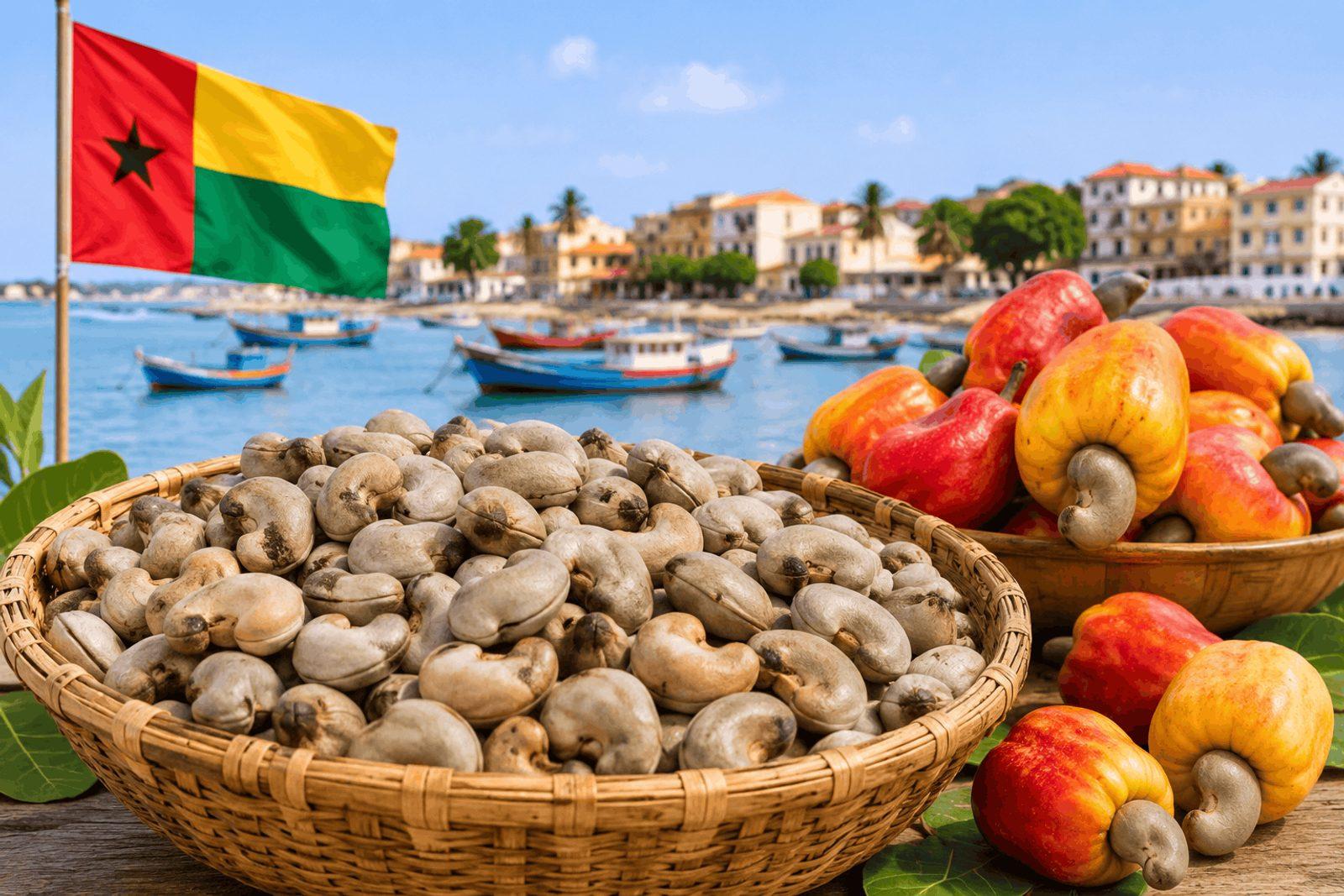
Guinea-Bissau's export earnings depend heavily on one agricultural product: raw cashew nuts.
During the 2025 campaign, the country exported approximately 211,400 tonnes of cashews, up from 167,500 tonnes in 2024, according to the International Monetary Fund (IMF). Around 250,000 tonnes passed through the country's supply chain to Bissau, but that figure is not the same as the volume officially recorded as exports.
Cashews account for more than 90% of Guinea-Bissau's recorded merchandise exports. This makes the country particularly exposed to changes in international cashew prices, harvests and demand from overseas buyers.
India is the country's dominant cashew buyer. Most of the nuts are exported raw and processed abroad, where they are shelled, roasted and packaged for consumers. Guinea-Bissau therefore earns money from producing and exporting the crop but captures only a small share of the processing activity that takes place later in the supply chain.
For rural households, cashews are an important source of cash income. The crop also brings foreign exchange into the country and generates government revenue through export-related activity.
When harvests are poor or international prices fall, the effects reach farmers, exporters, government finances and businesses that depend on the cashew trade.
This is the nineteenth country profile in our series, Africa's Markets, Country by Country, following Cabo Verde.
Guinea-Bissau is a small West African country between Senegal and Guinea, with a population of approximately 2.25 million according to the World Bank's 2025 data. Its economy was worth approximately US$2.5 billion in 2025.
The country has experienced repeated political instability since independence from Portugal in 1973. In November 2025, the military removed President Umaro Sissoco Embaló following presidential and legislative elections whose results had not been announced.
A military-led transitional government took control. Although elections were initially scheduled for December 6, 2026, the prime minister announced in October 2026 that they would have to be postponed. No replacement date had been announced as of November 5, 2026.
These political developments affect the country's business environment, public finances and ability to attract long-term investment.
Guinea-Bissau at a glance
Measure
Figure
Period and source
Nominal GDP
Approximately US$2.5 billion
2025, World Bank
GDP per person
Approximately US$1,124
2025, World Bank
Population
Approximately 2.25 million
2025, World Bank
Real GDP growth
5.8%
2025, World Bank
Real GDP growth forecast
4.7% to 4.8%
2026, World Bank and IMF
Inflation
0.9%
2025, World Bank
Public debt
75.6% of GDP
2025, World Bank
Tax revenue
8.5% of GDP
2025, World Bank
Cashew exports
Approximately 211,400 tonnes
2025, IMF
Cashews' share of recorded exports
More than 90%
IMF
Bank non-performing loans
More than 22% of lending
June 2025, World Bank
Currency
West African CFA franc (XOF)
Pegged to the euro
Exchange rate
€1 = CFAF 655.957
Fixed parity
Trade groups
ECOWAS, WAEMU, AfCFTA
Membership and ratification
Note
Economic figures are rounded. The World Bank and IMF use different reporting periods and projection rounds, so their 2026 growth forecasts are presented separately.
How the economy is built
In this section
Services, retail trade, construction and government activity are concentrated largely in Bissau, the capital.
Agriculture and fishing support much of Guinea-Bissau's economy. Many households depend on farming, with cashews providing an important source of income alongside rice, cassava, groundnuts, palm products and fruit.
Rice is the country's main staple food. Although it is grown locally, Guinea-Bissau still imports rice to meet domestic demand.
Cashews have become the country's most important commercial crop. Their production and export support farmers, traders, transport companies, exporters and other businesses involved in moving the harvest to international markets.
Fishing is another important economic activity. Guinea-Bissau has extensive coastal waters and fishing grounds around the Bijagós islands. The government also earns revenue by granting foreign vessels permission to fish in its waters.
Services, retail trade, construction and government activity are concentrated largely in Bissau, the capital. The city's port is an important route for international trade.
The economy grew by 5.8% in 2025, according to the World Bank. A strong cashew campaign supported agricultural output, rural incomes and private consumption. Services and construction also contributed to growth.
The World Bank projects growth of 4.8% in 2026, while the IMF's October 2026 World Economic Outlook puts its forecast at 4.7%.
Despite this growth, Guinea-Bissau has limited resources to finance public services and infrastructure. Tax revenue was approximately 8.5% of GDP in 2025, the lowest level among WAEMU countries, according to the World Bank.
Public debt stood at 75.6% of GDP in 2025, above the 70% ceiling under WAEMU's convergence criteria. The country also faces pressure from public spending needs, limited revenue collection and the cost of maintaining essential services.
Inflation averaged 0.9% in 2025. The West African CFA franc's fixed exchange rate with the euro provides monetary stability, although it does not remove the country's exposure to changes in food, fuel and international commodity prices.
The banking sector also faces difficulties. Non-performing loans exceeded 22% of bank lending by June 2025. This limits the ability of banks to provide new credit and support business investment.
Political situation and the 2025 military takeover
In this section
In October 2026, Prime Minister Ilídio Vieira Té announced that the December elections would have to be postponed.
Political instability has affected Guinea-Bissau for much of its post-independence history.
The latest military takeover took place on November 26, 2025, shortly after presidential and legislative elections. The military intervened before official election results could be announced and removed President Umaro Sissoco Embaló.
The military established a High Military Command and appointed Major-General Horta Inta-A as transitional president. Ilídio Vieira Té became transitional prime minister.
The takeover disrupted the electoral process and brought another period of uncertainty for the country.
In January 2026, the transitional authorities announced that presidential and legislative elections would take place on December 6, 2026.
However, the situation changed again in August when voters approved a new constitution through a referendum. The changes expanded the powers of the president, including the authority to appoint and dismiss the prime minister and cabinet. They also reduced the number of parliamentary seats from 102 to 65.
The main opposition party, PAIGC, called for a boycott of the referendum, arguing that the process lacked sufficient political and institutional safeguards.
In October 2026, Prime Minister Ilídio Vieira Té announced that the December elections would have to be postponed. He said political parties had not completed the processes needed to select their leaders and that potential candidates had missed the deadline for submitting their applications.
He did not announce a new election date.
The military takeover, constitutional changes and delayed elections have created uncertainty for businesses considering long-term investments in the country.
Guinea-Bissau has also been identified for years as a transit point for cocaine trafficked from South America towards Europe. Drug trafficking has affected state institutions and contributed to the country's security challenges.
What Guinea-Bissau sells, buys and who it trades with
In this section
The agreement covers vessels from several EU countries, including Spain, Portugal, Italy, Greece and France.
Cashews
Raw cashew nuts are Guinea-Bissau's most important export.
The 2025 campaign produced approximately 211,400 tonnes of recorded exports, compared with 167,500 tonnes in 2024. The harvest moves through farmers, local traders, intermediaries and exporters before leaving the country, mainly through the port of Bissau.
India is the leading destination for Guinea-Bissau's cashews. Indian companies import the raw nuts for processing, which includes removing the shells, roasting and packaging them.
This means Guinea-Bissau participates heavily in the production and export stages, while much of the processing takes place outside the country.
For the 2026 campaign, the transitional government maintained a reference farmgate price of 410 CFA francs per kilogram and set an intermediary purchase price of 478 CFA francs per kilogram in Bissau.
These are official reference prices. They should not be confused with the actual average price received by every farmer.
Cashew exports also support businesses involved in transport, storage, packaging and export services.
Fish and seafood
Fishing is another important source of economic activity and government revenue.
Guinea-Bissau grants foreign fishing vessels access to its waters through agreements that include financial contributions and licence payments.
One example is the European Union's fisheries partnership agreement with Guinea-Bissau, which runs from September 2024 to September 2029.
Under the agreement, the EU contributes €17 million annually. Of this amount, €4.5 million is allocated to supporting sustainable fisheries management and development. Fishing operators also make payments for access and catches.
The agreement covers vessels from several EU countries, including Spain, Portugal, Italy, Greece and France.
Fishing provides opportunities for local employment and food supply, but the sector faces problems with monitoring and illegal fishing. Poor enforcement can reduce fish stocks and limit the income available to local fishing communities and the government.
Other exports
Guinea-Bissau also produces groundnuts, palm products, timber and other agricultural goods.
These products contribute to local economic activity, although they are much less important to export earnings than cashews.
The country also has mineral deposits, including bauxite and phosphates. However, these resources have not developed into large-scale mining industries.
Their commercial value will depend on further exploration, infrastructure, investment and the ability to extract and transport them profitably.
What Guinea-Bissau buys
Guinea-Bissau imports a range of goods to meet household and business needs.
These include rice, fuel, medicines, machinery, vehicles, building materials, processed food and consumer products.
Rice is particularly important because local production does not meet all domestic demand.
China and India are among the suppliers of imported rice. Other countries also supply food, fuel, machinery and manufactured goods.
The country depends on international trade for many essential products, making transport costs, exchange-rate conditions and access to foreign currency important considerations for businesses.
Trade agreements and how goods move
In this section
Proposals for alternative port infrastructure, including a possible deep-water port at Buba, have been discussed.
WAEMU and ECOWAS
Guinea-Bissau belongs to the West African Economic and Monetary Union (WAEMU) and the Economic Community of West African States (ECOWAS).
It joined WAEMU in 1997, becoming the only Portuguese-speaking member of the monetary union.
Membership gives Guinea-Bissau access to a regional economic and monetary framework that includes a common currency, shared monetary institutions and regional trade arrangements.
The country uses the West African CFA franc, which is pegged to the euro at 655.957 CFA francs to one euro.
Guinea-Bissau is also an ECOWAS member. The organisation has been involved in discussions about the country's political transition following the November 2025 military takeover.
AfCFTA
Guinea-Bissau has ratified the African Continental Free Trade Area Agreement (AfCFTA).
The agreement aims to make trade between African countries easier by reducing tariffs and addressing other barriers to trade.
For Guinea-Bissau, participation provides a framework for expanding trade with other African markets beyond its traditional trading partners.
However, taking advantage of these arrangements will depend on infrastructure, production capacity, customs procedures and the ability of local businesses to meet regional product standards.
Lusophone links
Guinea-Bissau is a member of the Community of Portuguese Language Countries (CPLP).
The organisation includes Portugal, Brazil, Angola, Mozambique, Cabo Verde, São Tomé and Príncipe and other Portuguese-speaking countries.
This gives Guinea-Bissau diplomatic, cultural and institutional links with countries that share its official language.
Portuguese is the official language, while Guinea-Bissau Creole, commonly called Kriol, is widely spoken.
The port of Bissau
The port of Bissau is the country's main maritime gateway and plays an important role in cashew exports and imports.
It is located near the mouth of the Geba River and serves businesses moving goods into and out of Guinea-Bissau.
However, the port has infrastructure problems. The IMF has reported shallow berth depths, inadequate dredging and ageing cargo-handling equipment. These problems restrict the size of vessels that can use the terminal and affect the movement of goods.
The condition of the port adds to the cost and difficulty of transporting products, particularly during the busy cashew export season.
Proposals for alternative port infrastructure, including a possible deep-water port at Buba, have been discussed. However, their implementation and financing remain uncertain.
Roads and borders
Guinea-Bissau shares land borders with Senegal and Guinea.
Road connections are important for moving agricultural products, imported goods and people between the country and its neighbours.
The connection with Senegal is particularly important because of the movement of goods through the Casamance region and towards Ziguinchor.
Road conditions outside major urban areas remain a challenge. Many rural roads are unpaved, and heavy rains can make transportation difficult during the wet season.
For businesses, this affects the cost of collecting agricultural produce, reaching suppliers and delivering goods to customers.
Sectors with room to grow and doing business
In this section
Companies should confirm the applicable procedures with the relevant authorities before starting operations.
Cashew processing
Cashew processing is one of the clearest opportunities in Guinea-Bissau's economy.
The country produces and exports large quantities of raw cashew nuts, but most of the processing takes place abroad.
Investing in local processing would allow more of the value created from the crop to remain in the country.
Businesses could participate in shelling, roasting, packaging, storage and distribution. There is also room for companies providing equipment, transport and quality-control services.
However, setting up processing facilities requires reliable electricity, financing, trained workers, suitable equipment and access to buyers.
These costs need to be assessed before investment. Having access to raw cashews does not automatically make a processing business profitable.
Fisheries
Guinea-Bissau's coastal waters provide opportunities in fishing and seafood processing.
Investment in cold storage, refrigeration, fish handling, packaging and transportation could help businesses reduce losses and supply better-quality products to domestic and international markets.
There is also room for services that support local fishers and improve the monitoring and management of fishing activities.
The sector's growth will depend on responsible fishing practices, effective enforcement and investment in infrastructure.
Rice and agriculture
Rice production is another area with room for development.
Although rice is grown locally, Guinea-Bissau continues to import it to meet domestic demand.
Improving production could reduce the need for imports and create opportunities for businesses involved in farming inputs, irrigation, storage, milling and distribution.
Other agricultural products, including mangoes, groundnuts and palm products, also provide opportunities for production and processing.
However, expanding agricultural output requires investment in transport, storage, equipment, reliable inputs and access to buyers.
Tourism
The Bijagós archipelago is one of Guinea-Bissau's most distinctive natural attractions.
The islands are recognised as a UNESCO Biosphere Reserve and are known for their coastal environment, marine turtles, saltwater hippos and traditional island communities.
Tourism remains relatively small compared with agriculture and fishing.
There is room for investment in accommodation, local transport, guided activities and services that support visitors. However, access, infrastructure, conservation and the availability of reliable services will influence how much the sector can grow.
Energy
Reliable electricity is important for businesses looking to process agricultural products, operate cold storage facilities and manufacture goods.
Guinea-Bissau has made progress through the regional Organisation for the Development of the Gambia River Basin (OMVG) electricity interconnection, which links the country to a wider regional power network involving Senegal, Guinea and The Gambia.
The interconnection has improved electricity supply and reduced the extent to which power is a constraint for some formal businesses.
However, reliable and affordable electricity remains important for companies planning to establish processing and manufacturing operations.
Solar energy also offers opportunities for businesses serving areas where electricity access and supply remain limited.
Doing business in Guinea-Bissau
Guinea-Bissau operates under the OHADA business law framework, which provides common rules for companies and commercial activities across its member countries.
Businesses need to follow the country's registration, tax, licensing and other regulatory requirements. Companies should confirm the applicable procedures with the relevant authorities before starting operations.
Portuguese is the official language, while Kriol is widely spoken. Companies entering the market may need local staff or partners who understand the language, business practices and regulatory environment.
Foreign investors also need to understand the rules governing investment, foreign-exchange transactions and the movement of profits.
The business environment has several challenges. These include political uncertainty, limited access to finance, infrastructure problems, high operating costs and weaknesses in public institutions.
The World Bank's 2026 economic update also identifies access to finance, tax rates and institutional uncertainty as constraints for businesses.
Companies considering Guinea-Bissau should therefore assess the market carefully, understand the relevant regulations and work with partners who have experience operating in the country.
Risks and trade-offs
In this section
The banking sector also has a high level of non-performing loans, which affects the availability of credit.
Political instability
The November 2025 military takeover disrupted the electoral process and created uncertainty around the country's political future.
The constitutional referendum in August 2026 and the subsequent postponement of the December elections have added to these concerns.
Businesses considering long-term investments need to monitor the transition and any changes to the country's political and regulatory arrangements.
Dependence on cashews
More than 90% of Guinea-Bissau's recorded merchandise exports come from cashews.
This concentration leaves the country exposed to changes in harvest volumes, international prices and demand from overseas buyers.
A poor harvest or a fall in cashew prices can affect farmers, exporters, foreign-exchange earnings and government revenue.
Developing other agricultural exports and expanding local processing would help reduce this dependence.
Weak public finances and banking
Tax revenue remains low, while public debt is above the WAEMU ceiling.
The banking sector also has a high level of non-performing loans, which affects the availability of credit.
These conditions limit the government's ability to finance infrastructure and public services. They also make it harder for businesses, particularly smaller companies, to obtain funding.
Infrastructure limitations
The condition of the port, roads and electricity network affects the movement of goods and the cost of doing business.
Companies involved in agriculture, processing and distribution need to account for transport, storage and power costs when assessing the market.
Illegal fishing and drug trafficking
Illegal fishing reduces the economic value that Guinea-Bissau can obtain from its coastal waters.
Drug trafficking also remains a concern because it affects security, public institutions and the country's international reputation.
Both issues require stronger institutions and effective enforcement.
What this means for an African business
In this section
Guinea-Bissau has resources that can support more economic activity, particularly in agriculture and fisheries.
Guinea-Bissau is a relatively small market, with approximately 2.25 million people, but it has important agricultural and fishing resources.
Its cashew industry offers opportunities in raw nut trading, processing, packaging, storage and transportation. African businesses could also explore opportunities in fisheries, rice production, solar energy, construction materials and the supply of consumer goods.
For companies already involved in agricultural processing, Guinea-Bissau is worth examining because of its established cashew production and access to regional and international markets.
However, businesses need to look beyond the availability of raw materials. Electricity, transport, finance, market access and political conditions will affect the cost of operating there.
The postponement of the December 2026 elections is another development investors need to consider. Companies planning long-term commitments should monitor the political transition and understand how it affects regulations, public institutions and business operations.
Working with experienced local partners, checking suppliers and buyers, and understanding the annual cashew campaign are important steps before entering the market.
Guinea-Bissau has resources that can support more economic activity, particularly in agriculture and fisheries. The challenge is building the infrastructure, processing capacity and business conditions needed to retain more value within the country.
The next West African profile in this series is The Gambia, followed by a comparison of all 15 West African economies.
Sources
International Monetary Fund, Guinea-Bissau: Ninth and Tenth Reviews Under the Extended Credit Facility Arrangement, Country Report No. 26/83, March 2026
International Monetary Fund, Guinea-Bissau: Eleventh Review Under the Extended Credit Facility Arrangement, June 2026
World Bank, Guinea-Bissau 2026 Economic Update: Pathways for Unlocking Productivity-Led Private Sector Growth, June 2026
Reuters, Guinea-Bissau sets December 2026 election date after coup, January 22, 2026
Reuters, Guinea-Bissau to delay elections following last year's coup, October 8, 2026
Reuters, Guinea-Bissau approves new constitution that expands presidential powers, September 1, 2026
World Bank, World Integrated Trade Solution (WITS), Guinea-Bissau trade data
European Commission, EU-Guinea-Bissau Sustainable Fisheries Partnership Agreement, 2024 to 2029
OHADA, Guinea-Bissau membership and the regional business law framework
UNESCO, Bijagós Archipelago Biosphere Reserve
World Bank, World Development Indicators, Guinea-Bissau
AfCFTA and tralac, Guinea-Bissau ratification status