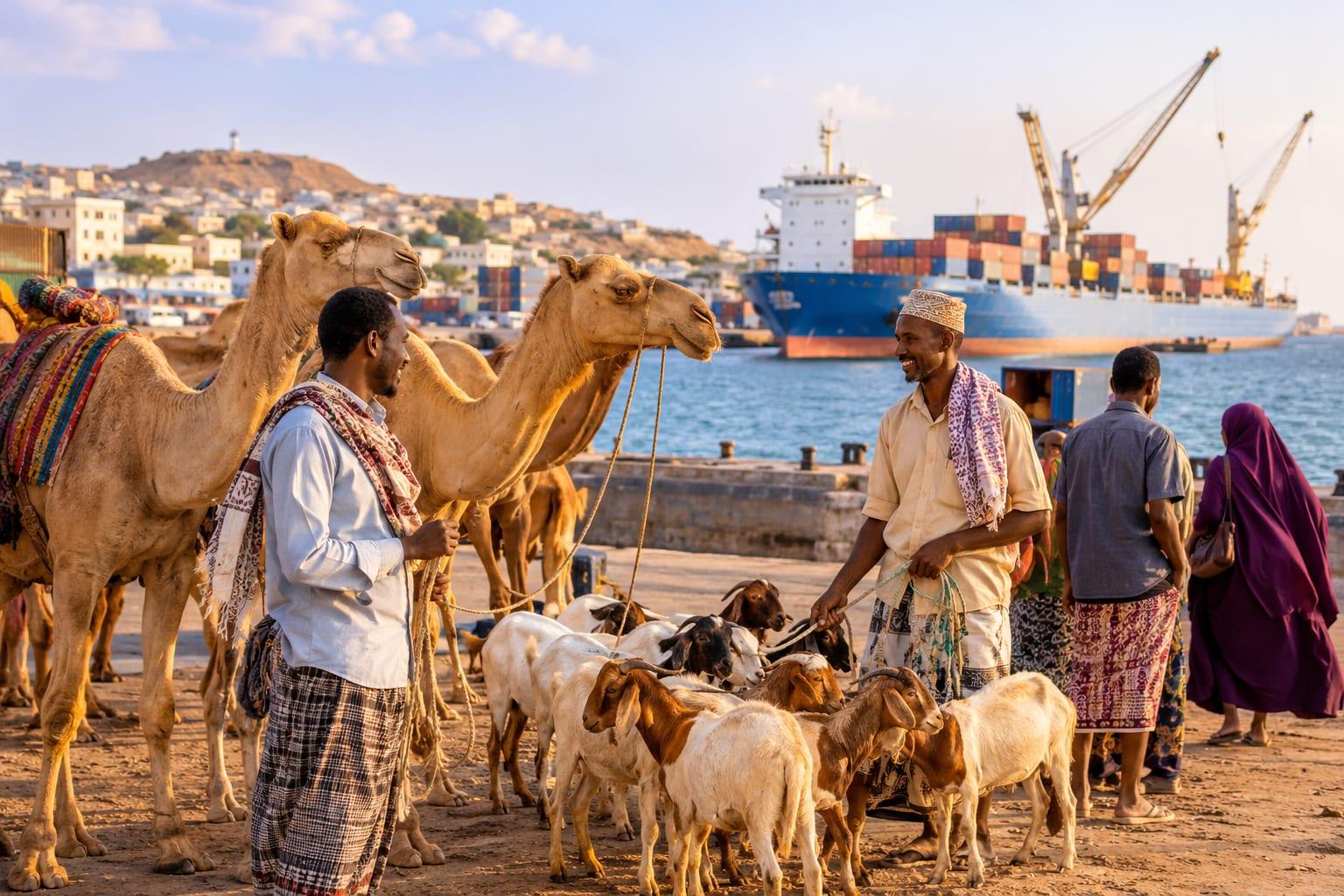
Discover how Djibouti earns its income through ports, Ethiopian trade, military bases and logistics, and explore its debt, investment opportunities and business environment.
A country that makes money from its location
In this section
Much of Ethiopia's trade passes through Djiboutian ports before going on by road or rail into Ethiopia.
The United States pays Djibouti about US$63 million a year for Camp Lemonnier, its only permanent military base in Africa. France, China, Japan and Italy also keep military facilities in the country, and other foreign troops work from allied bases. In 2017, China opened its first overseas military base in Djibouti, a short distance from the American one. In July 2026, the European Union also signed an agreement with Djibouti covering the presence and work of forces in its Red Sea naval mission.
There is a reason so many countries keep troops in a country of about 1.2 million people. Djibouti sits beside the Bab el-Mandeb Strait, a narrow passage linking the Red Sea to the Gulf of Aden and the Indian Ocean. Ships travelling between Asia, Europe and the Middle East pass through it, which makes Djibouti's location valuable for both trade and security.
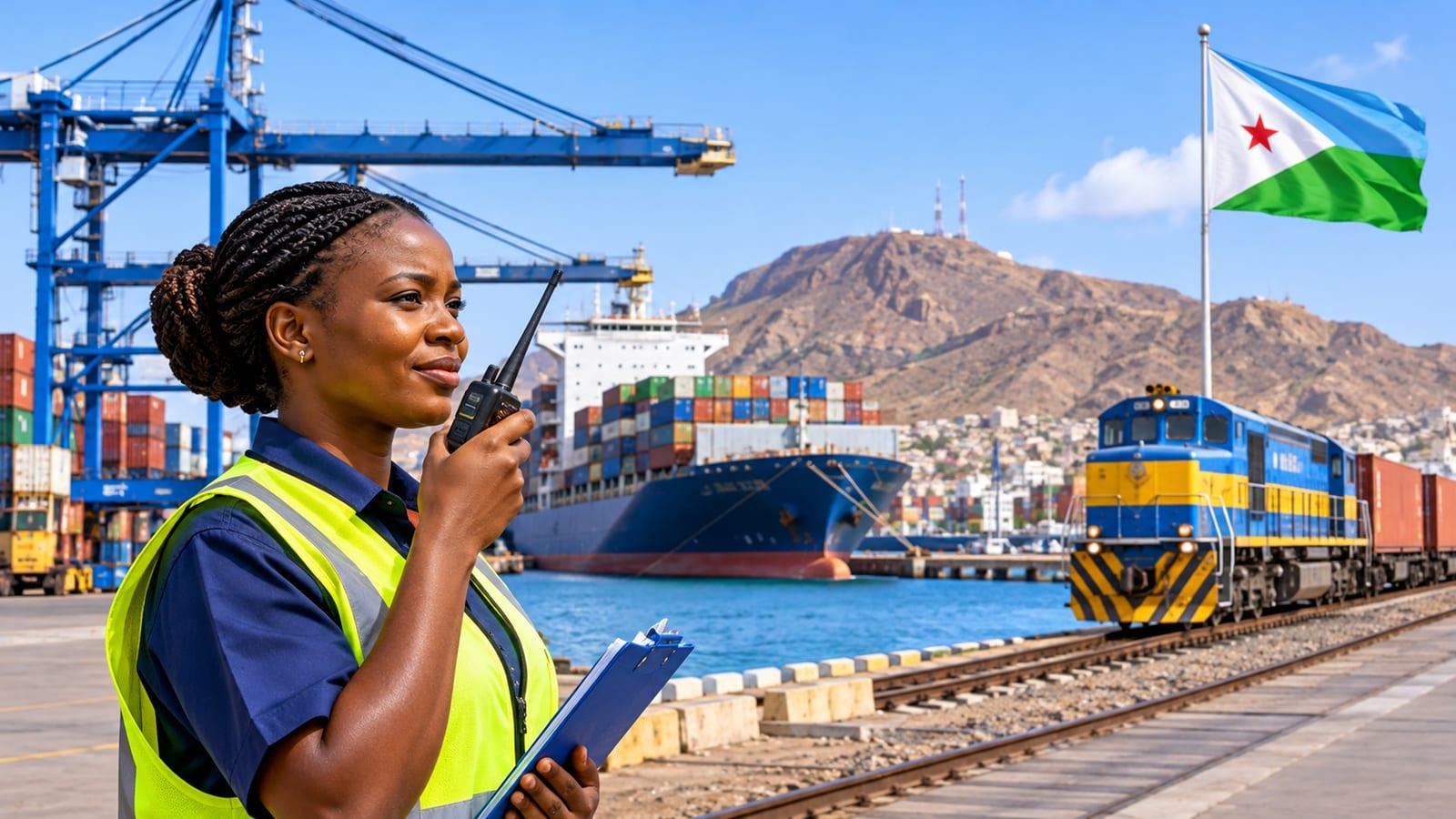
Djibouti is also the main sea gateway for neighbouring Ethiopia, a landlocked country of more than 130 million people. Much of Ethiopia's trade passes through Djiboutian ports before going on by road or rail into Ethiopia. This brings business to port operators, shipping lines, freight forwarders, transport companies, warehouse operators and other service providers.
The economy depends on serving international shipping and neighbouring markets. Port operations, logistics, military leases, transport infrastructure and financial services make up much of its activity. But Djibouti also faces serious problems, including public debt, expensive electricity, unemployment and poverty.
This is the twenty-seventh country profile in our series, Africa's Markets, Country by Country, and the seventh in its East Africa stage, following South Sudan. Djibouti is a small economy: the World Bank puts its nominal GDP at about US$4.6 billion in 2025. The economy grew by an estimated 6.5% that year, helped by construction, telecommunications, tourism and demand for services along the Ethiopia trade corridor. The World Bank's October 2026 assessment expects slower growth of about 5.7% in 2026, because of insecurity at sea, higher freight costs and other pressures.
President Ismaïl Omar Guelleh has led Djibouti since 1999. He won another term in April 2026, taking his time in office past 27 years.
Djibouti at a glance
The GDP figures below are for 2025, not 2026 projections, so they all come from the same set of estimates.
Measure
Figure
Period and source
Nominal GDP
About US$4.6 billion
2025, World Bank
Population
About 1.2 million
2025, World Bank
GDP per person
About US$3,906
2025, World Bank
Real GDP growth
6.5%
2025 estimate, IMF and World Bank
Real GDP growth forecast
5.7%
2026, World Bank, October 2026
Inflation
About 0%
2025, IMF
Fiscal deficit
About 0.7% of GDP
2025, IMF estimate
External public debt
About 68.9% of GDP
2024, World Bank-IMF
Debt owed to China Exim Bank
About US$1.47 billion
2024, World Bank-IMF
US military base lease
About US$63 million a year
US Congressional Research Service
Commercial electricity tariff
About US$0.25 per kWh
2026, World Bank Group
Currency
Djiboutian franc (DJF)
Fixed at DJF 177.721 per US dollar
Regional and international memberships
COMESA, IGAD, Arab League and AfCFTA
Membership and ratification records
How the economy is built
In this section
Under the deal, payments were limited to about US$20 million over 2024 to 2027, far less than originally scheduled.
Djibouti has little farmland, little fresh water and few minerals that could support a big export industry. Its climate is hot and dry, and it relies heavily on imported food. According to a World Bank announcement in September 2026, nearly 90% of its food comes from imports.
Without a large farming or manufacturing sector, Djibouti has built an economy around services. Its ports handle cargo for international shipping and neighbouring countries, while its railway, roads and warehouses move goods between the coast and inland markets. The government also earns money from foreign military bases and has invested in telecommunications, free trade zones and other infrastructure to draw international businesses.
How Ethiopia became so important
Ethiopia's reliance on Djibouti built up over several decades. When Eritrea became independent in 1993, Ethiopia lost direct access to the sea. The 1998 to 2000 war between Ethiopia and Eritrea then cut Ethiopian use of Eritrean ports, which made Djibouti Ethiopia's main sea gateway.
The two countries went on to build transport and trade links between Djibouti's ports and Ethiopia's commercial centres. Today, more than 90% of Ethiopia's trade is commonly estimated to pass through Djibouti, although the exact share depends on the period and how it is measured.
The World Bank has estimated that about US$400 million a year in port fees comes from handling Ethiopia-related trade. These fees are earned from the services needed to receive, handle, store and move cargo. They should not be confused with the total value of Ethiopian goods passing through Djibouti, since most of those goods belong to Ethiopian importers, exporters and traders.
The arrangement helps both countries. Ethiopia gets access to international shipping routes, and Djibouti earns money from the infrastructure and services needed to move Ethiopian goods.
Infrastructure paid for with loans
To grow as a regional trade hub, Djibouti invested heavily in ports, railways, water infrastructure and industrial sites. Chinese loans paid for several of these projects.
The Doraleh port complex added capacity for containers, general cargo and petroleum products. The railway between Djibouti City and Addis Ababa gave the two countries another way to move goods. A water pipeline from Ethiopia was also built to improve Djibouti's water supply.
The Addis Ababa to Djibouti railway began commercial service in January 2018. It runs about 750 kilometres and carries freight between the ports and Ethiopia's capital. Although the railway offers an alternative to roads, trucks are still essential to the corridor because they reach places the railway does not.
These investments improved Djibouti's transport links, but they also left a heavy debt burden. The March 2026 joint World Bank-IMF debt assessment classed the country's external and overall public debt as in distress and unsustainable.
At the end of 2024, external public debt stood at about 68.9% of GDP. China Exim Bank was owed about US$1.47 billion, almost half of the country's external public debt.
In October 2023, Djibouti reached a deal with China Exim Bank that temporarily cut payments on the railway and water pipeline loans. Under the deal, payments were limited to about US$20 million over 2024 to 2027, far less than originally scheduled.
This gives temporary relief but does not solve the debt problem. Djibouti still needs to negotiate with creditors, deal with unpaid arrears and limit new borrowing. The World Bank and IMF have also called for closer oversight of state-owned companies and better management of public money.
Growth and its limits
Djibouti's economy has kept growing despite its debt problems and the insecurity around it. The IMF estimated growth of 6.5% in 2025, helped by port activity, construction, transport, telecommunications and retail.
Inflation fell to about zero in 2025, from 2.1% in 2024. The government ran a fiscal deficit of about 0.7% of GDP in 2025, and its 2026 budget planned for no deficit.
However, the World Bank's October 2026 assessment expects growth of 5.7% in 2026. Insecurity at sea, higher shipping costs and uncertainty over trade routes have weighed on the outlook. The country also depends on Ethiopian demand, because so much of its transport and port business relies on its neighbour.
Growth has not created enough jobs or cut poverty by as much. The World Bank still names weak job creation, high unemployment, informal work and unequal access to economic opportunity as major concerns.
What Djibouti sells, buys and who it trades with
In this section
The IMF has encouraged Djibouti to review its military lease arrangements to raise more government revenue.
Djibouti's trade figures need care, because the country handles large volumes of goods that are neither made nor used there. A container arriving at Doraleh may hold machinery, food or fuel for Ethiopia, while goods leaving the port may belong to Ethiopian exporters.
The country earns money from the services involved in this trade, not from owning the goods that pass through its ports.
Port and logistics services
Port operations are among Djibouti's most important sources of economic activity. The country earns money from container handling, bulk cargo, petroleum storage, ship services, transshipment and other shipping-related work.
The Doraleh Container Terminal handles containers, while the Doraleh Multipurpose Port handles general and bulk cargo. Horizon Djibouti Terminals runs petroleum storage, serving fuel imports, storage and distribution.
These facilities serve both the home economy and regional markets, especially Ethiopia. How much they earn depends on how much cargo moves through the corridor and how well Djibouti competes with other ports.
The Addis Ababa to Djibouti railway carries containers and other freight between the port and Ethiopia's capital, while road transport remains an important part of the same corridor.
Transport companies, freight forwarders, customs agents, shipping lines and warehouse operators all take part in this trade. Businesses that can move cargo quickly, handle paperwork and coordinate deliveries between the two countries provide services that importers and exporters rely on.
Foreign military bases
Djibouti earns income from military bases run by foreign governments. The United States, France, China, Japan and Italy keep bases or facilities in the country.
The United States pays about US$63 million a year under its Camp Lemonnier lease. Other countries have their own arrangements, with different terms and payments.
The economic benefit goes beyond the lease payments. Military bases also need housing, food, maintenance, construction, transport, utilities and other services, which brings business to local suppliers.
The IMF has encouraged Djibouti to review its military lease arrangements to raise more government revenue. This matters because the country has several foreign military partners, all drawn by the strategic value of its location.
Goods exports and re-exports
Djibouti makes relatively little itself, so its goods export figures include a lot of re-exports. Salt from the Lake Assal area is one of its own products, while livestock and other regional goods also move through its trading networks.
The free trade zones and ports let goods be imported, stored, processed or sent on to other markets. As a result, the value of goods recorded as exports should not be read as the value of products made in Djibouti.
This matters when judging the country's industrial capacity and how much local businesses add to export earnings.
What Djibouti imports
Djibouti imports most of the food, fuel, machinery, vehicles, building materials and consumer goods its people and economy need.
The World Bank estimates that nearly 90% of the country's food needs are met by imports. This creates openings for food distributors, wholesalers, cold-chain operators, shipping companies and other businesses supplying the home market.
Its main import partners include China, India, the United Arab Emirates, Türkiye and Saudi Arabia. Ethiopia is also an important regional trading partner, especially for goods and services tied to the transport corridor.
Trade agreements and how goods move
In this section
Other regional ports, including those in Eritrea, Sudan and Kenya, also come up in talks about other routes.
Djibouti belongs to several regional and international organisations that support trade, economic cooperation and political ties.
The country is a member of the Common Market for Eastern and Southern Africa (COMESA), the Intergovernmental Authority on Development (IGAD) and the Arab League. It has also ratified the African Continental Free Trade Area (AfCFTA). Our guide to Africa's trade blocs explains how these groups work.
IGAD has its headquarters in Djibouti City, which gives the country an important role in regional cooperation across the Horn of Africa and eastern Africa.
However, joining a trade agreement does not remove every barrier to doing business across borders. Companies still need to understand tariffs, customs procedures, rules of origin, product standards and the rules of each market.
The main ports
Djibouti has built several port facilities for different kinds of trade.
The Port of Djibouti provides traditional port services, while Doraleh has become a major centre for containers, general cargo and petroleum. The Doraleh Container Terminal specialises in containers, and the Doraleh Multipurpose Port handles a wider range of cargo.
The Port of Tadjourah was built partly to export potash from the wider region, while the Port of Ghoubet handles salt exports from the Lake Assal area.
These facilities let Djibouti serve different cargo markets instead of relying on a single port.
Free trade zones
The Djibouti International Free Trade Zone was built to attract companies in storage, processing, distribution and regional trade. Businesses in the zone can use warehouses, industrial facilities and other infrastructure for international trade.
The government hopes companies will do more than move goods through the country. By encouraging storage, packaging, assembly and other work that adds value, Djibouti wants to keep more of the benefit from regional trade.
For a company supplying Ethiopia or other nearby markets, the free zone may be a useful base for holding stock and organising distribution. However, businesses should check the tax incentives, licensing rules, customs procedures and running costs before investing.
Competition for Ethiopia's trade
Djibouti's position as Ethiopia's main sea gateway is valuable, but it is not guaranteed to last unchanged.
Ethiopia wants more access to the sea and more trade routes. In January 2024, Ethiopia and Somaliland signed a memorandum of understanding on access to the coast. The deal set off a diplomatic dispute with Somalia, which objected on sovereignty grounds.
The memorandum is not a working commercial port agreement. Even so, it shows that Ethiopia wants more options for its trade.
Other regional ports, including those in Eritrea, Sudan and Kenya, also come up in talks about other routes. If Ethiopia moves a large share of its trade through other ports in future, Djibouti could lose some of its cargo business.
For now, Djibouti remains Ethiopia's main sea gateway, backed by established ports, road links, the railway and long-standing business relationships.
Sectors with room to grow and doing business
In this section
Businesses can provide freight forwarding, warehousing, cargo handling, customs support and transport coordination.
Djibouti's government wants to widen the economy and attract businesses that create jobs beyond ports and public infrastructure projects. The World Bank Group's September 2026 Country Private Sector Diagnostic names off-grid solar energy, data centres and tourism as sectors with strong potential for private investment.
The report estimates that reforms could bring in at least US$600 million of investment and create about 12,000 jobs over five years across these three sectors. These are possible outcomes, not investments or jobs already secured.
Logistics, warehousing and light industry
Djibouti's position next to Ethiopia and its existing transport infrastructure create openings for companies in logistics and regional distribution.
Businesses can provide freight forwarding, warehousing, cargo handling, customs support and transport coordination. There may also be openings in food processing, packaging, assembly and other work that adds value before goods move into neighbouring markets.
Cold storage matters especially for meat, fish, fruit and vegetables. Ethiopia's farm and livestock production needs reliable storage and transport if products are to reach regional and international buyers in good condition.
However, the cost of electricity and the supply of suitable industrial land must be weighed before investing in facilities that need refrigeration or constant power.
Energy
Electricity is one of the biggest running costs for businesses in Djibouti. The World Bank Group's September 2026 assessment puts commercial electricity tariffs at about US$0.25 per kilowatt-hour, against an African regional average of about US$0.14.
This gap hits businesses that rely on machinery, refrigeration, data infrastructure and air conditioning. It also makes other energy sources commercially attractive.
Djibouti has strong solar, wind and geothermal potential. The Ghoubet wind farm, with 60 megawatts of installed capacity, is an important part of its renewable energy build-out.
The World Bank Group estimates that reforms could attract up to US$390 million of private investment into off-grid solar over five years, with the potential to create more than 8,500 jobs. This depends on changes that make private electricity generation and distribution commercially workable.
Digital services and data centres
Djibouti has become an important telecommunications link between Africa, Asia and Europe. Eight working submarine internet cables pass through the country, providing international connectivity for telecom operators and digital businesses.
This creates openings for data centres, cloud services, telecommunications, network management and other digital services.
The World Bank Group estimates that the data-centre sector could attract between US$160 million and US$240 million of investment and create between 700 and 1,300 jobs over five years if the needed reforms are carried out.
However, connectivity alone does not make a country a good data-centre location. Investors also need reliable electricity, suitable buildings, skilled staff, clear rules and competitive running costs.
Tourism
Djibouti has natural attractions that set it apart in the region. Lake Assal, which lies below sea level and is the lowest point in Africa, draws visitors to its salt formations and unusual landscape. Lake Abbe is known for its limestone chimneys, while the Gulf of Tadjourah offers marine tourism, including whale-shark sightings. Our look at Djibouti's history and culture covers the country beyond its ports.
Tourism is still a small part of the economy, but there is room to develop accommodation, transport, guided trips, hospitality and marine tourism.
The World Bank Group estimates that tourism could attract between US$66 million and US$180 million of investment and create about 2,600 jobs over five years, if the business environment improves and suitable facilities are built.
Agriculture and agribusiness
Djibouti's climate and water shortages make large-scale farming difficult, but livestock, horticulture and date growing offer openings for local businesses.
In September 2026, the government and the World Bank Group launched the Djibouti AgriConnect Compact, which names these three value chains as priorities for investment and jobs.
Livestock matters a great deal to rural livelihoods. Better animal health services, processing, storage and market access could let businesses earn more from the sector. Horticulture and dates also offer ways to grow more food locally and rely less on imports.
Companies in animal feed, veterinary services, food processing, farm inputs, cold storage and distribution may find openings as these value chains grow.
What doing business in Djibouti involves
Djibouti has several advantages for companies serving international shipping and regional markets. Its currency is fixed to the US dollar, its ports give access to major sea routes, and it sits next to Ethiopia, a much larger economy.
The Djiboutian franc has been pegged at 177.721 francs to the US dollar since 1973. This gives exchange-rate stability, although keeping the currency board going depends on having enough foreign exchange reserves. The IMF has said those reserves need to be strengthened.
French and Arabic are the official languages, while Somali and Afar are widely spoken. Businesses should plan for the language needs of their customers, suppliers and government contacts.
There are also challenges investors should look at before entering. Electricity and other utility costs are high, smaller companies can struggle to get finance, and the World Bank names skills gaps and high labour costs as limits on private-sector growth.
The government and state-owned companies also play large roles in key sectors, including telecommunications, water and electricity. Serviced land outside the free zones can be hard to get, and the state owns most land.
The dispute between DP World and the government over the Doraleh Container Terminal is another important point for investors.
DP World used to run the terminal through a joint venture in which it held a 33% stake. In February 2018, the Djiboutian government took control of the terminal. Later international arbitration ruled in DP World's favour on several contract issues. In January 2022, a tribunal awarded DP World about US$148 million in damages for lost dividends, management fees and seized cash, plus interest, and a US court later enforced an award of about US$200 million. Not every ruling has gone DP World's way: in September 2025, a separate DP World claim was dismissed.
The dispute shows why companies should carry out careful legal checks, understand the terms of government concessions and get proper advice before committing money to long-term infrastructure or operating agreements.
Djibouti is also working to strengthen its rules against money laundering and terrorist financing. The IMF's January 2026 assessment noted that the country was still under enhanced monitoring by MENAFATF, the regional body responsible for these standards.
Risks and trade-offs
In this section
The March 2026 World Bank-IMF assessment classed Djibouti's public debt as in distress and unsustainable.
Djibouti's economic model brings in important revenue, but it also exposes the country to risks that businesses and investors should understand.
Dependence on Ethiopia. A large share of Djibouti's port and logistics business depends on Ethiopian trade. If Ethiopia moves more cargo through other ports, Djibouti could lose revenue and business. The country needs to keep its port services competitive while building other sources of income.
Public debt. The March 2026 World Bank-IMF assessment classed Djibouti's public debt as in distress and unsustainable. The temporary relief from the Chinese payment pause does not remove the need for creditor talks, stronger public finances and more careful borrowing.
Red Sea insecurity. The Bab el-Mandeb Strait is strategically important, but conflict and attacks on ships can disrupt the movement of goods. Changes in shipping routes, higher insurance premiums and rising freight costs can hurt port activity and raise the cost of imports. The same insecurity that makes Djibouti important for military operations can also cause problems for its commercial economy.
High running costs. Expensive electricity, limited access to finance, skills shortages and land constraints make it hard for some businesses to set up and grow. These costs matter most for manufacturing, cold storage and other activities that need reliable infrastructure.
Political and institutional risks. President Guelleh's long time in office and the limited room for political opposition raise questions about political competition and how power will eventually be handed over. The government also needs to keep confidence in its institutions and in the enforcement of business contracts if it wants long-term private investment.
What this means for an African business
In this section
Renewable energy, especially solar power, is another area worth a look because high electricity prices affect so many businesses.
Djibouti is a small consumer market, but its business importance goes well beyond its population. For businesses trading with Ethiopia, it provides the ports, transport links and services needed to move goods between world markets and one of Africa's largest populations.
A Nigerian, Kenyan, Ugandan or South African company that wants to supply Ethiopian customers, for example, may need to understand how cargo moves through Djibouti, which freight forwarders work the corridor, what customs procedures apply and how long distribution takes after goods reach the port.
Companies in logistics, shipping, warehousing, food distribution and financial services can explore openings created by this trade. Businesses supplying equipment, building materials, consumer goods and farm products may also find a market, although they must check local demand, competition and import rules before committing.
The free trade zone may suit companies that need storage or a regional distribution base, while the country's submarine cable links create openings in telecommunications and digital infrastructure. Renewable energy, especially solar power, is another area worth a look because high electricity prices affect so many businesses.
However, companies should not assume Djibouti is a cheap gateway into Ethiopia. Electricity, transport, labour, financing and other running costs can be high, and the market is closely tied to government-controlled infrastructure. Businesses should look into who owns the facilities, licensing rules, tax arrangements, land access and contract protections before entering.
Djibouti offers business openings because it connects international shipping routes to Ethiopia and other markets in the Horn of Africa. Its long-term prospects will depend on how well it uses that advantage, reduces its debt, attracts private investment and creates more productive jobs for its people.
The next profile in the East Africa stage is Eritrea, a country whose economy, trade restrictions and relationship with international markets present a very different set of challenges.