Explore Madagascar's economy, from vanilla, nickel and clothing exports to tourism, trade agreements, infrastructure challenges and business opportunities.
From vanilla farms to international markets
In this section
Farmers who had done well in the boom were left with a much weaker market, while exporters earned less.
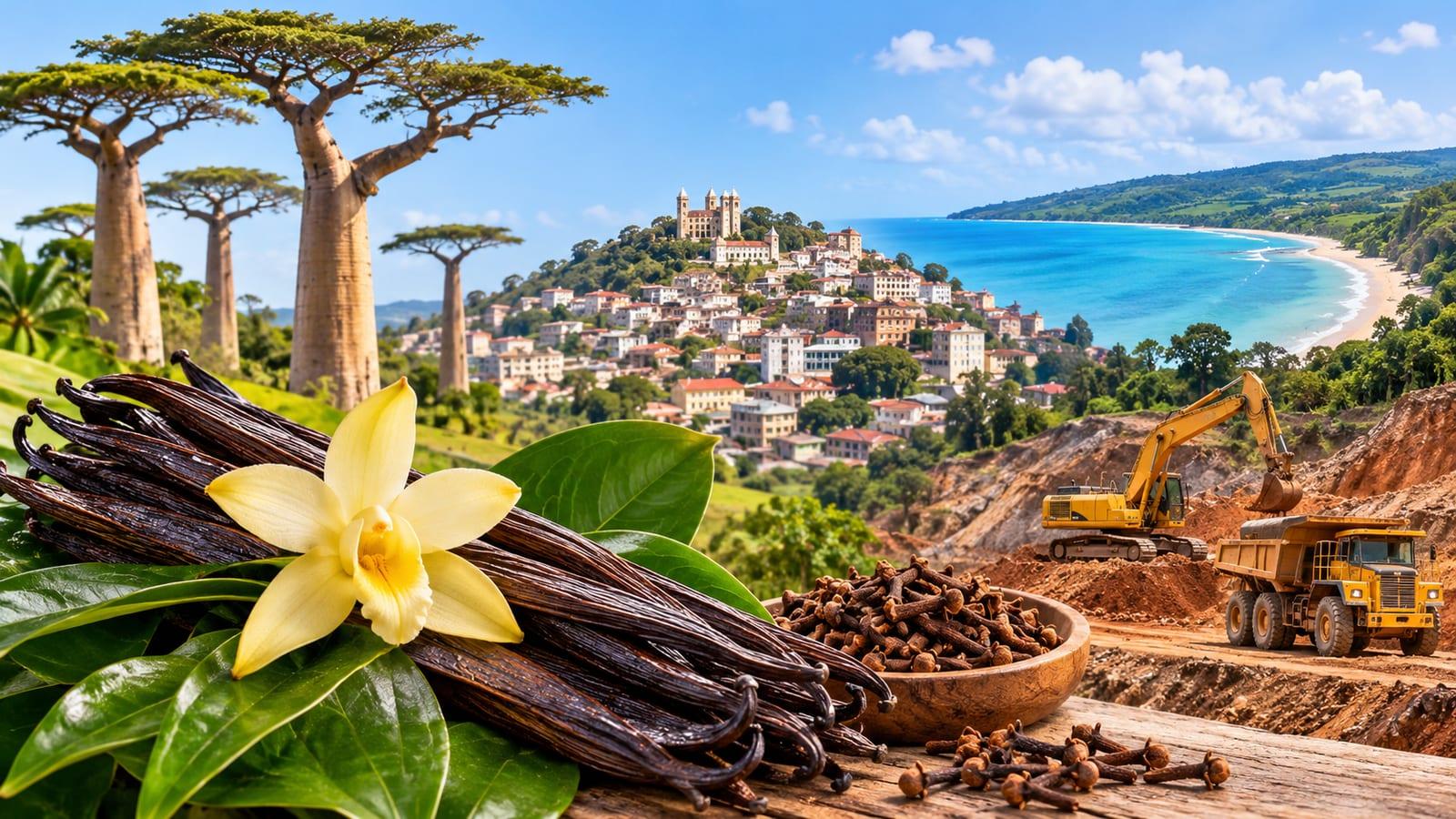
Madagascar is one of the world's most important sources of natural vanilla, and its place in the international vanilla trade has brought a lot of attention to the island's farm economy. The country also produces nickel, cobalt, ilmenite, cloves and other commodities that supply manufacturers in different parts of the world. Clothing factories, tourism businesses and service companies add to the economy, although many of these industries struggle with electricity, transport and access to finance.
Vanilla shows the opportunities and risks of producing farm commodities for international markets. Madagascar's vanilla industry saw exceptionally high prices in 2017 and 2018, which encouraged farmers and traders to invest in production. As supply increased and international buyers changed their buying patterns, prices fell sharply. Farmers who had done well in the boom were left with a much weaker market, while exporters earned less.
This is the twenty-third country profile in our series, Africa's Markets, Country by Country, following Sudan.
The country has more than 32 million people and a projected nominal gross domestic product (GDP) of about US$20.98 billion in 2026, according to the International Monetary Fund's (IMF) October 2026 World Economic Outlook. Its GDP per person is projected at about US$649, which reflects the limited income available to much of the population.
Madagascar has also gone through major political change. In October 2025, President Andry Rajoelina was removed from power after weeks of demonstrations over electricity and water shortages. Colonel Michael Randrianirina then became transitional president after the military took control. His administration has proposed holding elections in 2027, although the country remains in a period of political transition.
For businesses looking at African markets, Madagascar offers a sizeable population, farm production, mineral resources and regional trade arrangements. However, companies considering the market need to plan for limited infrastructure, low household spending power, political uncertainty and exposure to tropical cyclones.
Madagascar at a glance
Measure
Figure
Period and source
Nominal GDP
US$20.98 billion
2026 projection, IMF WEO October 2026
GDP per person
US$649
2026 projection, IMF WEO October 2026
Population
32.32 million
2026 projection, IMF WEO October 2026
Real GDP growth
3.1%
2025 estimate, IMF
Real GDP growth
3.8%
2026 projection, IMF
Real GDP growth
4.5%
2027 projection, IMF
Inflation
7.2%
End-2025, IMF
Inflation
9.3%
End-2026 projection, IMF
Public debt
47.7% of GDP
2025 estimate, IMF
Public debt
49.3% of GDP
2026 projection, IMF
Tax revenue
9.8% of GDP
2025 estimate, IMF
Current account deficit
6.0% of GDP
2025 estimate, IMF
Current account deficit
8.3% of GDP
2026 projection, IMF
Foreign reserves
6.9 months of imports
2025 estimate, IMF
Foreign reserves
6.1 months of imports
2026 projection, IMF
Tourist arrivals
308,275
2024, IMF
Tourist arrivals
330,909
2025 provisional, Ministry of Tourism
Currency
Malagasy ariary
National currency
Regional trade membership
SADC, COMESA
Current membership
Continental trade agreement
AfCFTA
Ratified
How Madagascar's economy is built
In this section
Other farm products include cassava, maize, coffee, cloves, lychees, cocoa, sugar cane and vanilla.
Agriculture remains an important part of Madagascar's economy because a large share of the population depends on farming and related work for a living. However, farm production does not bring high incomes for most rural households. Low productivity, limited irrigation, poor roads and weak storage make it hard for farmers to grow more and reach larger markets.
Rice is the country's main staple food and one of its most important crops. It is grown across the central highlands and in major farming areas such as the Lake Alaotra region. Despite local production, Madagascar still imports rice to meet demand at home. This leaves room for better farming methods, irrigation, storage and distribution, especially as population growth puts more pressure on food supplies.
Other farm products include cassava, maize, coffee, cloves, lychees, cocoa, sugar cane and vanilla. Zebu cattle are also important in rural livelihoods and Malagasy cultural life. Fishing and forestry add to economic activity in different parts of the island.
The industrial sector includes mining, food processing, textiles and clothing manufacturing. Mining matters because nickel, cobalt and other mineral exports bring in foreign exchange. Clothing factories also supply international buyers, making use of trade preferences and Madagascar's experienced garment workforce.
Services make up a large part of economic activity. These include retail and wholesale trade, transport, telecommunications, financial services, government administration and tourism. Antananarivo is the country's main commercial and administrative centre, while Toamasina plays a big role in international trade because of its port.
Madagascar has struggled to raise income per person over time. According to the World Bank, GDP per person measured in constant 2015 US dollars fell from about US$812 in 1960 to US$456.50 in 2025. This long decline reflects decades of weak growth, political instability, limited investment and low productivity.
Poverty remains widespread. The World Bank estimates that 66.5% of the population lived below the international poverty line of US$3 per person per day in 2025, using 2021 purchasing power parity. That is a modelled estimate, not a new household survey carried out in 2025. The comparable observed figure was 69.2% in 2021.
Growth has not been strong enough to create enough jobs or raise household incomes at the pace needed to cut poverty by much. Population growth, estimated at about 2.4% a year, adds to the pressure on public services, jobs and infrastructure.
Political developments and their economic consequences
In this section
The political transition remains an important factor for companies making long-term investment decisions.
Madagascar's political history has repeatedly hurt business confidence and investment.
In 2002, a disputed presidential election led to a serious political crisis between Marc Ravalomanana and Didier Ratsiraka. The standoff disrupted economic activity and affected transport and trade. Another major crisis followed in 2009, when Andry Rajoelina came to power after a takeover backed by sections of the military. The change of government drew international criticism and led to the suspension of some foreign aid.
Rajoelina later became president through elections, but his government faced fresh public anger in 2025.
Demonstrations began in September 2025, first over electricity outages and water shortages. Young people played a leading role in the protests, which grew into wider demands for political accountability and better public services.
Military defections weakened Rajoelina's position. After he left the country, parliament voted to impeach him, and Colonel Michael Randrianirina announced that the military had taken control. Randrianirina was sworn in as transitional president on October 17, 2025.
The takeover was a military intervention, not a normal constitutional transfer of power. The African Union and other international bodies raised concerns about what happened and the need to restore constitutional government.
In March 2026, Randrianirina dismissed the prime minister and the entire cabinet as part of a reshuffle of the transitional administration. His government describes its programme as a national refoundation, with plans for institutional reforms and a return to elected government.
The authorities have said elections are expected in 2027. However, businesses should tell the difference between a proposed election timetable and a completed election. The political transition remains an important factor for companies making long-term investment decisions.
What Madagascar sells, buys and who it trades with
In this section
The other shareholder is Korea Mine Rehabilitation and Mineral Resources Corporation, commonly known as KOMIR.
Madagascar's exports reflect its farm resources, mining industry and factories. Vanilla, nickel, cloves, titanium-bearing minerals, clothing, essential oils and seafood are among its main export products.
Vanilla
Vanilla is one of Madagascar's best-known farm exports. The country is the leading exporter of natural vanilla and plays a major role in supplying makers of food, drinks, cosmetics and fragrances.
The main growing areas are in the north-east, especially the SAVA region, which includes Sambava, Antalaha, Vohemar and Andapa. Vanilla takes a lot of hand labour. Farmers pollinate the flowers by hand because the natural pollinators found where vanilla first grew are not present in the same way in Madagascar's commercial growing areas.
After harvest, the green pods go through a curing process that develops the flavour and aroma international buyers want. The quality of the finished product depends on picking at the right stage, careful processing and proper storage.
Vanilla prices have swung widely. High international prices in 2017 and 2018 encouraged farmers and traders to expand production. As more vanilla came onto the market, prices weakened, putting pressure on producers who had come to depend on the higher prices.
The difference between green vanilla sold by farmers and cured vanilla exported to international buyers matters when comparing prices. Green vanilla holds a lot of moisture and must be processed before it reaches the quality most international buyers need. Its farmgate price should not be compared directly with the price of cured export-grade vanilla.
In June 2026, the Malagasy government set minimum prices for green vanilla. The minimum was 10,000 ariary per kilogram for pods longer than 13 centimetres and 5,000 ariary per kilogram for shorter pods.
These prices were meant to give farmers a basic level of protection, although they do not guarantee that buyers will purchase every available quantity at those prices.
Madagascar exported about US$231.55 million worth of vanilla in 2024, equal to about 4,544 tonnes, according to World Bank WITS data based on UN Comtrade statistics.
France was the largest single destination, buying about US$86.15 million. The United States followed with US$66.42 million, while Canada, Germany and the Netherlands were also important buyers.
For farmers, exporters and investors, the vanilla industry offers openings in growing, processing, quality control, storage and making finished vanilla products. However, companies entering the sector need to understand how much international prices move and the importance of reliable sourcing arrangements.
Nickel and cobalt
Mining is another important source of export earnings.
Ambatovy is one of Madagascar's largest industrial mining projects. Located in the east of the country, it extracts nickel and cobalt from lateritic deposits and processes the material into products used in manufacturing and industry.
The project was designed to produce about 60,000 tonnes of nickel a year, although actual output has generally been lower. Ambatovy produced about 28,000 tonnes of nickel in 2024, according to reporting on the operation.
The mine has had several operating problems. A damaged slurry pipeline forced a shutdown in September 2024, and Cyclone Gezani disrupted operations again in February 2026.
Ownership also changed in 2026. Sumitomo Corporation sold its entire stake in the project to Ambatovy Mineral Resources Investment Holding Company, known as AMRI. The consortium is led by Essenwood Partners in partnership with South Africa's Zungu Investments.
The other shareholder is Korea Mine Rehabilitation and Mineral Resources Corporation, commonly known as KOMIR. Ambatovy's announcement of the ownership change named AMRI and KOMIR as the project's shareholders.
The new owners are expected to support the operation's recovery, although restoring production and financial stability will depend on how the mine performs, repair costs and international nickel and cobalt prices.
Nickel is used in stainless steel and batteries, while cobalt is used in rechargeable batteries and other industrial products. Demand from battery makers has made these minerals important to countries and companies seeking a place in supply chains linked to electric vehicles and energy storage.
Other minerals
Madagascar also produces ilmenite, which is used to make titanium dioxide, a white pigment found in paints, coatings, plastics and paper.
Rio Tinto operates QIT Madagascar Minerals, commonly called QMM, near Fort-Dauphin in the south-east of the country. The operation produces ilmenite and also recovers zirconium-bearing material and monazite.
Monazite contains rare earth elements used in specialised industrial products, including permanent magnets.
The mining industry also includes graphite, chromite and gemstones. Graphite has drawn interest because it is used in battery anodes, although the size and commercial performance of individual projects need to be judged one by one.
Madagascar is also known for sapphires and other gemstones. Their production and trade involve both formal commercial operations and small-scale mining.
Mining offers openings for equipment suppliers, engineering firms, transport companies, maintenance providers and businesses that support mineral processing. However, investors must think about environmental duties, community relations, land access and the state of infrastructure.
Clothing and textiles
Madagascar has an established clothing industry, with factories making garments for international brands and retailers.
The sector benefits from an experienced workforce and preferential access to some overseas markets. Export processing zones have drawn manufacturers that produce clothing and textiles for customers in the United States, Europe and elsewhere.
The African Growth and Opportunity Act, known as AGOA, has been especially important to the clothing industry because it gives eligible African countries preferential access to the US market.
AGOA expired on September 30, 2025, but the United States reauthorised the programme in February 2026, with the extension applying back to October 2025. In September 2026, it was extended again, to December 31, 2028.
Madagascar is among the countries named as AGOA beneficiaries for 2026. The programme's future beyond December 2028 will depend on further decisions by the US government and Congress.
The industry also benefits from Madagascar's trade relationship with the European Union. Clothing exports are among the products that have gained from the existing EU-Eastern and Southern Africa Economic Partnership Agreement.
For manufacturers, the sector offers openings in garment production, fabric sourcing, packaging, quality assurance, logistics and factory services. Its growth will depend on reliable electricity, access to imported materials, shipping costs and the ability to meet international production and labour standards.
Other farm and manufactured exports
Cloves are another important export. Madagascar is a major producer and supplier to international spice markets, where cloves are used in food, drinks, cosmetics and medicines.
Other exports include lychees, cocoa, coffee, essential oils, shrimp and other seafood.
These products offer openings for businesses in processing, packaging, refrigeration, distribution and export services. In several farm industries, more local processing could let producers keep more value before products leave the country.
Tourism also brings foreign currency into Madagascar through hotels, transport, restaurants, tour services and other visitor spending.
What Madagascar imports
Madagascar imports a range of goods for household use, manufacturing and infrastructure.
Important imports include petroleum products, rice, machinery, vehicles, medicines, cooking oil, electrical equipment, textiles and other manufactured goods.
China is the country's largest single import supplier. Oman also accounts for a large share of imports and is easy to overlook.
According to the World Trade Organization's 2024 trade data, the main import partners were:
Import partner
Share of imports
China
24.7%
European Union
15.7%
Oman
13.6%
India
5.5%
Pakistan
4.4%
South Africa
4.3%
United Arab Emirates
4.2%
The European Union figure is the combined share of its member countries, not one single supplier.
On the export side, the European Union took 31.5% of Madagascar's merchandise exports in 2024. The United States took 15.4%, China 10.5%, South Korea 7.2% and Japan 6.9%.
These figures show that Madagascar's trade is tied to several major markets in Europe, Asia and North America. They also show why it pays to understand the destination market before entering the country's export industries.
Trade agreements and how goods move
In this section
Toamasina is Madagascar's main commercial port and handles a large share of the country's international cargo.
Madagascar takes part in several regional and international trade arrangements that shape its access to overseas markets.
SADC and COMESA
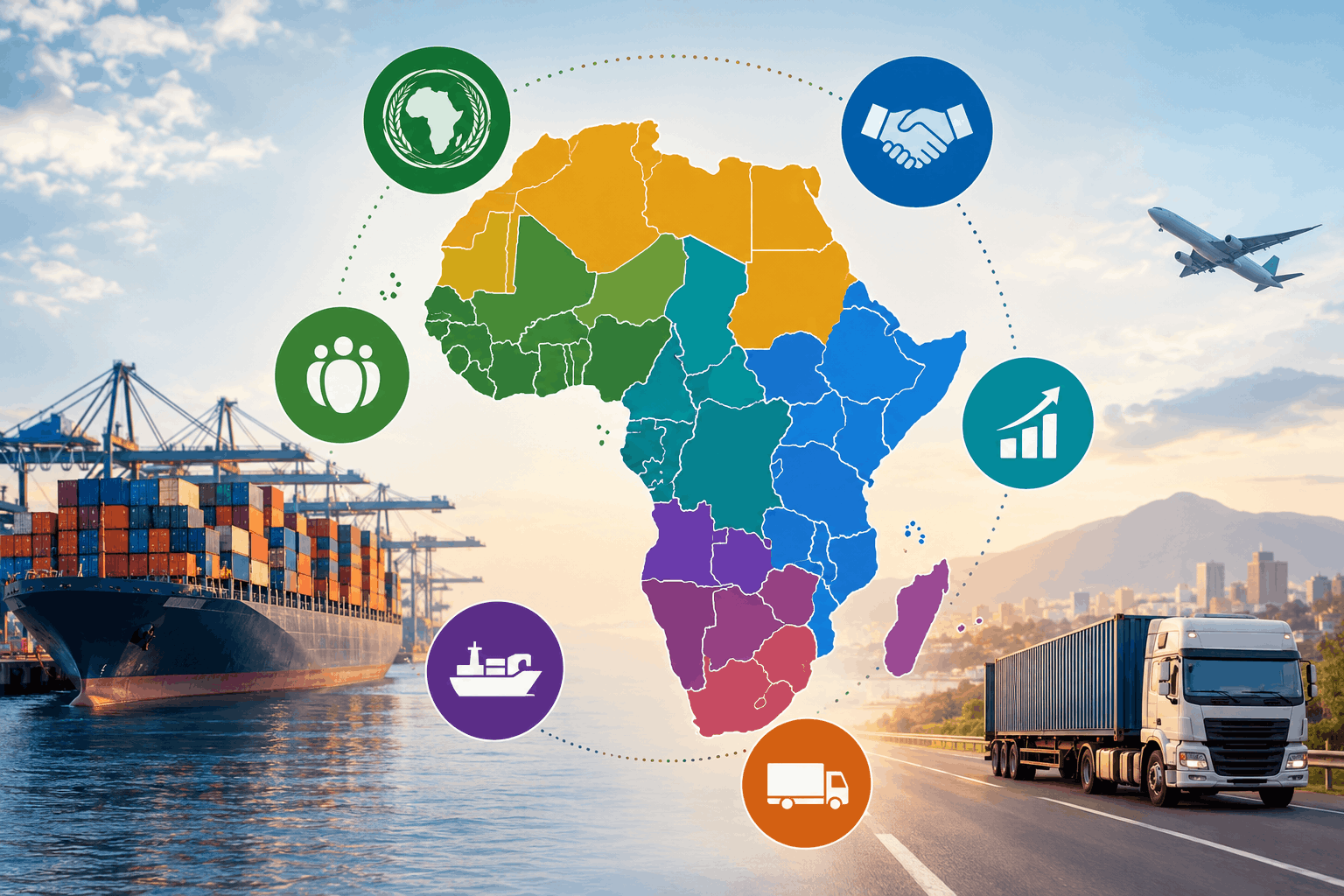
Madagascar is a member of the Southern African Development Community (SADC) and the Common Market for Eastern and Southern Africa (COMESA). Our guide to Africa's trade blocs explains how these groups work.
SADC has 16 member states, including Madagascar, South Africa, Mauritius, Tanzania, Mozambique and Zambia. It works to improve economic cooperation, trade integration and regional development.
COMESA brings together countries from eastern and southern Africa and provides a framework for trade cooperation and economic integration.
Membership creates openings for businesses to trade across regional markets under the preferential arrangements that apply. However, membership does not mean every product automatically qualifies for duty-free treatment. Companies still need to check rules of origin, product classifications, customs requirements and tariff schedules.
African Continental Free Trade Area
Madagascar has ratified the African Continental Free Trade Area (AfCFTA) agreement and is among the countries that have deposited their instruments of ratification.
The AfCFTA aims to create a single African market for goods and services, backed by common rules and arrangements for lowering trade barriers.
For Madagascar, taking part creates chances to build trade ties with other African countries. Businesses in food processing, textiles, manufacturing, logistics and professional services may benefit as the agreement is put into practice.
The practical benefits depend on how tariff cuts, customs procedures, rules of origin and other national commitments are carried out.
Trade with the European Union
Madagascar has an established Economic Partnership Agreement with the European Union through the Eastern and Southern Africa arrangement.
The interim agreement was signed in 2009 and has been provisionally applied since May 2012. It gives qualifying Malagasy products preferential access to the European market.
In June 2026, the European Union and four Eastern and Southern African countries, including Madagascar, concluded negotiations to deepen and modernise the existing agreement.
The enhanced agreement covers a wider range of trade-related areas, including customs procedures, services, investment, digital trade, intellectual property and public procurement.
However, concluding negotiations does not mean all the new provisions are already in force. The agreement is going through legal review, with signature and ratification still to follow.
Trade with the United States
AGOA remains an important trade arrangement for Madagascar, especially for its clothing and textile makers.
The programme lets eligible sub-Saharan African countries export qualifying products to the United States without paying certain import duties.
Madagascar remains a designated beneficiary for 2026, and the programme now runs until December 31, 2028.
Businesses supplying the American market need to watch future decisions in Washington, because changes to AGOA could affect production costs, sourcing decisions and how competitive Malagasy manufacturers are.
Ports and transport infrastructure
Toamasina is Madagascar's main commercial port and handles a large share of the country's international cargo. Its position on the east coast makes it a key entry point for imported goods and an export route for farm and mineral products.
The port is connected to Antananarivo by the RN2 highway, one of the country's most important transport corridors. This route is essential for moving goods between the capital and the coast.
Other ports also support regional and industrial trade. Mahajanga serves the north-west, Toliara serves the south-west, and the Port of Ehoala near Fort-Dauphin supports mining and other commercial activity.
Madagascar's road network remains a major challenge for businesses. Some roads become difficult or impassable in the rainy season, which raises transport costs and makes it harder for farmers and manufacturers to deliver on time.
Ivato International Airport in Antananarivo is the country's main international air gateway. Air transport is important for tourism, passenger travel and high-value goods that need faster delivery.
Sectors with room to grow and doing business in Madagascar
In this section
Vanilla producers could benefit from better curing facilities, extraction plants, quality testing and packaging.
Madagascar has several industries that could attract more investment, although opportunities vary by location, infrastructure needs and how easily businesses can reach customers.
Power and water
Electricity supply is one of the country's most persistent business problems.
JIRAMA, the state-owned water and electricity company, has struggled with financial difficulties, ageing infrastructure, too little investment and inefficient operations. Power cuts and water shortages affect households, manufacturers, hotels and shops.
The electricity shortages were also among the immediate causes of the September 2025 demonstrations.
The IMF has called for JIRAMA's recovery plan to be carried out, with the aim of making service more reliable while reducing the financial burden on the government.
This creates possible openings for private companies in solar power, hydropower, mini-grids, energy storage, electricity distribution and water treatment.
Businesses that can provide reliable power to factories, commercial buildings, hotels and rural communities may find demand for their services. However, investors need to understand the regulations, electricity tariffs, project financing needs and the financial position of possible customers.
Agro-processing and food production
Madagascar produces a wide range of farm commodities, but much of their value can be lost when they are sold with little processing.
Vanilla producers could benefit from better curing facilities, extraction plants, quality testing and packaging. Cocoa production offers openings for chocolate making, while cloves and other spices can be processed into finished products for food and fragrance companies.
Lychees and other perishable products need proper storage, refrigeration and transport to reach international markets in good condition.
Rice production also deserves attention. Investment in irrigation, farm equipment, storage and processing could improve supply at home and reduce the need for imported rice.
Companies entering this sector should study the supply of raw materials, seasonal production patterns, farmer relationships and access to reliable transport.
Clothing and light manufacturing
Madagascar already has an established garment industry, which gives investors an existing workforce and industrial base to work with.
There are openings in clothing production, textile processing, packaging, factory equipment, quality assurance and logistics.
The country's trade arrangements with the European Union and its AGOA eligibility also give access to important export markets, although US trade preferences are only confirmed until December 2028.
Companies considering manufacturing in Madagascar should assess electricity costs, access to imported fabrics, labour supply, shipping schedules and what their buyers require.
Tourism and hospitality
Madagascar's natural environment draws visitors interested in wildlife, forests, beaches and outdoor activities.
The island is especially known for its lemurs, many species of which are found nowhere else. Its baobab landscapes, national parks, coral reefs and coastal destinations also add to its appeal. Our profile of Madagascar's history and culture covers the country beyond its economy.
Tourist arrivals reached 308,275 in 2024. Provisional figures published by the Ministry of Tourism put arrivals at 330,909 in 2025, including visitors arriving by air and sea.
The increase points to a recovery in international visitor numbers, although arrivals alone do not show how much tourism contributes to the economy.
There are openings in accommodation, transport, restaurants, specialist tours, conservation-related tourism and hospitality training.
Better roads, reliable electricity, easier access to regional destinations and more accommodation outside the established tourism centres could support further growth.
Mining and mineral processing
Madagascar's nickel, cobalt, ilmenite, graphite and other mineral resources attract interest from international mining companies and industrial suppliers.
The openings go beyond digging minerals out of the ground. Businesses can also provide geological services, mining equipment, engineering, maintenance, transport, safety systems and mineral processing.
Local processing plants could increase the value kept in Madagascar, although such projects need large investment, reliable power and suitable infrastructure.
Mining companies also need to deal with environmental protection, land access and the concerns of communities living near project sites.
Business registration and operating conditions
Foreign investors looking to set up in Madagascar can work with the Economic Development Board of Madagascar (EDBM), which provides information and support for investment and company set-up.
French and Malagasy are the main languages used in government, administration and business. Companies entering the market should plan for local language needs when preparing contracts, hiring staff and dealing with government agencies and customers.
Businesses also need to plan for practical operating conditions, including power cuts, road quality, access to foreign currency, customs procedures and the supply of skilled workers.
The Malagasy ariary is the national currency, and exchange-rate movements can affect the cost of imported equipment, raw materials and other business expenses.
Political uncertainty is another factor, especially for investors planning projects that take several years to pay back their initial capital.
Risks and trade-offs
In this section
Investors need to follow institutional reforms, election arrangements and changes in economic policy.
Madagascar has large farm, mineral and tourism resources, but companies should not overlook the risks of operating in the country.
Political uncertainty: The military-led transition that began in October 2025 has raised questions about the country's political direction and when it will return to elected government. Investors need to follow institutional reforms, election arrangements and changes in economic policy.
Electricity and water shortages: Unreliable utilities raise operating costs, especially for manufacturers, hotels, food processors and businesses that depend on refrigeration or nonstop production.
Cyclones and climate risks: Madagascar is exposed to tropical cyclones, flooding and drought. In February 2026, Cyclone Gezani struck the eastern coast near Toamasina, causing heavy damage to homes and infrastructure. The World Meteorological Organization reported that nearly 270,000 people were affected in the immediate aftermath, while Madagascar's disaster management agency later reported a higher preliminary figure as assessments continued. Cyclones can disrupt roads, ports, electricity supply, farming and mining.
Drought is also a serious concern in southern Madagascar, where long periods of poor rainfall have hurt farming and food security.
Commodity price swings: Vanilla, nickel, cobalt, cloves and other exports are exposed to international market movements. A fall in prices can cut export earnings and affect the incomes of producers and companies that depend on these commodities.
Low household spending power: Madagascar has a large population, but a big share lives below the international poverty line. Businesses selling consumer products need to understand local incomes, price expectations and the differences between urban and rural markets.
Infrastructure and transport: Poor roads, limited logistics facilities and unreliable utilities can raise the cost of moving goods. Companies should work out these costs before deciding where to set up production or distribution.
Public finances: Tax revenue remains low compared with the size of the economy. This limits the government's ability to pay for infrastructure, public services and development programmes without relying on outside aid and borrowing.
The IMF's current programme includes reforms meant to improve revenue collection, strengthen public financial management and deal with the financial troubles of public utilities.
What this means for an African business
In this section
Energy and water services deserve attention because unreliable supply affects several industries at once.
Madagascar offers African companies access to a market of more than 32 million people, with established industries in farming, mining, textiles and tourism. Its location in the Indian Ocean also puts it on trade routes linking eastern and southern Africa with Asia.
Its membership of SADC and COMESA provides a framework for regional trade, while its part in the AfCFTA opens the way to wider trade ties across the continent.
For businesses in South Africa, Mauritius, Kenya and other African markets, Madagascar could offer openings in food processing, farm inputs, renewable energy, water infrastructure, transport, hospitality and industrial services.
Companies already working with farm producers may also find chances to source vanilla, cloves, cocoa, essential oils and other products from Malagasy suppliers. However, entering these industries takes an understanding of production seasons, quality standards, export requirements and the existing relationships between farmers, traders and processors.
The clothing industry is another area worth a look, especially for companies supplying fabrics, packaging, equipment and manufacturing services. Because there is already an export base, businesses can look at serving existing factories rather than relying only on new factories being built.
Energy and water services deserve attention because unreliable supply affects several industries at once. Companies with experience in solar installations, energy storage, water treatment and distribution may be able to solve problems that affect both businesses and households.
However, Madagascar should not be treated as a market where a large population automatically means strong consumer demand. Low household incomes, infrastructure costs and the concentration of business activity in certain places all affect the size of the market a company can actually reach.
Before entering, companies should work out who their customers will be, where suppliers are located, how products will reach buyers, which local partners they need and which bodies regulate the industry.
The country's political transition also makes it important to understand the rules and the chance of policy changes before committing large sums.
Madagascar has resources and industries that can support trade with other African countries, but success will depend on understanding the conditions businesses operate under and the cost of reaching customers.
The next country profile in the East Africa stage of Africa's Markets, Country by Country, is Mauritius, an island economy with a different industrial structure and a much higher income per person.