
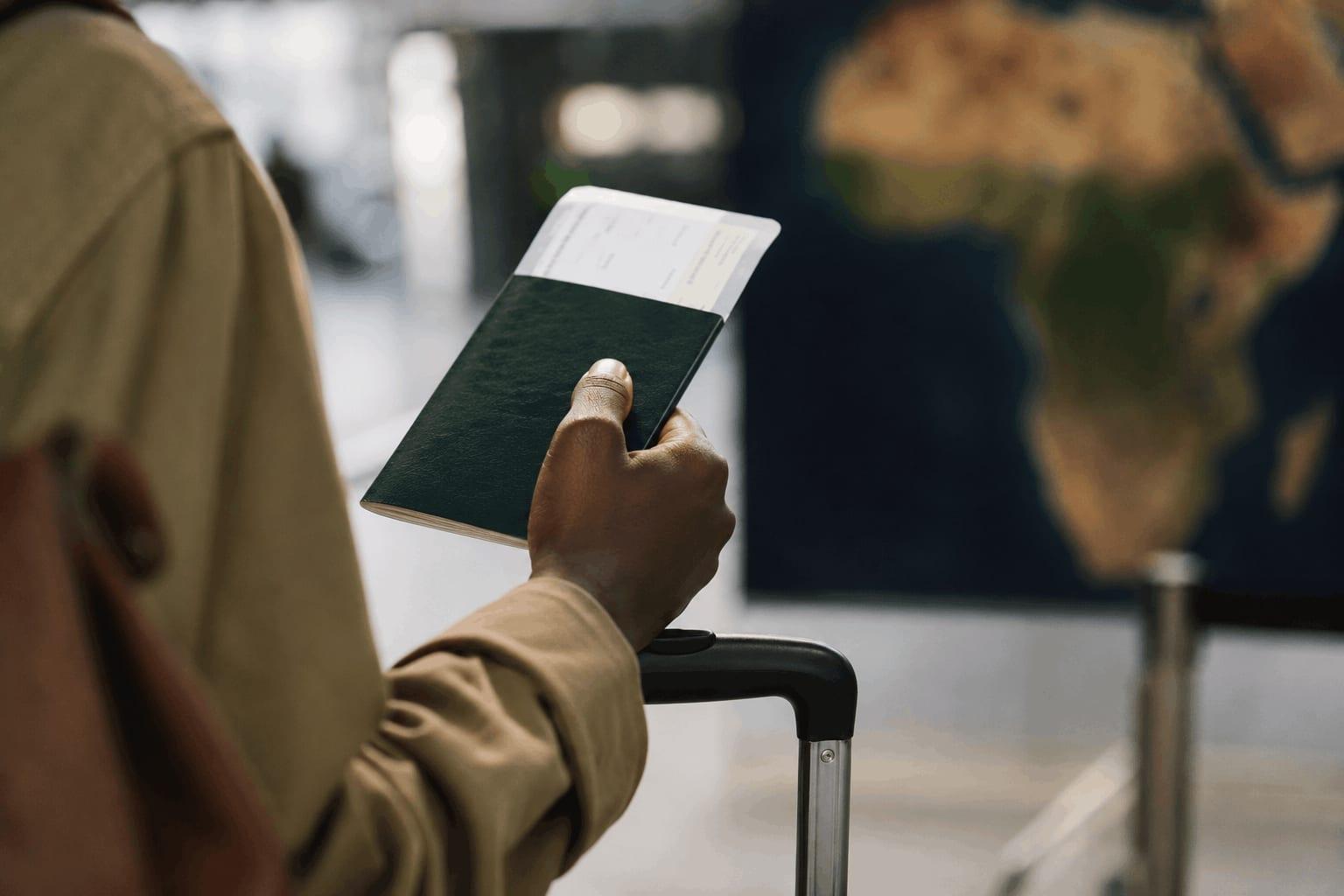
On 1 May 2025, Nigeria stopped issuing visas on arrival. Travellers who used to get permission at the airport now have to obtain approval through the Nigeria Immigration Service e-Visa portal before they travel, since airlines can refuse to let passengers fly without valid pre-travel authorisation.
The government first announced the change on 21 February 2025, citing national security, and the e-Visa system itself went live on 1 May. The government then adopted the Nigeria Visa Policy 2025 on 8 May, formalising the shift and building on an earlier 2020 framework, and adding a new Short Visit Visa category that can only be obtained online. Visas on arrival that had already been issued stayed valid for a couple of weeks after the switch, until 30 May 2025, and after that the counter was simply gone.
The government's reasoning is efficiency and security: applications get checked against international databases before anyone travels, paper landing cards are replaced with digital ones, there is now an electronic record of who enters and leaves, and the stated processing time is 24 to 48 hours. By most ordinary measures, that looks like modernisation, since it is faster than a paper queue and harder to cheat.
But by the measure that the African Union Commission and the African Development Bank use to track visa openness across the continent, in a report called the Africa Visa Openness Index, this counts as Nigeria becoming less open, and by enough of a margin to drop the country twenty-six places on a table of fifty-four countries. Both of those things can be true at once, and the gap between them is worth looking at closely.
How the index counts
The Africa Visa Openness Index is now in its tenth year. It looks at how easy it is for citizens of one African country to enter another. There are 2,862 possible country-to-country travel scenarios across the continent.
The scoring is straightforward. Visa-free travel gets one point. Visa on arrival gets 0.8. If you have to get permission before you travel, whether through a traditional visa, an e-visa or an electronic travel authorisation, you get zero. The index does not consider how fast, cheap or convenient that process is.
So, if a country replaces a visa desk at the airport with an online system that approves you within 24 hours, it loses four-fifths of a point for every affected country. It does not matter that the traveller can still enter. The difference is that permission now has to be obtained before the journey instead of at the border.
Nigeria is one of four countries that made this kind of change in 2025, alongside Guinea-Bissau, Mauritania and Somalia. Together, their changes affected 162 country-to-country travel scenarios. The index records those changes as a decline in visa openness, even when the new system may actually make the process easier for travellers. Across Africa, 31 countries now offer e-visas.
What actually changed for Nigeria's score
In the 2024 edition of the index, Nigeria ranked sixth, tied with Cabo Verde, with a score of 0.864. At the time, 17 African countries could enter Nigeria without a visa, while 36 could get one on arrival. In other words, no African traveller covered by the index had to get permission before leaving home.
In the 2025 edition, Nigeria's score fell to 0.321 and its rank dropped to 32nd. The same seventeen countries still travel visa-free. The other thirty-six, who used to get a visa at the airport, now need an e-visa approved before they board. Under the index's scoring rules, that single policy shift accounts for the entire fall, since those thirty-six scenarios went from being worth 0.8 each to being worth nothing.
Let's say this in simpler terms; The same 17 countries could still enter visa-free. The difference was the other 36. They could no longer get their visas at the airport and now had to apply for an e-visa before travelling.
Nigeria's drop is not the only thing that moved West Africa's regional average down that year. Nigeria's change was not the only reason West Africa's regional score fell in 2025. Burkina Faso, Mali and Niger also left ECOWAS in January 2025, so they were no longer included in the regional calculation. That means the regional decline and Nigeria's individual decline should be treated as separate numbers, not as evidence for each other.
This is a continental pattern, not a one-off
Nigeria is not an outlier. Across the whole continent, visa-on-arrival access fell to 20.4% of all travel scenarios in 2025, the lowest level the index has ever recorded, down from 24.8% the year before. Scenarios that now require a visa before travel rose in the same period, from 47.1% to 51.1%, pushing that category above the halfway mark for the first time since 2021. Meanwhile visa-free travel did not fall at all. It actually rose slightly to 814 scenarios, or 28.2% of the total, the highest level the index has ever recorded.
Put together, that means visa-free access is at a record high at the very same time that visa-on-arrival access is at a record low, and the two trends have not cancelled each other out because the movement did not flow between them. It flowed from visa-on-arrival straight into pre-travel authorisation, and the index treats that destination as equivalent to the old consular queue it replaced.
Africa is not simply becoming more closed, and it is not simply becoming more open either. It is moving the point where permission is required from the border to before the border, and the tool used to measure progress reads that shift as a step backwards.
Three different changes hiding under one label
The category "visa required ahead of travel" is actually hiding at least three different kinds of policy change.
A country can restrict access by replacing visa-free entry with a visa requirement. In 2025, Algeria, Angola, Benin, Tunisia and Uganda made targeted changes of this kind, affecting travellers from ten African countries in total.
A country can digitise an existing process, by replacing a visa-on-arrival system with an e-visa or an electronic travel authorisation. This is what Nigeria, Guinea-Bissau, Mauritania, and Somalia did.
Or a country can liberalise, by removing a pre-travel requirement altogether. Kenya is the clearest example of this in either direction. It introduced an electronic travel authorisation in 2024, which the index classified as equivalent to an e-visa, and its rank fell to 46th as a result. In 2025 it then exempted 52 African countries from that same authorisation entirely, and its rank jumped to third place with a score of 0.962. The index caught both moves correctly and quickly.
From a traveller's point of view, these are three very different kinds of policy. From the point of view of a measurement system built around when permission is required, two of them look identical.
Seychelles shows this most clearly. It runs a compulsory electronic travel authorisation covering all arrivals, and because that authorisation has to be obtained ahead of travel, the index classifies it the same way it classifies an e-visa. Seychelles, which had sat at the top of the index since it first launched, scored zero in 2025 and dropped to 54th place, dead last, without turning away a single African traveller.
South Africa shows the other side of the problem. Its electronic travel authorisation, piloted in 2025, applies to travellers who already needed a visa before travelling and moves that process online. For those travellers, that can make the process faster and easier. But the change does not improve South Africa's score because those travellers already needed permission before departure, so the scenarios scored zero before and still score zero afterwards.
In other words, the index cannot capture an improvement when a country makes an existing visa process easier. In the same way, it cannot tell the difference between Nigeria moving visa processing online and a country making its border genuinely harder to cross.
The report itself acknowledges this limitation. It says the index does not distinguish between the different ways travellers can get permission before a trip, even though a quick online process can be much easier than a traditional paper-based visa. Both still receive the same score.
The report also makes an important point about electronic travel authorisations. They should not become visas in disguise. Where a country already offers visa-free or visa-on-arrival access, the report says any new authorisation should ideally be free and limited to basic information.
Why this matters beyond a ranking
This is not just a scoring quibble, for two reasons.
First, these numbers back up a real policy argument. The African Union's free movement agenda rests on the idea that people should be able to move as freely as goods do, and the visa openness figures are one of the main measures used to track progress on that goal. The agenda itself is stalled. According to the African Union's own treaty records, its Protocol on the Free Movement of Persons was adopted in January 2018 and signed by 32 countries, but only four of them, Mali, Niger, Rwanda, and São Tomé and Príncipe, have actually ratified it, against a threshold of fifteen ratifications needed for the protocol to take legal effect. Nigeria has neither signed nor ratified it. If the continent's headline openness figures are falling mainly because governments are digitising rather than genuinely restricting movement, then the argument for continental mobility is being made using a number that nobody has fully worked out how to interpret.
Second, applying for permission before you travel is not the same as applying for it once you arrive, even when the online process itself is fast. It requires reliable internet, a working device, an email address, a way to pay online, and documents that match up correctly across systems. Visa on arrival had its own costs and uncertainties, including payment, biometrics, waiting, and an official's discretion at the counter, but it placed that burden at a different point in the journey, and it did not require a traveller to be online and paid up before departure.
Nigerian citizens travelling within the ECOWAS bloc remain visa-free, and nothing about this change affects that. But for visitors from most of the rest of the continent, Nigeria's policy now asks them to seek permission before they ever leave home, rather than when they land.
The real question underneath all of this
Nigeria's reform makes sense on its own terms. The same can be said of Seychelles, which introduced a universal electronic travel authorisation and then fell from the top of the index to the bottom, even though it did not suddenly start turning African travellers away. South Africa presents another version of the same problem. It moved part of its existing visa process online, making it easier for some travellers, but the index gives it no credit because those travellers already needed permission before departure.
Which brings us to the bigger question: what actually makes a border open? Is it a border you can cross without asking for permission, or one where getting permission is simple, quick and predictable?
African countries are increasingly building systems where permission is easier to get rather than unnecessary to get, while the main measure of visa openness still focuses on whether permission is required at all. Until those two ideas are reconciled, Africa will keep producing a strange contradiction: governments can say they are making travel easier, while the numbers say the continent is becoming less open, and both can be technically right.
───
Sources
• DLA Piper GENIE, "Nigeria's visa-on-arrival policy: Key updates"
• PwC Nigeria, "New immigration rules in Nigeria from 1 May 2025"
• International Bar Association, "Nigeria Visa Policy 2025"
• Fragomen, "Nigeria: Visa-on-Arrival Cancellation and eVisa Rollout"
• Aluko & Oyebode, "Nigeria Rolls Out e-Visa and Automated Entry System"
• African Development Bank and African Union Commission, Africa Visa Openness Index 2025, "2025: Visa openness remains a work in progress" and full report PDF
• Vanguard News, "Nigeria ranks 6th on Africa Visa Openness Index"
• United Nations Economic Commission for Africa, "Experts meet to review the ECA-AUC policy report on the AU Free Movement of Persons Protocol"
• African Union, list of signatories and ratifications to the Protocol on Free Movement of Persons (PDF), the primary record for ratification status, cited directly rather than through the AVOI report
← Back to blog Planning a trip to Nigeria? Check the free ETA & visa tracker for what you actually need before you fly.See all 9 posts


 More in this clusterSee all 13 articles on Africa Travel & Visas
August 4, 2026
Nigeria Visa Changes: Why Travellers Now Need Approval Before Flying
By Tori, Ria's Colony
Series
Post 1 of 9
Moving Africa
1Nigeria Visa Changes: Why Travellers Now Need Approval Before FlyingYou're reading this one
2Two Indices Looked at Seychelles. One Called It the Second Most Open Country on Earth. The Other Ranked It Last in Africa.Related reading
August 15, 2026
The Missing Africa Passport Ranking: What No Index Measures
August 15, 2026
Africa's Electronic Travel Authorizations: A Country-by-Country Tracker
August 15, 2026
Can Africa Be One Travel Market With 54 Different Borders? Inside the Visa Data Gap
August 7, 2026
South Africa Visa Fee: What the New R500 ETA Charge Means