Mozambique's eVisa portal lets most of the world apply online, but blocks six nationalities, including Nigeria, forcing them into embassy-only applications. Tanzania excludes Nigeria from its Commonwealth visa waiver too. Neither government will explain why, and the continent's main openness index isn't built to catch it.
Questions were put to Mozambique's National Migration Service on 31 July 2026. No response had been received at the time of publication. VFS Global responded twice.
Mozambique wanted a modern visa system. In 2025 it launched an online portal that let travelers apply for entry from their own homes instead of standing in line at an embassy. The system broke down within weeks of launch. It was rebuilt with help from VFS Global, the international company that runs visa processing for governments around the world, and it has been working again since.
Today the portal handles applications from most of the planet.
But not from everyone.
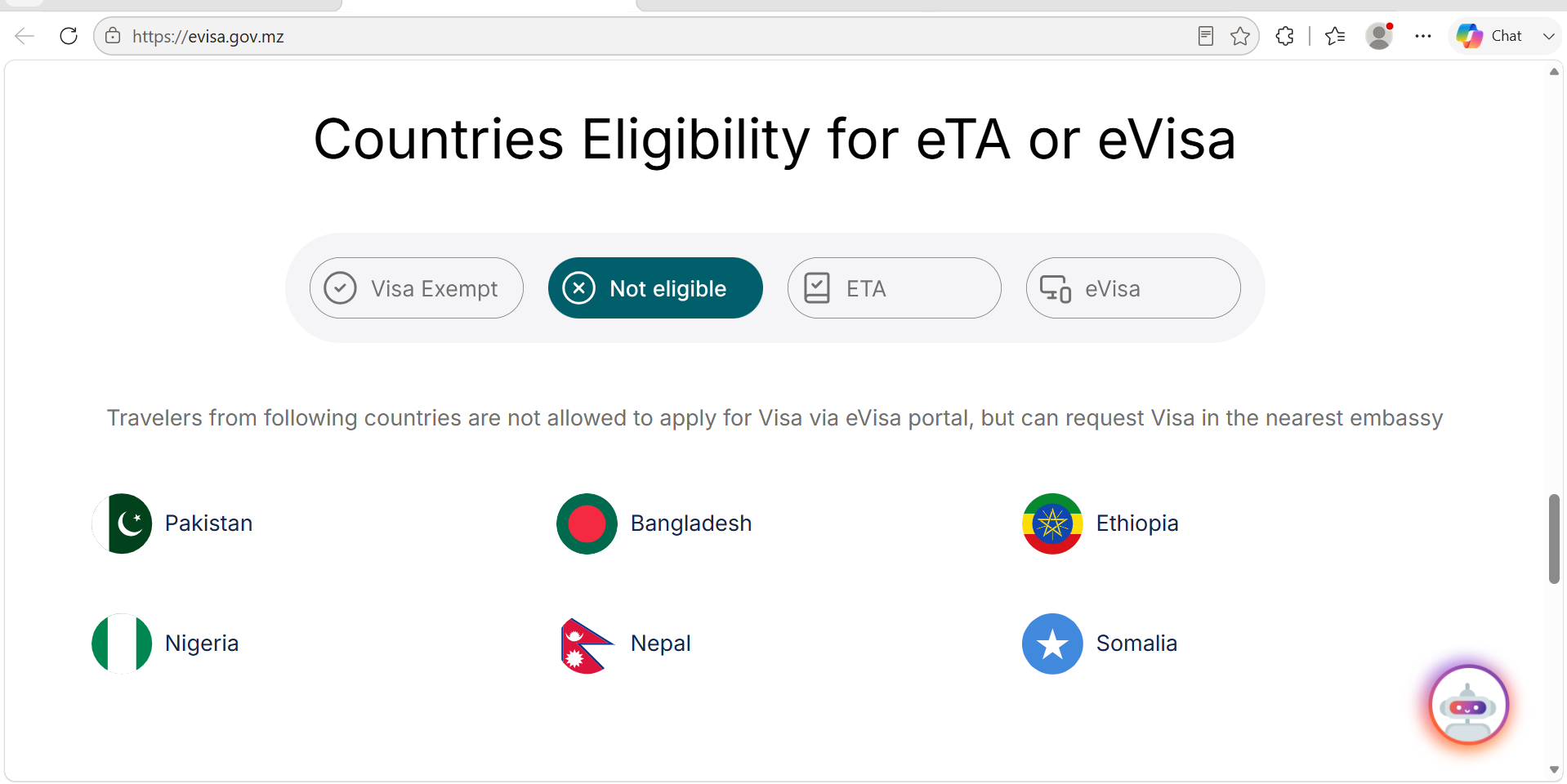
If you check the eligibility page on Mozambique's eVisa portal, you will find that citizens of six countries cannot use it at all: Pakistan, Bangladesh, Nepal, Ethiopia, Somalia and Nigeria. This is confirmed on the government's own site, and multiple independent visa information services list the same six names. There is no footnote explaining why these six were picked, no date attached to the decision, and no public statement from the Mozambican government about how the list was drawn up.
Three of the six countries on that list are in Africa.
What it actually means to be left off the list
In this section
For most people in Nigeria, that means Abuja, where Mozambique maintains its diplomatic mission in the country.
The visa requirement itself has not changed. A Nigerian who wants to visit Mozambique still needs a visa, the same as before. What has changed is how that person is allowed to ask for one.
Picture two travelers who both need a Mozambican visa. One is Portuguese. The other is Nigerian. The Portuguese traveler opens a laptop, fills in a form, uploads a passport photo, pays online, and waits for an email. So can a Brazilian. So can a Malaysian. So can a Kenyan or a South African, both of whom, as it happens, do not need a visa to enter Mozambique at all.
The Nigerian traveler cannot do any of that. They have to find a Mozambican embassy or consulate, physically travel there, and apply in person.
For most people in Nigeria, that means Abuja, where Mozambique maintains its diplomatic mission in the country. For someone travelling from Benin City, that is a full day on the road each way, and it has to happen before the trip even begins, not during it. A traveler in Lisbon can decide to visit Mozambique on a Tuesday and start the process that evening. A traveler in Benin City has to plan a separate journey just to be allowed to plan the real one.
The visa fee charged at the embassy may be exactly the same figure as the fee charged online. But the true cost, in time, in transport, in missed work, in the sheer hassle of it, is not the same at all. And that gap does not show up anywhere in the way the world currently measures how open African borders are.
The index that cannot see this problem
In this section
Add it all up across all 53 possible partner countries and you get a score between 0 and 1.
Every year, the African Development Bank and the African Union Commission publish something called the Africa Visa Openness Index. It has been running since 2016, and its whole purpose is to track how easy or hard it is for people to move around the continent. Countries are scored and ranked based on it, and African leaders cite it at summits as proof of progress toward integration.
The index works by looking at one thing only, for every pair of African countries: does country A require a visa from citizens of country B, and if so, can that visa be picked up on arrival, or does it need to be arranged in advance? Each of those outcomes gets a weight. Visa-free entry scores the most. Visa on arrival scores less. Requiring a visa in advance scores zero. Add it all up across all 53 possible partner countries and you get a score between 0 and 1.
Nowhere in that formula is there a question about how you are allowed to apply. The index treats "you need a visa" as a single flat outcome. It has no box to check for "you need a visa, and you can only apply for it online" versus "you need a visa, and you must physically appear at an embassy before you're even allowed to start the online process that everyone else uses."
That means Mozambique's treatment of Nigerians and its treatment of Kenyans looks completely different in real life, but shows up as no difference at all on the one instrument built specifically to measure this kind of thing.
Mozambique's border actually has four tiers
In this section
Nationals of these six countries cannot apply online.
Read the eVisa portal carefully and it becomes clear that Mozambique does not really have two categories of visitor, the kind who need a visa and the kind who don't. It has four.
Visa-free. A long list of countries, mostly African neighbors and fellow members of the Southern African Development Community, can enter Mozambique with no visa at all. Public sources listing the exempt countries name Kenya, Rwanda, Tanzania, Botswana, Namibia, Zambia, Zimbabwe, Malawi, Lesotho, Eswatini, Mauritius, Angola, Cabo Verde, São Tomé and Príncipe, Uganda, Seychelles and South Africa among them.
Electronic Travel Authorization. A separate, smaller group needs to secure an ETA before flying, a lighter check than a full visa. Twenty-nine countries fall into this category, and the overwhelming majority of them are in Europe, North America, the Middle East or Asia. Only three African countries appear here: Ghana, Côte d'Ivoire and Senegal.
Online visa, the standard route. Everyone else who needs a visa applies through the eVisa portal, from home, on a phone or a laptop.
Embassy only. Pakistan, Bangladesh, Nepal, Ethiopia, Somalia and Nigeria. No online option. No exceptions listed.
Nigeria is Africa's most populous country and its largest economy by GDP. It sits in the fourth and most restrictive tier of Mozambique's system, a tier that otherwise consists entirely of South Asian and East African countries. No African country outside that short list of six shares Nigeria's position.
Mozambique's eVisa portal, captured 15 August 2026. Nationals of these six countries cannot apply online.
We asked who made this decision
In this section
As of publication, more than a week after our questions were sent, we have received no response.
Two organizations are involved in running Mozambique's digital border: the Mozambican government itself, and VFS Global, the outsourcing company that rebuilt the eVisa platform after its 2025 collapse and now operates it.
We put questions to both.
VFS Global answered within days. George Cherian, the company's Senior General Manager for Corporate Communication, said VFS Global acts purely as a technical service provider for the Mozambique eVisa platform. According to Cherian, all decisions relating to visa policy, eligibility criteria and application requirements, including which nationalities are allowed to use which application channel, are made solely by the Government of Mozambique and its relevant authorities. He said VFS Global does not determine, shape, or influence those decisions in any way, and pointed us toward Mozambique's National Migration Service, known as SENAMI, for further comment.
We then asked VFS Global a different, narrower question. Not about Mozambique specifically, but about the company's own footprint: in how many of the other countries where VFS Global operates similar eVisa platforms are particular nationalities blocked from applying online?
That is a question about VFS Global's own systems and its own business, not about any single government's sovereign policy choices. An official spokesperson for the company said VFS Global was not in a position to share the consolidated figures, comparisons or characterizations we had asked for, and referred us back to SENAMI once again.
We wrote directly to SENAMI. As of publication, more than a week after our questions were sent, we have received no response.
So here is where things stand. The company that built and runs the website says the government decided everything. The government has said nothing at all. And nobody, so far, has explained to a Nigerian citizen why they cannot use a website that a Brazilian, a Malaysian or a Motswana can use freely.
Nigeria is not just excluded in Mozambique
In this section
In every case, the headline visa requirement between the two countries stayed exactly where it was.
If Mozambique's list were the only example of this pattern, it would be easier to treat as an isolated policy quirk. It is not the only example.
Tanzania. Tanzania's official visa guidelines, published by its own immigration department, grant visa-free entry to citizens of East African Community countries, most Southern African Development Community countries, and Commonwealth countries, with named exceptions. Nigeria is one of those named exceptions. So are the United Kingdom, Canada, India, Pakistan, Australia and New Zealand. A Zambian, a Malawian or a Kenyan passport holder can walk into Tanzania without a visa. A Nigerian passport holder cannot, despite Nigeria's Commonwealth membership, which would otherwise have qualified them for the same waiver.
It goes further than that. Tanzania's immigration department also places Nigeria in a category it calls the Referral Visa. According to Tanzania's own published guidelines, people in this category cannot get a visa on arrival under any circumstances. They must apply entirely online, wait for the Commissioner General of Immigration to personally approve the application, and are advised to submit that application at least two months ahead of travel. The guidelines specifically warn Referral Visa applicants not to pay for flights or hotel bookings until the visa has actually been approved, because there is no guarantee of a fast turnaround, or of approval at all. Other nationalities on Tanzania's Referral Visa list include Afghanistan, Iraq, Somalia, Syria and Yemen, a group generally associated in immigration policy with security screening rather than tourism promotion.
We contacted Tanzania Immigration Services with questions about this policy. We received no response.
Cabo Verde. Cabo Verde's rules work through a different mechanism, but land on a similar outcome. Every traveler heading to Cabo Verde, regardless of nationality, must complete online pre-registration through a government platform called EASE and pay an airport security tax before arrival. On top of that, starting 1 January 2026, Cabo Verde suspended visa on arrival for citizens of 96 countries, under a decree published in the country's official bulletin in late 2025. Travelers from those 96 countries, who previously could arrive, register online, pay a fee, and collect a visa at the airport, must now secure a full visa from an embassy before they ever board a flight. Citizens of the United States, the United Kingdom, the European Union, Canada, Australia and Brazil remain visa-exempt and unaffected by the change, though they still have to complete the same online pre-registration as everyone else.
Three countries. Three different administrative mechanisms, an exclusion from an online portal, an exclusion from a Commonwealth waiver combined with a referral category, and a suspension of visa on arrival. In every case, the headline visa requirement between the two countries stayed exactly where it was. What moved was the route to actually getting the paperwork done, how much advance notice a traveler needs, and whether the whole process can be handled from a phone at home or requires a physical trip to a diplomatic mission first.
On Mozambique's portal, the entire policy exists as a list of six country names on a webpage.
Every major tool used to measure openness across Africa asks essentially the same single question: does this passport need a visa to enter that country, yes or no?
That question no longer captures what is actually happening at these borders.
A government can leave its formal visa requirement completely untouched and still make entry substantially harder for specific nationalities, simply by moving them out of the standard online channel and into a referral queue, an embassy-only track, or a lengthened notice period. None of that requires passing a new law. None of it needs to be announced in a press release or debated in parliament. On Mozambique's portal, the entire policy exists as a list of six country names on a webpage. It could be changed tomorrow with no public record of the change at all.
That is, in effect, a configuration setting rather than a piece of legislation. And because it operates below the level that any current index tracks, it is functionally invisible to the statistics that African governments and regional institutions rely on when they talk about progress on free movement.
This matters for a continent that has spent years building formal commitments to the opposite goal. The African Union has its own Protocol on Free Movement of Persons. The African Continental Free Trade Area, one of the most ambitious integration projects in the world, assumes that businesspeople, traders and workers can actually travel to do business across borders. Digital visa systems were supposed to be part of the solution, a way to cut the friction out of travel for people who previously had to queue outside embassies for days. In many respects, for many travelers, that promise has been kept.
But a digital border is only an improvement for the people it actually lets through the front door. For everyone else, it can quietly become a more efficient version of the exact same obstacle.
What we can say for certain, and what we cannot
We can establish, based on the government's own portal and on multiple independent visa information sources that describe it consistently, that Mozambique's eVisa system excludes citizens of Pakistan, Bangladesh, Nepal, Ethiopia, Somalia and Nigeria from applying online, and directs them instead to apply at an embassy.
We can establish that VFS Global rebuilt and now operates that platform, and that the company says every decision about who can use which channel belongs entirely to the Government of Mozambique.
We can establish that VFS Global declined to say how many of its other eVisa platforms, in other countries, carry similar nationality-based restrictions on the online channel.
We can establish that SENAMI, Mozambique's migration authority, has not responded to written questions on this subject.
We can establish, from Tanzania's own published immigration guidelines, that Nigeria is named as an exception to the country's Commonwealth visa waiver, and is separately placed in Tanzania's Referral Visa category, which requires online-only applications submitted at least two months in advance with approval from the Commissioner General of Immigration.
We can establish that Tanzania Immigration Services has not responded to written questions either.
We cannot establish why any of these specific decisions were made, when exactly they were taken, or whether the underlying reasoning has been written down anywhere that the public can see. That is not for lack of trying to find out.
The question worth putting to these governments
In this section
If these distinctions rest on solid, defensible reasoning, the governments that made them should be able to explain it.
There is a version of this story built entirely around document security and immigration risk assessments, and it may well be the true one. Governments generally have reasons for the distinctions they draw between different nationalities, and in many cases those reasons are legitimate and defensible, tied to passport fraud rates, overstay statistics, or diplomatic reciprocity.
But so far, nobody has actually said so.
African institutions have spent the better part of a decade arguing, publicly and repeatedly, that the continent needs to make it dramatically easier for Africans to travel to other African countries. Digital visa systems were supposed to be a straightforward part of delivering on that argument, cutting out the embassy queue and letting people apply from wherever they happen to be.
Right now, Mozambique's portal is measurably easier to use if you are flying in from Lisbon than if you are flying in from Lagos. Tanzania's border is more open to a visitor from Malawi than to a visitor from Nigeria. In both cases, the official openness statistics that get cited at African Union summits record no difference between those travelers whatsoever.
If these distinctions rest on solid, defensible reasoning, the governments that made them should be able to explain it. We asked. We will publish anything we hear back.
Part of MOVING AFRICA, a series on the cost and difficulty of travelling across the continent.