ECOWAS cut selected aviation taxes and charges from January 2026. Nigeria's published tariff still lists an $80 passenger charge for West Africa.
Questions were put to the ECOWAS Commission, the Federal Airports Authority of Nigeria and the Nigeria Civil Aviation Authority on 7 August 2026. No responses had been received at the time of publication.
There was supposed to be a change in the cost of flying across West Africa this year.
From 1 January 2026, ECOWAS member states were expected to remove taxes applied to air transport and reduce passenger and security charges by 25 percent.
The policy had been agreed in Abuja in December 2024. It was presented as a major attempt to deal with one of the region's most persistent problems: flying within West Africa is often far more expensive than the distance would suggest.
The idea was simple. If governments remove selected taxes and reduce selected charges, the cost of operating flights should come down, making it cheaper for people to fly within the region.
ECOWAS says its own simulations, conducted with the International Civil Aviation Organization (ICAO), the International Air Transport Association (IATA) and the African Airlines Association (AFRAA), suggest the reforms could generate more than 1.2 million additional passengers a year across domestic, regional and international markets.
But seven months after the policy took effect, there is a basic problem.
At least in Nigeria, one of the most important public tariff pages still shows the old passenger service charge.
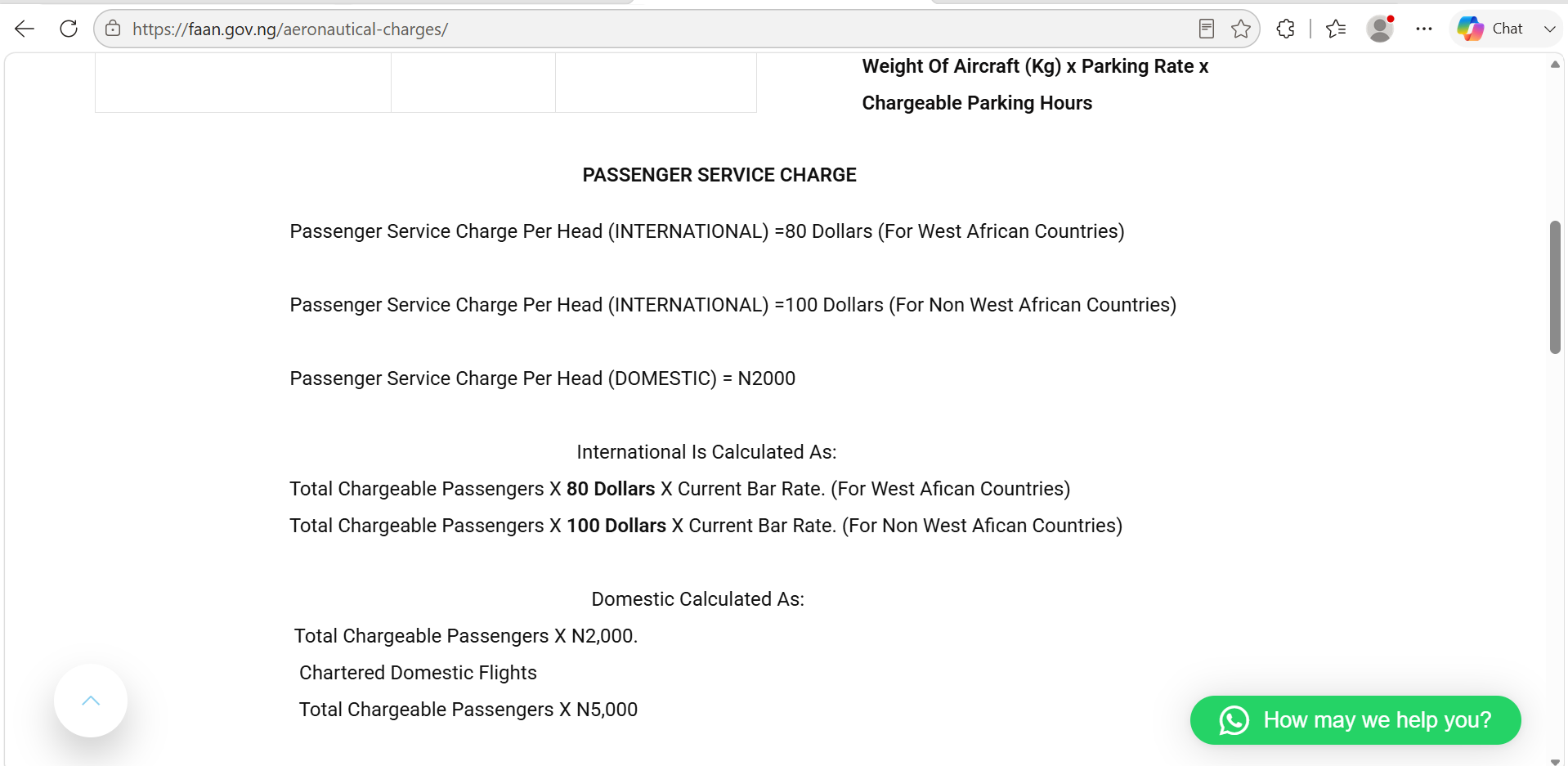
The Federal Airports Authority of Nigeria (FAAN) currently publishes an international Passenger Service Charge of $80 per passenger for West African destinations and $100 for destinations outside West Africa.
If the $80 West Africa charge were reduced by 25 percent, it would become $60.
But that does not mean we can say Nigerian passengers are definitely still being charged $80.
What we can say is more precise, and in some ways more important: the publicly available FAAN tariff still tells passengers and airlines that the charge is $80.
That is the question we have put to FAAN.
Because when a regional policy is supposed to reduce the cost of moving around West Africa, the public should be able to see where that reduction has happened.
First, what exactly did ECOWAS agree to?
In this section
The Act was adopted by ECOWAS Heads of State and Government at their 66th Ordinary Session in Abuja on 15 December 2024.
The reform comes from Supplementary Act A/SA.2/12/24 on the Common Policy on Charges, Taxes and Fees in Civil Aviation within ECOWAS Member States.
The Act was adopted by ECOWAS Heads of State and Government at their 66th Ordinary Session in Abuja on 15 December 2024.
ECOWAS later announced that the measures would take effect from 1 January 2026.
Under the reform, member states were to:
remove taxes applied to air transport;
reduce passenger service charges by 25 percent;
reduce security charges by 25 percent.
ECOWAS described the policy as part of a wider effort to make air travel more affordable and improve regional integration.
But this does not mean every cost attached to every airline ticket disappears.
It is not a promise that every ticket in West Africa would suddenly become 25 percent cheaper.
Airfares are made up of several things. There is the airline's base fare, then there can be airport charges, government taxes, security charges, passenger service charges and other fees.
Some of those costs may be imposed by the country where the passenger departs. Others may be connected to the destination, the airline or the particular airport.
The reform does not mean every airline ticket should automatically become 25 percent cheaper. It targets specific taxes and charges.
So the issue is not whether every ticket has fallen by 25 percent. The issue is whether the taxes covered by the reform have been removed and whether the passenger and security charges have actually been reduced by 25 percent.
Why did ECOWAS want to change the system?
In this section
West Africa is a relatively compact region, yet flying between neighbouring countries can still be expensive.
The regional bloc's argument is not new.
West African air travel has been expensive for years, and the problem is not only the price airlines set for their seats.
ECOWAS says passengers in the region can face as many as 66 separate charges, while airlines face more than 100 fees when operating flights. It also says costs in the ECOWAS region are about 85 percent higher than global averages for regional flights and 82 percent higher for international routes.
That matters because the price of flying affects much more than whether an individual can afford a holiday.
Consider:
a small business owner who needs to travel from Lagos to Accra for a meeting.
a Ghanaian company trying to send a team to Nigeria.
a tourist who wants to visit two or three West African countries instead of flying directly in and out of one country.
a regional airline trying to operate a route between neighbouring countries.
When the cost of the ticket becomes too high, some of those trips simply do not happen.
That has consequences for tourism, business and trade.
It also works against the larger idea behind regional integration, where movement between neighbouring countries should become easier rather than more expensive.
ECOWAS itself has linked the high cost of air travel to weak demand, limited tourism, reduced trade opportunities and the broader challenge of free movement across the region.
West Africa is a relatively compact region, yet flying between neighbouring countries can still be expensive.
Take Lagos and Accra. The two cities are relatively close, and the route is one of the busiest intra-African air connections.
You would expect a route connecting two major commercial cities this close to each other to be relatively affordable. But the taxes and charges attached to the journey can add significantly to the cost of the ticket.
Then came the reform
The decision was adopted in December 2024.
Before it took effect, however, the membership of ECOWAS changed. Burkina Faso, Mali and Niger formally left the bloc on 29 January 2025. ECOWAS now has 12 member states: Benin, Cabo Verde, Côte d'Ivoire, The Gambia, Ghana, Guinea, Guinea-Bissau, Liberia, Nigeria, Senegal, Sierra Leone and Togo.
So the aviation reform was adopted when ECOWAS had 15 members, but it is now being implemented across 12.
The withdrawal of the three countries does not mean the Supplementary Act no longer applies to the remaining members. ECOWAS has continued to treat it as part of its regional aviation framework. In June 2026, the Commission said the Act had entered into force on 1 January and that it had been carrying out sensitisation and stakeholder engagement across member states to support implementation.
The announcement was made. The Act took effect.
What we still need to see is how it has been applied across the 12 countries.
By December, the industry was expecting change
AFRAA welcomed the reform in December 2025.
The association described the decision to remove air transport taxes and reduce passenger and security charges as a major development for the region. AFRAA's Secretary General, Abderahmane Berthe, said the changes could make regional air travel more affordable and support regional integration.
The aviation industry had been pushing governments to address the cost of flying in Africa for years, so the announcement was significant.
Then 1 January arrived, and airlines still needed clarity on how the changes would be implemented.
That uncertainty quickly became part of the story.
By January, airlines were asking what had actually changed
AFRAA sought clarification from the ECOWAS Commission on how the reform would be implemented.
Airlines needed to know which charges were changing, when the changes would take effect and how they should be reflected in their ticketing systems. A regional decision still has to be translated into the actual figures airlines use when selling tickets and paying airport and government charges.
In April 2026, IATA made a similar call. It urged governments to implement the December 2025 ECOWAS decision to remove aviation taxes and reduce selected charges by 25 percent. IATA said consistent implementation at national level was necessary for the region to see the benefits of lower aviation costs.
By then, both AFRAA and IATA had publicly raised the need for clearer implementation of the ECOWAS decision.
And then there is Nigeria
Nigeria is particularly interesting because we can actually see one of the country's published charges.
FAAN's aeronautical charges page currently lists the international Passenger Service Charge at:
$80 for passengers travelling to West African countries
and
$100 for passengers travelling to non-West African countries.
For a West African destination, a 25 percent reduction would be straightforward mathematics:
FAAN's published schedule of aeronautical charges, captured 7 August 2026. The international Passenger Service Charge for West African destinations is listed at $80.
That tells us what FAAN's published tariff currently says. It does not tell us, on its own, whether airlines are still being charged that amount. The charge may have changed without the website being updated, or there may be another instruction governing what airlines are currently paying.
We do not have enough information to say which is the case.
So we asked FAAN.
The bigger problem is that Nigeria also introduced a new $11.50 levy
On 1 December 2025, Nigeria introduced an additional $11.50 charge per international passenger under its Advance Passenger Information System, or APIS.
The NCAA said the charge would apply to international travel into and out of Nigeria and would be collected through airlines. The system is intended to support the collection and processing of passenger information for border management and security.
The timing is important. Nigeria introduced the new charge one month before the ECOWAS aviation reform was due to take effect.
So Nigeria entered January 2026 with a new charge on international passengers at the same time ECOWAS was introducing a policy to remove selected aviation taxes and reduce passenger and security charges by 25 percent.
That timing does not establish that the APIS levy is contrary to the ECOWAS Supplementary Act. Whether the levy falls within the charges covered by the Act depends on its legal basis and how the relevant provisions are interpreted.
We have therefore asked the Nigeria Civil Aviation Authority a specific question:
Is the $11.50 APIS levy consistent with Nigeria's obligations under Supplementary Act A/SA.2/12/24?
We will leave that answer to the regulator.
The international aviation industry has already raised concerns about APIS charges
Nigeria is not the only country facing questions over API-PNR charges.
In April 2026, IATA said charges for passenger data systems were above global norms in several African countries. It named Angola, the Democratic Republic of Congo, Nigeria, Ghana and Kenya.
IATA said Tanzania's $45 one-way charge was the highest in the world.
IATA also warned that high charges for these systems can increase the cost of air travel and affect connectivity.
The systems themselves serve a purpose. Governments use advanced passenger information and passenger name records for border management and security. The question is how much passengers are being charged for them and how those charges fit within the wider cost of flying.
For Nigeria, that puts the $11.50 APIS charge alongside the country's other taxes and aviation charges rather than looking at it on its own.
There is another number worth looking at
In November 2025, Ibom Air Managing Director George Uriesi spoke about the cost of operating the Lagos-Accra route.
He said an airline operating the route faced about $185 in taxes before setting its ticket price.
The $185 figure came from Uriesi. It is not an independent calculation by MOVING AFRICA or an official government tariff, so we are using it as his account of the costs faced by the airline.
But it gives some context to the wider discussion about aviation charges. An airline still has to cover its base fare, fuel, staff, maintenance, insurance and other operating costs after those taxes and charges have been paid.
Lagos-Accra is also a route the ECOWAS aviation reform was intended to affect. Both Nigeria and Ghana are ECOWAS members, and the reform specifically targets taxes and charges that add to the cost of regional air travel.
So when ECOWAS says those costs should come down, the question is what that reduction looks like for an airline operating a route such as Lagos-Accra, and eventually, for the passenger buying the ticket.
What does a passenger actually pay?
A passenger does not pay one single charge when buying an international flight ticket.
The final amount can include the airline's fare as well as taxes, fees and other charges. Some go to airports, some to government agencies, while others cover security, passenger facilities or ticketing. The charges can also come from the country of departure, the destination country or both.
That makes it difficult to use one figure as "Nigeria's ticket tax" without knowing exactly what the figure includes and which authority imposes each charge.
Different sources can also arrive at different totals because they are counting different charges.
Published tariffs help clear some of that up. They show what an airport or government agency says it charges and give passengers, airlines and others a figure they can check.
But if the published figures are out of date, it becomes difficult to know what airlines are actually paying.
And if FAAN's $80 figure is still current, then there is a straightforward question to answer:
Why has the 25 percent ECOWAS reduction not appeared in the published tariff?
The reform was not supposed to depend only on a press release
ECOWAS has said that Supplementary Acts are legally binding within its framework. Member states are also expected to make the necessary changes to their national laws, policies and related documents so the provisions can be applied across the region.
In practice, that means the regional decision still has to move through national systems.
Ministries may need to change regulations. Civil aviation authorities may need to issue instructions. Airport operators may need to update their tariffs. Airlines may need to change their ticketing systems.
Eventually, those changes should show up in the cost of a ticket.
A passenger is unlikely to see the Supplementary Act itself. They will see whether the charges on their ticket have gone up, stayed the same or come down.
This is why the date matters
The policy was supposed to take effect on 1 January 2026.
For months afterwards, there was uncertainty about implementation.
Then, on 28 June 2026, ECOWAS announced that it would convene the inaugural meeting of the ECOWAS Air Transport Economic Oversight Committee, or ECATEOC, from 2 to 3 July in Lomé, Togo.
The Commission described the meeting as a major step toward operationalizing the regional economic oversight framework and accelerating implementation of the policy.
That is important.
The oversight committee is not an unrelated project.
ECOWAS says ECATEOC is the regional mechanism established to assess implementation progress, review the air transport market, update the implementation strategy and establish a monitoring and reporting framework.
In other words, the regional body responsible for overseeing the reform was being formally operationalized six months after the reform itself entered into force.
That does not prove that member states failed to implement the policy during those six months.
ECOWAS says it had already carried out sensitization and stakeholder engagement missions across member states.
But it does raise a reasonable question about how implementation was being measured before the oversight mechanism was formally operationalized.
And the oversight mechanism now has a lot to measure
ECOWAS says the committee will include the directors-general of national civil aviation authorities, directors of air transport, ECOWAS institutions and partners including the African Union Commission, ICAO, IATA, the African Civil Aviation Commission and AFRAA.
That gives the committee access to the people responsible for the different parts of the system.
National aviation authorities can provide information on implementation in their countries. Airport authorities can provide their current charges. Airlines can show what they are being billed, while ticket data can show what passengers are actually paying.
The regional committee can then compare what is happening across the 12 member states.
The questions we have put to ECOWAS
We have written to the ECOWAS Commission and Chris Appiah, Director of Transport, with three sets of questions.
First, implementation across the 12 member states.
How many countries have amended their national aviation laws, policies or related documents to give effect to the Supplementary Act?
We have asked for the names of the countries, rather than a general statement that implementation is underway.
Second, what has the regional oversight mechanism found?
What monitoring has been carried out since the Act took effect, and what does the data show?
Have passenger service charges fallen? Have security charges fallen? Have the taxes identified for removal actually been removed?
Third, the concerns raised by the aviation industry.
AFRAA sought clarification from the Commission in January. IATA called for consistent national implementation in April.
What has ECOWAS done in response?
And will the Commission publish its findings so that airlines and passengers can see how the reform is being implemented across the region?
The questions we have put to FAAN
Nigeria is our starting point because FAAN publishes its aeronautical charges online.
We asked FAAN:
Has the Passenger Service Charge for departures to West African destinations been reduced from the published $80 in line with the ECOWAS 25 percent reduction?
If so, when did the reduction take effect?
And if the charge has been reduced, why does FAAN's published schedule still show $80?
We also asked which charges on the published schedule fall under the air transport taxes covered by the ECOWAS Supplementary Act.
That distinction is necessary because not every charge listed on an airport tariff is covered by the reform. Each charge has to be considered according to the category it falls under and the provisions of the Act.
The question to NCAA
We have also written to the Nigeria Civil Aviation Authority about the $11.50 APIS levy.
We asked:
Is the $11.50 levy introduced on 1 December 2025 consistent with Nigeria's obligations under Supplementary Act A/SA.2/12/24?
The NCAA's response will clarify how the levy fits within Nigeria's obligations under the ECOWAS aviation framework.
What we know and what we do not know
In this section
In June, ECOWAS announced the formal operationalization of its regional air transport economic oversight committee.
Here is what we can establish so far.
ECOWAS adopted the Supplementary Act in December 2024.
ECOWAS says the Act entered into force on 1 January 2026, with member states required to remove air transport taxes and reduce passenger and security charges by 25 percent.
Burkina Faso, Mali and Niger left ECOWAS on 29 January 2025, leaving 12 current member states.
FAAN's publicly available aeronautical charges page still lists $80 for international passengers travelling to West African countries.
Nigeria introduced an additional $11.50 APIS charge for international passengers from 1 December 2025.
In April 2026, IATA called for national implementation of the ECOWAS aviation reform.
In June, ECOWAS announced the formal operationalization of its regional air transport economic oversight committee.
There are still several things we cannot establish from the information currently available.
We do not have a complete, publicly verified picture of how all 12 member states have implemented the reform.
We do not know whether Nigeria's $80 published Passenger Service Charge is still the amount airlines are actually being charged.
We do not know whether the NCAA considers the $11.50 APIS levy to fall within the charges affected by the Supplementary Act.
And we do not yet know whether the reductions have reached passengers through lower ticket prices.
Those are the questions we have put to the relevant institutions.
There is a bigger issue here than one $20 reduction
It would be easy to reduce the Nigerian part of this story to one figure: $80 should become $60.
That $20 reduction matters, particularly when passengers are already paying several other charges. But there is a wider question about what happens after ECOWAS adopts a regional policy.
ECOWAS has spent years trying to make it easier for people, goods and services to move across West Africa. The cost of crossing those borders is part of that conversation.
If countries want more regional trade and travel, the cost of getting from one country to another cannot keep shutting people out.
This matters even more with air travel. For many routes between West African cities, flying can save hours compared with travelling by road. But a route being available does not help much if the ticket is beyond what people can afford.
Connectivity is not just about having a flight between Lagos and Accra.
It is also about whether people can afford to take it.
And there is a reason to take the promise seriously
ECOWAS estimates that removing selected taxes and reducing passenger and security charges by 25 percent could generate more than 1.2 million additional passengers annually.
It's a significant number. But it is also a projection.
The real test will come from what happens to passenger numbers after implementation and whether the savings are actually reflected in the market.
If fares fall and passenger traffic increases, the reform will have evidence behind it.
If charges remain high and passenger numbers do not respond, then the region will need to ask why.
And if governments remove the charges but airlines do not pass the savings through to passengers, that will raise another question.
The policy is therefore not finished when a government changes a tariff.
There needs to be a chain from policy to implementation to airline costs to ticket prices to passenger behavior.
That chain is what we are watching.
Nigeria is only the starting point
We are starting with Nigeria because its published tariff gives us something concrete to examine.
But this is not only a Nigerian story.
The ECOWAS reform applies across the current member states.
So the same questions should eventually be asked in Benin, Cabo Verde, Côte d'Ivoire, The Gambia, Ghana, Guinea, Guinea-Bissau, Liberia, Senegal, Sierra Leone and Togo.
Has the required tax been removed?
Has the Passenger Service Charge been reduced by 25 percent?
Has the security charge been reduced by 25 percent?
Have the national tariff documents been updated?
Are airlines actually being billed the new amounts?
And most importantly, are passengers seeing any difference?
ECOWAS has said its oversight committee will assess implementation progress across member states and establish a monitoring and reporting framework.
That information should eventually give us a clearer picture.
The uncomfortable part
In this section
ECOWAS said the Passenger Service Charge should fall by 25 percent.
The most interesting part of this story may not be that implementation is complicated.
Everyone already knows that.
The interesting part is how long it takes for a regional decision to become something a passenger can actually see.
The reform was adopted in December 2024.
It was announced publicly again in December 2025.
It entered into force on 1 January 2026.
By April, IATA was calling for national implementation.
By June, ECOWAS was announcing the formal operationalization of its oversight committee.
And as of August, Nigeria's public FAAN tariff still shows the $80 Passenger Service Charge for West African destinations.
Maybe the operational charge has already changed.
If it has, FAAN can tell us.
Maybe the charge is not covered in the way we understand it.
If that is the case, the relevant authorities can explain the distinction.
Maybe Nigeria has not yet implemented the reduction.
If so, that should also be clear.
The problem is not that there are questions.
The problem is when passengers have to guess the answer.
For now, Nigeria gives us a particularly simple question.
ECOWAS said the Passenger Service Charge should fall by 25 percent. FAAN's public tariff still says $80 for West African destinations. Has it actually fallen to $60, and if it has, why has the public tariff not moved?
We have asked.
We will publish the responses, or record their absence.
Because this is what MOVING AFRICA is interested in.
Not just what governments say they are changing.
But what actually changes when an African tries to move.
Not at the summit.
Not in the communiqué.
Not in the policy document.
On the receipt.
Part of MOVING AFRICA, a series on the cost and difficulty of travelling across the continent.