
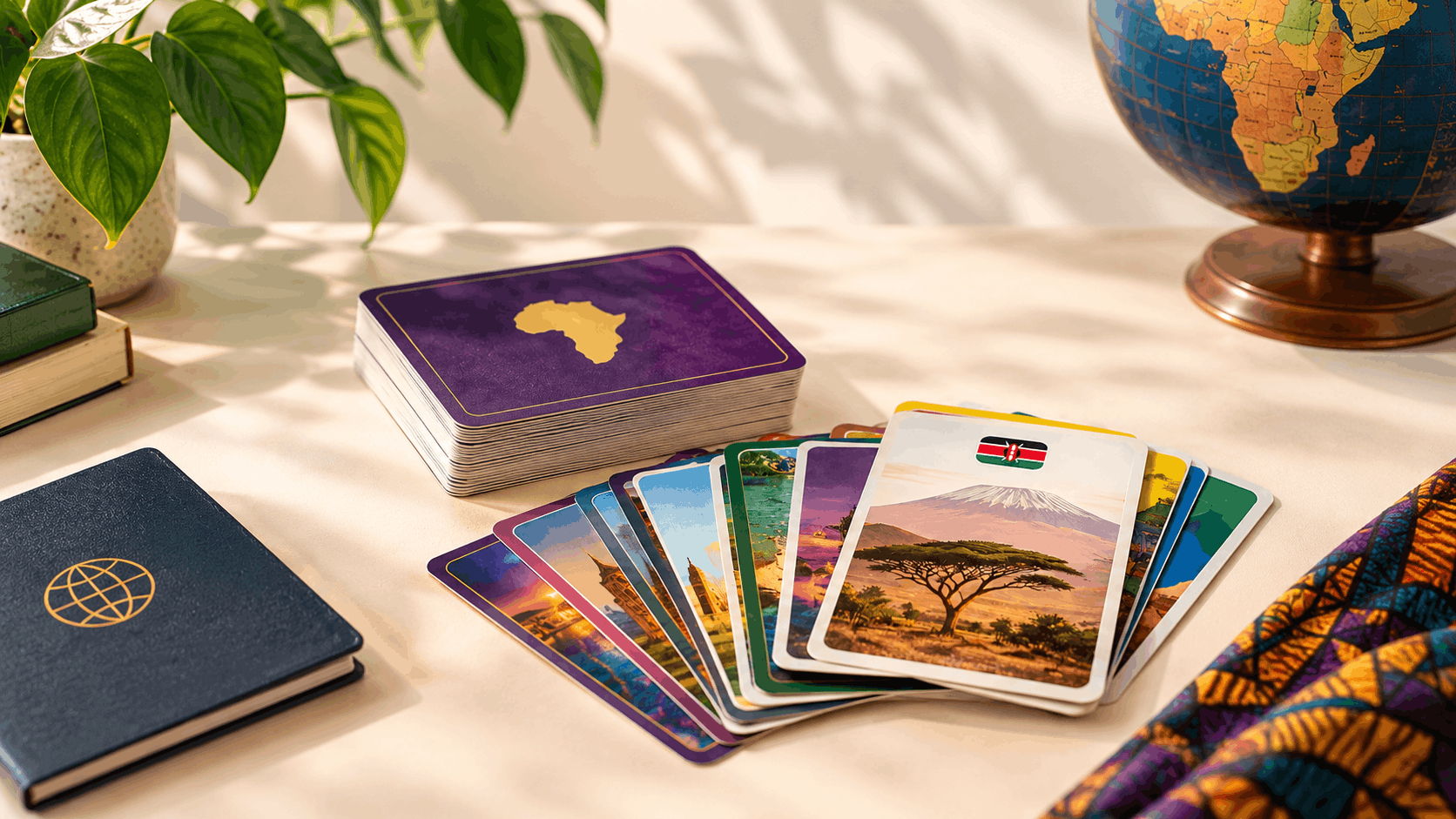
Today Ria's Colony is launching African Ambassador, a free quiz card game about all 54 African countries. It asks one simple question: how well do you know Africa? You can play it right now at ambassador.riascolony.org, on your phone, laptop or a big screen, in English, French, Swahili or Arabic. There is nothing to download and nothing to pay.
The idea is easy to explain. You draw a card, answer a question about Africa, and the card turns over to show a short fact. It does this whether you got the answer right or wrong, so every card leaves you knowing something you did not know a minute ago. Every right answer also builds your lifetime rank, from Rookie all the way to Grand Ambassador, and you can collect a passport stamp for each of the 54 countries.
We built African Ambassador because of a gap we keep running into in our own work. It is a gap between how connected African countries are on paper and how little many of us actually know about each other. This post explains that gap, why we chose a game to help close it, and how African Ambassador works.
Updated 4 October 2026 with everything added since launch: Arabic, Classroom Mode, new cards on history before and after independence, raw materials, trade and tourism, and a clearer way to win a friend challenge.
The problem: one continent, 54 strangers
Africa is one continent, but for a lot of people it does not feel that way. Ask a student in Lagos to name the capital of Malawi, the main export of Zambia, or the languages spoken in Madagascar, and many will pause. Ask the same student about the capital of France or the biggest companies in America and the answers come faster. This is not a failure of the student. It is what happens when most of what we read, watch and study about the world points away from the continent we live on.
That distance shows up in hard numbers too. In 2024, trade between African countries grew by 12.4% to reach about US$220.3 billion, according to Afreximbank's African Trade Report 2025. That sounds large until you see the share: trade among African countries still makes up only around 14 to 15% of the continent's formal trade. Most of what African countries sell still leaves the continent, and most of what they buy still comes from outside it. Afreximbank's earlier report described this level as low when set against other regions of the world.
Travel tells a similar story. The 2025 Africa Visa Openness Index, published by the African Development Bank and the African Union Commission, found that African citizens can cross into another African country without a visa in about 28% of country-to-country travel routes. That is better than the 20% recorded in 2016. But the same report found that just over half of all trips between African countries still need a visa arranged before you travel, up from about 47% the year before.
The African Continental Free Trade Area (AfCFTA) is meant to change this by turning the continent into a single market for roughly 1.4 billion people. But trade agreements and open borders only go so far if people on either side do not know much about each other. You do not do business with a country you cannot place on a map. You do not plan a holiday to a place you have never heard anything good about. You do not hire, partner with or sell to people whose customs and markets you have never thought about.
That is the problem African Ambassador is built for. It does not try to fix trade policy or visa rules. It goes after the smaller, earlier problem that sits underneath them: most of us have not had a fun, easy way to learn about the other 53 countries we share a continent with.
Why we made it a game
We could have written another long guide, and we do write those. Our blog already covers African countries one by one, and our free tools explain entry rules, tourism figures and safety for all 54. But reading is something you choose to sit down and do. Most people will not read 54 country guides. Many will happily play a quick game while waiting for a bus, during a lunch break, or with friends after dinner.
A quiz also teaches in a way reading does not. When you try to pull an answer out of your own head, even if you get it wrong, you are more likely to remember the right answer later than if you had simply read it. Learning researchers call this the testing effect, and it has been studied for decades. African Ambassador is built around it. Every card asks you to make a guess first, and only then shows you the answer and a short fact.
That short fact is the heart of the game. Getting a card wrong is not a dead end. It is the moment you learn something. A player who misses a question about Lesotho's borders or Senegal's main exports walks away knowing the answer, plus one more detail they did not ask for. Over a few weeks of play, those small facts add up to a much clearer picture of the continent.
We also wanted something people could do together. Learning about Africa should not feel like homework. It should feel like a game night, a classroom competition or a bit of friendly rivalry in a group chat. That is why African Ambassador lets you play alone, send friends a challenge, pass one phone around, or run a whole class from one big screen.
How it works: two ways to play
When you open African Ambassador, you choose between Play solo and Play with friends.
Play solo
Play solo contains four games.
Safari is the main game. It is an endless deck with three lives, and the questions get harder as you go up the levels:
- Level 2: 8 right answers
- Level 3: 12 more
- Level 4: 16 more
- Level 5: 20 more
So reaching Level 5 in one game takes 56 right answers. After that, the levels keep going: 6, 7 and up. Each new level gives you back one life and one skip. Each question has a 20-second timer, which you can turn off before you start. From Level 3, some cards are Mystery Country cards: clues about a country, one at a time, with more points the fewer clues you need.
Safari also keeps track of what you have seen. You will meet about 1,000 cards before one comes back, and questions of the same kind, like flags, wait several cards before another one comes.
The Daily Deck is a new set of 10 cards every day. Everyone gets the same cards, wherever they are, so it is easy to compare scores with friends, family, classmates or colleagues. Play it on days in a row to build a streak.
This week's deck contains 10 cards on one theme. The theme changes every Monday.
Fresh Cards brings new questions about what is happening across Africa every two weeks, so there is always something new to meet.
Play with friends
Tap Play with friends to choose how you want to play.
Challenge friends. The game gives you a link that you can send by WhatsApp, social media or email. Everyone who opens it plays the same 10 cards on their own phone, and every score goes onto one shared scoreboard. The player with the most points wins. If two players have the same points, the one who answered faster wins, and the scoreboard shows each player's time. Open the link again any time to see who is winning. The link stays open for 30 days.
Pass one phone around. Two to six players take turns on one phone or big screen. If a player gets a card wrong, another player can steal it: a right steal earns half the points, a wrong one loses 5 points. With Pass it on, a player can hand their card to someone else instead of answering it.
Classroom Mode. For a class, a family or any group around one screen, like a projector, TV or laptop. One person leads. They choose how many questions, how hard, and a topic, then reveal each answer and mark who got it right. Nobody else needs a phone. Every answer comes with a short explanation, some cards have a question for the room to talk about, and teams can play for points. You can open it straight from ambassador.riascolony.org/class.
What the cards cover
The deck goes far beyond flags and capitals, though it has plenty of both. The cards cover:
- Places: flags, capitals, borders, coastlines, rivers, lakes and national parks
- Nature: wildlife and plants
- Raw materials: what Africa mines and grows, and what it now makes from them at home
- People and culture: food, sport, languages, everyday customs and famous Africans
- History before independence: old kingdoms and empires, from Nok and Carthage to Songhai and Dahomey
- History after independence: the years countries became free, their founders and milestones
- Trade and business: ports, railways, trade routes and how business works across the continent
- Tourism: places worth a trip and festivals, from Ganvié to FESPACO
These cards tell Africa's story in Africa's own voice. Ria's Colony exists to promote trade and tourism across Africa, so the game does not stop at geography. It also asks about what countries produce, what they sell, where they came from and what is worth seeing, because that is the kind of knowledge that helps someone think about working, investing or travelling in a new market.
The deck also does not run out. Most cards are built from facts about all 54 countries as you play, hand-written cards add depth, and Fresh Cards bring new questions every two weeks. Right or wrong, a short fact follows every answer.
From Rookie to Grand Ambassador
Your lifetime rank grows with every right answer, across all your games, and it never goes down:
- Rookie: where everyone starts
- Explorer: 150 right answers
- Connector: 500 right answers
- Trader: 1,500 right answers
- Ambassador: 5,000 right answers
After Ambassador come Senior Ambassador, Envoy, Special Envoy, High Commissioner and Grand Ambassador. The top ranks take months of play. Games where you pass one phone around and Classroom games do not count toward your rank.
You can also see your Africa profile: which topics you know best, like wildlife, history or business, and which ones need more work.
The Africa Passport
The Africa Passport gives players another goal to work towards. With a free Ambassador Pass, you collect a stamp for each of the 54 African countries. Each stamp has five steps:
- Step 1: get 3 questions about that country right. They can come from any game and add up over time.
- Step 2: get one right in Safari at Level 2 or higher.
- Step 3: the same, at Level 3 or higher.
- Step 4: at Level 4 or higher.
- Step 5: at Level 5 or higher.
A stamp moves up at most one step per game, and stamps never go down. Stamp every country in one of Africa's five regions to earn a region badge, in bronze, silver or gold.
The passport gives you a picture of the countries you know well and the ones where you still have more to learn.
The Ambassador Pass
Your first game needs nothing at all. To keep playing after that, you make a free Ambassador Pass with just your email. There is no password: we send you a code or a one-tap link.
The Pass keeps your rank, Africa profile, passport stamps, best score and Daily Deck streak on any phone or computer. You play under your own nickname, and if you like, we email you on evenings when your streak is about to end. It never needs renewing. If you do not play for 90 days, we delete the account, and we email you a week before.
You can also add the game to your phone's home screen, so it opens full screen like any other app.
Who it is for
African Ambassador is for anyone curious about Africa, and we mean that widely.
Students can use it to learn geography, history and economics in a way that sticks, and to test themselves before exams or quiz competitions. Teachers can run Classroom Mode on a projector or smart board with no student devices, or send the class a challenge link and compare scores at the end of the lesson. Because it runs in a browser, schools do not need special software.
Families and friends can use it for game night. Passing one phone around works well for mixed ages, while the Daily Deck and challenge links give a group chat something to compare.
The diaspora can use it to stay close to the continent, or to help children growing up abroad learn about Africa beyond their family's home country.
Travellers can use it to get to know a country before they visit, from its languages and food to its customs and parks.
Business people and professionals looking at new African markets can use it as a light first step. It will not replace proper market research, but it builds the kind of background knowledge that can make a first meeting, a first trip or a first deal across a border feel less unfamiliar.
The game is available in English, French, Swahili and Arabic, so players across much more of the continent can play in a language they know.
How it fits our work
Ria's Colony exists to make it easier to understand other African countries, travel between them and do business across their markets. We do that through stories, learning, travel information, business development and connections. African Ambassador is the most playful piece of that work, and often it will be the first piece someone meets.
The game sits alongside our other free tools, each of which goes deeper on one part of the picture:
- African ETA Tracker: what each African country requires before you fly
- Tourism at a Glance: arrivals, receipts and growth for all 54 countries
- Africa Contraband Guide: what you cannot carry across the border in each country
- Women's Safety in Africa: how safe each country is for women, with every source shown
We hope the game works as a doorway. A card about Rwanda's parks might send a player to check Rwanda's entry rules. A fact about Ghana's exports might lead someone to read our country guides, or to talk to us about entering that market. Knowing a little about a place is often what makes people want to know more.
Questions people ask
Play now
African Ambassador is live at ambassador.riascolony.org, and you can read more about it at riascolony.org/ambassador.
Tap Play solo and choose Safari, today's Daily Deck, this week's deck or Fresh Cards. Or tap Play with friends to send a challenge, pass one phone around or start Classroom Mode.
When you post your score, tag us @riascolony on Instagram, TikTok, X, LinkedIn or Facebook. We would love to see how far you get, and which country gave you the most trouble.
If you are a school, a youth group, a company or an organization that wants to use African Ambassador with your community, we would be glad to hear from you at support@riascolony.org.
About Ria's Colony
Africa is one continent, but understanding other African countries, travelling between them and doing business across their markets is harder than it should be. Ria's Colony exists to make that easier. We promote trade and tourism across Africa through media, learning, business development, travel information and connections. Learn more at riascolony.org.
Press and pitches: support@riascolony.org
Sources
- Afreximbank, African Trade Report 2025; summary by Ecofin Agency and News Agency of Nigeria (intra-African trade of US$220.3 billion in 2024, about 14.4% of formal trade)
- Afreximbank, African Trade Report 2024 (intra-African trade low compared with other regions)
- African Development Bank and African Union Commission, Africa Visa Openness Index 2025 and 2025 findings (28% visa-free routes, 51.1% visa required before travel)
- ThisDay, AfCFTA and 1.4 billion Africans (AfCFTA market size)
- Roediger, H. L. and Karpicke, J. D. (2006), "Test-Enhanced Learning", Psychological Science 17(3) (the testing effect)