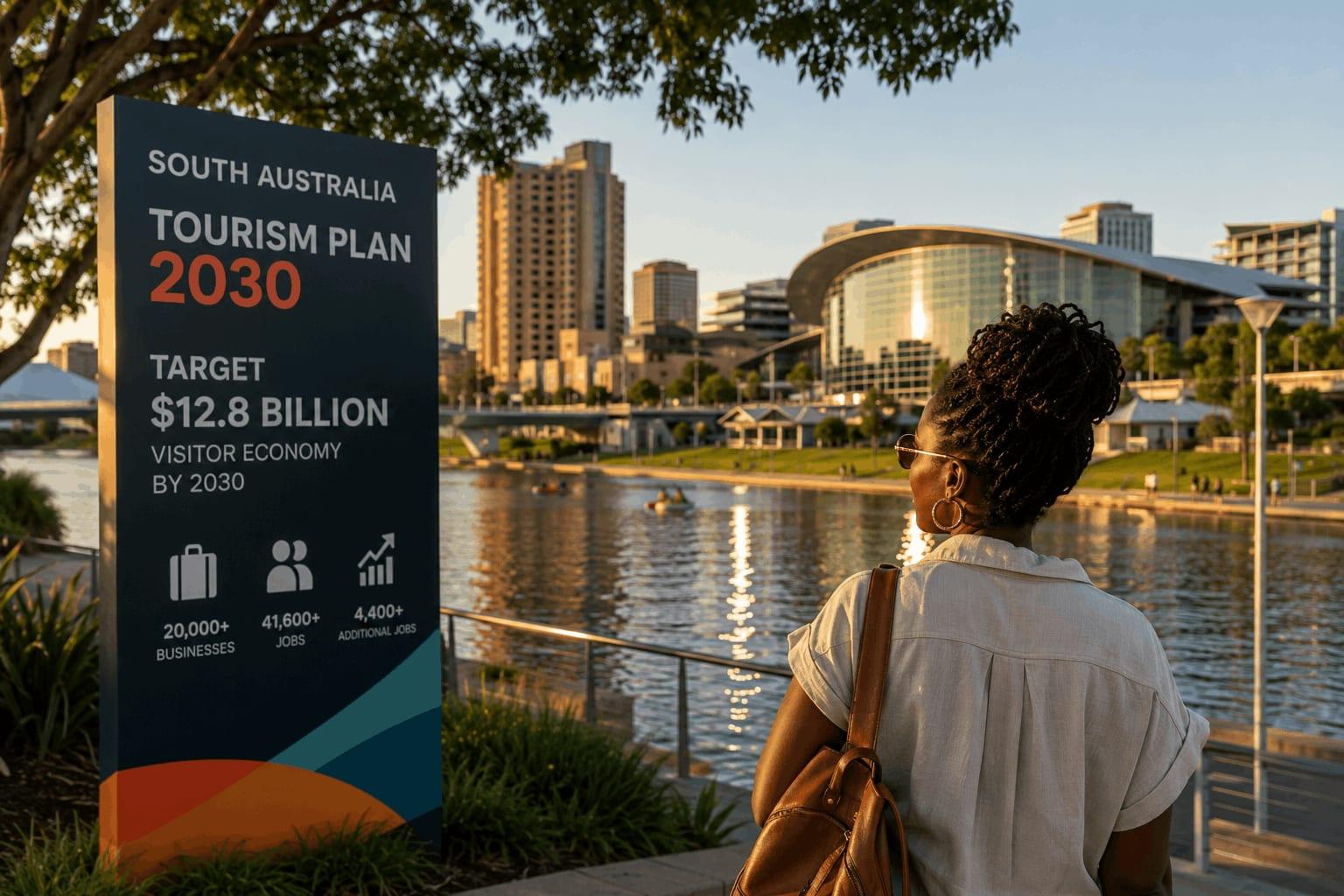
South Australia's government says its visitor economy is currently worth $9.8 billion. It says that economy supports more than 20,000 businesses and employs more than 41,600 people, which the state government describes as roughly 1 in every 25 South Australian workers, or about three times the number employed in mining. These figures come from the refreshed South Australia Tourism Plan 2030, released in June 2025 by the South Australian Tourism Commission (SATC) and reaffirmed in a media release from the Premier of South Australia's office.
The plan's target is $12.8 billion by 2030, along with 4,400 additional jobs. To hit that number from a $9.8 billion base, the visitor economy has to grow by close to a third in under five years.
That is the headline. What follows is a closer look at what sits underneath it: where the numbers come from, what has already been built toward the target, what is still just a plan on paper, and where the public record contains gaps or contradictions worth noticing before anyone decides whether $12.8 billion is realistic.
The $9.8 billion figure, along with the 20,000 businesses and 41,600 jobs, appears in multiple official sources: the SATC's own announcement of the refreshed plan, a matching release from the Premier's office, and coverage in trade press such as Australasian Leisure Management. It is repeated consistently enough across government channels that there is little reason to doubt it as the figure the government is currently using to describe the size of the sector.
But the SATC's own website is not fully consistent on this point. On its "What We Do" page, Tourism SA describes the current visitor economy as worth $10.6 billion, while the same page repeats the 41,600 jobs figure and the $12.8 billion target. Two different dollar figures for the "current" state of the same industry, both published by the same agency, is the kind of detail that matters if you're trying to work out how big a gap the plan actually needs to close. Is $9.8 billion the figure at the time the plan was released in mid-2025, and $10.6 billion a more recent update as the page was refreshed later? That would be a reasonable explanation, but the page does not date the $10.6 billion figure or explain the change, so it's not possible to say for certain from public information alone. It is worth asking the SATC directly which number it considers current, and what time period each one covers, before treating either as the fixed starting point for a five-year growth target.
The mining comparison, and what it is actually measuring
The claim that tourism employs "three times" the number of people mining does in South Australia is one of the more attention grabbing lines in the government's own messaging, and it is repeated word for word across the SATC release, the Premier's office release, and trade coverage of the plan's launch. It is presented as a comparison of workforce size, not economic output, export value, or wages, and none of the sources reviewed here provide the underlying mining employment figure being compared against, so it is not possible from this research alone to independently verify the ratio or know exactly which mining employment dataset and date it is drawn from. It is a fair statistic to ask the SATC to show its working on, particularly given how often it gets repeated as shorthand for the size of the tourism sector relative to a more traditionally cited South Australian industry.
The target is not new. It has been revised before, and progress on the previous version fell short
In this section
Most state visitor economy figures around the world work the same way.
South Australia's current 2030 ambition is a redraft of an earlier plan, not a stand-alone idea. The original South Australian Tourism Plan 2020, published in 2014, aimed to grow the visitor economy from $5.1 billion to $8.0 billion by the end of 2020. According to the SATC's own account on its YourSAy public consultation page, the sector reached $6.7 billion partway through that plan, a rise of more than 30 percent in four years, and was described at the time as "on track" to hit $8.0 billion.
Whether it actually reached $8.0 billion by the 2020 deadline is a separate question, and one the public record reviewed here does not answer directly, because 2020 was also the year international and much domestic travel collapsed due to COVID-19 border closures. A tourism plan target dated for December 2020 and a pandemic that shut down most travel for the back half of that year make direct before-and-after comparison difficult, and no source found in this research states a final, audited number against that original $8.0 billion target.
The next planning document, the South Australian Visitor Economy Sector Plan 2030, published by the SATC in August 2019, describes the prior plan period differently again: it says the sector "grew from $5.1b to $6.8b," a figure close to but not identical to the $6.7 billion cited on the YourSAy page. Small discrepancies like this, $6.7 billion versus $6.8 billion, are probably just rounding or different reporting cut-off dates rather than anything more significant. But they are a reminder that tourism economic figures in these documents are estimates, generated through a particular methodology and revised over time, not hard, audited accounting figures. That is not a criticism specific to South Australia. Most state visitor economy figures around the world work the same way. It is simply useful context for reading a target like $12.8 billion.
What the plan actually commits to building: airline seats
In this section
By mid-2026, Travel And Tour World's reporting states Adelaide will be served by 13 international airlines flying to 12 destinations.
Unlike the topline dollar target, the plan's aviation goal is unusually specific, and specific enough to check against what has actually happened since.
According to the SATC and matching Premier's office releases, the plan targets 20,200 weekly international airline seats into South Australia by 2030. That is an increase of 6,300 seats a week over the level at the time the plan was published, which works out to roughly 327,600 additional seats over a full year.
Has movement toward that number started? Based on aviation industry reporting, yes, and by a meaningful amount. Adelaide Airport recorded a 32 percent increase in international seating capacity through 2025, with 1.14 million international passengers arriving over the year, an 18.3 percent increase compared with the year before, according to reporting by Travel And Tour World, an aviation and tourism trade publication. That is a large single-year jump, though it is worth remembering percentage increases are easier to post from a smaller base, and this reporting reflects one year of data, not a trend confirmed over multiple years.
The specific route additions cited in aviation trade coverage during 2025 and into 2026 include:
- United Airlines launched a nonstop Adelaide to San Francisco service in December 2025, described as the first-ever direct flight between Adelaide and the United States, operated three times weekly using Boeing 787-9 aircraft, according to Aviation Week and Point Hacks.
- Qatar Airways moved to fully nonstop Adelaide to Doha services from late 2025, removing a previous routing that detoured through Melbourne, according to Point Hacks.
- China Southern Airlines resumed and then expanded its Guangzhou to Adelaide service, with plans reported to move it to a year-round operation from March 2026, according to Travel And Tour World.
- China Eastern Airlines was reported to be adding a seasonal Adelaide to Shanghai service beginning in mid-2026.
- Cathay Pacific reintroduced seasonal nonstop Hong Kong to Adelaide flights from November 2025, three times weekly through March 2026, following what was reported as a gap of more than five years on that route.
- Indonesia AirAsia began direct Denpasar (Bali) to Adelaide flights, reported to launch around June 2025.
- Emirates was reported to have chosen Adelaide as the first destination in its network to fly the Airbus A350, along with introducing a new Premium Economy cabin on that route.
- Qantas launched a new direct Adelaide to Auckland service, reported to have started around October 2025.
By mid-2026, Travel And Tour World's reporting states Adelaide will be served by 13 international airlines flying to 12 destinations. A separate flight-tracking site, AirportOverview, lists Adelaide Airport connecting to 35 total destinations (23 domestic and 12 international) across 38 airlines as of mid-2026, with 2,202 weekly departures in total.
Total passenger volume through Adelaide Airport is also part of the public record here. The Adelaide Economic Development Agency (AEDA) reported approximately 2.2 million total travellers passing through Adelaide Airport in the first quarter of 2025 alone, and separate reporting from Travel And Tour World describes the airport as tracking toward a record nine million total passengers across 2026. Those are total passenger figures, covering both domestic and international travel, so they should not be read as a direct measure of progress against the international seat target specifically. But they do provide a wider baseline against which the 1.14 million international passenger figure, and the stated 20,200 weekly international seat target, can be measured over time.
None of this proves the 2030 target of 20,200 weekly international seats will be met. It does show the airline side of the plan has real, dated, named commitments behind it rather than only an aspiration. Readers who want to check progress for themselves can compare Adelaide Airport's published passenger statistics year over year against the 20,200 weekly seat figure the SATC has set as the 2030 marker.
The brand campaign: what "Celebrate the Simple Pleasures" actually is
In this section
Structurally, the campaign is a departure from a single hero television commercial.
The plan leans on a new destination brand and marketing platform called "Celebrate the Simple Pleasures," launched by the South Australian Tourism Commission in April 2025. It was developed by South Australian creative agency Frame Creative, and its launch was timed to coincide with the AFL's Gather Round, an event that brings national media attention to the state.
According to reporting in Mumbrella, an Australian media and marketing trade publication, the campaign positions South Australia as, in the words used in that coverage, "a sanctuary for the burnt-out and overwhelmed." Frame Creative's chief executive Tim Pearce was quoted describing the intent as giving travelers a reason to slow down, built around the idea that global audiences are more burnt out and time-poor than in the past.
Structurally, the campaign is a departure from a single hero television commercial. Coverage from Glam Adelaide, AdNews and the SATC's own campaign page describes an ongoing series of shorter episodes and content pieces, opening with a food and drink theme through spots including "The Simple Pleasure of a Long, Long Lunch" and "The Simple Pleasure of Pipis to Plate," alongside outdoor and print advertising featuring the work of named South Australian artists including Cecilia Gunnarsson, James Brown, Mickey Mason, Mike Barr and Lisa Temple.
SATC chief executive Emma Terry was quoted across several of these releases describing the platform as being "about celebrating our South Australian way of life and inviting the rest of the world to come and enjoy it." The campaign's initial run was domestic, across Australian television, outdoor and digital channels, with international market expansion reported to begin from mid-2025, run in partnership with Virgin Australia according to the Premier's office release.
A later addition to the campaign, described on the SATC's own website as "Possum Moon," is reported to focus on the state's festivals and events calendar.
What none of the sources reviewed here provide is a public breakdown of media spend, a defined list of specific target international markets and their order of priority, or any published data yet on how the campaign has performed against awareness, consideration or booking intent metrics. The Tourism Plan 2030 document itself references "domestic market segmentation" work to understand the types of visitors the state wants to attract, and mentions emerging markets including India, but the publicly available version of the plan does not lay out a full country-by-country media or audience plan. If that detail exists, it may sit in an internal marketing plan that has not been made public, which is common practice for a live advertising campaign, but it does mean an outside observer cannot currently verify how precisely the campaign's audience targeting lines up with where the additional airline seats are actually landing from.
What the plan says drives demand, according to its own language
The Tourism Plan 2030 document, published by the SATC, sets out three stated priorities: increasing South Australia's appeal to drive demand, delivering new and evolving tourism products and experiences, and what it calls "positioning tourism as a force for good," which includes sustainability and inclusion goals developed jointly with the Tourism Industry Council of South Australia under a banner called "True South."
The plan names the state's core competitive strengths as nature, food, wine and drink, and events and festivals, based on stakeholder input gathered from more than 400 industry representatives across the state's 12 tourism regions, according to the SATC.
One detail buried in the plan document is worth noting on its own: it states that on an average international flight into Adelaide, 16 percent of passengers are international students, and that 65 percent of those students are, in turn, visited by family or friends during their time studying in South Australia. That is a fact about who is already filling seats into Adelaide today, separate from anyone the new brand campaign is trying to reach, and it suggests the education sector plays some role in South Australia's existing visitor pipeline that is distinct from leisure tourism marketing.
Separately, the state government's Department of State Development reports that international tourism expenditure in South Australia reached $1.3 billion in the 2023/24 financial year, which it describes as surpassing pre-pandemic levels in dollar terms, even though it also states that international visitor numbers themselves remained below pre-pandemic levels at that point. Higher spend from fewer visitors than before the pandemic is a specific and checkable claim, and it raises a fair question of its own: is the growth strategy counting on more visitors, higher spend per visitor, or some mix of both to reach $12.8 billion? The public plan document does not appear to break the $3 billion gap between $9.8 billion (or $10.6 billion) and $12.8 billion into a stated split between visitor volume growth and yield growth. That is a reasonable thing to ask the SATC directly, since the answer changes what kind of success or failure would actually look like in the coming years.
The employment side of the target
The plan's jobs figure, 4,400 additional roles by 2030 on top of the existing 41,600, is stated consistently across every government release reviewed for this piece. What is not detailed in public materials is a breakdown of what kind of jobs these are expected to be: full-time versus part-time or casual, which regions they are expected to appear in, or which parts of the visitor economy (accommodation, hospitality, transport, tour operators, events) are expected to generate them. Given that the plan explicitly notes tourism in South Australia is "mainly delivered by small business," and describes an intention to support operators in "building capability, capacity and resilience," it is fair to ask how much of the projected job growth depends on existing small operators scaling up their own hiring, versus new investment or new business formation the government hopes the plan will attract.
So where does that leave the actual gap in the plan
In this section
The airline capacity numbers already achieved in 2025 suggest real momentum on at least one measurable front.
Two sides of this plan are visible and checkable right now. The airline seat target has real, named, dated commitments behind it, several of which are already flying. The brand campaign exists, has a named agency, a defined creative direction, and at least one confirmed distribution partner in Virgin Australia. Both of these are supply-side and awareness-side moves. They are the parts of the plan a government and its tourism board can announce, launch and measure relatively directly.
What is much harder to see in the public record is the connective step in between: whether the specific people the campaign is reaching are the same people likely to book the specific new routes being added, and whether that audience is large enough, and travel-ready enough, to fill 327,600 additional annual seats by 2030 on top of whatever growth would have happened anyway. None of the sources reviewed for this piece, including the SATC's own plan document, publish a stated model connecting expected campaign reach to expected seat utilisation. That connective data may exist internally. It has not been made public in anything found during this research.
This is not a claim that the plan will fail, or that the $12.8 billion target is unrealistic. The airline capacity numbers already achieved in 2025 suggest real momentum on at least one measurable front. It is also not a claim that the campaign is failing to reach the right people, since no public data on the campaign's actual audience reach or booking impact was found either. What can be said with confidence, based only on what is publicly documented, is that the plan currently gives the public two separate, verifiable data points (airline seats and jobs/dollar targets) and one much less verifiable one (whether marketing reach is converting to travel demand at the rate required). Anyone assessing whether South Australia is on track for 2030 should watch all three, not just the ones the government chooses to report progress on in future updates.
Questions worth asking as this plays out
In this section
None of these questions have public answers as of this writing.
A few things would be useful to know, and are worth putting directly to the SATC, the state government, or independent tourism economists as the plan progresses:
- Which of the two current visitor economy figures, $9.8 billion or $10.6 billion, does the SATC consider the accurate baseline for the $12.8 billion target, and what time period does each cover?
- Is the $12.8 billion target expected to come mainly from more visitors, higher spend per visitor, or a defined mix of both?
- What proportion of the new airline capacity added in 2025 and 2026 is filled by leisure travellers responding to the Simple Pleasures campaign specifically, versus other drivers such as international education, business travel, migration-linked family visits, or airline commercial decisions unrelated to state marketing?
- Is there a published breakdown of which countries or audience segments the international phase of the Simple Pleasures campaign is targeting, and how that maps against the specific new routes (San Francisco, Guangzhou, Shanghai, Hong Kong, Denpasar, Doha, Auckland)?
- What would the SATC consider an early warning sign that the plan is falling behind its 2030 targets, and at what point in the next five years will progress against the 20,200 weekly seat figure and the $12.8 billion figure be publicly reported in a way that lets outside observers track it themselves?
None of these questions have public answers as of this writing. They are the kind of questions a target this size should be able to answer, and the kind of questions worth asking again in a year or two, once there is more than a single year of post-launch data to look at.
Sources
- South Australian Tourism Commission, "Growing benefits for all a focus of South Australia Tourism Plan 2030," tourism.sa.gov.au
- Premier of South Australia, "Growing benefits for all a focus of South Australia Tourism Plan 2030," premier.sa.gov.au
- Tourism SA, "South Australia Tourism Plan 2030," tourism.sa.gov.au/news-articles/south-australia-tourism-plan-2030
- Tourism SA, "What We Do," tourism.sa.gov.au/about/what-we-do
- Tourism SA, "Plans and Strategies," tourism.sa.gov.au/plans-and-strategies
- Tourism SA, Tourism Plan 2030 document (PDF), tourism.sa.gov.au/media/1a1faihm/sa-tourism-plan-2030.pdf
- South Australian Tourism Commission, "The South Australian Visitor Economy Sector Plan 2030" (2019 PDF), tourism.sa.gov.au/media/txpncuwn/satc_tourism-plan-2030_final_aug2019.pdf
- South Australian Government, YourSAy public consultation page, "South Australian Tourism Plan 2030," yoursay.sa.gov.au
- South Australian Department of State Development, "Tourism," statedevelopment.sa.gov.au/tistrategy/tourism
- Australasian Leisure Management, "Refreshed South Australia Tourism Plan 2030 released," ausleisure.com.au
- Glam Adelaide, "SA launches new destination marketing campaign 'Celebrate the Simple Pleasures'," glamadelaide.com.au
- Mumbrella, "SA campaign celebrates the simple pleasures," mumbrella.com.au
- AdNews, "'Celebrate the Simple Pleasures' in South Australia," adnews.com.au
- Premier of South Australia, "The world invited to celebrate South Australia's Simple Pleasures," premier.sa.gov.au
- Mi3, "South Australia invites the world to experience 'the simple pleasures' in latest tourism campaign," mi-3.com.au
- Tourism SA, "Simple Pleasures" campaign page, tourism.sa.gov.au/support/campaigns/simple-pleasures
- Travel And Tour World, "United Airlines Joins Cathay Pacific, Qantas, Air New Zealand, Indonesia AirAsia, and China Eastern in Expanding Adelaide's Global Flight Network," travelandtourworld.com
- Travel And Tour World, "Adelaide Airport Surges Toward Historic 2026, Breaking Records With Nine Million Passengers And A Strong Expansion Of International Routes," travelandtourworld.com
- Travel And Tour World, "United Joins Emirates, Cathay Pacific, Air New Zealand, Qantas, and More to Skyrocket Adelaide's Global Connectivity," travelandtourworld.com
- Point Hacks, "Adelaide Airport expands as a gateway for international travel," pointhacks.com.au
- Aviation Week, "50 New Routes Starting In December 2025," aviationweek.com
- AEDA (Adelaide Economic Development Agency), "Adelaide Soaring to New Heights: Your Guide to New Flights," aedasa.com.au
- FlightConnections, "Flights from Adelaide (ADL)," flightconnections.com
- AirportOverview, "Flights from Adelaide (ADL)," airportoverview.com