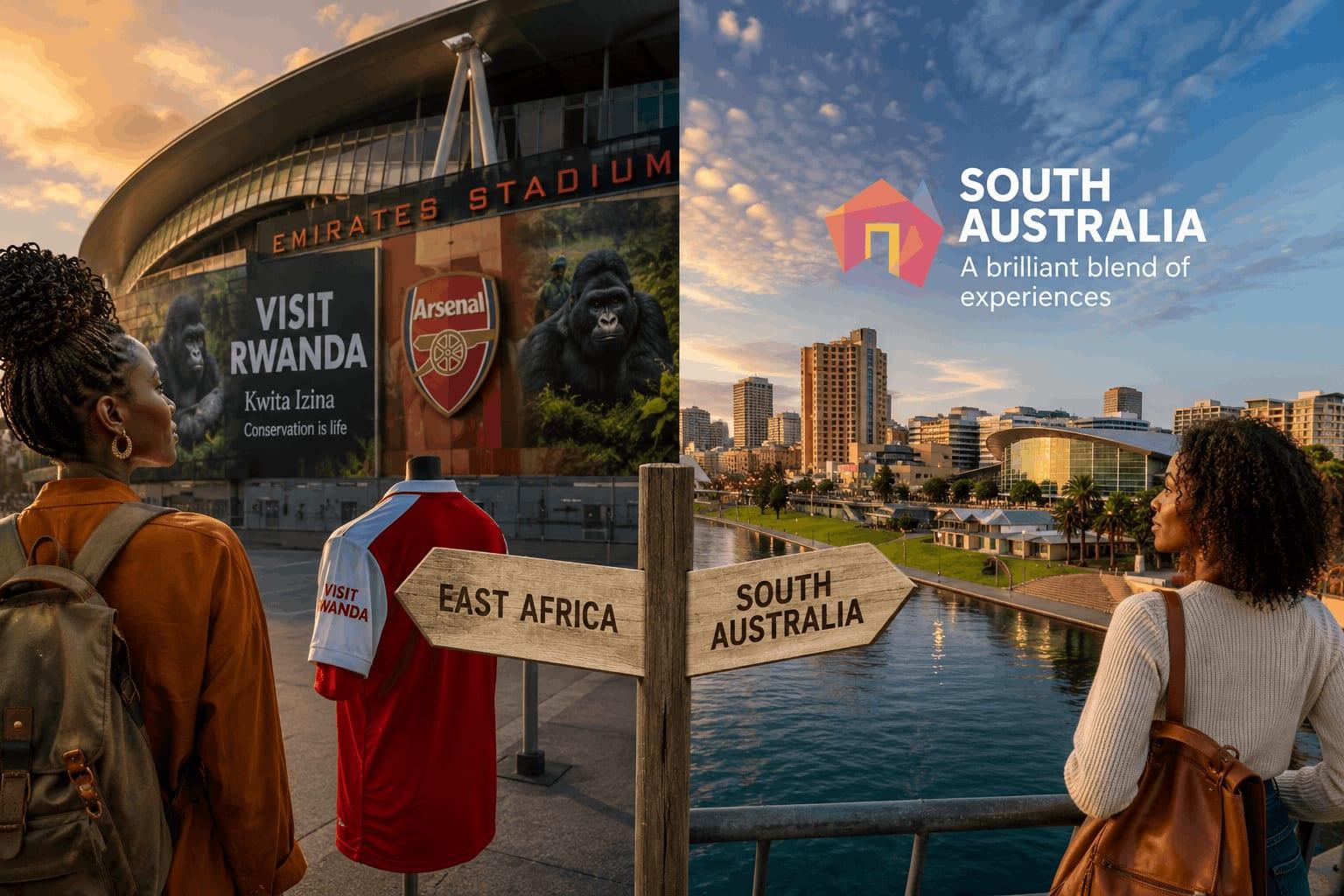
Look at two places on opposite sides of the planet right now. Rwanda, in East Africa, has just closed the book on an eight-year football shirt deal with Arsenal. South Australia, on the other side of the world, has put a number on its future: a $12.8 billion visitor economy by 2030, backed by a brand nobody had heard a year ago. Neither story involves the other. There is no shared company, no joint announcement, no reason the two would ever appear in the same sentence.
But line up the public record on both, and a pattern shows up. Both places are spending real money on tourism. Both have numbers to show for past efforts. And both are, right now, in the market for something new: a way to reach people who are already planning a trip, not just people who happened to see a logo.
This piece lays out what is actually known about each case, using statements from the organizations involved and reporting from outlets that covered them. It does not try to tell you why Rwanda ended its deal with Arsenal, or whether South Australia's new campaign will hit its target. Those are open questions. What follows are the facts as they have been reported, so you can weigh them yourself.
Rwanda and Arsenal: eight years, one sleeve, and an ending with two stories attached to it
In this section
The deal began at roughly £10 million per year, based on figures reported from Arsenal's 2023-24 club accounts.
In May 2018, Arsenal signed a sponsorship deal with the Rwanda Development Board (RDB) for the "Visit Rwanda" brand to appear on the sleeve of the club's shirts. It was the first sleeve sponsorship in Arsenal's history, and it made Rwanda the first country to put a "Visit Rwanda" logo on a European top-five league shirt. Paris Saint-Germain, Bayern Munich and Atletico Madrid later signed similar deals with Rwanda.
On November 19, 2025, the Rwanda Development Board announced that the Arsenal partnership would end in June 2026, at the close of the 2025-26 season. The announcement came in a joint statement described by both sides as a mutual decision.
Here is what the two organizations said publicly. RDB Chief Executive Officer Jean-Guy Afrika said the partnership "broke new ground for tourism boards around the world, driving awareness and visitation for Rwandan tourism at a pace traditional campaigns could never match." Arsenal chief executive Richard Garlick called it "a significant journey" and said the two organizations had "worked together to raise global awareness of Rwanda's tourism and conservation efforts."
The official joint statement, published on Arsenal's own website, framed the decision as strategic rather than reactive: it said the move "reflects Visit Rwanda's broader strategy to diversify its global sports partnerships and expand into new markets that support the next phase of its tourism and investment ambitions," and stated that the two sides had "exceeded the original goals of the partnership."
That is one version of events, and it is the version that comes directly from the two parties who signed the contract. There is also a second, separate strand of reporting worth setting alongside it, because it appeared in multiple outlets covering the same announcement.
The numbers behind the deal
Whatever the reasons for ending it, the scale of the partnership itself is well documented. The deal began at roughly £10 million per year, based on figures reported from Arsenal's 2023-24 club accounts. By the time of its conclusion, at least one outlet reported the value of the arrangement at more than $13.3 million per year, though contract terms for sponsorship deals are rarely published in full detail by either party, so that figure should be read as a reported estimate rather than a confirmed contract value.
On the outcomes side, RDB provided its own figures at the time of the announcement: visitor arrivals to Rwanda reached 1.3 million in 2024, and tourism revenue climbed to approximately $650 million, which RDB described as a 47 percent increase in tourism revenue since the partnership began in 2018. These are numbers supplied by the tourism board itself, not independently audited figures from a third party, which is a distinction worth keeping in mind when reading any tourism board's account of its own campaign's success. Governments and public agencies routinely report such figures as fact in press statements, and RDB's numbers were repeated without independent verification across the outlets that covered the announcement.
The part of the story that runs alongside the official statement
Separately from RDB's own framing, several news outlets covering the announcement pointed to a different backdrop. The Visit Rwanda sponsorship had, according to this reporting, come under sustained public criticism tied to the conflict in the eastern Democratic Republic of Congo, where the DRC government has accused Rwanda of backing the M23 armed group. That conflict has been reported to have killed thousands of people and displaced large numbers of civilians, and a ceasefire and peace framework between the DRC and M23 were reported to have been signed in recent months prior to the sponsorship's conclusion.
Reporting also noted that in February 2025, the DRC government publicly appealed to Arsenal, Paris Saint-Germain and Bayern Munich, the three clubs sponsored by Visit Rwanda, to end what the DRC's appeal reportedly described as their sponsorship arrangements with Rwanda, given the conflict. Separately, reporting noted that some Arsenal supporters staged protests in April 2025 against the continuation of the sponsorship, and that Arsenal faced criticism for reportedly not meeting with DRC Foreign Minister Thérèse Kayikwamba Wagner to discuss the arrangement.
It is also a matter of public record, reported by multiple outlets, that Bayern Munich ended its own Visit Rwanda sponsorship earlier in 2025, ahead of Arsenal's announcement, and that reporting attributed that decision in part to pressure from Bayern's own supporters. Atletico Madrid, by contrast, is reported to have signed a fresh deal with Visit Rwanda running through 2028, and Rwanda's partnership with Paris Saint-Germain has continued, according to the same reporting. Rwandan president Paul Kagame has been described in reporting as a long-time Arsenal supporter with access to an executive box at the Emirates Stadium, and is also reported to hold a sponsorship arrangement with PSG.
None of this reporting proves what actually drove the decision to end the Arsenal deal. The official statement from RDB and Arsenal does not cite the DRC conflict as a factor. Reporting from other outlets places the conflict, the protests and the diplomatic appeal in the same timeline as the decision, without RDB or Arsenal confirming a causal link. Readers can draw their own conclusions from the sequence of events, but the public record, as it stands, contains an official explanation and a separate set of reported circumstances, and the two have not been reconciled by either party.
What comes next for Rwanda's tourism marketing
Whatever the reason, RDB has been explicit in public statements about where it intends to direct its marketing efforts once the Arsenal deal ends. Afrika said that while the sleeve partnership has concluded, Rwanda intends to "leverage lessons learned in other international sporting platforms," pointing specifically to existing partnerships with the LA Rams and SoFi Stadium in Los Angeles. Reporting has also described Rwanda as working to expand its sports marketing presence into new geographic markets, including the United States, through arrangements connected to the NFL, and into southern Europe through its continuing relationship with clubs such as Atletico Madrid and Paris Saint-Germain.
In plain terms, the publicly stated plan is not to stop sports sponsorship as a marketing tool, but to spread it across more countries and more sports than a single Premier League shirt deal could reach. Whether that broader footprint produces the same reported growth in visitor numbers that the Arsenal partnership is credited with is something that will only be measurable in future years, once RDB or independent researchers publish comparable data.
South Australia: a number, a plan, and a brand nobody had heard of before June 2025
In this section
A tourism plan with a 2030 target is, by definition, a set of goals that have not yet been achieved.
On June 25, 2025, the South Australian government released a refreshed version of its South Australia Tourism Plan 2030. Unlike the Rwanda case, this is not the story of a deal ending. It is the story of a state government setting a public, numbered target for its tourism sector and naming the campaign it intends to use to reach it.
The number and where it comes from
The headline figure in the plan is $12.8 billion. That is the size the South Australian government wants its visitor economy to reach by 2030, up from a stated current value of $9.8 billion. The plan also targets 4,400 additional tourism jobs over the same period. According to the government's own release, the sector currently employs more than 41,600 South Australians, described as roughly 1 in 25 jobs in the state, and stated to be three times the number of jobs generated by the state's mining industry. The sector is also reported to include more than 20,000 individual tourism businesses.
It is worth noting that the $12.8 billion figure is not new to the 2025 refresh. The original South Australia Tourism Plan 2030, published in August 2019 by the South Australian Tourism Commission, set the same $12.8 billion target, building on a visitor economy that the 2019 document said had already grown from $5.1 billion to $6.8 billion under an earlier plan. In other words, the 2025 announcement reaffirmed a target that has existed in South Australian tourism policy for roughly six years, rather than introducing an entirely new goal. What changed in 2025 was the strategy and branding built around reaching it, following input the government said it gathered from more than 400 industry stakeholders across all 12 of the state's tourism regions.
The new brand: Celebrate the Simple Pleasures
The centerpiece of the refreshed plan's marketing strategy is a new state tourism brand and campaign called "Celebrate the Simple Pleasures." According to the government's own description, the campaign is aimed at travelers seeking what it calls authentic, meaningful experiences, built around the state's stated strengths in nature, food, wine, drink, and events and festivals.
This replaces earlier campaign language. Planning documents connected to the 2025 refresh reference an earlier working theme called "True South," which the government's own tourism plan materials described as having "struck a chord" in stakeholder testing, built around ideas of authenticity, community, culture and sustainability. Whether "True South" was ever used as a public-facing campaign or remained an internal planning concept, and how it relates to the final "Celebrate the Simple Pleasures" brand that was actually launched, is not fully detailed in the public documents reviewed for this piece. What is confirmed is that "Celebrate the Simple Pleasures" is the brand the government announced alongside the 2025 plan refresh, not "True South."
South Australian Tourism Commission (SATC) Chief Executive Emma Terry was quoted in coverage of the plan's release saying the state needs "to continue to increase our state's appeal for interstate and international audiences" and needs "to generate a pipeline of new and evolving tourism products and experiences" in order to meet the target. Tourism Minister Zoe Bettison was quoted describing the plan as being about the state's "whole tourism ecosystem working together," and pointed to the state's strengths in nature, food, wine, drink, and events as the combination she said makes South Australia distinctive.
The specific, measurable targets inside the plan
Beyond the headline $12.8 billion figure, the refreshed plan includes at least one specific, measurable operational target worth noting separately: international airline seat capacity. According to reporting on the plan, South Australia wants 20,200 international airline seats available each week by 2030. That represents an increase of 6,300 seats per week compared to current capacity, or roughly 327,600 additional seats annually. This is a concrete, checkable number, unlike the more general aspiration to grow "appeal" or "demand," and it gives outside observers a specific figure to track over the coming years as an indicator of whether the plan is on schedule.
The plan document itself lists three stated strategic priorities: increasing South Australia's appeal and consideration among travelers to grow demand, delivering new and evolving tourism products and experiences, and positioning tourism as what the document calls "a force for good," a phrase the government has connected to sustainability and community benefit goals. The plan also includes stated ambitions around being recognized as, in the government's words, a "top three" destination and a national leader in sustainable and inclusive tourism, with pilot initiatives described as being developed during 2025.
What the plan does not yet tell you
A tourism plan with a 2030 target is, by definition, a set of goals that have not yet been achieved. The $9.8 billion current figure is a starting point, not a midpoint measurement against the new campaign, because "Celebrate the Simple Pleasures" only launched alongside the plan itself in mid-2025. There is, as of this writing, no independent third-party data available showing whether the new brand campaign has had any measurable effect on visitor numbers, spending, or international arrivals, because not enough time has passed since its launch. The South Australian Tourism Commission has said it will report on progress through its annual reports, which is the appropriate place to look for future verification of whether the plan is tracking toward its target.
Setting the two cases side by side
In this section
RDB chose to lead with a percentage increase, 47 percent, tied directly to the years the Arsenal deal was active.
Here is what can be said with confidence, based only on public statements and reported facts, about what these two cases have in common and where they differ.
Both involve public tourism authorities: the Rwanda Development Board, a government agency, and the South Australian Tourism Commission, also a government agency, working alongside the state's Minister for Tourism. Both have attached specific dollar or numerical figures to their marketing efforts, rather than speaking only in general terms. RDB has publicly credited its Arsenal partnership with a 47 percent increase in tourism revenue since 2018, reaching $650 million in 2024. South Australia has set a public target of $12.8 billion by 2030, up from a stated $9.8 billion baseline.
Both are also, as of this year, in a period of transition in how they market themselves internationally. Rwanda has ended a single, high-profile sponsorship arrangement and stated publicly that it intends to spread its marketing efforts across new sports and new geographic markets, including the United States and southern Europe, rather than replace the Arsenal deal with a single equivalent. South Australia has launched an entirely new brand campaign attached to an existing, multi-year numerical target, built on stakeholder consultation the government says involved more than 400 people across 12 regions.
Both cases also involve a public agency putting a specific figure in front of the media rather than leaving the outcome to be inferred. RDB chose to lead with a percentage increase, 47 percent, tied directly to the years the Arsenal deal was active. The South Australian Tourism Commission chose to lead with a dollar gap, $9.8 billion against a $12.8 billion goal, and paired it with a jobs number, 4,400, that is easier for the public to picture than a revenue figure alone. Both choices are communication decisions as much as they are economic ones, and both were made by government bodies with a direct interest in showing their work in a favorable light. That does not make either figure false. It does mean that a percentage growth figure supplied by the same agency that ran the campaign being measured, or a target set by the same commission that will later report on whether it was met, is not the same category of evidence as a number produced by an outside auditor with no stake in the outcome.
Where the two cases differ is in what triggered the current moment. Rwanda's situation follows the natural conclusion of a fixed-term sponsorship contract, against a backdrop of reported public criticism connected to a regional conflict that neither RDB nor Arsenal has officially cited as a factor in ending the deal. South Australia's situation follows a scheduled refresh of an existing government tourism plan, timed to a 2030 target that was set years earlier, with a newly designed brand campaign built to support that pre-existing goal.
Questions worth asking, rather than conclusions worth repeating
In this section
Readers following either story going forward have a reasonably clear way to check the claims being made today.
Some people who work in travel marketing have argued, in industry commentary, that tourism boards today are less interested in simple visibility, such as a logo appearing on a shirt or a billboard, and more interested in reaching audiences who are already inclined to book a trip, and in partnering with sources those audiences already trust for travel information. That may or may not be an accurate read of what is driving decisions at RDB or the South Australian Tourism Commission specifically. Neither organization has stated, in the public materials reviewed for this piece, that this framework is what is guiding their current strategy. It is a theory held by some observers in the marketing industry, not a fact confirmed by either tourism board.
With that distinction in mind, here are questions the public record raises but does not answer, for readers who want to think through this themselves rather than accept someone else's framing of it.
On Rwanda: did the Democratic Republic of Congo conflict, the reported supporter protests, and the DRC government's public appeal to Arsenal, PSG and Bayern Munich play any role in the timing or nature of the decision to end the sleeve sponsorship, given that Bayern Munich ended its own Visit Rwanda deal earlier in the same year, while Atletico Madrid signed a new deal running through 2028 during the same period? Or was the decision, as officially stated, purely a strategic choice about diversifying markets after "exceeding" the partnership's original goals? The public statements from RDB and Arsenal offer one explanation. The reported sequence of events around the DRC conflict offers a separate set of circumstances that happened alongside it. Only RDB and Arsenal have access to the internal reasoning behind the timing of their decision, and neither has addressed the conflict directly in their public statements about the partnership's conclusion.
On South Australia: will "Celebrate the Simple Pleasures," a campaign that only launched in mid-2025, actually move the state's visitor economy from $9.8 billion toward $12.8 billion by 2030, a target that has technically existed in state policy since at least 2019? What specific role does the new brand play in hitting the airline capacity target of 20,200 weekly international seats, compared to other stated factors such as new hotel investment and airline route announcements that the government has separately pointed to as evidence of "momentum" prior to the plan's release? These are measurable questions. The South Australian Tourism Commission's own annual reporting process is the stated mechanism for tracking them over the coming years, and that reporting, once published, will be the place to look for actual evidence rather than campaign messaging.
Readers following either story going forward have a reasonably clear way to check the claims being made today. For Rwanda, that means watching whether visitor numbers and tourism revenue continue to climb once the Arsenal sponsorship ends in June 2026, and whether Rwanda's new US and southern European sports marketing partnerships produce publicly reported figures comparable to what RDB has claimed for the Arsenal deal. For South Australia, that means watching the South Australian Tourism Commission's annual reports for movement on the $9.8 billion to $12.8 billion figure, and for progress on the 20,200 weekly international seat target, over the years between now and 2030.
Neither outcome is knowable today. What is knowable is what each organization has said publicly, what independent reporting has documented alongside those statements, and where the two accounts do not fully line up. That is the material available to work with, and it is presented here without a verdict attached, because the verdict does not yet exist.
Sources
- Rwanda Development Board / Arsenal FC, joint statement on the conclusion of the Visit Rwanda partnership, published on Arsenal.com, November 19, 2025: https://www.arsenal.com/news/visit-rwanda-update
- AllAfrica, "Rwanda: Arsenal, Visit Rwanda Agree to End Partnership in June 2026," November 19, 2025: https://allafrica.com/stories/202511200114.html
- AllAfrica, "Rwanda Says It Has Expanded Into New Global Markets After Arsenal Deal Ends," November 19, 2025: https://allafrica.com/stories/202511200069.html
- AllAfrica, "Arsenal–Visit Rwanda - End of an Iconic Partnership, Start of a New Strategic Phase," November 19, 2025: https://allafrica.com/stories/202511190582.html
- AllAfrica, "Arsenal to End Visit Rwanda Sponsorship After Eight Years," November 20, 2025: https://allafrica.com/view/group/main/main/id/00094822.html
- Flashscore, "Arsenal ending eight-year partnership with sponsor Visit Rwanda": https://www.flashscore.com/news/soccer-premier-league-arsenal-ending-eight-year-partnership-with-sponsor-visit-rwanda/tjfhNzaD
- Mozzart Sport Kenya, "Arsenal to end criticized Rwanda sponsorship," February 2026: https://www.mozzartsport.co.ke/football/news/arsenal-to-end-criticized-rwanda-sponsorship/59907
- The Athletic (via X/Twitter), confirmation of Arsenal sleeve sponsorship figures from 2023-24 club accounts: https://x.com/TheAthleticFC/status/1991091037834727723
- South Australian Tourism Commission / Tourism SA, "South Australia Tourism Plan 2030": https://tourism.sa.gov.au/news-articles/south-australia-tourism-plan-2030
- Tourism SA, "Growing benefits for all a focus of South Australia Tourism Plan 2030," June 24-25, 2025: https://tourism.sa.gov.au/news-articles/growing-benefits-for-all-a-focus-of-south-australia-tourism-plan-2030
- Premier of South Australia, media release, "Growing benefits for all a focus of South Australia Tourism Plan 2030": https://premier.sa.gov.au/media-releases/news-archive/growing-benefits-for-all-a-focus-of-south-australia-tourism-plan-2030
- Mirage News, "SA Tourism Plan 2030: Expanding Benefits for All," June 25, 2025: https://www.miragenews.com/sa-tourism-plan-2030-expanding-benefits-for-all-1484342/
- Australasian Leisure Management, "Refreshed South Australia Tourism Plan 2030 released": https://www.ausleisure.com.au/news/refreshed-south-australia-tourism-plan-2030-released/
- The Indian Sun, "Can South Australia hit $12.8B in visitor spend by 2030?," June 26, 2025: https://www.theindiansun.com.au/2025/06/25/can-south-australia-hit-12-8-b-in-visitor-spend-by-2030/
- Tourism SA, "Plans and Strategies": https://tourism.sa.gov.au/plans-and-strategies
- South Australian Tourism Commission, "South Australian Visitor Economy Sector Plan 2030" (2019 original plan, PDF): https://tourism.sa.gov.au/media/s3ynh5hk/satc_tourism-plan-2030_final_aug2019.pdf
- South Australia Tourism Plan 2030 (2025 refresh, PDF): https://tourism.sa.gov.au/media/1a1faihm/sa-tourism-plan-2030.pdf