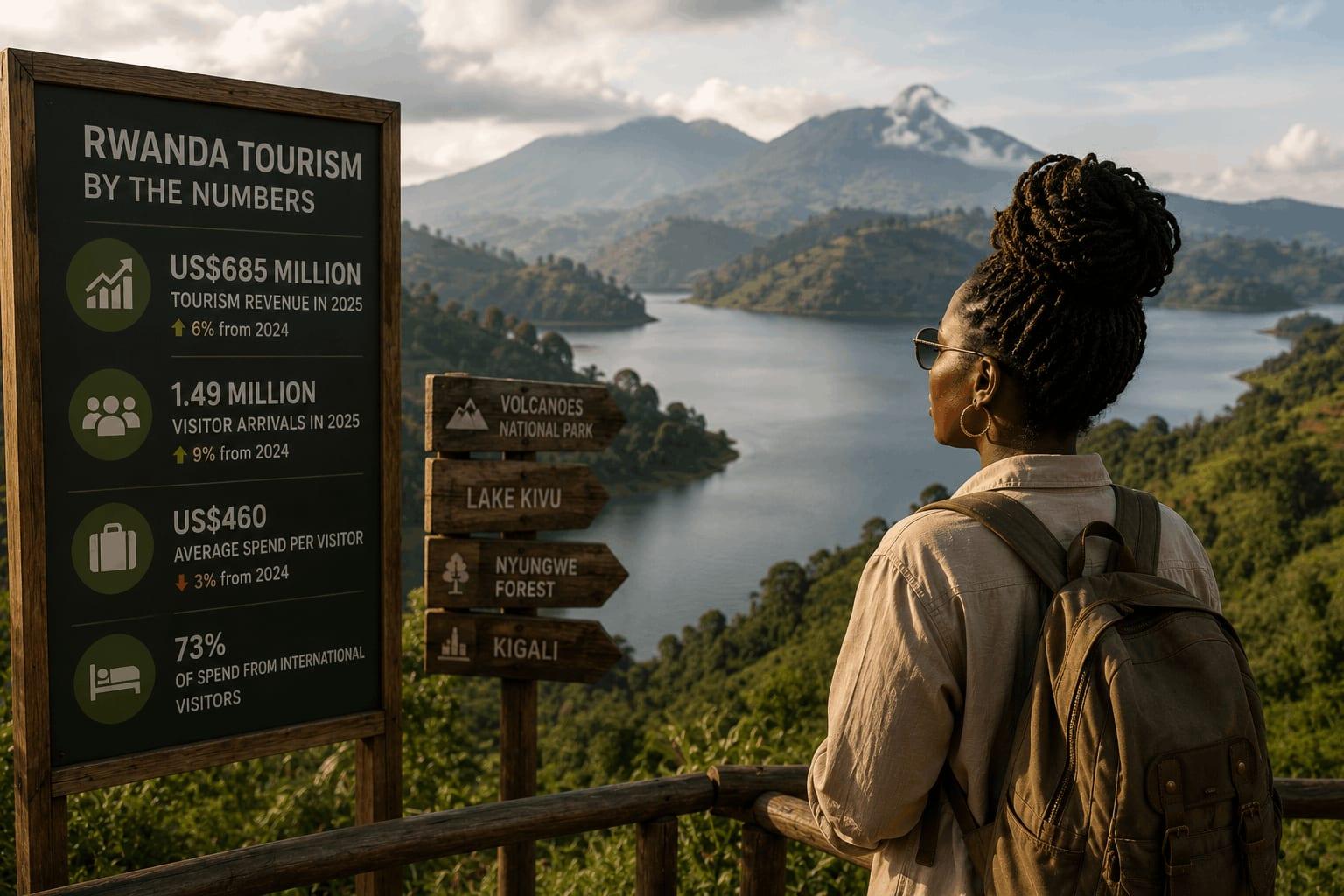
Rwanda's tourism sector brought in 685 million US dollars in 2025, up from 647 million the year before. That figure comes from the Rwanda Development Board's (RDB) 2025 annual report, released on April 28, 2026, and it has been repeated in headlines across East Africa and beyond. On its own, a 6 percent jump in one year is a decent result. It is not the kind of number that stops anyone in their tracks.
But a single headline figure rarely tells you what is actually happening inside a sector. Revenue can grow for many different reasons, more visitors, higher spending per visitor, a stronger currency, a booming conference calendar, or some mix of all of these. To understand what is really going on in Rwanda's tourism economy in 2025, you have to open up the number and look at what is inside it.
That is what this piece does. It pulls apart the RDB's own reported figures, checks them against multiple independent sources, and lays out what the data shows without telling you what to conclude from it. Some of the patterns raise straightforward questions. Others sit next to controversies that have nothing to do with spreadsheets and everything to do with politics, war, and how a country chooses to spend its tourism income. Both belong in the same conversation, because both are part of the same industry.
The five year climb, and where it started
In this section
A sector recovering from a shock tends to grow fast at first simply because it started from a low base.
To understand 2025, it helps to see where Rwanda's tourism revenue has been.
In 2019, before the COVID-19 pandemic, Rwanda's tourism sector earned about 498 million dollars, according to RDB figures reported at the time. When the pandemic hit global travel in 2020, that number collapsed to roughly 121 million dollars, a drop of more than 74 percent in a single year, as reported by Africa-Press and The New Times, both citing RDB's 2022 annual report.
Recovery from there was fast. In 2021, revenue rose to about 164 million dollars. In 2022, it jumped again to 445 million dollars, a 171.3 percent increase in one year, according to CGTN and The New Times, both citing the same RDB report. RDB's chief executive at the time, Clare Akamanzi, pointed to the reopening of global travel after COVID restrictions and improved airline connectivity into Kigali as the main drivers.
In 2023, revenue climbed again to 620 million dollars, a 36 percent increase, according to The New Times and allAfrica, both citing RDB's 2023 annual report. That year, RDB said the sector had finally overtaken its pre-pandemic 2019 level, putting the recovery rate at 124 percent.
Then in 2024, growth slowed sharply. Revenue rose to 647 million dollars, an increase of only 4.3 percent, according to the allAfrica report on the 2025 figures, which included the 2024 comparison. And now in 2025, revenue reached 685 million dollars, a 6 percent increase.
Line them up and the pattern is clear. Triple-digit percentage growth in the recovery years of 2021 and 2022. Strong growth of 36 percent in 2023. Then two years in a row of single-digit growth, 4.3 percent in 2024 and 6 percent in 2025.
That alone is worth sitting with. A sector recovering from a shock tends to grow fast at first simply because it started from a low base. As it approaches and passes its old highs, growth naturally slows down. Is what happened in 2024 and 2025 simply that, a maturing market settling into a steadier pace? Or is it a sign that Rwanda is bumping up against limits, in visitor capacity, in how much a small country's parks and conference venues can hold, in how much more it can extract from each visitor without changing its approach? The numbers do not answer that question by themselves. They just make it worth asking.
Visitors grew faster than revenue, and that is unusual
In this section
More people visited Rwanda in 2025 than in 2024, at a rate faster than revenue grew.
Here is where the 2025 numbers get more interesting.
Visitor arrivals reached 1.49 million in 2025, up from 1.36 million in 2024, a 9 percent increase, according to RDB's own report as cited by The New Times, allAfrica, and RDB's official website. Revenue, as noted above, grew by only 6 percent.
Put those two figures side by side and you get an odd result. More people visited Rwanda in 2025 than in 2024, at a rate faster than revenue grew. If you did the simple arithmetic, average revenue per visitor actually declined slightly year over year, since a 9 percent rise in visitor volume outpaced a 6 percent rise in total income.
This is worth noticing because it runs against what you might expect from a country that has spent years marketing itself as a "high-value, low-volume" tourism destination. That phrase is not something outsiders invented to describe Rwanda. It comes directly from RDB officials themselves. Michaella Rugwizangoga, RDB's Chief Tourism Officer, was quoted by The New Times describing Rwanda's growth strategy in exactly those terms, as a push to position the country as a unique high-end, low-volume, eco-tourism destination.
So here is a fair question, not a conclusion, just a question: if the stated strategy is to prioritize value over volume, why did volume grow faster than value in the very year the RDB is celebrating as a strong performance? There are several possible explanations, and none of them can be confirmed or ruled out from the topline numbers alone. It could be that a growing share of the 1.49 million arrivals are lower-spending regional travelers rather than the long-haul, high-spending visitors the "high value" branding targets. It could be that per-visitor spending on the high end held steady or even rose, while an entirely separate category of low-cost regional or transit travel expanded underneath it, pulling the average down without touching the high-value core. It could also be a currency effect, a reporting effect, or something else the public report does not break down. Readers with access to the full RDB annual report, rather than press summaries of it, would be able to check spending per visitor by category and see which explanation the underlying data actually supports.
What can be said with confidence, because it is stated directly in the report as reported by multiple outlets, is this: arrivals rose 9 percent, revenue rose 6 percent, and those are two different growth rates moving in the same direction but at different speeds.
Air travel is growing four times faster than road travel
In this section
Anyone wanting a fuller picture would need the RDB's full statistical annex, not just the summary version circulated in press coverage.
The clearest and most consistently reported detail inside the 2025 numbers is the split between air arrivals and road arrivals.
According to allAfrica and The New Times, both citing the RDB 2025 report directly, air arrivals grew by 23 percent year over year, while road arrivals grew by only 5 percent. The report attributes the air growth to improved international connectivity and sustained demand from international markets, and describes the road growth as reflecting Rwanda's strong regional appeal.
Twenty-three percent is a large jump for one year in air arrivals specifically. Road arrivals into Rwanda are typically dominated by regional travelers crossing land borders, often for shorter visits, business trips, or family reasons, and typically spending less per trip than someone who has flown in from Europe, North America, or Asia for a dedicated holiday. Air arrivals, by contrast, tend to skew toward longer-haul, higher-spending visitors, the kind of traveler booking a gorilla trekking permit, a multi-day safari package, or a stay at a luxury lodge.
If that general pattern holds for Rwanda specifically, and the report does not provide a broken-out revenue-per-arrival figure for air versus road travelers, then a 23 percent jump in air arrivals against a 5 percent rise in road arrivals suggests the composition of Rwanda's visitor base shifted somewhat toward higher-spending travelers in 2025, even if the overall per-visitor average, as discussed above, appears to have softened.
The report also notes that visitor inflows were led by markets from the East African Community and the Democratic Republic of Congo, alongside what it describes as steady growth from Europe, North America, Asia, and the rest of Africa, according to allAfrica's summary of the RDB findings. That detail matters because it tells you the EAC and DRC, both reachable primarily by road, remain the largest single sources of visitors by country of origin, even as the fastest percentage growth is happening in the air segment. Both things can be true at once: road travel remains the largest slice of total arrivals, while air travel is the fastest growing slice.
A reasonable person could look at this and ask what "growing faster" actually buys a country if the segment growing faster is still smaller in absolute terms than the segment growing slower. That is a legitimate open question, and the public reporting so far does not include the raw arrival numbers split by air versus road, only the percentage growth rates. Anyone wanting a fuller picture would need the RDB's full statistical annex, not just the summary version circulated in press coverage.
The gorilla permit and the economics behind "high value, low volume"
In this section
The high-value pricing model clearly applies to gorilla permits.
Rwanda's tourism strategy has a name, and it shows up in almost every official statement about the sector: high-value, low-volume tourism. Understanding what that actually means in practice requires looking at the country's best known tourism product, mountain gorilla trekking.
A gorilla trekking permit in Rwanda costs 1,500 US dollars per person for international non-resident visitors, a price that has been in place since 2017 and remained unchanged through 2025, according to multiple tour operator sources and confirmed by RDB's own permit pricing structure. For comparison, the same experience costs 800 dollars in Uganda and 400 dollars in the Democratic Republic of Congo, making Rwanda's permit the most expensive of the three countries where mountain gorillas can be tracked in the wild.
Foreign residents of Rwanda and citizens of other East African Community countries pay a reduced rate of 500 dollars, and Rwandan nationals pay 200 dollars, according to permit pricing published by several licensed tour operators and consistent with RDB's publicly stated fee structure.
Access is also deliberately capped. Rwanda limits gorilla trekking to 96 permits per day, since only a fixed number of habituated gorilla families can be visited without disturbing them, according to tour operator guides referencing RDB's permit allocation rules. That cap is not a marketing device. Gorilla groups can only tolerate a limited amount of human contact before the stress of repeated visits starts to affect their health and behavior, which is the actual conservation logic behind capping numbers in the first place, according to conservation-focused explanations of the pricing policy.
Put the price and the cap together and you get the mechanism behind "high value, low volume" in its purest form: charge a very high price for access to a scarce, non-renewable resource, use part of that revenue to fund the conservation work that keeps the resource intact, and accept that this necessarily limits the total number of people who can ever participate. It is a model that trades volume for margin on purpose.
Whether that model is working as intended in the broader tourism sector, beyond gorilla trekking specifically, is exactly the question raised by the arrivals-versus-revenue gap described earlier in this piece. Gorilla trekking is one product within a much larger tourism sector that also includes safari tourism at parks like Akagera and Nyungwe, business and conference travel, leisure travel, and a growing category the RDB describes as health and education tourism. The high-value pricing model clearly applies to gorilla permits. Whether it applies with the same rigor across every other segment of the sector is not something the topline national numbers can confirm or deny on their own.
One data point worth noting here: Akagera National Park, Rwanda's savanna reserve and a different, lower-cost tourism product than gorilla trekking, projected 4.9 million dollars in revenue for 2025, following a 3 percent revenue decline to 4.7 million dollars in 2024, according to a report by African Parks, the organization that manages the reserve, as covered by allAfrica. That decline in 2024 was attributed to reduced average spending per visitor, partly linked to health concerns following Marburg virus and Monkeypox outbreaks that year, and to the temporary closure of one of the park's camps for facility upgrades. This is a small but concrete example of a single tourism product where visitor numbers rose while average spending per visitor fell, the same directional pattern seen in the national totals for 2025, though at Akagera the cause is identifiable and specific rather than a mystery.
The conference sector: growing faster than everything else
In this section
A conference delegate is a fundamentally different kind of visitor than a leisure tourist.
If there is one figure in the 2025 report that stands out as unambiguously strong, it is the performance of Rwanda's Meetings, Incentives, Conferences, and Exhibitions sector, commonly called MICE.
The MICE segment generated 94.7 million dollars in 2025, up from 84.8 million dollars in 2024, an increase of 11.8 percent, according to RDB's report as cited by Xinhua, The New Times, allAfrica, and RDB's own website. That growth rate is nearly double the 6 percent growth rate of the tourism sector as a whole.
The report also states that Rwanda hosted 165 international and regional events in 2025, a figure repeated across multiple outlets including Xinhua and ATQ News, the latter quoting Kadigiri Ginette, RwandAir's Regional Manager for West and Central Africa, at a tourism conference in Lagos in mid-2026.
For comparison, in 2023 Rwanda's MICE sector generated 95 million dollars from 160 events that attracted 65,000 delegates, according to a report by IndiaOutbound.info citing RDB's 2023 annual report. Read carefully, that means 2023's MICE revenue, at roughly 95 million dollars, was actually slightly higher than 2024's 84.8 million dollars, before rising again to 94.7 million in 2025. That is not a smooth, steady upward line. It is a dip in 2024 followed by a recovery in 2025 that brought the sector back to roughly where it had already been two years earlier. This detail does not appear in most of the 2025 coverage, which focuses on the year-over-year comparison between 2024 and 2025 without mentioning that 2023 had already reached a similar level. Whether that matters to how impressive the 2025 MICE growth actually is depends on how you choose to read it, as genuine renewed momentum, or as a return to a level the sector had already touched two years before.
Why does conference tourism matter more than its dollar figure alone suggests? A conference delegate is a fundamentally different kind of visitor than a leisure tourist. Conferences are typically booked by institutions, associations, and corporations, often years in advance, and they tend to bring higher average per-visitor spending because delegates pay for premium hotel stays, event venues, catering, and business services, categories where costs and margins both run higher than typical leisure tourism spending. A country that becomes known as a reliable conference destination also builds repeat institutional relationships rather than one-time visits, since organizations that hold a successful event in a country are more likely to return or recommend it to others.
Kigali has invested specifically in this segment. The Kigali Convention Centre, opened in 2016, was built explicitly to position the country as a East African hub for large international meetings, and Rwanda has hosted major events in recent years including African Union summits and international sporting and business conferences. The 2025 growth in MICE revenue, even accounting for the 2023-to-2024 dip noted above, fits a longer-term pattern of the government treating conference tourism as a distinct strategic priority rather than a side effect of general tourism growth.
Where does the marketing money go? The Visit Rwanda sponsorships
In this section
Readers can decide for themselves what weight, if any, to give this alongside the revenue and arrivals figures.
Any honest look at how Rwanda funds and promotes its tourism sector has to include the "Visit Rwanda" sports sponsorships, because they are the most visible and most contested piece of the country's tourism marketing strategy, and because RDB officials themselves have said publicly that the money for these deals comes directly from tourism revenue.
In 2018, Rwanda signed a sleeve sponsorship deal with Arsenal Football Club, reported at the time to be worth around 30 to 39 million dollars over three years, according to Fox News and the Euronews coverage from that period. Rwanda's Deputy Foreign Minister at the time, Olivier Nduhungirehe, told the Associated Press that the funding came from tourism revenue, not from foreign aid, and RDB stated its goal was to double tourism receipts to 800 million dollars by 2024, a target that, based on the figures above, the country came close to but had not yet reached by 2025.
The deal drew criticism from British lawmakers and media at the time, given that the UK provided Rwanda with tens of millions of pounds in foreign aid annually, and RDB's own chief executive responded that critics of the Arsenal deal effectively wished the country to remain poor, according to reporting from Fox News.
The Arsenal sponsorship was renewed multiple times and eventually reported to be worth over 10 million pounds, or roughly 13 million dollars, per year, according to Reuters and Goal.com. Rwanda extended similar "Visit Rwanda" branding partnerships to other major European clubs, including Paris Saint-Germain starting in 2019, Bayern Munich starting in 2023, and later Atletico Madrid.
In 2025, this arrangement became entangled with a much more serious issue: the conflict in the eastern Democratic Republic of Congo. In February 2025, the DRC's foreign minister, Thérèse Kayikwamba Wagner, wrote directly to Arsenal, Bayern Munich, and Paris Saint-Germain, urging them to end what she called "blood-stained" sponsorship deals with Visit Rwanda, according to reporting from The Africa Report and Reuters. Her letter cited a United Nations report alleging that thousands of Rwandan troops were active in Congolese territory, an allegation Rwanda's government has denied. Rwanda-backed M23 rebels had seized a number of towns and cities in eastern Congo during this period, in what Reuters described as the gravest escalation of the conflict in more than a decade, a conflict whose roots trace back to the spillover of Rwanda's 1994 genocide into the Congo and to competition over the region's mineral resources.
Rwanda's government responded that the DRC's criticism of the sponsorship deals amounted to a threat to regional peace and stability, according to Reuters, and separately maintained its position that it was acting in self-defense against ethnic Hutu-led militias it says are aligned with elements of the Congolese military.
The pressure had visible effects. A fan advocacy group called Gunners for Peace surveyed more than 2,500 Arsenal supporters and found that only 2 percent wanted the Visit Rwanda sponsorship renewed, while 86 percent wanted the deal ended, according to Goal.com's reporting on the group's statement. In November 2025, Arsenal and RDB jointly announced that the eight-year sponsorship would end at the close of the 2025-26 season, describing it as a mutual decision. Both Arsenal's statement and RDB's public comments framed the end of the deal as part of a strategic pivot rather than a response to pressure, with RDB stating it was diversifying its sports partnerships into new markets, including deals with United States-based teams under the same ownership group as Arsenal, Kroenke Sports and Entertainment, according to Goal.com and SportsPro.
Bayern Munich, facing similar pressure from its own supporters, reframed its Visit Rwanda partnership to focus on development programs rather than promotional branding, according to SportsPro. Paris Saint-Germain and Atletico Madrid, by contrast, have continued their Visit Rwanda branding deals, according to Goal.com's coverage from November 2025.
None of this changes the topline tourism revenue figures reported for 2025. But it does sit directly beside them, because the sponsorships were funded, by the Rwandan government's own account, out of tourism revenue and framed explicitly as tourism marketing spend. A reader trying to understand Rwanda's tourism sector in full would reasonably want to know not just how much money came in, but how some of that money has been spent, and what controversies have attached themselves to that spending. Readers can decide for themselves what weight, if any, to give this alongside the revenue and arrivals figures. It is not something the RDB's annual report addresses, since the report covers revenue performance rather than marketing expenditure or its political consequences.
Who is actually visiting, and why
In this section
The RDB's 2025 report also breaks down visitors by purpose of travel, though in less numerical detail than the arrivals and revenue figures.
The RDB's 2025 report also breaks down visitors by purpose of travel, though in less numerical detail than the arrivals and revenue figures. According to allAfrica and The New Times, both citing the report directly, business travel remained the largest single segment by purpose of visit in 2025. The report also highlighted what it described as notable growth in health and education travel, categories the RDB frames as part of a broader effort to position Rwanda as what it calls a diversified, year-round destination, rather than one dependent on a single peak season or a single type of visitor.
This detail is worth pausing on because it is easy to overlook next to the more dramatic gorilla trekking and safari branding that dominates Rwanda's international tourism image. If business travel is genuinely the largest segment by purpose of visit, that reinforces the picture painted by the MICE sector's above-average growth rate: a meaningful share of Rwanda's tourism economy is not leisure tourism at all, but people traveling for work, meetings, medical treatment, or study. Health and education travel in particular can indicate that Rwanda's public and private healthcare and education institutions have reached a level of regional reputation sufficient to draw paying visitors from neighboring countries, though the report as summarized in public coverage does not specify which countries these travelers are coming from, what conditions or programs are drawing them, or how large this category is in dollar or visitor terms relative to business and leisure travel.
Without access to the full breakdown by purpose of visit, in both visitor numbers and revenue contribution, it is not possible to say how large the health and education segment actually is, only that RDB's own report flags it as growing.
What the numbers show, and what they do not
In this section
Tourism revenue reached 685 million dollars in 2025, a 6 percent increase from 647 million dollars in 2024.
Laid out together, here is what can be said with confidence, based on RDB's own reported figures as confirmed across multiple independent outlets:
Tourism revenue reached 685 million dollars in 2025, a 6 percent increase from 647 million dollars in 2024. Visitor arrivals reached 1.49 million, a 9 percent increase from 1.36 million. Air arrivals grew 23 percent, more than four times the 5 percent growth rate of road arrivals. The MICE conference segment generated 94.7 million dollars, up 11.8 percent from 84.8 million dollars in 2024, though this figure is close to and only slightly above the roughly 95 million dollars the same segment generated back in 2023. Business travel was the largest segment by purpose of visit, with health and education travel noted as growing categories. And Rwanda's most prominent piece of tourism marketing, the Visit Rwanda sports sponsorship program, ended its highest-profile partnership, with Arsenal, in November 2025, following sustained criticism tied to the conflict in eastern Congo.
What cannot be said with confidence, because the publicly available summaries of the RDB report do not include this level of detail, is why arrivals grew faster than revenue in a country whose stated strategy is built around the opposite outcome, what the actual revenue-per-visitor figures look like broken down by air versus road arrivals, or how large the health and education tourism segment is in absolute terms.
These gaps are not evidence of anything on their own. They are simply the limits of what has been made public in press coverage of the report, as distinct from the full underlying dataset RDB itself holds.
Questions worth sitting with
In this section
None of these questions have a single correct answer sitting in the data reviewed for this piece.
A few questions come out of this that are worth asking rather than answering, since the public data does not settle them:
If Rwanda's stated strategy is high-value, low-volume tourism, and 2025 saw volume grow faster than value, does that represent a temporary blip, a shift in strategy, or a change in the mix of visitors coming into the country?
Does the strong growth in air arrivals reflect Rwanda successfully reaching new higher-spending international markets, or could some of that growth be regional or transit travelers who happen to arrive by plane rather than by road?
Given that the MICE sector's 2025 revenue is close to what it already achieved in 2023, is describing it as the fastest-growing segment in 2025 the fairest way to characterize its recent trajectory, or does that framing miss a dip and recovery pattern that a two-year comparison alone would not show?
And separately from all of the revenue figures: does it matter, to how the tourism sector as a whole is assessed, that some of its marketing spend went toward sponsorship deals that became politically entangled with an active regional conflict, one serious enough that a neighboring country's foreign minister described the arrangement in the language she used, and serious enough that Arsenal's own fanbase pushed to end it?
None of these questions have a single correct answer sitting in the data reviewed for this piece. They are the kind of questions a fuller version of the RDB's own report, or independent reporting with access to disaggregated figures, could help answer. Until then, the honest position is to lay out what is confirmed, flag what is not, and let readers weigh it for themselves.
Sources
- Rwanda Development Board, "Rwanda Development Board Reports Strong Performance Across Investment, Exports and Tourism in 2025," April 28, 2026. https://rdb.rw/rwanda-development-board-reports-strong-performance-across-investment-exports-and-tourism-in-2025/
- Xinhua, "Rwanda's tourism revenues soar to 685 mln USD in 2025: report," April 28, 2026. https://english.news.cn/20260428/ab07ff44b94c4962b376010f4dd72dbd/c.html
- The New Times, "Rwanda's tourism revenues hit Rwf1tn in 2025 - report," April 29, 2026. https://www.newtimes.co.rw/article/35238/news/tourism/rwandas-tourism-revenues-hit-rwf1tn-in-2025---report/amp
- allAfrica, "Rwanda's Tourism Revenues Hit Rwf1tn in 2025 - Report," April 29, 2026. https://allafrica.com/stories/202604290078.html
- Eastleigh Voice, "Rwanda's tourism revenues soar to $685 million in 2025 - report," April 29, 2026. https://eastleighvoice.co.ke/rwanda/340664/rwandas-tourism-revenues-soar-to-685-million-in-2025-report
- ATQ News, "Africa: Rwanda Earned $94.7m from 165 Conferences, Generated $685m in Tourism Revenue in One Year – RwandAir Executive," July 11, 2026. https://atqnews.com/africa-rwanda-earned-94-7m-from-165-conferences-generated-685m-in-tourism-revenue-in-one-year-rwandair-executive/
- The New Times, "Rwanda's tourism revenue hit $620 million in 2023," April 25, 2024. https://www.newtimes.co.rw/article/16248/news/tourism/rwandas-tourism-revenue-hit-620-million-in-2023
- allAfrica, "Rwanda's Tourism Revenue Hit $620 Million in 2023," April 25, 2024. https://allafrica.com/stories/202404250251.html
- allAfrica, "Rwanda Tourism Revenue More Than Doubled to U.S.$445 Million in 2022," May 8, 2023. https://allafrica.com/stories/202305080112.html
- CGTN, "Rwanda's tourism revenue up 171 percent in 2022," May 5, 2023. https://newsaf.cgtn.com/news/2023-05-05/Rwanda-s-tourism-revenue-up-171-percent-in-2022-1jxx2CtkOKA/index.html
- Africa-Press, "Rwanda tourism revenue more than doubled to $445m in 2022," May 6, 2023. https://www.africa-press.net/rwanda/culture-and-art/rwanda-tourism-revenue-more-than-doubled-to-445m-in-2022
- IndiaOutbound, "Rwanda tourism receipts rise 36 pc to USD 620 million in 2023," April 26, 2024. https://indiaoutbound.info/trade-news/rwanda-tourism-receipts-rise-36-pc-to-usd-620-million-in-2023/
- allAfrica, "Rwanda: Akagera National Park Targets $4.9m in Revenues," June 6, 2026. https://allafrica.com/stories/202506060021.html
- Jewel Gorilla Safaris, "Rwanda Gorilla Trekking Permit | Cost and Booking (2025 to 2030)," December 24, 2025. https://jewelgorillasafaris.com/rwanda-gorilla-trekking-permit/
- Gorilla Treks in Rwanda, "Understanding the $1500 cost of Gorilla Trekking in Rwanda," April 15, 2026. https://www.gorillatreksinrwanda.com/news/understanding-the-1500-cost-of-gorilla-trekking-in-rwanda/
- Realm Africa Safaris, "Rwanda Gorilla Permit Prices (Updated 2024-2026 Permit Prices)." https://realmafricasafaris.com/rwanda-gorilla-permit-prices/
- Goal.com, "Arsenal announce end of controversial sponsorship deal with Visit Rwanda after eight years," November 19, 2025. https://www.goal.com/en/lists/arsenal-announce-end-controversial-sponsorship-deal-visit-rwanda/blt9f4448657ed58507
- The Africa Report, "Decoding Arsenal's exit from the Visit Rwanda deal: A shift in strategy?" November 21, 2025. https://www.theafricareport.com/399211/why-is-arsenal-wrapping-up-its-rwanda-sponsorship-deal/
- SportsPro, "Arsenal drop controversial Visit Rwanda sleeve sponsorship," November 20, 2025. https://www.sportspro.com/news/arsenal-visit-rwanda-sleeve-sponsorship-cancelled-november-2025/
- Reuters (via Yahoo News), "Rwanda says DRC criticism of Arsenal, Bayern and PSG deals threatens regional peace." https://www.yahoo.com/news/rwanda-says-drc-criticism-arsenal-112227635.html
- Fox News, "Rwanda defends $39 million sponsorship deal with Arsenal." https://www.foxnews.com/world/rwanda-defends-39-million-sponsorship-deal-with-arsenal.amp
- Euronews, "Rwanda defends Arsenal deal," May 29, 2018. https://www.euronews.com/2018/05/29/rwanda-defends-arsenal-deal