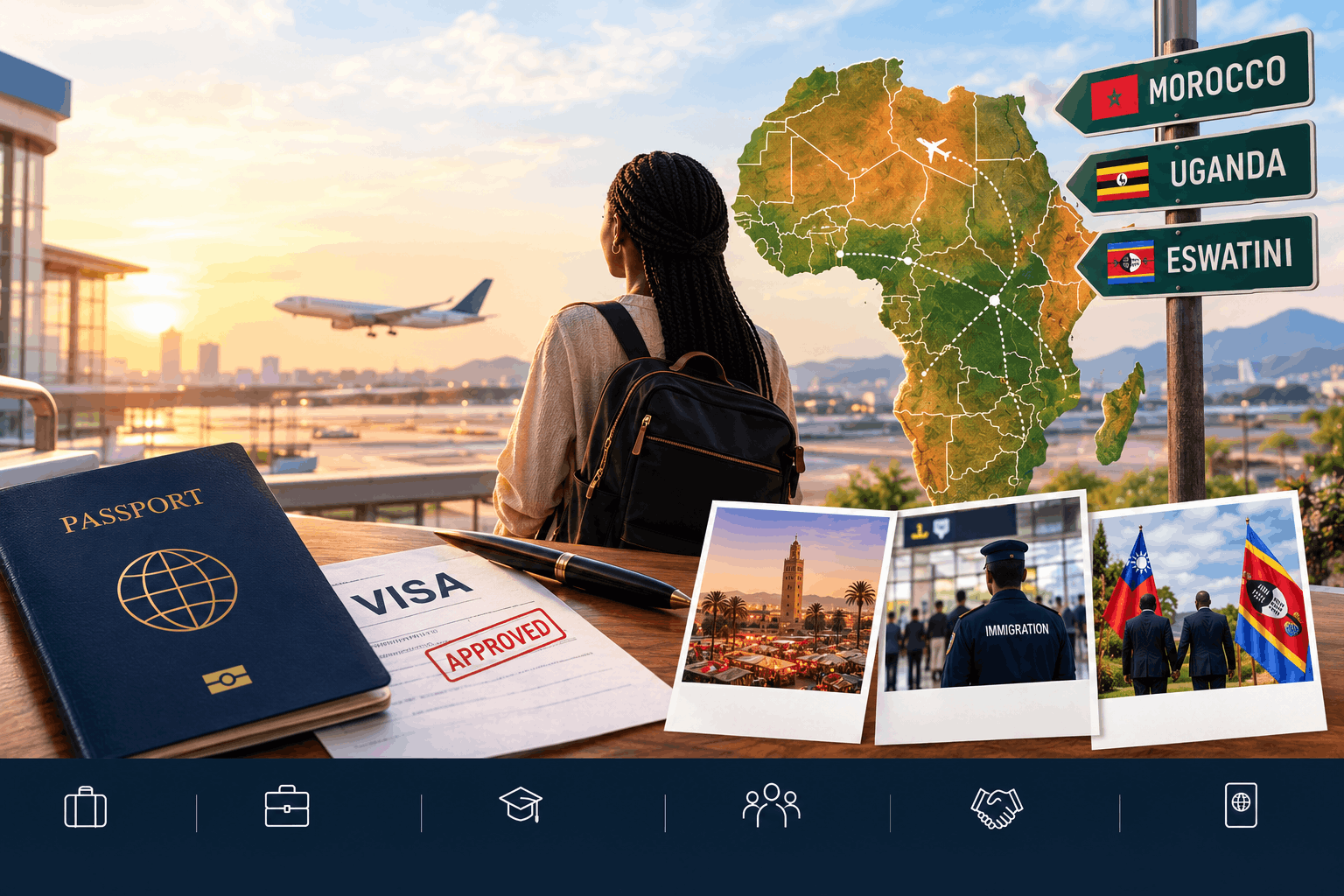
How diplomatic relations can change visa rules, border procedures and business travel across Africa, with Morocco, Uganda and Eswatini as case studies.
A visa can look like a small administrative detail.
You fill out a form, submit your passport, provide the required documents, pay a fee and wait for a decision. For most travellers, that is the practical side of international travel.
But sometimes the rules around that visa are connected to something much larger than the trip itself.
A government can change the way it processes applications because of a diplomatic dispute, reciprocity, a change in foreign policy or the way it recognises another government. When that happens, the effect is felt by people who may have nothing to do with the disagreement.
They may be tourists who have already booked flights.
They may be business owners travelling to meet partners.
They may be employees visiting a regional office, researchers conducting fieldwork, students attending a programme or investors trying to enter a new market.
A recent case involving Morocco and Taiwanese travellers offers a particularly clear example.
In July 2026, Morocco stopped accepting applications for the Visa Confirmation Letters, or VCLs, that Taiwanese passport holders needed for short-term tourism and business travel to Morocco. Two months later, Morocco resumed accepting VCL applications for tourism, but not for other purposes.
Taiwan responded to the original suspension by stopping visa applications from Moroccan nationals, citing reciprocity.
Elsewhere on the continent, Taiwan reported difficulties involving its passport holders at Uganda's Entebbe International Airport. Uganda had already publicly reaffirmed its One-China position months earlier, including its statement that it has no official or diplomatic relations with Taiwan.
And in Eswatini, the picture is different again. Eswatini remains Taiwan's only formal diplomatic ally in Africa, and Taiwan's President Lai Ching-te travelled there for a state visit in May 2026.
These are not three versions of the same immigration system. They are different countries, with different foreign policies, administrative arrangements and relationships with Taiwan.
What connects them is more practical.
Diplomacy can affect how people move.
Sometimes the effect appears before a traveller reaches an airport, when an application can no longer be submitted. Sometimes it appears at the border, when an immigration officer questions the document in a traveller's hand. And sometimes formal diplomatic relations make government-to-government travel and cooperation possible in ways that do not exist elsewhere.
For Ria's Colony, that is the more useful story.
What happened between Morocco and Taiwan?
In this section
Travellers presented it on arrival, where Moroccan immigration officials determined the permitted period of stay.
The Morocco case began in July, and the dates matter.
Before the suspension, Taiwanese nationals could not use Morocco's electronic visa system. For short-term tourism and business travel, they instead used a Visa Confirmation Letter, or VCL. Taiwan's Bureau of Consular Affairs describes the VCL as an A4 document rather than the conventional visa sticker placed inside a passport. Travellers presented it on arrival, where Moroccan immigration officials determined the permitted period of stay. Taiwan's current consular guidance says travellers were generally given 14 or 15 days.
The system was already unusual because Taiwan and Morocco do not maintain formal diplomatic relations, and Taiwan does not have a representative office in Morocco. Taiwanese travellers therefore depended on an administrative route involving the Moroccan Embassy in Japan.
On July 20, according to Taiwan's Ministry of Foreign Affairs, the Moroccan government instructed its diplomatic missions and consulates worldwide to stop accepting applications for these VCLs. Three days later, on July 23, the Moroccan Embassy in Japan notified Taiwanese travel agencies that it had stopped accepting applications.
For people who already had valid VCLs, the position was different.
Taiwan's consular guidance states that people who had received their VCLs before July 20 could still enter Morocco for business or tourism during the document's validity period. The immediate problem was therefore not that every Taiwanese traveller already holding permission was suddenly barred. It was that people who still needed to begin the application process could no longer use that route.
That distinction is worth understanding because immigration rules often operate through very specific administrative channels.
A traveller may technically have a route into a country. But if the authority responsible for issuing the document needed to use that route stops accepting applications, the route becomes practically unavailable to new applicants.
That is what happened here.
Morocco did not publicly state a reason for the July suspension in the sources reviewed.
Taiwan responded on July 30 by announcing that it would stop accepting visa applications from Moroccan nationals, except where special approval was granted. Taiwan's Foreign Ministry described the move as a response based on reciprocity.
Reciprocity, in this context, means responding to the treatment of one country's nationals by applying a corresponding measure to nationals of the other country.
It is not a universal rule that every visa restriction automatically produces a reciprocal restriction. Governments decide how, and whether, to respond. In this case, Taiwan publicly explained its measure in those terms.
The result was a change in mobility in both directions.
People travelling between Morocco and Taiwan were now dealing with rules that had changed because of a government-to-government dispute, even though the people affected included ordinary travellers, families and businesses.
Then Morocco reopened part of the route
In this section
The available evidence therefore establishes the difference in treatment, but not the reason for it.
By September, the situation changed again.
Taiwan's Ministry of Foreign Affairs said that its representative in Tokyo had contacted the Moroccan Embassy in Japan and received confirmation that Morocco had resumed accepting VCL applications for Taiwanese passport holders travelling for tourism from September 21.
That is a narrower change than saying Morocco had restored visa access generally.
The reopening was for tourism applications. Non-tourism applications, including business travel, had not resumed according to the information available to Taiwan at the time.
So a Taiwanese person planning a holiday could once again begin the VCL process, while someone travelling for another purpose could still face restrictions.
That distinction has practical consequences.
Imagine two people holding the same Taiwanese passport. One wants to spend a week visiting Marrakech and the Atlas Mountains. The other wants to travel to Casablanca to meet a supplier.
Their nationality is the same. Their destination is the same. Their routes may not be.
The first traveller can once again apply for the relevant VCL. The second may still be unable to use that route.
Morocco had not, in the information reviewed, publicly explained why tourism applications were restored while other categories remained restricted. The available evidence therefore establishes the difference in treatment, but not the reason for it.
That is an important boundary.
Several explanations are conceivable. The distinction could reflect an internal policy decision, a phased reopening, a diplomatic accommodation or something else. None of those explanations has been established by the public record reviewed here.
So the safest description is also the most useful one: Morocco partially reopened the route. It did not restore the previous arrangement in full.
Taiwan, meanwhile, continued to restrict visa applications from Moroccan nationals while the remaining Moroccan restrictions were unresolved.
The situation therefore contains four separate developments: an initial suspension, a reciprocal Taiwanese response, a partial Moroccan reopening and an unresolved restriction on other categories of travel.
For travellers, that makes one question more useful than the generic question, "Does Morocco issue visas to Taiwanese nationals?"
The better questions are:
Which type of travel is currently being accepted?
Which document is required?
Where is the application submitted?
Has the rule changed recently?
Those questions are often more useful than a single statement saying "visa required."
Why does Taiwan's relationship with China enter the picture?
In this section
Morocco's public record reviewed here does not establish that China's position caused the July 2026 VCL suspension.
To understand why the Morocco case attracted attention, it helps to understand the diplomatic context without reducing the entire issue to a simple China-versus-Taiwan story.
Taiwan operates with its own government, institutions, immigration system and passport. At the same time, the People's Republic of China claims Taiwan as part of China and opposes other states establishing formal diplomatic relations with Taiwan.
Governments use different formulations when describing their positions on China and Taiwan, and the terminology around "One China" is not identical across countries.
For a traveller, however, the practical question is relatively straightforward.
A government has to decide how it treats documents issued to people from a particular territory or political entity. That decision can affect visa applications, entry procedures, official representation and consular interaction.
Morocco and China have developed a strategic partnership. In September 2025, Moroccan Foreign Minister Nasser Bourita described Morocco's development of relations with China as a strategic choice and reaffirmed Morocco's adherence to the One-China principle during talks with Chinese Foreign Minister Wang Yi.
That is relevant context.
It is not proof of causation.
Morocco's public record reviewed here does not establish that China's position caused the July 2026 VCL suspension. Morocco did not publicly give a reason for the decision in the sources examined.
That distinction should remain intact.
It is possible to acknowledge the wider diplomatic environment without claiming knowledge of a motive that has not been publicly established.
There is another detail worth keeping in view.
The absence of formal diplomatic relations does not mean that all practical interaction disappears.
Taiwanese travellers had a functioning route into Morocco before July. They could obtain VCLs for short-term business and tourism. That meant practical travel and commercial contact existed even without formal diplomatic relations.
This is why the useful question is not simply whether two governments have embassies in each other's capitals.
It is how their political relationship affects the practical systems people use.
Visa processing is one of those systems.
Paperwork can become diplomacy
In this section
A foreign-policy position can be expressed in language about sovereignty, recognition and bilateral relations.
Governments have many ways to express a foreign-policy position.
Some are obvious. A government can issue a public statement, recall an ambassador or announce a formal policy change.
Others are much quieter.
A consular procedure can change. An application route can close. An official representative office can be moved. A travel document can be treated differently at a border.
These decisions may look administrative because that is how they reach the public.
But administrative systems are where government policy becomes something an individual has to act on.
The Morocco case shows this clearly.
There was no public announcement saying that Taiwanese travellers were being placed at the centre of a new diplomatic confrontation. Instead, the practical information appeared through the visa system: the VCL applications stopped being accepted.
That does not establish that the visa system was deliberately being used as a diplomatic signal. It does show that a change in government policy could be experienced by a traveller as a change in paperwork.
That difference matters.
A foreign-policy position can be expressed in language about sovereignty, recognition and bilateral relations.
That is the point at which international politics becomes personal.
It is also why small operational decisions can reveal how a diplomatic position is being implemented, even when they do not explain why a government made the decision in the first place.
Uganda shows what the issue can look like at the border
In this section
Taiwan later reported difficulties involving Taiwanese travellers at Entebbe in August 2026.
The Morocco case concerns the application process.
Uganda shows what the issue can look like when a traveller is already standing at a border.
On August 13, 2026, Taiwan's Ministry of Foreign Affairs said that three Taiwanese nationals, including a business traveller and accompanying family members, had arrived at Entebbe International Airport the previous day.
According to Taiwan's account, Ugandan immigration officials withheld their Taiwanese passports and asked them to produce Chinese passports before returning the Taiwanese documents and stamping their entry. Taiwan said the travellers were eventually allowed into Uganda.
Taiwan's Foreign Ministry also said the incident followed another case involving two Taiwanese nationals, one of whom was subsequently deported. It advised Taiwanese citizens to postpone tourism and business travel to Uganda.
There is an important limitation here.
These details come from Taiwan's Ministry of Foreign Affairs. The account should therefore be attributed to Taiwan rather than presented as an independently established description of every action taken by Ugandan immigration officials.
That does not make the incident irrelevant.
It makes the sourcing more important.
Uganda's public diplomatic position is independently documented.
On November 11, 2025, months before the reported August 2026 airport incident, Uganda's Ministry of Foreign Affairs issued a statement reaffirming its commitment to the One-China principle. It said the People's Republic of China is the sole legal government representing the whole of China, described Taiwan as part of China and stated that Uganda does not maintain official or diplomatic relations with Taiwan.
The chronology matters.
Uganda stated its One-China position in November 2025.
Taiwan later reported difficulties involving Taiwanese travellers at Entebbe in August 2026.
The two facts can be discussed together because they concern the same diplomatic framework. But the earlier statement should not be presented as proof that Uganda's November policy directly caused the August airport incident.
Nor should the reported airport conduct automatically be treated as proof of what Uganda's formal immigration rules require.
The public record reviewed here does not establish that connection.
What does "One China" mean at the border?
In this section
Governments do not all treat passports issued by politically disputed or unrecognised authorities in the same way.
The phrase can sound more straightforward than it is.
Governments use "One China" language within different political and diplomatic frameworks. The United States, China, Taiwan and African governments do not all use identical terminology or describe their relationships in exactly the same way.
For a traveller, the practical question is easier to see.
A government has to decide how it treats travel documents issued by a particular authority. That can affect whether a document is accepted for a visa application, whether it is accepted at immigration, how official representation is handled and what kind of consular assistance is available.
A passport is both a travel document and an official document issued by a particular authority. Governments do not all treat passports issued by politically disputed or unrecognised authorities in the same way.
That can create complications at borders.
Taiwan's account of the Entebbe incident illustrates the point. According to Taiwan's Ministry of Foreign Affairs, the travellers were asked to produce Chinese passports before their Taiwanese passports were returned and their entry was stamped. Taiwan said the officers linked the measure to Uganda's One-China policy.
Uganda's own public position says it has no official or diplomatic relations with Taiwan and recognises the government of the People's Republic of China as the sole legal government representing China.
Those facts provide diplomatic context for the reported incident.
They do not, by themselves, establish every detail of what happened at Entebbe.
That distinction is important because a government statement about diplomatic recognition and the instructions followed by an immigration officer are not necessarily the same document.
For a traveller, however, the difference can become very practical.
A policy that sounds abstract in a foreign ministry communiqué can become a question at an immigration counter:
Which passport are you travelling on?
Which authority issued it?
How does this country treat that document?
And what happens if the document does not fit neatly within the destination country's diplomatic framework?
Those are no longer abstract questions when someone is standing at the airport.
Uganda also shows why business mobility belongs in this conversation
It would be easy to treat the Uganda case as a tourism story.
It is not only that.
Taiwan's Foreign Ministry said in August that Taiwanese nationals and businesses had established a presence in Uganda, including Taiwanese companies operating and investing there. It said the reported border difficulties therefore had implications beyond individual holidaymakers.
That gives the story another dimension.
When border procedures become uncertain, the people affected are not necessarily people who have chosen a destination for a holiday.
They can be people already operating businesses there.
A founder may need to visit a local partner.
An employee may need to inspect a facility.
A company may need to attend a trade event.
An investor may need to meet government officials.
A consultant may need to travel for a project.
A business relationship can exist long before the people involved think of themselves as participants in international diplomacy.
Yet maintaining that relationship still depends on the rules governing entry.
This is one reason visa policy belongs in conversations about doing business across Africa.
A market can look accessible on paper while the actual process of getting people into the market is more complicated.
The African Union adds another layer
Uganda's position is not an isolated statement.
In January 2026, the African Union and China held their ninth strategic dialogue. In the joint press release, the African Union side reaffirmed its commitment to the One-China principle and stated that the People's Republic of China is the sole legal government representing China and that Taiwan is part of China's territory.
That does not mean every African country's visa policy toward Taiwanese travellers is identical.
It does not mean every African country handles Taiwanese passports in the same way.
And it does not mean a country's diplomatic position automatically tells a traveller exactly what will happen at immigration.
National immigration authorities still administer their own entry rules.
The AU position does, however, provide a wider regional diplomatic context in which many African governments conduct relations with Beijing.
For anyone trying to understand travel policy, that context is useful.
But it should not replace checking the actual immigration rules of the country being visited.
A regional diplomatic position and a country's day-to-day immigration procedure are related subjects. They are not the same document.
Then there is Eswatini
In this section
President Lai Ching-te travelled to Eswatini in May 2026 for a state visit at the invitation of King Mswati III.
Eswatini provides a very different case.
It is Taiwan's only remaining formal diplomatic ally in Africa. Taiwan's Legislative Yuan and Presidential Office both describe Eswatini as Taiwan's only diplomatic ally on the continent.
The relationship is not only ceremonial.
President Lai Ching-te travelled to Eswatini in May 2026 for a state visit at the invitation of King Mswati III. On May 2, the two sides held a bilateral meeting and witnessed the signing of a customs mutual assistance agreement, alongside a joint communiqué.
The visit itself had an unusual lead-up. Taiwan said the trip had been temporarily postponed in April after Seychelles, Mauritius and Madagascar withdrew overflight permissions for the planned route. Taiwan attributed that episode to Chinese pressure. That attribution should remain identified as Taiwan's account rather than presented as an independently established explanation. The visit was subsequently rescheduled and took place in May.
Eswatini therefore provides a useful contrast with Morocco and Uganda.
In Morocco, Taiwanese travellers had a practical tourism and business route despite the absence of formal diplomatic relations, until Morocco suspended the VCL process.
In Uganda, the country's formal One-China position exists alongside Taiwan's reported difficulties involving its passport holders at the airport.
In Eswatini, Taiwan maintains formal diplomatic relations and conducts state-level engagement.
The administrative consequences are different because the diplomatic relationships are different.
That does not mean diplomacy determines every immigration decision. Each country retains authority over admission to its territory, subject to the regional and international arrangements it has accepted.
But the contrast makes one thing visible: the same passport can sit inside very different administrative and diplomatic systems depending on where its holder is travelling.
Visa policy is also part of the business environment
In this section
A conference invitation may no longer be useful if the participant cannot secure the necessary entry document.
This is where the subject becomes relevant beyond Taiwan.
Visa policy is often discussed as a tourism issue.
For businesses operating across African markets, it is also an operating condition.
Imagine a company based in Lagos that wants to develop a partnership in Casablanca.
The founder may need to travel for an introductory meeting.
The company's technical team may need to visit later.
A marketing team might need to attend an industry event.
A local partner may eventually need to travel in the other direction.
The business relationship depends on much more than a contract.
People need to be able to move.
Now imagine the rules change after the company has already started making plans.
A required visa route is suspended.
A confirmation letter is no longer being issued.
A consulate changes its processing procedure.
A particular nationality becomes subject to a new restriction.
A reciprocal measure is introduced.
The business itself has not necessarily become less viable. But the cost and uncertainty of operating it have changed.
Flights may have to be changed.
Projects can be delayed because employees cannot travel.
A conference invitation may no longer be useful if the participant cannot secure the necessary entry document.
A company may have to reconsider where it holds meetings.
A researcher may have to postpone fieldwork.
A tourism operator may lose customers from a particular market.
None of this requires the company to be the subject of a diplomatic dispute.
The company can be affected simply because its people need to cross a border.
That is particularly relevant to Africa, where businesses increasingly operate across multiple national markets.
There is no single African visa system.
The African Continental Free Trade Area is designed to increase economic integration and reduce barriers to trade, but movement between African countries still operates through national immigration systems alongside regional arrangements.
A company can therefore participate in an increasingly connected African economy while its employees still have to navigate separate immigration rules in each country.
Mobility belongs in market-entry research for exactly this reason.
The cost of entering a market is not only the cost of registering a company, finding an office or identifying customers.
It can also include the time and uncertainty involved in getting the people who run the business into the country.
Regional integration helps, but it does not erase national immigration rules
In this section
A traveller therefore needs to know the purpose of travel, not just the nationality attached to the passport.
Africa has several regional arrangements that make movement easier in particular circumstances.
Citizens of some regional blocs have rights or simplified procedures that do not apply to travellers from outside those blocs.
Countries can also negotiate bilateral visa exemptions or other arrangements.
But there is no single rule that allows every African passport holder to move freely across all 54 countries.
A Nigerian travelling to Rwanda, a Kenyan travelling to Uganda and a Ghanaian travelling to Morocco are not necessarily dealing with the same immigration framework.
The same is true for a Taiwanese traveller moving between different African countries.
Requirements can vary according to nationality, destination, purpose of travel and the arrangements between the relevant governments.
That is why a traveller who has successfully entered one African country should not assume the same procedure applies in another.
It is also why travel information can become outdated quickly.
A website checked six months ago may not reflect a new diplomatic measure.
A travel agency's process may be based on an arrangement that has since changed.
A visa exemption that existed last year may have been replaced by another system.
A route that works for tourism may not work for business.
The Morocco case demonstrates this last point clearly.
By late September, tourism VCL applications had resumed for Taiwanese passport holders, while non-tourism applications had not.
A traveller therefore needs to know the purpose of travel, not just the nationality attached to the passport.
What the Morocco case tells us about changing visa rules
In this section
A tourist and a businessperson may hold passports from the same country and still face different rules.
The Morocco episode is also useful because the change did not happen in one step.
The July suspension affected the VCL route for Taiwanese nationals.
The September reopening was narrower.
That shows how governments can manage mobility during periods of diplomatic tension without choosing only between completely open travel and a complete closure.
A government can change one category.
It can reopen tourism while maintaining restrictions on other purposes.
It can create exceptions.
It can introduce special approval procedures.
Another government can respond through reciprocity.
From the traveller's perspective, those distinctions are not technicalities.
They determine whether a trip can happen.
A tourist and a businessperson may hold passports from the same country and still face different rules.
The same can be true for someone attending a conference, conducting research or visiting a company.
That is why a useful visa guide should answer more than one question:
What nationality does the rule apply to?
What kind of travel is permitted?
What document is required?
Where is the application submitted?
Is there an online option?
Is there an embassy-only route?
Are there exceptions?
When was the information last updated?
Has the government officially announced the change?
And, where the situation is politically sensitive, whose account is being relied upon?
Those questions can be more useful than a generic statement saying "visa required."
What this means for people travelling across Africa
In this section
If you are travelling somewhere unusual for your nationality, check the official source close to your departure date.
The practical lesson is not that travellers need to become experts in diplomatic relations before every trip.
It is that immigration rules exist within a wider government system.
If you are travelling somewhere unusual for your nationality, check the official source close to your departure date.
If you are travelling for business, do not assume that the tourist route applies to you.
If you are travelling on a passport issued by a territory whose international status is politically contested, check not only the visa requirement but also how the destination country's authorities treat that document and its issuing authority.
If a visa route has recently changed, confirm the change directly with the relevant embassy or immigration authority.
And if you are planning a business trip, build some flexibility into the process.
A visa delay is not always a sign that a destination is closed to your nationality. It may be a temporary administrative problem, a change in processing, a diplomatic measure or a rule that applies only to a particular category of travel.
The opposite is also true.
A country may appear to have reopened a route, but the reopening may only cover tourism.
The Morocco case is a good example.
As of late September 2026, Taiwanese passport holders had again been able to apply for Moroccan VCLs for tourism following confirmation received through the Moroccan Embassy in Japan, while non-tourism applications had not resumed according to Taiwan's account.
For someone planning a holiday, that is useful information.
For someone planning a business trip, it is not enough.
What remains unknown about Morocco
In this section
Morocco has a strategic relationship with China and publicly adheres to the One-China principle.
There is one question this article should resist answering for the sake of having a neat ending.
Why did Morocco suspend the VCL process in July?
The public record reviewed here does not establish the answer.
Morocco has a strategic relationship with China and publicly adheres to the One-China principle. It is also a major tourism destination and is preparing to co-host the 2030 FIFA World Cup with Spain and Portugal. Morocco welcomed a record 19.8 million tourists in 2025, according to figures from its tourism ministry reported by Reuters.
Those facts provide context, but they do not supply a motive.
It would be easy to construct a neat explanation: Morocco wanted to maintain its diplomatic position on Taiwan while protecting tourism access. But the evidence available does not establish that.
The same applies to the September reopening.
It is possible to observe that tourism applications returned while other categories remained restricted.
It is not possible, from the sources reviewed, to say with confidence why Morocco drew that particular line.
That is worth leaving open.
A quiet suspension followed by a partial reopening can fit several explanations. It could reflect an internal review, a change in administrative policy, a diplomatic development or another factor that has not been made public.
The important fact for travellers is not the theory.
It is that the rules changed.
The wider question is about mobility
In this section
A foreign-policy position can become a question about which travel document an immigration officer will accept.
The Morocco case started with a visa document.
The Uganda case involved a passport at an airport.
Eswatini shows what formal diplomatic relations can look like when they are maintained through state visits and government-to-government cooperation.
The three situations are different, but they point towards the same practical question:
How do relationships between governments affect the movement of people?
That question matters to tourism.
It matters to business.
It matters to research and education.
It matters to conferences and events.
It matters to families and individuals who have built connections across borders.
And it matters to anyone trying to understand Africa as a collection of markets rather than as one undifferentiated destination.
For an African founder looking to enter a new market, the visa process is part of the research.
For a Taiwanese traveller planning a trip to Morocco, it can determine whether the trip can happen at all.
For a Taiwanese business operating in Uganda, uncertainty at the border can affect the people who need to move between the company and its market.
For Eswatini and Taiwan, formal diplomatic relations provide a different framework for government-to-government engagement.
None of these examples means that diplomacy determines every immigration decision.
Immigration systems have their own laws, procedures and administrative practices.
Nor does diplomatic recognition provide a complete explanation for every border decision.
But diplomatic relationships can shape the environment in which those systems operate, and sometimes the effect becomes visible to ordinary travellers.
That is what makes visa policy worth watching.
A change that appears in a government communiqué can end up changing a flight itinerary.
A diplomatic disagreement can become a visa application that cannot be submitted.
A foreign-policy position can become a question about which travel document an immigration officer will accept.
And a reciprocal measure can affect people who were never involved in the disagreement in the first place.
For people travelling across Africa, this is a useful part of the map to understand.
The map is not only made up of airports, borders and flight routes.
It also includes the relationships between governments that determine how people move through them.
Sometimes the question is not only whether you need a visa.
It is how the relationship between two governments shapes the route by which you can get one.
Sources reviewed for this article include Taiwan's Ministry of Foreign Affairs and Bureau of Consular Affairs, Uganda's Ministry of Foreign Affairs, the African Union, Taiwan's Presidential Office, Morocco-China diplomatic statements, Reuters, and FIFA. Statements about the reported Uganda airport incidents and the April 2026 Eswatini overflight dispute are attributed to Taiwan where applicable. The available public record does not establish Morocco's reason for the July 2026 VCL suspension or the reason for the September distinction between tourism and non-tourism applications.