
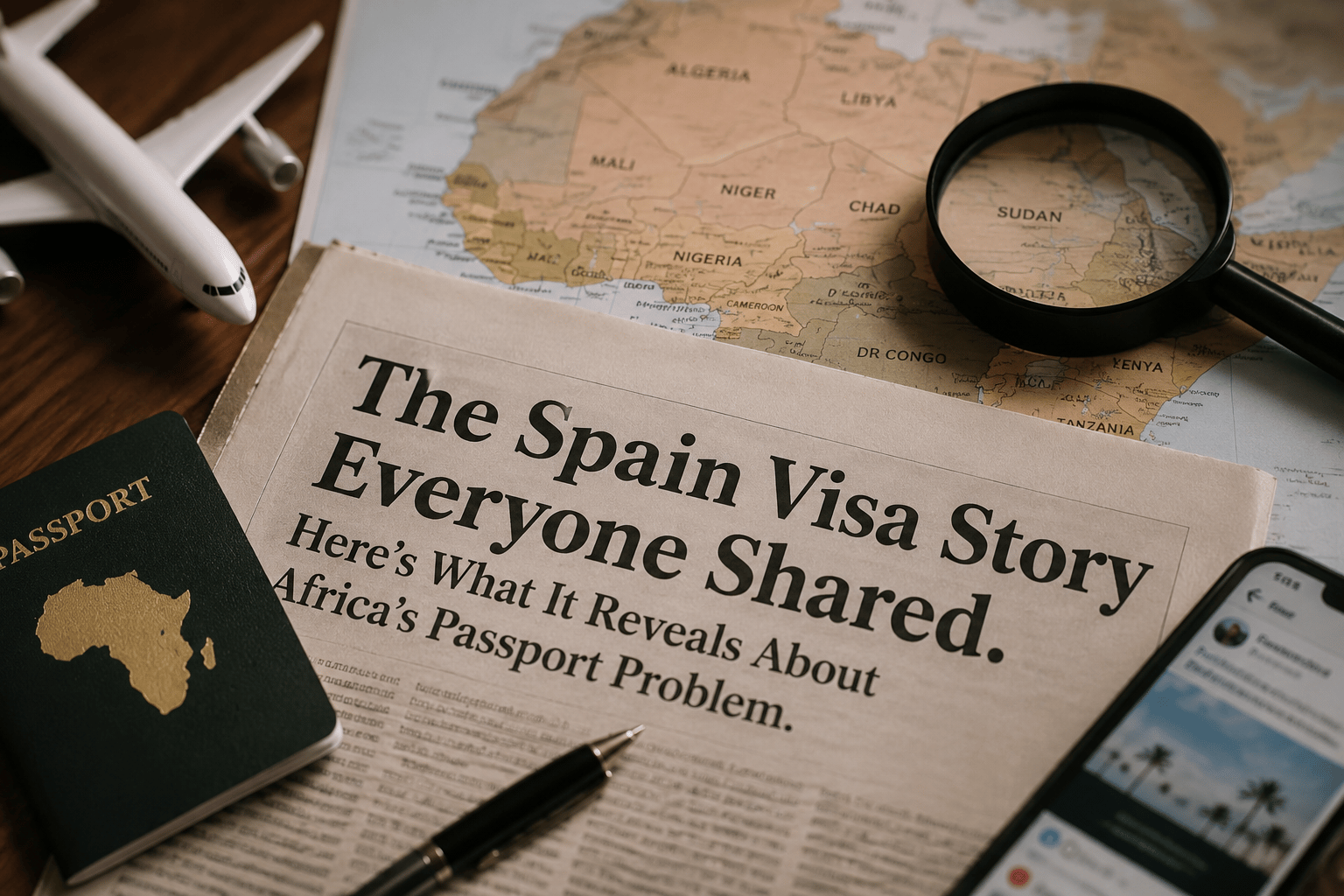
For a few days, it was difficult to scroll through social media without seeing the same headline.
Spain had reportedly granted visa-free access to citizens of eight African countries. Rwanda, Botswana, Namibia, Mauritius, Seychelles, Lesotho, Eswatini and Cape Verde were said to be the beneficiaries. The reports spread quickly across news websites, blogs and social media platforms, prompting excitement and celebration in many corners of the continent.
There was only one problem.
The reports could not be substantiated through official European Union or Spanish government sources.
That may seem like the end of the story, but it is arguably where the more interesting conversation begins.
The speed with which the story travelled revealed something important. It exposed how deeply passport mobility matters to Africans and how closely travel policy is tied to the way countries are perceived.
The reaction was never just about Spain.
It was about access.
Why the story resonated
If the same headline had claimed that Spain was introducing a new customs procedure or updating airport security requirements, it would have received little attention.
Instead, it centred on visa-free travel.
That difference matters.
Across much of Africa, international travel often begins long before boarding a flight. It begins with paperwork, appointments, supporting documents, application fees and uncertainty.
A short business trip, holiday or conference can require weeks of preparation. Travellers may need to provide proof of accommodation, bank statements, travel insurance, return flight reservations and evidence that they intend to return home after their visit. Even after meeting every requirement, approval is not guaranteed.
For many travellers, the visa process has become an accepted part of international travel.
For others, it represents something much larger.
It represents friction.
Every additional form, fee or appointment increases the cost of mobility. That cost is not only financial. It affects time, flexibility and opportunity.
This is one reason stories about visa-free access spread so quickly. They speak to a challenge that millions of people understand personally.
Passport strength is more than a travel ranking
Every year, passport rankings attract considerable attention.
Countries celebrate moving up the list. Others question why their position has remained unchanged.
It is tempting to see these rankings as little more than travel statistics.
In reality, they measure something broader.
A passport reflects the agreements a country has negotiated, the level of trust it enjoys internationally and the ease with which its citizens can cross borders.
A stronger passport reduces administrative barriers. It makes spontaneous travel more realistic. It allows entrepreneurs to attend meetings with less preparation. It makes it easier for researchers to collaborate internationally and for families to maintain relationships across borders.
None of these outcomes guarantees economic growth.
Collectively, however, they contribute to mobility, and mobility creates opportunity.
Country marketing begins long before tourism campaigns
When governments discuss country marketing, the conversation often revolves around;
- Tourism.
- Advertising campaigns.
- Destination branding.
- International exhibitions.
- Promotional videos.
These initiatives remain valuable, but they represent only one part of how countries build reputation.
A country's image is shaped by every interaction people have with it. How quickly can a business be registered? How efficient is immigration? Are public services digital? Can investors navigate regulation with confidence? How reliable is infrastructure? How safe do visitors feel? How predictable are public institutions?
Each experience contributes to perception. Over time, those perceptions become reputation. Marketing communicates reputation, but policy often creates it.
Policy is one of the most overlooked branding tools
Governments rarely describe policy as marketing. Yet some of the world's strongest national brands have been built through consistent public policy rather than advertising.
Estonia developed a global reputation for digital government through years of investment in public technology.
Singapore became associated with efficiency because visitors, businesses and residents consistently experienced efficient systems.
The United Arab Emirates positioned itself as a global aviation and business hub by investing in airports, logistics, infrastructure and regulatory reform.
Rwanda has earned international recognition for conference tourism, public cleanliness, digital government initiatives and improvements in administrative efficiency.
None of these reputations emerged from a single campaign.
They developed because policy and execution reinforced one another over many years. The marketing followed.
Visa policy is one part of a much larger picture
Visa policy influences perception, but it should not be overstated.
Countries do not become attractive destinations simply because they offer visa-free access or because their citizens enjoy greater mobility abroad. Tourism depends on many variables like:
- Air connectivity influences whether destinations are practical to reach.
- Infrastructure shapes the quality of the visitor experience.
- Safety affects traveller confidence.
- Accommodation, transport, pricing, exchange rates and service standards all influence destination choice.
The same applies to investment. Investors assess taxation, regulation, legal systems, workforce quality, political stability and access to markets.
A visa policy may reduce friction, but it cannot compensate for weak institutions or poor governance.
The strongest country brands are built when policy, infrastructure and communication move in the same direction.
What the reaction says about Africa
The widespread interest in the Spain reports also reflects changing ambitions across the continent.
Africa is becoming increasingly connected to global business, education and tourism;
- Entrepreneurs attend conferences across multiple regions.
- Students pursue international education.
- Creative professionals collaborate across borders.
- Researchers participate in global networks.
- Diaspora communities maintain economic and cultural ties with home.
As these connections deepen, mobility becomes more valuable.
This helps explain why passport access has become part of broader conversations about competitiveness. It is no longer viewed only as a travel issue. It is increasingly seen as an economic one.
Building stronger country brands
African governments have invested significantly in nation branding over the past two decades. Many have refreshed tourism identities, launched investment promotion agencies and expanded international marketing campaigns. These efforts remain important. They are also more effective when supported by policy.
Countries strengthen their reputation when they simplify business registration.
When immigration systems become more efficient.
When airports improve passenger experience.
When public institutions become more transparent.
When digital government reduces bureaucracy.
When diplomacy expands opportunities for citizens abroad.
Every improvement creates another positive interaction. Every positive interaction strengthens reputation.
Brand equity is not created through slogans alone. It is built through consistent experience.
A lesson beyond the headline
Whether the Spain reports ultimately prove to be inaccurate or simply misunderstood, the conversation they generated should not be dismissed. It highlighted an issue that deserves greater attention.
Passport mobility matters.
Not because it determines the success of a nation, but because it influences how easily citizens engage with the world.
It also reminded travellers of the importance of verifying policy changes through official government sources before making travel plans.
Travel information moves quickly online.
For governments, the discussion offers another lesson.
Country branding is no longer confined to tourism campaigns or international advertising. It is shaped by the everyday experience of citizens, visitors, investors and businesses.
Policies that reduce friction, strengthen trust and expand opportunity contribute to a country's reputation in ways that promotional campaigns alone cannot.
The strongest national brands are built where communication reflects reality.
Marketing can tell the world who a country is. Policy gives people a chance to experience it for themselves.
Aerial View explores the ideas, policies and trends shaping how countries are experienced, perceived and remembered.
Subscribe to receive future analyses on tourism, country branding, mobility and Africa's evolving place in the global economy.